
Vivitrol vs Suboxone: How to Choose
Reviewed by Tiffany Komba, LMFT #136055 · Last reviewed November 22, 2026
Published November 22, 2026
Contents
Deciding between Vivitrol and Suboxone rarely comes down to which medication works better. It comes down to which one a person can start. The clearest evidence for that comes from a large U.S. trial where 65.4 percent of people assigned to Vivitrol relapsed within 24 weeks, compared with 56.8 percent assigned to Suboxone, according to the NIDA-sponsored X:BOT trial published in 2017. But those numbers hide the story. Of the 570 adults in that trial, 79 people never managed to start Vivitrol, while 17 failed to start Suboxone. Among the 474 people who did begin their assigned medicine, relapse was nearly identical: 52.0 percent for Vivitrol and 55.6 percent for Suboxone. That gap between assignment and actual receipt is the pivot every family in Yuba City and across Yuba-Sutter should understand before choosing.
If you or a loved one is in crisis, call or text 988 (Suicide & Crisis Lifeline) or call 911 for an emergency.
At Addiction Resource Center, we often hear a version of this question from adults, spouses and referrers. They have read that one medicine is a monthly shot and the other is a daily film, and they want the winner. There is no winner. There is a starting gate, a set of personal circumstances, and a prescriber who needs full information. This guide walks through how each medicine acts, why starting Vivitrol carries a real hurdle, what the relapse numbers mean when you read them carefully, and how a family in Northern California can turn all of that into a clear next step.
Vivitrol and Suboxone Side by Side
Vivitrol and Suboxone both treat opioid use disorder, and neither is the better medicine for every adult. Vivitrol is extended-release naltrexone, a full opioid blocker given as a 380 mg intramuscular injection about once a month. Suboxone is buprenorphine plus naloxone, a partial opioid agonist taken daily as a film that dissolves under the tongue. The FDA approved the Suboxone film in August 2010, and approved injectable naltrexone for opioid dependence in October 2010, after its earlier 2006 approval for alcohol use disorder.
The mechanism difference drives almost everything else. Naltrexone sits on opioid receptors and stops opioids from attaching, like a locked gate. Buprenorphine also attaches to those receptors, but it activates them only partially. That partial activation is enough to calm withdrawal and craving without producing the strong high of full opioids like fentanyl.
The initiation difference is where the decision really lives. Vivitrol can't safely start while opioids are still in a person's system. A clinician generally waits until the person has been opioid-free for 7 to 10 days, and sometimes longer after buprenorphine or methadone. Suboxone, by contrast, can often start once withdrawal is emerging, which for many people is a much shorter and more achievable window.
How the X:BOT trial shapes the choice
The clearest comparison comes from the NIDA-sponsored X:BOT trial, which followed 570 adults with opioid dependence across eight U.S. community-based inpatient treatment programs for up to 24 weeks. Across everyone randomized, relapse was 65.4 percent for Vivitrol and 56.8 percent for Suboxone. The gap came mostly from the start: 79 participants couldn't begin Vivitrol, versus 17 who couldn't begin Suboxone. Among the 474 people who started, relapse was 52.0 percent with Vivitrol and 55.6 percent with Suboxone. That is a clinically meaningful narrowing. Once a person is through the door, both medicines can provide broadly comparable relapse prevention. The door itself is higher for Vivitrol.
Here is the side-by-side picture in table form.
| Point of comparison | Vivitrol | Suboxone |
|---|---|---|
| Active medicine | Extended-release naltrexone | Buprenorphine with naloxone |
| Action at opioid receptors | Full antagonist; blocks effects | Partial agonist; naloxone is included |
| Usual dose form | 380 mg intramuscular injection about monthly | Daily sublingual film |
| When it can start | Generally after 7 to 10 opioid-free days | During emerging withdrawal, after a shorter interval |
| People who started in X:BOT analyses | 72 percent | 94 percent |
| 24-week relapse, all assigned | 65.4 percent | 56.8 percent |
| 24-week relapse after a real start | 52.0 percent | 55.6 percent |
The 72 percent versus 94 percent initiation split comes from the X:BOT trial itself: 204 of 283 people started Vivitrol, compared with 270 of 287 who started Suboxone. That single row explains most of the overall difference people see in headlines.
Addiction Resource Center does not prescribe either medicine. We provide comprehensive adult outpatient care, including an intensive outpatient program where counseling and relapse prevention planning run alongside whatever a medical prescriber chooses. Families often benefit from reviewing how a medicine feels day to day with a trusted clinician. When you meet with your prescriber, having a structured way to talk about side effects can help, which is why we encourage people to discuss medication effects with their doctor before making a final choice.
How Each Medicine Acts in the Body
The two medicines took different scientific paths into treatment, and those paths still show in how each one feels. Suboxone combines buprenorphine, a partial opioid agonist, with naloxone. The FDA approved the sublingual film in August 2010, partly to reduce diversion and accidental pediatric exposure. Vivitrol is extended-release naltrexone, a full opioid antagonist. Injectable naltrexone was approved for opioid dependence in October 2010, after its earlier 2006 approval for alcohol use disorder.
What a person notices day to day reflects this chemistry. Buprenorphine occupies opioid receptors enough to quiet withdrawal and cravings, but it has a ceiling effect. Past a certain dose, more buprenorphine doesn't produce more opioid effect, which lowers the risk of slowed breathing compared with full agonists. The naloxone in Suboxone is poorly absorbed under the tongue and is there mainly as a deterrent if someone tries to inject the dissolved film. It isn't the active treatment.
What naltrexone does differently
Naltrexone doesn't activate opioid receptors at all. It blocks them. A person who uses an opioid while a Vivitrol injection is active won't get the usual effect. The National Institute on Drug Abuse reports in 2025 that naltrexone may also reduce cravings, but the blocker only works if it goes in at the right time. Starting it while opioids remain in the body can trigger rapid, severe withdrawal.
That's why the opioid-free wait is a safety rule, not a provider preference. NIDA's 2025 medications page states that people commonly need to be opioid-free for 7 to 10 days before starting naltrexone. For someone using fentanyl, which hides in fat tissue longer than older short-acting opioids, even that window can be too short. The next section explains why the wait matters so much at the clinical level.
Once a person has truly started either medicine, pharmacology alone doesn't settle the choice. The receptor action tells you what the medicine does. It doesn't tell you who can get to the first dose safely, stay on the schedule, and handle a missed visit. Those are human factors, and they often matter more.
Families sometimes ask us to explain naltrexone in plain terms. We cover that separately in our guide to naltrexone for addiction, including how the blocking effect feels and what questions to ask a prescriber before the first injection.
How Starting Each Medicine Actually Works
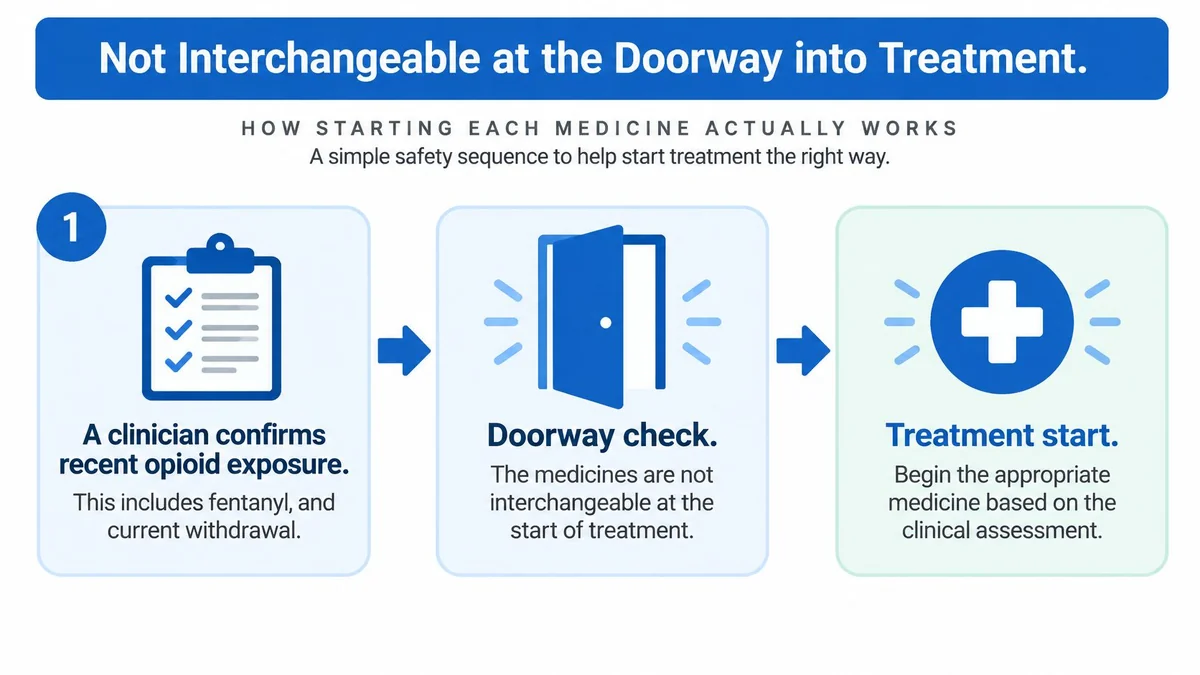
The medicines are not interchangeable at the doorway into treatment. A person can't swap one for the other mid-week, and the reason is clinical, not administrative. Starting Vivitrol too early while physical dependence remains can produce antagonist-precipitated withdrawal, a state severe enough to need hospital care. Starting Suboxone too early, while a full opioid still occupies the receptors, can do the same thing, though the window is different.
Here is the safety sequence a prescriber follows, in order.
- Confirm recent opioid exposure. A clinician asks about fentanyl, heroin, prescription opioids, buprenorphine and methadone, including timing and amount. Fentanyl changes the math because it lingers longer than many people expect.
- Assess current withdrawal. For Suboxone, dosing generally begins as withdrawal is emerging, so the partial agonist can quiet symptoms. Starting too early or too late both cause problems.
- Check the opioid-free interval for Vivitrol. The person generally must be opioid-free for at least 7 to 10 days before the first injection. The FDA label for Vivitrol states the medicine should generally be started only after that opioid-free window.
- Check the longer window after buprenorphine or methadone. People transitioning from either medicine may remain vulnerable to precipitated withdrawal for up to about two weeks. That means a switch from Suboxone to Vivitrol can't be rushed.
- Watch for severe withdrawal signs. If naltrexone is given while physiologic opioid dependence persists, withdrawal can be severe enough to require hospitalization.
- Use a medically supervised induction. This is not a home experiment. Programs verify recent opioid exposure, assess withdrawal severity, and use a written induction protocol.
Vivitrol's FDA-labeled opioid use disorder indication is specifically relapse prevention following detoxification. Suboxone, by contrast, often works as the more practical bridge from active opioid use into maintenance treatment. Neither is safer without supervision.
Safety comes first. Withdrawal can be dangerous, and medical care may be needed. Addiction Resource Center does not provide detox and does not prescribe these medicines. A person who needs medically supervised withdrawal should complete it in an appropriate medical setting first, then consider outpatient counseling afterward. We walk through the physical symptoms families should know in our guide to opioid withdrawal symptoms. If you or a loved one is in crisis, call or text 988 or call 911.
What the Relapse Numbers Mean After a Real Start
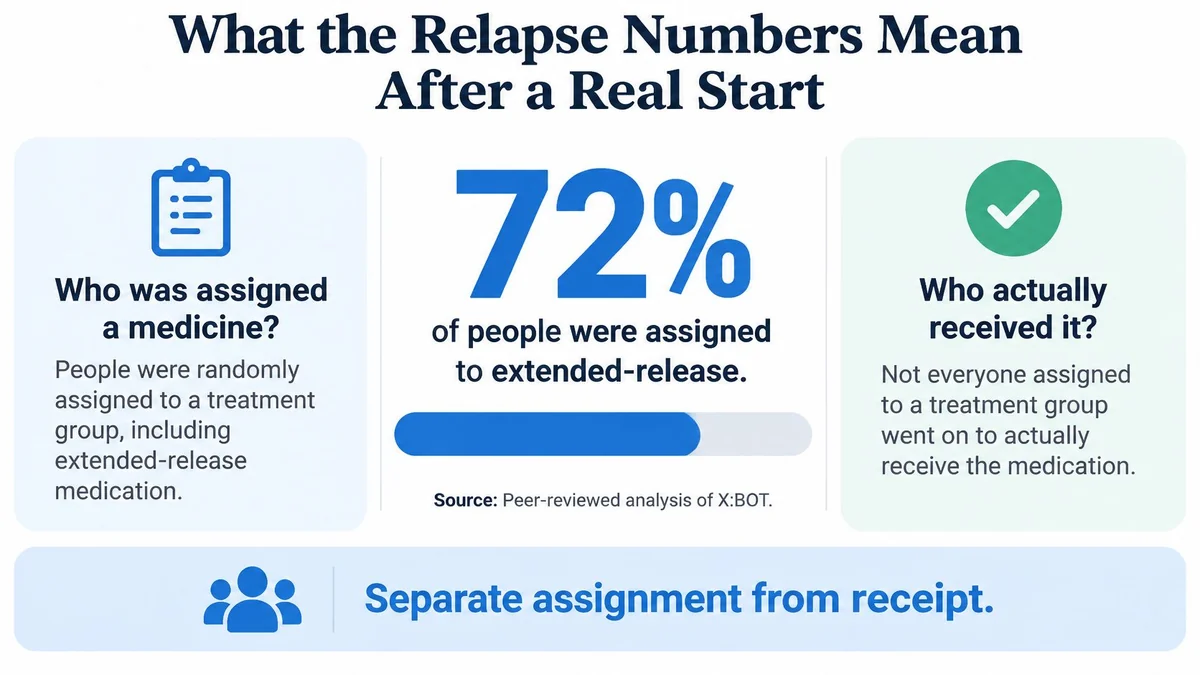
Two different questions get mixed together in most Vivitrol vs Suboxone discussions, and the mix-up matters. The first question is: who was assigned a medicine? The second is: who received it? Those two groups have different relapse rates, and treating them as the same group produces a distorted picture.
A peer-reviewed analysis of X:BOT found that 72 percent of people assigned to extended-release naltrexone started it, compared with 94 percent assigned to buprenorphine-naloxone. Across all randomized people, the analysis published in PubMed reported a hazard ratio for opioid relapse of 1.40 with naltrexone relative to buprenorphine-naloxone, with a 95 percent confidence interval of 1.13 to 1.73. The hazard ratio for a positive opioid urine test was 1.31, with a confidence interval of 1.07 to 1.60.
In plain language, a hazard ratio above 1 means more relapse events happened in the naltrexone group. But that's the assigned group, not the started group. A large share of the excess comes from the 28 percent who never received the first injection. They were counted as relapsed, mostly because they never entered treatment.
The on-treatment picture changes the story
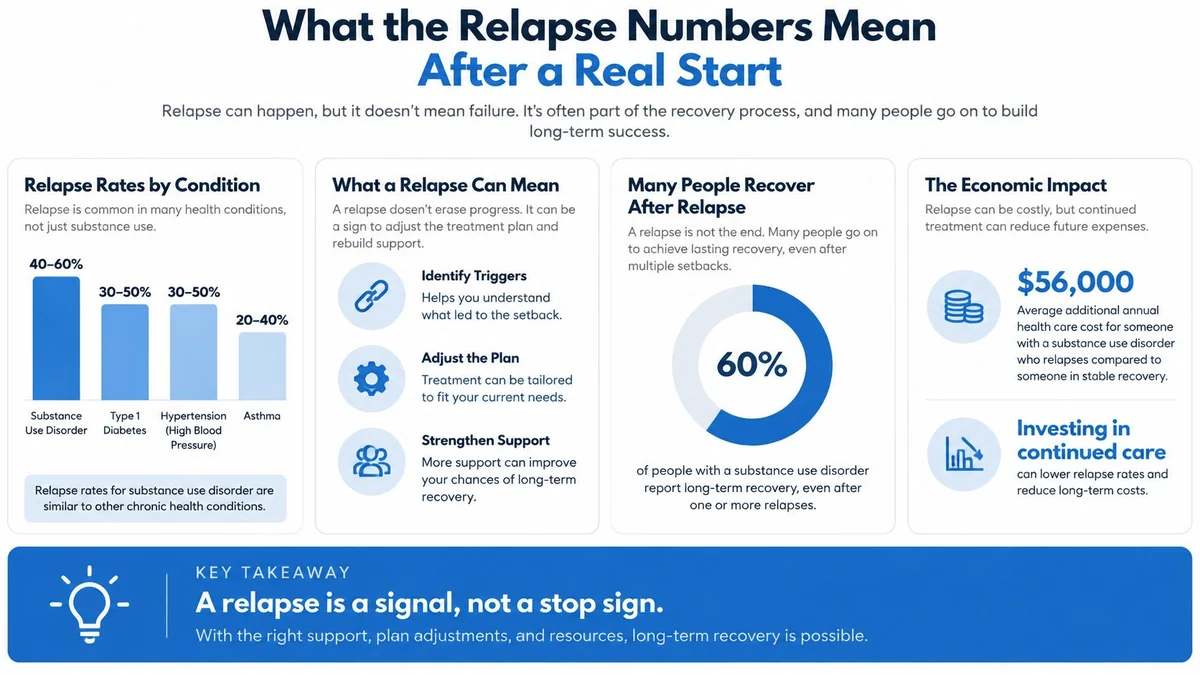
Among people who started, 52.0 percent relapsed on Vivitrol and 55.6 percent on Suboxone over 24 weeks. Those two figures are statistically close. A separate Norwegian study of 159 participants randomized after detoxification found the two treatments similarly effective for retention and opioid-use reduction, likely because participants had already cleared the opioid-free hurdle that blocks many Vivitrol starts.
The hazard ratio says more about the doorway than the medicine. When you see a headline claiming Suboxone beats Vivitrol, ask whether the comparison used everyone assigned or only everyone who got a real start. The useful answer for a family is usually the second one, with the detox requirement acknowledged up front.
The NIH news release summarizing the trial puts it directly: once people initiate treatment, the two medicines have similar outcomes. Clinical selection depends on current opioid use, the ability to complete an opioid-free interval, whether a monthly injection or daily dosing fits better, and medical assessment. For relapse prevention planning alongside medication, see our relapse prevention techniques guide.
Which Situation Fits Vivitrol or Suboxone
A Yuba-Sutter family doesn't need a universal efficacy winner. They need to know which medicine fits the life in front of them. The split comes down to one question: has the person already stopped opioids, or are they still using?
Someone still using opioids daily, especially with fentanyl in the supply, usually has a more realistic path with Suboxone. It can begin during emerging withdrawal and doesn't demand a full week of abstinence first. Someone who has already completed detoxification, can tolerate 7 to 10 opioid-free days, and wants a monthly blocker rather than a daily opioid medicine may reasonably choose Vivitrol. NIDA's summary of the X:BOT findings supports this: once detoxification is done and medication is started, the two show similar effectiveness, so the choice rests on initiation feasibility and dosing preference rather than a house favorite.
Situational leans, with reasons
| Situation | Usually considered | Main reason |
|---|---|---|
| Still using opioids and cannot stay opioid-free for a week | Suboxone | Can begin during emerging withdrawal |
| Detox finished and a monthly non-opioid blocker is preferred | Vivitrol | Antagonist after a completed opioid-free interval |
| Recent buprenorphine or methadone | Do not rush Vivitrol | Precipitated withdrawal risk can last about two weeks |
| Upcoming surgery or expected need for opioid pain care | Decide with the prescriber before Vivitrol | Blockade can blunt usual opioid pain relief |
| Missed visits are likely | Plan continuity before choosing | A late injection or stopped films both raise risk |
| Alcohol use disorder is also being treated | Vivitrol has an alcohol indication | Suboxone is not an alcohol blocker |
The pain-care row deserves emphasis. A blocked opioid receptor means ordinary opioid pain medicine may not work as expected after an injury or surgery. That plan belongs with the prescriber before the injection, not in the recovery room. The missed-visit row matters too. Vivitrol's blocker is only active while injections continue, and Suboxone's protection only lasts while doses are taken. Neither medicine replaces counseling, overdose education, or a continuity plan.
For a fuller review of how medication fits into a whole treatment plan, including what questions to ask a prescriber, see our MAT and addiction medicine overview.
What this means for you and your family
The practical question is who can start the medicine and stay on it. A prescriber needs honest answers about current opioid use, withdrawal history, whether an opioid-free interval is realistic, pain needs, dosing preference, and follow-up reliability. A family's job is to support that decision and keep the home environment steady while the prescriber handles the medicine.
A person in Yuba City using fentanyl may not be able to stop opioids for a week or more before treatment, so the prescriber may lean toward Suboxone because it can begin as withdrawal starts. A different person who finished detox, has been opioid-free for several days, and does not want a daily film or tablet may be a better fit for Vivitrol. Both paths can work when the starting point is real.
Addiction Resource Center provides comprehensive adult outpatient care, including an intensive outpatient program in person and by live telehealth in California, and a partial hospitalization program. We don't provide detox or residential care, and prescribing of Vivitrol or Suboxone stays with a licensed medical prescriber. IOP can fit people who have finished detox or inpatient treatment elsewhere and need continued support, or people whose needs do not require 24/7 supervision.
A spouse or parent can help by keeping appointment times visible, learning overdose warning signs, securing opioids in the home, and refusing any home induction or restart attempt. Insurance questions belong with our verification team, though no one can promise what a plan pays. For practical steps on supporting a loved one through treatment decisions, our guide to helping a family member with addiction walks through what works and what doesn't.
Addiction Resource Center is located at 1002 Live Oak Blvd Suite A, Yuba City, CA 95991. A confidential assessment starts through our admissions page or by calling or texting 530-625-7910. If you or a loved one is in crisis, call or text 988 or call 911.
Questions People Ask Before Choosing
Can someone switch from Suboxone to Vivitrol?
Only after a clinician confirms enough opioid-free time, and the window is often longer after buprenorphine than after short-acting opioids. An early injection can precipitate withdrawal. This switch is never a do-it-yourself transition.
What happens if a Vivitrol injection is late or Suboxone doses are missed?
Contact the prescriber promptly. Do not restart or layer medicines at home. Treat any return to opioid use as a serious overdose risk because tolerance may be lower after a break.
Will one medicine let a person keep working?
Both can be paired with care that fits a job. Evening IOP is one counseling option at Addiction Resource Center, while the prescription itself stays with the medical prescriber.
Does insurance pick the winner?
No. Coverage varies by plan and by how the medicine is billed. Don't guess. Use Addiction Resource Center's insurance verification process and ask the prescriber and plan directly about both options.
What should a family do if withdrawal or overdose is starting?
Safety first, because medical care may be needed. If you or a loved one is in crisis, call or text 988 or call 911. Do not wait to see if it gets worse.
There is no shortcut answer to Vivitrol vs Suboxone that works for every adult, but there is a clear way to find the right one. Start with honest answers about current opioid use and detox readiness, then bring those answers to a qualified prescriber. If you are unsure which step comes first, a confidential assessment at Addiction Resource Center is a safe place to begin, with no pressure and no requirement to have it all figured out beforehand.
Addiction Resource Center provides comprehensive outpatient care for adults 18+ at 1002 Live Oak Blvd Suite A, Yuba City, including an intensive outpatient program (IOP) with in-person, evening and telehealth options, and a partial hospitalization program (PHP). Counseling and relapse-prevention planning in IOP can run alongside whichever medicine your prescriber recommends; see our MAT and addiction medicine overview for questions to bring to that visit. Call or text 530-625-7910, start with admissions, or verify your benefits.
If you or a loved one is in crisis, call or text 988 (Suicide & Crisis Lifeline) or call 911 for an emergency.
Talk with us
Addiction Resource Center offers intensive outpatient treatment (IOP) for adults 18+ at our Yuba City office or by telehealth. Call or text 530-625-7910.
Check my insurance