You notice the empty bottles before your brother admits there's a problem. He's missed work, stopped answering messages, and promised several times that he'll cut back. Your family keeps debating whether to confront him, cover for him, or wait for him to ask for help. Meanwhile, everyone is sleeping badly and watching the next crisis …

You notice the empty bottles before your brother admits there's a problem. He's missed work, stopped answering messages, and promised several times that he'll cut back. Your family keeps debating whether to confront him, cover for him, or wait for him to ask for help. Meanwhile, everyone is sleeping badly and watching the next crisis develop.
Learning how to help a family member with addiction starts with a difficult truth: you can support recovery, but you can't control another adult's choices. The most effective response combines compassion with firm limits, practical treatment navigation, safety planning, and support for the family itself. One conversation rarely changes a substance use disorder, and protecting your loved one doesn't require sacrificing your own health, finances, or safety.
Table of Contents
- Supporting a Family Member Without Losing Yourself
- Starting a Compassionate Conversation
- Setting Boundaries That Protect Everyone
- Finding the Right Level of Treatment
- Planning for Safety and Mental Health Needs
- Supporting Treatment and Long-Term Recovery
- Building a Sustainable Family Action Plan
Supporting a Family Member Without Losing Yourself
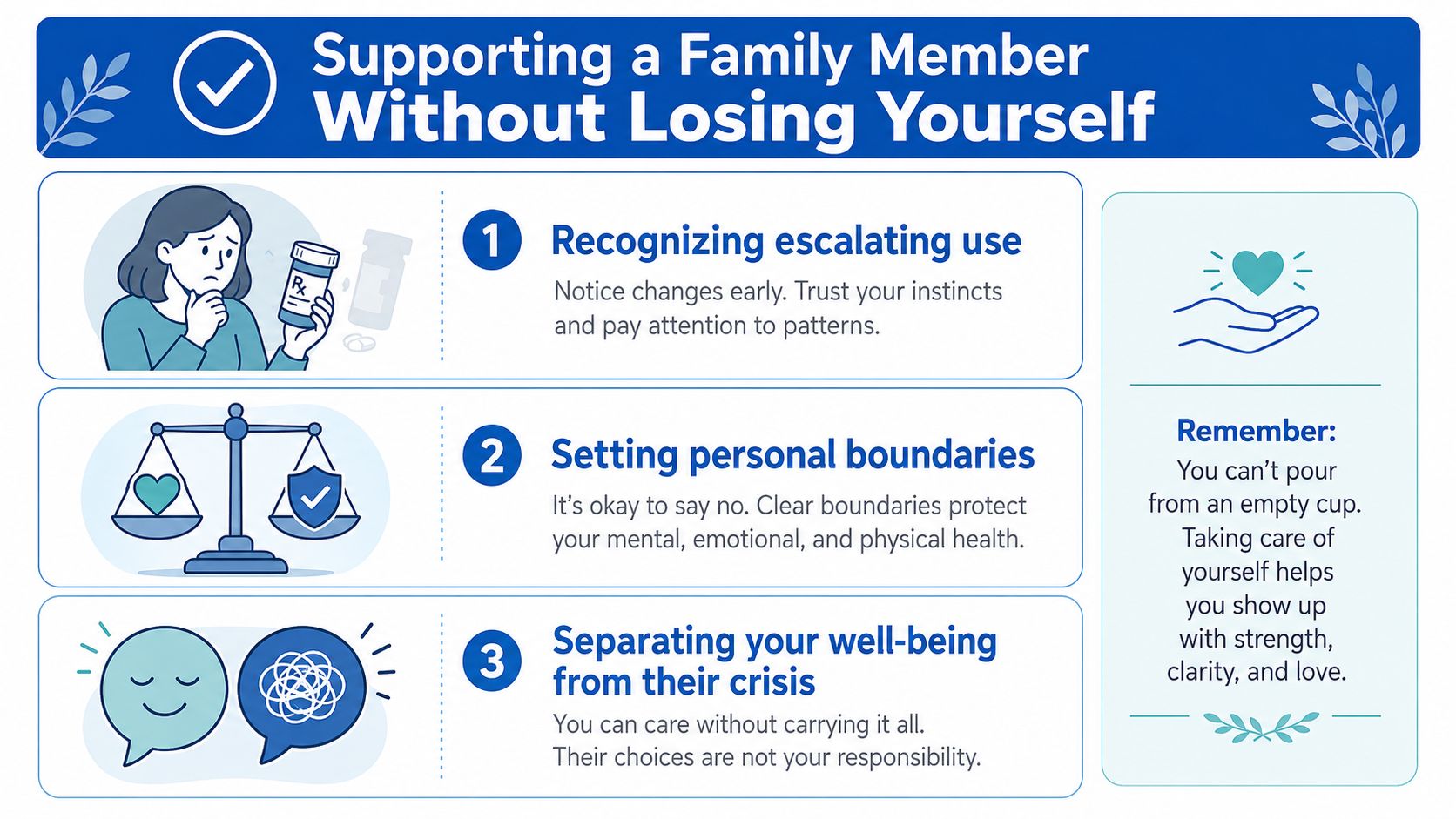
A parent might begin by making excuses. “He's under pressure.” “She'll stop when work settles down.” “I'll pay this bill just this once.” Those choices can feel protective, especially when the family member is frightened, ashamed, or visibly unwell. But support helps someone move toward responsibility, while enabling shields them from consequences and often leaves the family carrying the disorder.
Start today with three calm actions. Write down what you've observed, such as missed work, unsafe driving, disappearing medication, or repeated broken agreements. Don't interrogate, search for a confession, or build a courtroom case. Then identify one practical offer, such as helping call a treatment provider, arranging a clinical assessment, or staying with children while the person attends an appointment.
SAMHSA recommends that relatives express concern, offer help, and use its helpline for treatment referral. Its National Helpline for mental health and substance use support is free, confidential, and available 24/7, 365 days a year, in English and Spanish. That immediate access reflects an important shift in public health, families don't have to wait for a crisis to begin looking for care.
Check your own stability
Ask yourself directly:
- Sleep: Am I sleeping enough to think clearly, or am I staying awake monitoring the situation?
- Stress: Do I feel constantly tense, frightened, or responsible for preventing the next incident?
- Money: Have I used savings, borrowed funds, missed work, or paid obligations that belong to my loved one?
- Safety: Has there been intimidation, aggression, unsafe driving, theft, or substance use around children?
- Support: Is there at least one trusted person, counselor, or family group who knows what's happening?
A family member's addiction can affect an entire household. In 2023, nearly 19 million U.S. children, about 1 in 4, lived with at least one parent or primary caregiver with a substance use disorder, including more than 7.5 million living with moderate to severe SUD and over 6 million living with a co-occurring mental illness, as reported in SAMHSA's National Helpline information. These figures show why the response must protect children and caregivers, not only the person using substances.
Practical rule: Help with treatment, food, transportation to care, and honest communication. Don't finance substance use, conceal its effects, or place yourself in danger.
If you recognize patterns of over-responsibility, read about codependency in recovery and consider individual counseling. Your loved one's recovery matters, but your own stability is part of the recovery environment.
Starting a Compassionate Conversation
Choose a time when the person is as calm and sober as possible. A conversation during intoxication, withdrawal, a family celebration, or an active argument is unlikely to produce useful discussion. Keep the setting private, limit the conversation to a manageable period, and decide in advance which one or two behaviors you need to address.
Use an observation, an impact, and a request. This structure keeps you from drifting into accusations or a long list of historical failures.
- Describe what you saw. Say, “You missed work twice this week and drove home after drinking,” rather than, “You're ruining everything.”
- Name your concern. Say, “I'm scared because this is becoming unsafe,” or, “I'm worried about your health and your job.”
- Make one concrete request. Offer, “Will you let me help arrange an assessment tomorrow?” or, “Will you speak with a treatment professional this week?”
- Listen for the barrier. The person may fear withdrawal, cost, privacy, losing housing, or being judged. You don't need to solve every concern immediately. You do need to hear it accurately.
- Set the next contact. If they decline, say when you'll check in again and what support remains available.
A sibling might say to his brother, “I've noticed you're drinking through the weekend and missing plans you made with the kids. I'm worried, and I don't want to fight with you. I'll help you call a treatment provider tomorrow morning. Would you be willing to make that call with me?”
That wording is direct without turning the conversation into a verdict. SAMHSA advises choosing a private setting, expressing concern plainly, listening without judgment, offering help locating treatment, and remaining patient because change rarely happens overnight, as outlined in its Starting the Conversation guide.
Keep the door open without surrendering your position
Denial is common. Respond once, then stop arguing: “You may not see it the way I do. I'm still concerned, and the offer to help you speak with a professional remains.” Anger requires distance, not a louder voice: “I'll talk when we can do it safely. I'm leaving now.”
Deflection may sound like, “Everyone drinks,” or, “You're the one with the problem.” Don't chase every claim. Return to the specific behavior and your limit. Promises deserve a practical response: “I hope you follow through. Let's choose the next action rather than relying on a promise.”
Avoid lectures, ambushes, threats you won't enforce, and ultimatums designed to force an emotional breakthrough. If you need a structured family meeting, learn about staging an intervention and involve an experienced professional instead of assembling a surprise confrontation. End respectfully when the exchange becomes circular, and follow through on the next contact you promised.
Setting Boundaries That Protect Everyone
A boundary is a decision about your behavior, not a demand that another person become sober. “You need to stop using” is an expectation. “I won't give cash, and I'll end the visit if you arrive intoxicated” is an enforceable limit.
Build each boundary from four parts:
- Name the behavior. Identify the action you can observe, such as asking for cash, driving while impaired, threatening someone, or using drugs in the home.
- State your limit. Use short language and avoid explanations that invite negotiation.
- Connect an immediate consequence. The consequence should be something you control, such as ending a call, refusing a ride, or requiring the person to leave.
- Apply it consistently. A severe boundary that disappears under pressure teaches everyone that persistence defeats the limit.
| Situation | Specific Boundary | Connected Consequence |
|---|---|---|
| Money | I won't provide cash or pay debts connected to substance use. I can buy food directly or help contact treatment. | I'll end the financial discussion and won't transfer funds. |
| Housing | No drugs, alcohol-related threats, or intoxicated behavior in the home. A stay requires agreement to household rules. | The visit or housing arrangement ends if the rule is broken. |
| Transportation | I won't drive you while you're using or transport you to obtain substances. I will consider a ride to an assessment or treatment appointment. | I'll leave or arrange a safe alternative when the request isn't treatment-related. |
| Shared spaces | Medication, alcohol, weapons, and valuables are secured, and substance use isn't allowed around children. | Access to the space changes, and children move to a safer location. |
Boundaries aren't punishments. They make your response predictable and reduce the frantic bargaining that often surrounds repeated crises. They also prevent a family from confusing kindness with unlimited access to money, housing, transportation, or attention.
Guilt will show up. So will manipulation, anger, and accusations that you don't care. Answer briefly: “I care about you, and I'm still not giving you money.” You don't have to prove love by reversing a limit.
Review boundaries with a counselor or trusted support group. Ask whether each rule is specific, safe, financially realistic, and within your control. If you repeatedly break your own boundary, make it smaller and more immediate rather than more dramatic. If violence, stalking, theft, or threats occur, prioritize a safety plan and outside protection over continued access.
Finding the Right Level of Treatment
Treatment should match the person's medical condition, substance use, withdrawal risk, mental health needs, housing, transportation, and willingness to participate. A family shouldn't choose a program just because it has an open bed. Ask for an assessment and compare more than one recommendation when circumstances allow.
Medically supervised detox focuses on withdrawal management and stabilization. It can be appropriate when stopping a substance may create serious medical or psychiatric risk, but detox alone doesn't build the routines needed for sustained recovery. Residential rehabilitation provides a structured living environment, clinical care, counseling, recovery education, and distance from substances and triggers.
Medication-assisted treatment, also called medication for addiction treatment, can use approved medications alongside counseling and recovery support, depending on the substance and the individual's clinical needs. It may continue during residential, outpatient, or aftercare services. Intensive outpatient programs allow the person to live at home while attending structured treatment, making them useful when the person is medically stable and has a reasonably safe living environment.
| Setting | Best For | Typical Length | Family Involvement |
|---|---|---|---|
| Medically supervised detox | Withdrawal monitoring and initial stabilization | Varies by clinical need | Education, consent-based updates, discharge planning |
| Residential rehabilitation | People needing structured separation from substances and daily triggers | Varies by program and assessment | Family sessions, education, care coordination when authorized |
| Medication-assisted treatment | People who may benefit from medication alongside counseling | Ongoing care based on clinical response | Support with appointments, medication routines, and communication |
| Intensive outpatient program | Medically stable people able to live outside a facility | Varies by treatment plan | Family therapy, scheduling support, relapse-prevention planning |
Ask admissions staff:
- Are medical and psychiatric needs assessed together?
- Who manages withdrawal and medication?
- What credentials do the clinicians hold?
- How does the program respond to relapse or missed sessions?
- Is family programming available?
- What information can the family receive with the patient's written consent?
- How are housing, transportation, insurance, and payment handled?
- What does aftercare look like before discharge?
Families dealing with children, trauma, or difficult parent-child interactions may also benefit from understanding how PCIT helps families, especially when a qualified clinician determines that a parent-child intervention fits the broader situation. For a more detailed discussion of selecting the appropriate setting, use this guide to level of care determination.
A good referral answers what happens next, not just where the person can sleep tonight. Look for dual-diagnosis capability, licensed staff, clear family policies, realistic discharge planning, and continuity when the person moves from detox to rehabilitation, medication treatment, or outpatient care.
Planning for Safety and Mental Health Needs
Addiction becomes more dangerous when the family treats psychiatric symptoms as a separate issue to handle later. Severe depression, trauma symptoms, anxiety, mania, psychosis, suicidal thinking, and substance use can interact, making sudden changes in mood or behavior harder to interpret. Families need one coordinated clinical plan rather than separate promises from disconnected services.
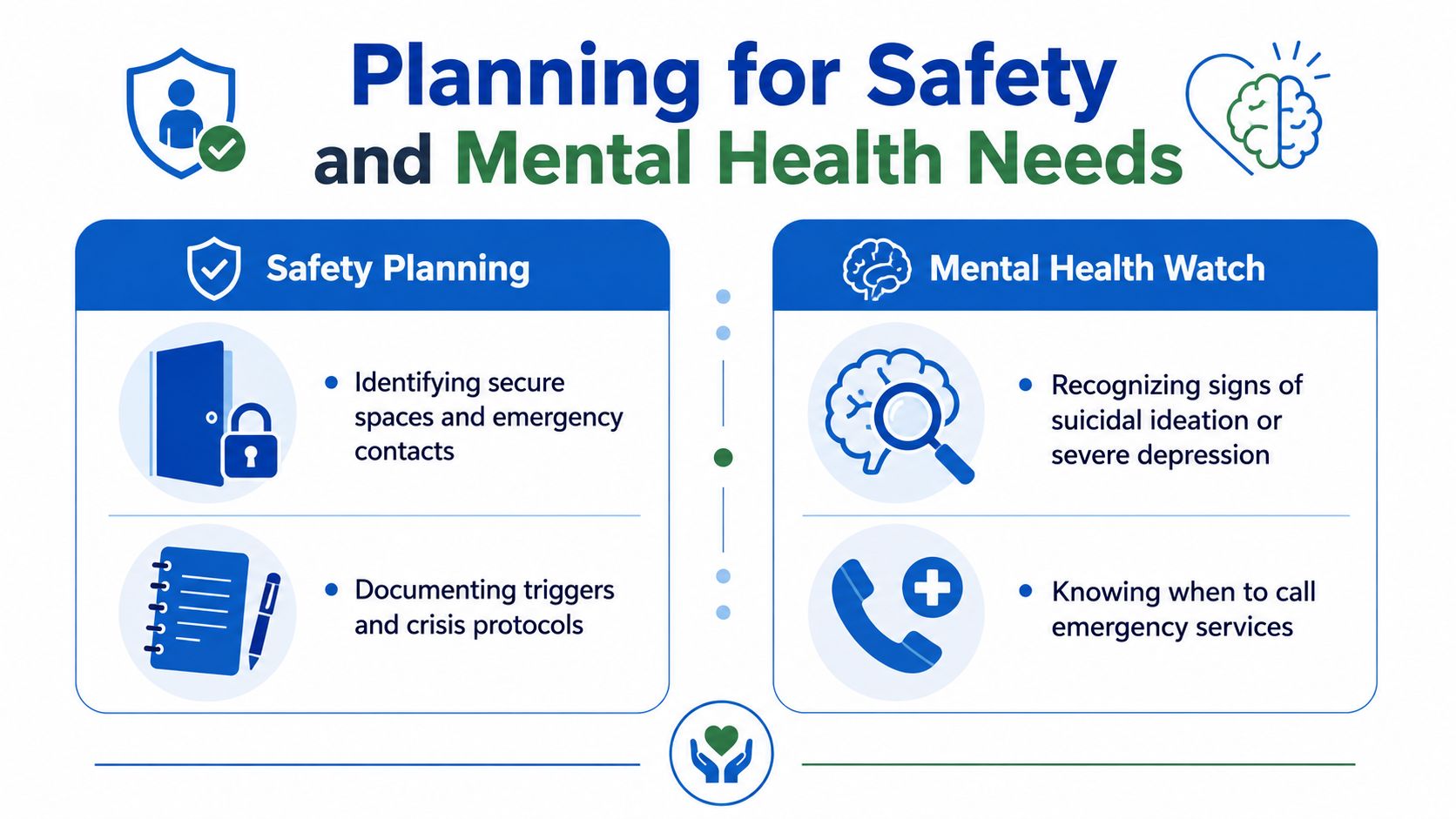
Watch for statements about death or hopelessness, giving away belongings, sudden withdrawal, self-harm, extreme agitation, confusion, hallucinations, dangerous impulsivity, or severe withdrawal symptoms. Ask directly whether the person is thinking about suicide or hurting themselves. A direct question doesn't create suicidal thinking, and a concerning answer requires immediate professional attention.
Put the plan on paper
A written plan is more useful than a family promise made during a calm afternoon. Include:
- Warning signs: Record the behaviors that usually precede a crisis, including isolation, missed medication, escalating use, threats, or sleeplessness.
- Safe locations: Identify where children and adults can go if the person becomes threatening or unpredictable.
- Emergency contacts: Keep 911, 988, the local mobile crisis team, the treatment program, and trusted relatives visible.
- Hazard reduction: Secure medications, weapons, alcohol, and other dangerous items where appropriate. Don't attempt to remove weapons during an active confrontation.
- Communication roles: Decide who calls for help, who contacts relatives, and who protects children. One calm coordinator is better than several people issuing instructions.
- Consent and records: Ask the loved one to authorize communication with the treatment team when possible, while respecting privacy rules.
Call 911 for an immediate overdose, serious medical emergency, violence, or imminent danger. Call or text 988 for a suicidal crisis or urgent emotional distress, and follow the crisis counselor's instructions. Withdrawal can become medically dangerous, so don't attempt to manage severe symptoms at home without professional guidance.
A treatment program should coordinate addiction care, psychiatric evaluation, therapy, medication management, and discharge planning. Families can ask whether the provider treats co-occurring conditions and how clinicians communicate across levels of care. Your own sleep and stability matter here too. A depleted caregiver may miss warning signs or make unsafe decisions, so schedule relief and get professional support before you reach a breaking point.
Supporting Treatment and Long-Term Recovery
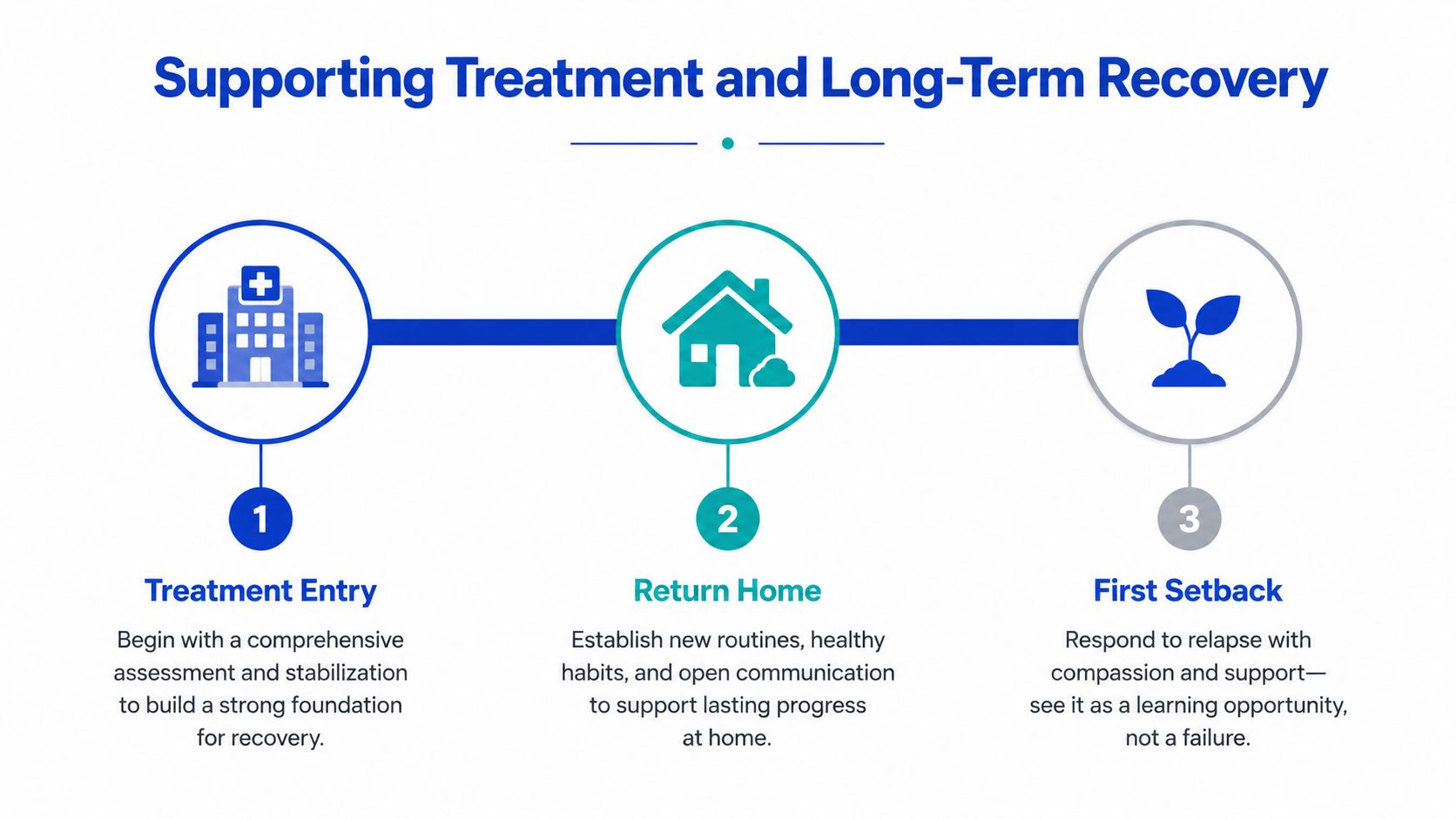
When Elena finally agreed to treatment, her family treated admission as the finish line. They sent long messages, paid overdue bills, and assumed that returning home meant she was ready to resume every responsibility. A better approach would have treated admission as the first handoff in a longer plan.
During detox or residential care, attend family sessions when invited and follow facility rules. Ask what kind of contact supports treatment, because some programs limit calls or structure communication. Send messages that reinforce effort without demanding reassurance: “We're glad you're getting care. We'll discuss the home plan with your counselor.”
Don't use treatment as a reason to resume rescuing. Paying debts, hiding a relapse, pressuring staff for exceptions, or blaming clinicians may relieve immediate discomfort while weakening accountability. Ask the care team what the family can do, what it should stop doing, and what warning signs should trigger a call.
Make the return home concrete
Before discharge, agree on practical details:
- Where will the person sleep?
- Which substances and medications must be secured?
- Who will provide transportation?
- What appointments are already scheduled?
- Will medication treatment continue?
- What happens if the person misses therapy or returns intoxicated?
- Which family member will communicate with the care team, with consent?
A check-in can be supportive without becoming surveillance. Discuss a predictable time to talk about appointments, sleep, cravings, work, and stress. Let the person bring information rather than demanding constant proof of sobriety.
If a lapse occurs, address safety first. Ask whether emergency care is needed, keep children away from immediate danger, and contact the treatment provider. Then separate the person from the behavior: “I care about you. Using again means we need to restart clinical support and follow the home boundary.” Avoid pretending nothing happened, but don't turn the lapse into a permanent identity.
Family involvement has a clinical role, not only an emotional one. SAMHSA's Treatment Improvement Protocol 39 identifies family therapy as part of evidence-based substance use disorder care and discusses family factors that can protect against relapse. Recovery is a long arc, and steady, imperfect involvement can provide structure without taking ownership of the person's decisions.
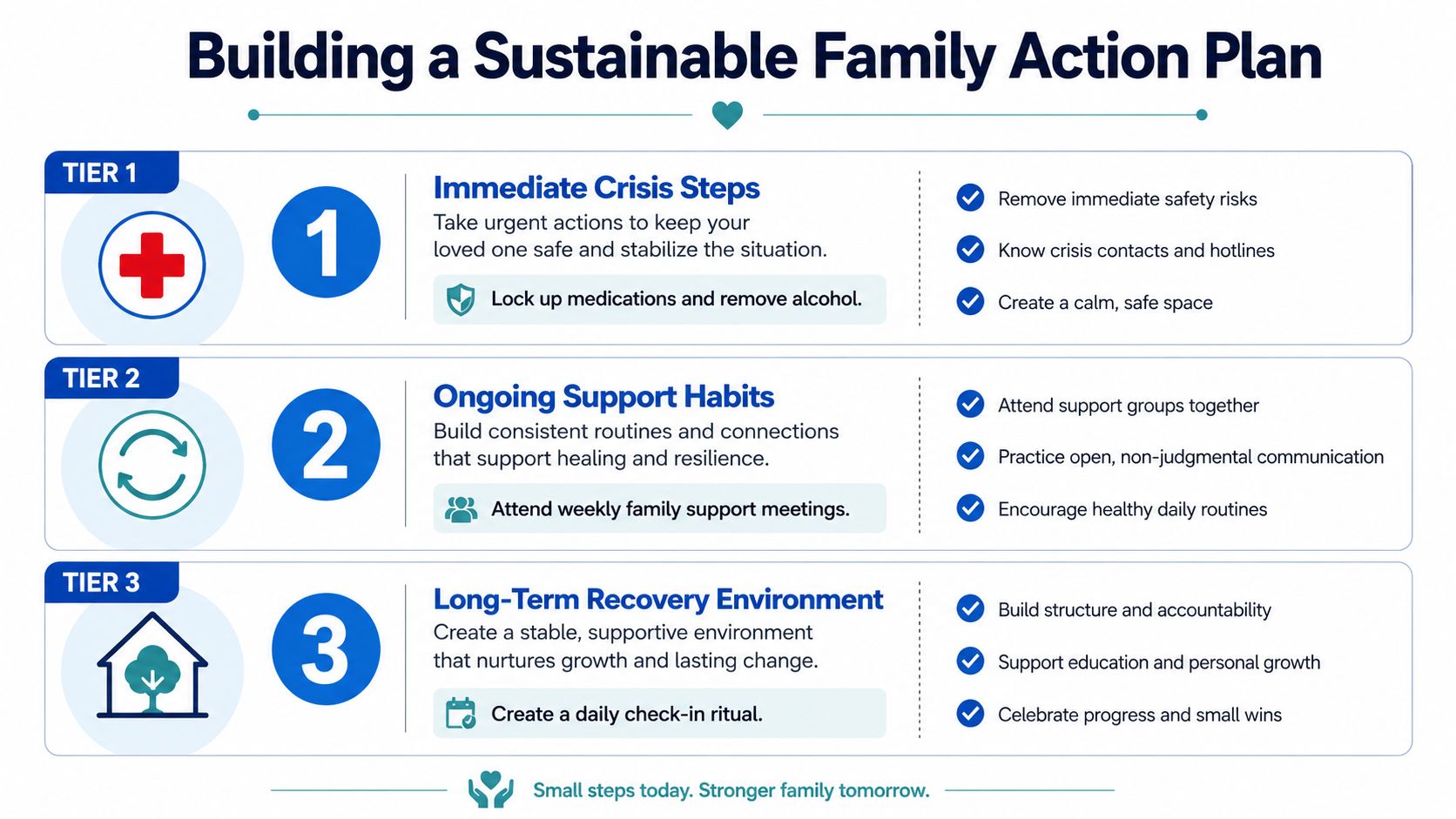
Building a Sustainable Family Action Plan
A useful plan starts with what must happen today, then protects the habits that keep the family from returning to crisis mode.
Same-day actions
If your loved one is overdosing, violent, severely confused, or in immediate danger, call 911. If someone is suicidal or in acute emotional crisis, call or text 988. Move children and vulnerable relatives to safety, secure dangerous items when you can do so safely, and don't confront an intoxicated or agitated person alone.
If there's no immediate emergency, write down the behaviors you've observed, choose one calm point of contact, and offer a specific treatment step. Use SAMHSA's 24/7 National Helpline referral service to identify treatment options instead of relying on online guesses or waiting for a crisis.
First-month priorities
Research detox, residential, medication, and outpatient options. Ask about co-occurring mental health care, family programming, insurance, transportation, and aftercare. Attend a family support meeting such as Al-Anon or SMART Recovery Family & Friends, and schedule counseling for yourself even if your loved one declines treatment.
Long-term practices
Keep boundaries written and review them when housing, work, children, or treatment status changes. Maintain regular check-ins with a therapist or family group, build relationships with people who understand addiction, and keep communication open without becoming a surveillance system. If relapse occurs, follow the safety plan, contact professionals quickly, and reassess what support the family needs.
The strongest family response is rarely a single dramatic confrontation. Low-conflict engagement, clear limits, rapid treatment navigation, and care for the caregiver give your loved one a better chance to choose help while keeping the household safer.
If your family needs help sorting through detox, residential rehabilitation, MAT, or IOP options, Addiction Resource Center LLC offers treatment guidance for adults and support for relatives navigating substance use and co-occurring mental health needs. Visit the center to discuss next steps, request an assessment, or connect with a team that can help turn concern into a practical plan.