An ASAM-aligned addiction intensive outpatient program for adults typically provides at least 9 hours of treatment each week across 3 to 5 days, with about 90 days as a recommended minimum duration. That baseline gives patients frequent clinical contact, accountability, and recovery practice without requiring them to sleep at a treatment facility. A 38-year-old parent …

An ASAM-aligned addiction intensive outpatient program for adults typically provides at least 9 hours of treatment each week across 3 to 5 days, with about 90 days as a recommended minimum duration. That baseline gives patients frequent clinical contact, accountability, and recovery practice without requiring them to sleep at a treatment facility.
A 38-year-old parent may be asking that question after another frightening relapse: should they leave home for residential treatment, or stay near their children and keep working through an IOP? The answer depends less on convenience than on clinical fit, safety, and the amount of structure the person can use consistently.
An IOP can be the middle path, but it isn't “rehab with fewer appointments.” It's a planned level of care for adults who need substantial therapeutic support but don't require round-the-clock supervision. The sections below translate that decision into practical terms, using the ASAM-aligned intensity benchmark as the starting point.
Table of Contents
- What an Addiction Intensive Outpatient Program Actually Is
- A Typical Week Inside an IOP Schedule
- Core Therapies Used During IOP Treatment
- How IOP Fits Alongside Detox, Residential, and PHP
- Telehealth IOP and Who It Works Best For
- Who Is a Good Fit for an IOP Level of Care
- Aftercare Planning After IOP Ends
- Putting It All Together for Your Next Step
What an Addiction Intensive Outpatient Program Actually Is
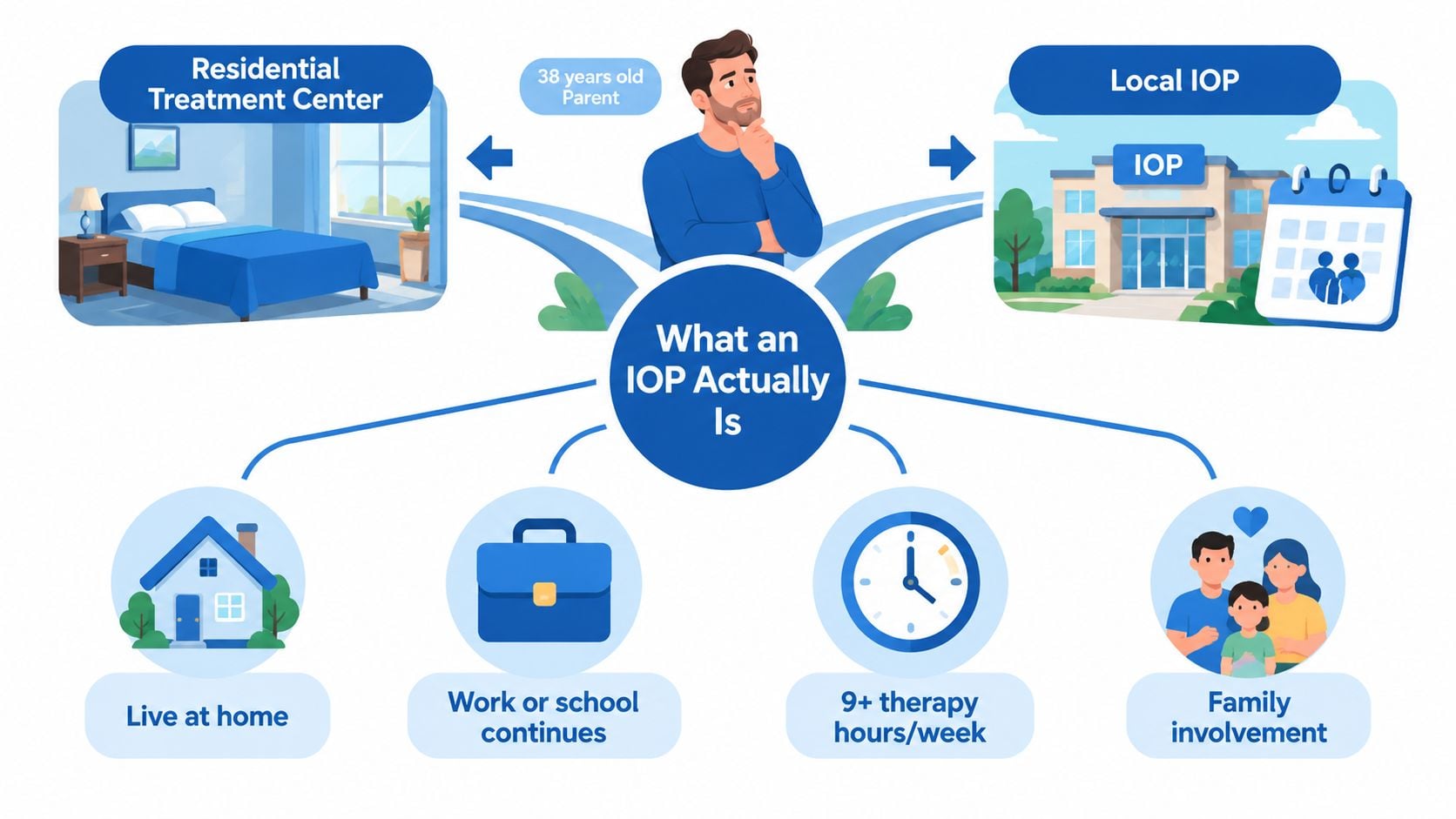
A parent may be deciding whether to stay home and keep working through treatment or leave for residential care. An addiction intensive outpatient program, commonly called an IOP, serves adults who can live at home while attending a structured schedule of addiction treatment. Between sessions, they may work, attend school, or care for children, as long as those responsibilities do not compromise safety or treatment participation.
For adults, an ASAM-aligned IOP typically provides at least 9 hours of services per week across 3 to 5 days, with a recommended minimum duration of about 90 days, according to ASAM level-of-care guidance. Some clinical guidance describes 6 to 30 contact hours per week, with the actual amount adjusted to severity, stability, and recovery needs. The purpose is regular clinical contact: supporting abstinence, practicing responses to relapse triggers, and treating co-occurring mental health conditions.
The three working parts of IOP
Scheduled programming gives recovery a dependable place in the week. The treatment plan may include group therapy, individual counseling, skills training, family sessions, and other clinical services.
Accountability makes changes easier to observe. Staff may track attendance, ask about cravings and triggers, coordinate drug screening, and revise the plan if the patient misses sessions or returns to use.
Coordinated clinical support links therapy with medical and psychiatric care. Depending on the person's needs, that support may include medication management, education about medication-assisted treatment, follow-up after withdrawal, or care for depression, anxiety, trauma, or another co-occurring condition.
Practical rule: IOP fits when a patient can return home safely and follow a treatment schedule intensive enough to change daily behavior.
IOPs have a substantial role in the American addiction treatment system. National census data found them second in prevalence only to regular outpatient treatment since 2002. In 2011, 6,089 programs reported offering IOPs, representing 44% of 13,720 addiction treatment programs. Those programs served 141,964 patients, or 12% of 1.2 million patients in care. A national review of IOPs describes their development from earlier outpatient approaches, including the Minnesota Model.
A Typical Week Inside an IOP Schedule
The easiest way to understand IOP intensity is to look at a week rather than a single appointment. A person may attend a morning program on Monday, Wednesday, and Friday, or attend across more days with shorter sessions. The exact schedule depends on clinical need, work hours, transportation, family responsibilities, and whether the program offers evening care.
A sample weekday might start with a check-in about cravings, sleep, medication, and immediate safety. The patient may then join a therapist-led group focused on cognitive behavioral strategies, take a short break, and attend a skills group on emotional regulation or relapse prevention. Individual therapy may occur once or twice during the week, while family sessions are scheduled when relatives can participate.
| Day | Morning Block | Afternoon Block | Total Hours |
|---|---|---|---|
| Monday | Check-in and process group | CBT or relapse-prevention skills | 3 |
| Tuesday | Individual therapy or family session | Care coordination and recovery planning | 3 |
| Wednesday | Check-in and psychoeducation | Coping-skills group | 3 |
| Thursday | Group therapy | Individual clinical review | 3 |
| Friday | Recovery planning and process group | Weekly wrap-up | 3 |
This sample illustrates a 3-hour daily structure, but not every patient attends five days. A program may cluster services across three days or spread them across four or five, as long as the schedule matches the treatment plan and reaches the required intensity. Patients and families can compare formats using this guide to intensive outpatient program schedules.
Why group therapy usually carries more of the week
Group work often occupies most programming time because it combines clinical teaching, practice, peer feedback, and accountability. Individual and family sessions fill in the areas that group treatment can't address privately, such as trauma history, medication concerns, relationship conflict, or a personal relapse pattern.
Many programs use a balance of roughly 70% to 80% group work and 20% to 30% individual and family services, but that ratio isn't a universal rule and should be confirmed with the program. Morning and early-afternoon schedules can leave evenings for parenting, job shifts, or classes. That flexibility is the central trade-off: the patient remains in daily life, but must practice recovery skills in the same environment where cravings and stress may appear.
Core Therapies Used During IOP Treatment
Therapy in an IOP should feel practical. Patients aren't only discussing addiction as an idea. They're learning how to identify a trigger before it becomes an urge, interrupt an automatic response, and choose an action that supports recovery.
Cognitive behavioral therapy and motivation
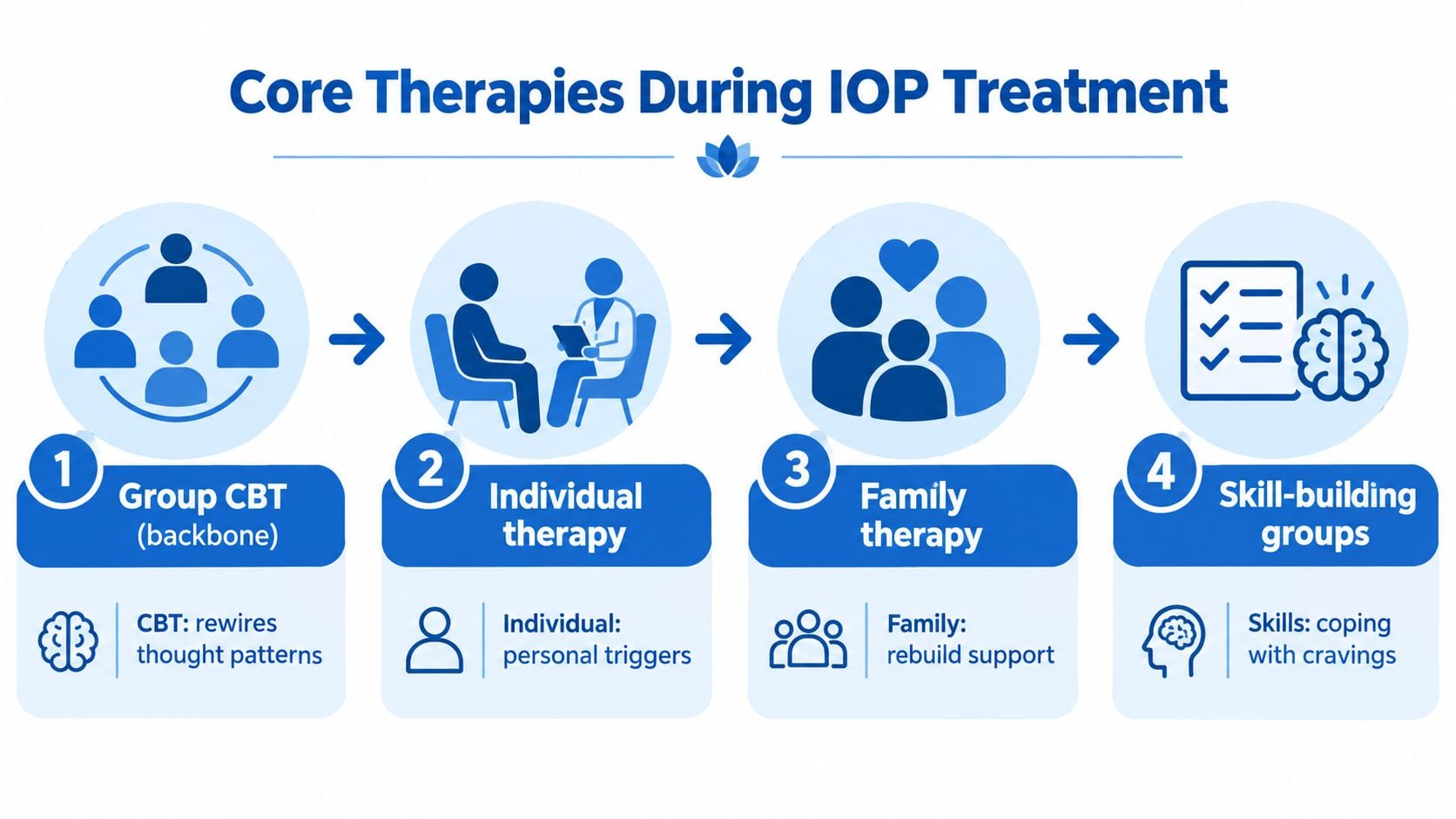
Group cognitive behavioral therapy, or CBT, often provides the backbone. A patient learns to identify the link between thoughts, emotions, situations, and substance use. For example, “I failed today, so I might as well use” can be examined and replaced with a more accurate response, such as calling a support person, leaving a risky setting, or attending a scheduled meeting.
Motivational enhancement therapy helps when a patient feels divided about change. Early in treatment, someone may want sobriety and still miss the relief that alcohol, opioids, stimulants, or another substance seemed to provide. The clinician helps the patient explore that conflict without arguing or shaming them, so motivation becomes connected to personally meaningful goals such as parenting, health, employment, or stable housing.
Skills for intense emotions and high-risk moments
A dialectical behavior therapy skills group teaches tools for distress tolerance, mindfulness, emotional regulation, and interpersonal effectiveness. Those skills matter when anger, panic, shame, or loneliness arrives faster than a person can think. Better emotional regulation may support improved sleep, fewer impulsive decisions, and more reliable communication.
Trauma-informed groups should avoid forcing disclosure before a patient is ready. They focus on safety, choice, grounding, and understanding how trauma symptoms can interact with substance use. Relapse-prevention planning then turns those insights into a specific response for high-risk situations, such as being offered drugs at work, receiving a painful family message, or returning to a neighborhood associated with use.
Family education and medication support
Family sessions can help relatives understand cravings, boundaries, communication, and the difference between support and rescuing. A partner may learn how to respond to a lapse without covering it up, while the patient practices asking for help before a crisis.
Psychoeducation about medication-assisted treatment is also important for opioid or alcohol use disorders. The treatment team may explain available medications, expected benefits, monitoring, and how medication fits with counseling. Programs should coordinate with qualified medical providers rather than treating medication as a separate issue.
These approaches can work together. A patient may use CBT to recognize a trigger, DBT skills to tolerate the emotion, an individual session to process the underlying pattern, and a family session to rebuild trust.
How IOP Fits Alongside Detox, Residential, and PHP
Families often hear several ASAM labels and still don't know what Tuesday will look like. The practical differences involve where the patient sleeps, how much supervision is available, how much medical monitoring is needed, and whether work or caregiving can continue.
| Level of Care | Hours/Week | Overnight Stay | Medical Monitoring | Best Fit For |
|---|---|---|---|---|
| Medically monitored detox, ASAM 3.7 to 3.2 | Varies by medical need | Often facility-based | Withdrawal management and medical oversight | People at risk for serious withdrawal or medical complications |
| Residential treatment, ASAM 3.x | Structured throughout the day | Yes | Staff support within a controlled setting | People needing a safe, substance-free living environment and intensive supervision |
| PHP, ASAM 2.5 | More intensive than IOP | No, patients return home | Frequent clinical and psychiatric support | People needing near-daytime treatment but not overnight care |
| IOP, ASAM 2.1 | At least 9 hours for adults | No | Coordinated clinical support without 24-hour supervision | Medically stable people who can use a structured home-based plan |
A person at risk for alcohol or benzodiazepine withdrawal may need medically monitored detox before outpatient therapy. Someone with an unsafe home, repeated inability to remain abstinent, or a need for constant supervision may be better served by residential treatment. A patient who needs more daytime structure or psychiatric support but can sleep safely at home may fit PHP. More detail on that higher outpatient intensity appears in this overview of partial hospitalization program options.
Common pathways through care
Treatment doesn't always move in a straight line. A patient may complete detox and enter IOP, step down from residential treatment into IOP, or move from PHP into a less intensive schedule. If symptoms, cravings, or safety concerns increase, the team may recommend stepping back up.
Insurance authorization can complicate those decisions. Programs and families may face prior-authorization denials that push a clinically appropriate patient toward less intensive care. Ask the admissions team to explain the recommended level, the documentation submitted, and what happens if the insurer denies the requested intensity.
Telehealth IOP and Who It Works Best For
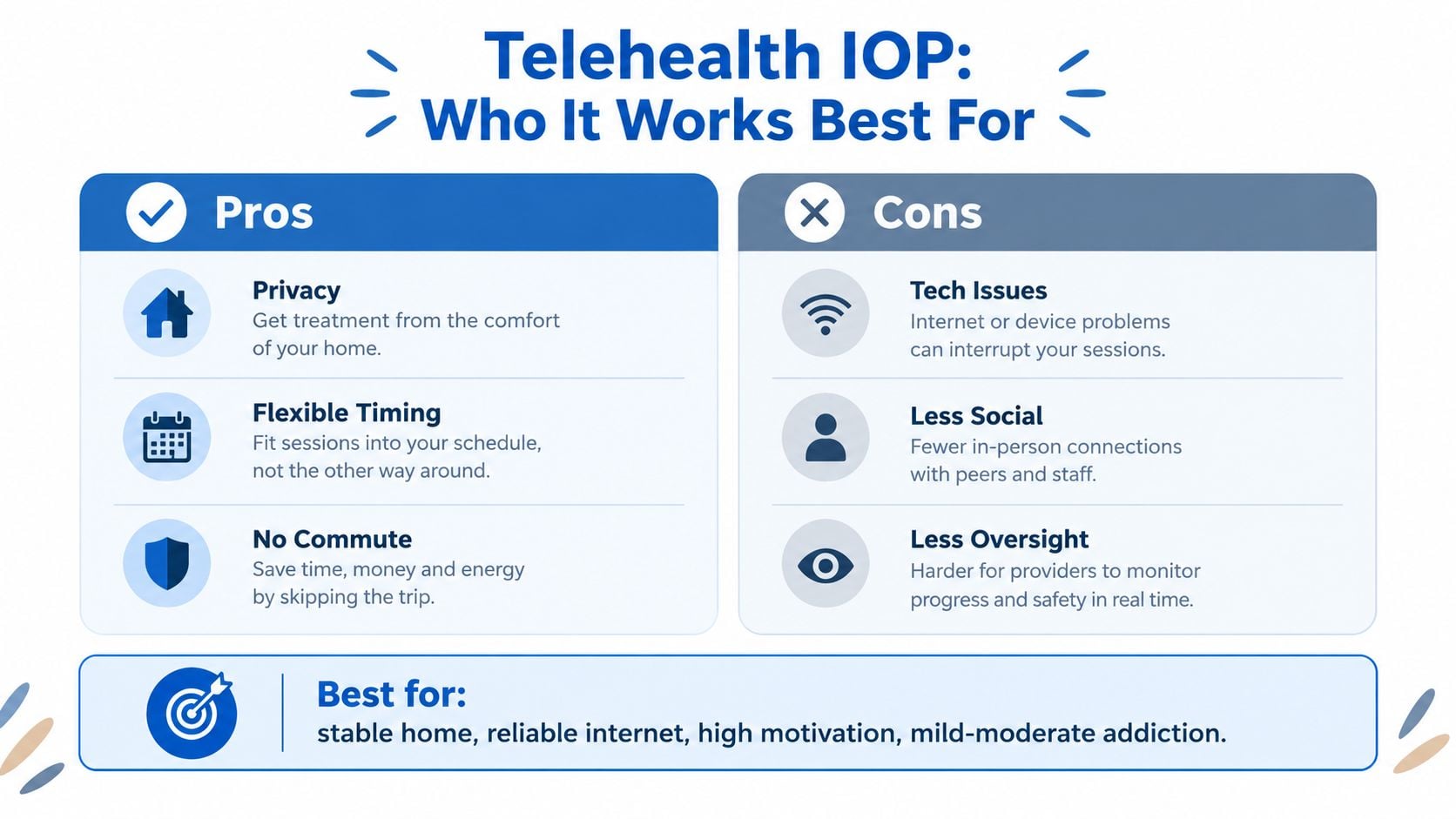
Telehealth IOP shouldn't be reduced to a yes-or-no question about whether remote treatment “works.” The better question is whether the patient has the home stability, privacy, technology, support, and engagement pattern needed to use video-based care consistently.
A large retrospective cohort of 4,724 telehealth SUD IOP patients found that about 80% stayed engaged for 30 days and 91% achieved at least 30 consecutive abstinent days, according to the telehealth IOP cohort study. The same evidence base also shows meaningful variation between patient groups. In a newer pilot involving hospitalized patients with opioid use disorder, median video completion was only 2%, while median engagement with a recovery coach was 31.8%.
That contrast changes the conversation. A working parent with a quiet room, reliable internet, and strong attendance habits may benefit from eliminating the commute. A person with unstable housing, serious untreated mental illness, limited privacy, or weak phone access may need in-person structure or a blended plan.
Questions to ask before choosing virtual care
- Clinician licensure: Will the treating clinician be licensed to provide care in the patient's state?
- Group privacy: Does the patient have a private place to attend, and what happens if someone else enters the room?
- Drug testing: How does the program arrange testing, and how quickly are results reviewed?
- Crisis response: Who does the patient call during an overdose risk, suicidal crisis, or sudden psychiatric deterioration?
- Technical backup: What happens when the internet, camera, or platform fails?
- Care coordination: Can the team coordinate medication, primary care, psychiatry, and a higher level of care when needed?
Patients comparing formats can review this explanation of a telehealth IOP program. Virtual care can be a strong support model for some adults, but it shouldn't hide warning signs that call for more direct supervision.
Who Is a Good Fit for an IOP Level of Care
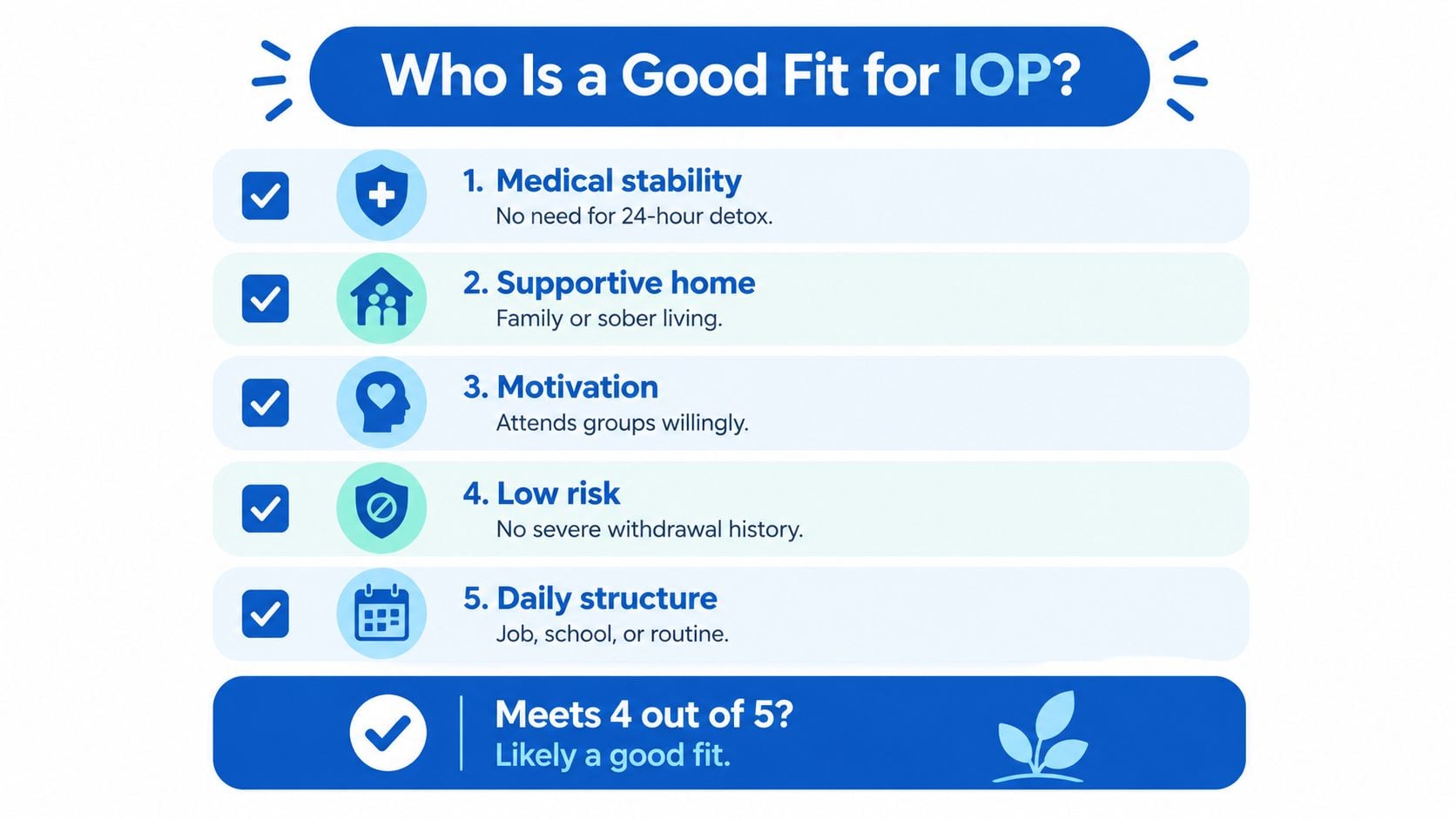
A good IOP candidate can usually remain medically safe outside a facility while participating in frequent treatment. That doesn't mean the addiction is mild or that the patient can manage recovery alone. It means the person can use structured care without needing continuous withdrawal management or overnight supervision.
The practical fit check
- Medical stability: The patient doesn't currently need 24-hour detox or hospital-level medical observation.
- A workable home: Home is reasonably safe, or the patient has access to supportive sober living.
- Reliable participation: The patient can attend several sessions each week and communicate when symptoms change.
- Manageable withdrawal risk: There isn't a known history suggesting dangerous withdrawal that requires closer monitoring.
- Daily structure: Work, school, caregiving, or another routine can support treatment rather than repeatedly conflict with it.
The home environment deserves careful attention. A patient may be clinically stable yet surrounded by substances, active conflict, or people who don't respect boundaries. In that situation, residential care or sober living may provide the protection needed to make therapy useful.
When another level may be safer
Active suicidality, untreated psychosis, serious alcohol or benzodiazepine withdrawal risk, complicated pregnancy, and recent homelessness can change the recommendation. These situations don't automatically determine one level of care for every person, but they require a more detailed assessment and may make ordinary IOP unsafe.
Families can ask one direct question before enrolling: Can your team treat co-occurring mental health conditions at the same time as substance use, and what happens if those symptoms become more severe? The answer should identify actual clinical support, not promise a referral after treatment begins.
Aftercare Planning After IOP Ends
The final IOP session shouldn't be the final recovery appointment. A responsible discharge plan gives the patient a clear response for cravings, emotional distress, missed medication, family conflict, and the early signs that often appear before a return to use.
A useful relapse-prevention plan names four things:
- Personal triggers, such as particular people, places, emotions, or routines.
- Early warning signs, such as isolating, skipping medication, sleeping poorly, or hiding behavior.
- Coping responses, including leaving the setting, contacting support, using grounding skills, or attending a meeting.
- People to call, with names and phone numbers written down before a crisis.
Step-down care should match demonstrated stability. Many patients move from IOP into standard outpatient counseling, then continue with individual therapy at a frequency that decreases as recovery becomes more established. The exact cadence should be individualized rather than assumed, especially when cravings, psychiatric symptoms, or medication needs remain active.
Keeping support connected
Recovery support groups such as AA, NA, SMART Recovery, and secular alternatives can add peer connection outside formal treatment. Patients should be encouraged to choose a setting where they feel safe and respected, rather than being told that one model fits everyone.
Family involvement may include psychoeducation, communication work, boundary setting, codependency-focused counseling, and scheduled check-ins. The family also needs a plan for responding to a lapse without abandoning safety or taking over the patient's responsibilities.
Aftercare should coordinate medication-assisted treatment refills, sober-living referrals, and primary-care follow-up for co-occurring conditions. A handoff works better when the receiving clinician has the relevant medication list, treatment goals, warning signs, and contact information for the patient's support network.
Putting It All Together for Your Next Step
A 38-year-old parent may be weighing two real options: continue living at home while working, or enter residential care. The question is whether an intensive home-based structure can provide enough safety and accountability, or whether withdrawal risks, mental health symptoms, housing instability, or relapse risk call for overnight supervision.
Use three questions to organize the decision:
- Clinical fit: Can the person stay safe without overnight supervision, and can the program address co-occurring conditions?
- Scheduling capacity: Can the patient attend at least 9 hours each week across 3 to 5 days, with about 90 days as a recommended minimum duration?
- Telehealth suitability: Does the patient have privacy, reliable technology, a stable recovery setting, and enough support to participate consistently?
A checklist for today's call
- Ask the assessor to explain the recommended ASAM level and why it fits.
- Request the weekly schedule, including hours, days, and the balance of group, individual, and family treatment.
- For telehealth, ask how the program handles testing, emergencies, missed sessions, privacy, and technology failures.
- Request the aftercare plan in writing before enrollment.
- Ask what happens if symptoms worsen or the current level no longer provides enough support.
Research supports a balanced view. One randomized study of 447 patients found no significant overall difference between intensive and more traditional addiction treatment at nine-month follow-up. Patients who stayed in treatment longer showed fewer drug problems, fewer positive urine screens, better employment status, and fewer psychological problems. A separate program-level study reported 91% retention, along with reductions in substance use and mental health symptoms from intake to discharge, as summarized in this IOP research brief.
IOP works best within a longer care plan. The right program matches intensity to safety, provides enough weekly contact to practice new skills, and prepares the next level before the current one ends.
Addiction Resource Center LLC offers adults 18 and older in-person and telehealth IOP services, including individual and group therapy, family therapy, addiction education, relapse prevention, and aftercare planning. Visit Addiction Resource Center LLC to explore options, request guidance for yourself or a loved one, or learn how to begin care in Yuba City and Northern California.