
Detox Drug for Alcohol: What Doctors Actually Use
Reviewed by Tiffany Komba, LMFT #136055 · Last reviewed November 20, 2026
Published November 20, 2026
Contents
- Why There Is No Single Detox Drug for Alcohol
- Medications Used in Supervised Alcohol Detox
- How Clinicians Judge Withdrawal Severity and Setting
- Why Benzodiazepines Remain the First-Line Choice
- When Anticonvulsants and Phenobarbital Are Used
- Monitoring During Detox and Warning Signs to Act On
- Medications That Prevent Relapse After Detox
- Confirm Medical Supervision Before You Start Detox
Search for a detox drug for alcohol and the most confident answer you'll find is that one medication handles it. Take the pill, clear the alcohol, get back to normal. That answer is wrong in a way that matters, and the correction is useful.
No medication makes your body eliminate alcohol faster. What medication does in alcohol detox is quieter. It lowers the odds that withdrawal turns dangerous, and it keeps you steady enough to get through the first few days without a seizure or a night in an emergency department.
The better question isn't which single drug works. It's which medication, at what dose, for how long, for this person, under whose supervision. That question has a real answer, and it changes with your drinking history, your health, and where you're being cared for.
Why There Is No Single Detox Drug for Alcohol
Alcohol withdrawal isn't a toxin problem. It's a nervous system problem. Heavy daily drinking pushes the brain into a constant depressant state, and when the alcohol stops, the brain swings hard the other way. That swing is what produces the symptoms.
The range is wide. At the mild end you get tremor, sweating, a racing heart, nausea, anxiety and insomnia. At the severe end come hallucinations, seizures and delirium tremens, a confused and agitated state that can be fatal without treatment.
Medication given during detox doesn't speed up the exit of alcohol. It reduces how severe withdrawal gets and prevents the complications that make it dangerous, especially seizures and delirium.
Three different things get labeled detox medication in everyday conversation, and mixing them up sends people toward the wrong plan:
- Acute withdrawal medication is given for hours to days to keep withdrawal safe. This is what a detox program means when it says medication.
- Long-term medication for alcohol use disorder is taken for weeks or months to reduce heavy drinking or support abstinence. Different drugs, different decision.
- Home remedies and supplements don't treat withdrawal, and alcohol withdrawal over the counter medication isn't a safe substitute for supervision. A sedative borrowed from a friend adds a second risk on top of the first.
The question that matters: not which drug is the detox drug for alcohol, but what this person needs, in what setting, with what monitoring, and who decides when the plan changes.
Almost every medication used in withdrawal is a prescription drug given under observation. The choice belongs to a clinician who can see the person, check vital signs, and adjust.
Medications Used in Supervised Alcohol Detox
| Medication class | Common examples | Typical role in supervised detox | Main monitoring concern |
|---|---|---|---|
| Benzodiazepines | Diazepam, lorazepam, chlordiazepoxide | First-line for moderate to severe withdrawal and seizure risk | Sedation, breathing depression, dependence |
| Anticonvulsants | Carbamazepine, gabapentin, valproate | Alternatives or adjuncts when benzodiazepines are unsuitable or for milder cases | Weaker evidence, drug interactions, liver function |
| Barbiturate | Phenobarbital | Option when benzodiazepines are contraindicated, in hospital or specialist settings | Narrow safety margin, respiratory depression, long duration |
| Alpha-2 agonist adjunct | Clonidine | Eases tremor, sweating and racing pulse; does not prevent seizures | Low blood pressure, dizziness |
| Beta-blocker adjunct | Propranolol | Controls heart rate and blood pressure surges | Low blood pressure, slow heart rate |
| Antipsychotic adjunct | Haloperidol | Used for agitation or hallucinations in severe cases | Sedation, heart rhythm changes |
Benzodiazepines hold the top row for people with moderate to severe withdrawal and for anyone at meaningful seizure risk. Diazepam, lorazepam and chlordiazepoxide differ in how quickly they act and how long they last, which is one reason the selection is individualized rather than automatic.
Anticonvulsants such as carbamazepine, gabapentin and valproate are used as alternatives or add-ons, either because benzodiazepines don't suit the person or because the withdrawal is mild enough that a gentler option makes sense. Phenobarbital is a barbiturate reserved for situations where benzodiazepines are contraindicated and monitoring is close.
Adjuncts That Do a Different Job
Clonidine and propranolol calm the physical storm, the shaking, sweating and pounding pulse, but neither prevents a seizure. Haloperidol may be added when agitation or hallucinations dominate the picture, though it needs watching for sedation and heart rhythm effects. These drugs are support, not protection.
How the Dose Gets Decided
The ASAM clinical practice guideline on alcohol recommends symptom-triggered dosing when trained staff can repeatedly assess withdrawal severity, with fixed-dose tapers as the alternative when reliable scoring or 24-hour monitoring isn't available. In plain terms, medication is given in response to measured symptoms rather than on a schedule set at admission.
Combinations are routine. A benzodiazepine plus clonidine for tremor and a racing pulse is an ordinary pairing. Antipsychotics and anticonvulsants get added for specific problems, never as a package deal.
Ask the care team: which drug is being used, why that one for you, what it is meant to prevent, and how it will be reduced over the next few days.
How Clinicians Judge Withdrawal Severity and Setting
Clinicians grade withdrawal rather than eyeballing it, most often with the CIWA-Ar scale. It scores tremor, sweating, anxiety, agitation, hallucinations, headache, nausea and orientation, then produces a number that guides both medication and setting. The bands below reflect common practice. Programs differ at the edges, so treat them as guides rather than verdicts.
| Withdrawal level | Typical signs | Usual care setting |
|---|---|---|
| Mild | CIWA-Ar under 8; tremor, sweating, mild anxiety, no hallucinations | Monitored outpatient or clinic-based detox with regular check-ins |
| Moderate | CIWA-Ar about 8 to 15; rapid pulse, agitation, nausea, insomnia | Medically supervised residential or structured inpatient detox |
| Severe | CIWA-Ar above 15, or any confusion, hallucinations, fever, seizure or delirium tremens | Hospital or inpatient medical detox with urgent evaluation when needed |
A mild start doesn't guarantee a mild course. In a 2024 Critical Care Explorations study of 8,742 people with alcohol withdrawal, 37.5% (3,280 people) progressed to high-intensity care (Critical Care Explorations). That is the argument for ongoing monitoring instead of a single assessment at admission.
Where the Score Stops Working
A number can't capture everything. Someone who is delirious, unable to communicate, cognitively impaired, or sick from a separate medical problem can't be scored reliably, and the score alone can't replace clinical judgment or vital-sign monitoring. Practice varies widely too: a 2026 survey reported phenobarbital use in 67% of emergency departments and 44% of inpatient medical units, while 74% of sites used the CIWA-Ar scale (review of phenobarbital practice and withdrawal assessment).
History outranks a single score in two situations. Prior withdrawal seizures or a prior episode of delirium tremens push a person toward a higher level of care even when the current number looks moderate. Repeated detox episodes deserve the same caution, because someone who has withdrawn several times may escalate faster than a first-timer, and one score taken at one moment won't show that pattern. Inpatient detox is particularly beneficial for people with severe addiction issues or co-occurring mental health disorders, since the setting covers medical and psychiatric needs at once.
Escalation rule: when the picture is unclear, the setting should be more supervised, not less. A night of observation costs far less than a seizure.
Why Benzodiazepines Remain the First-Line Choice
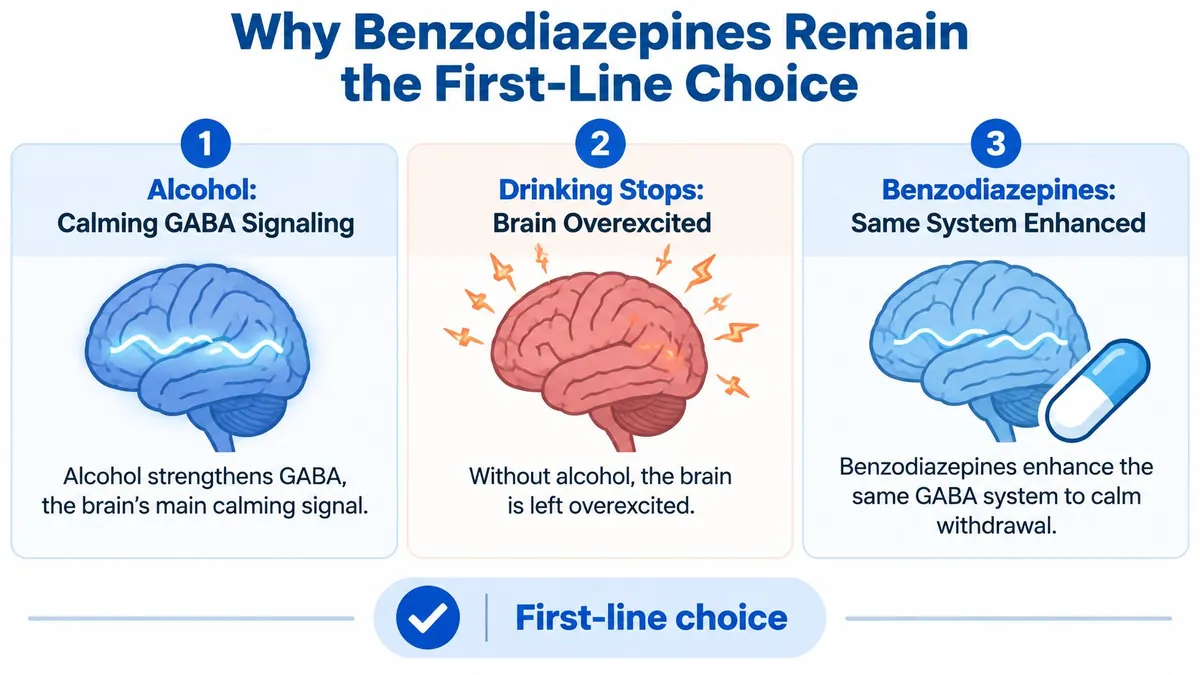
Alcohol strengthens GABA, the brain's main calming signal, and suppresses glutamate, its main excitatory one. Chronic drinking leaves the brain balanced around alcohol's presence. Remove it and the excitatory side runs unopposed: tremor, sweats, racing pulse, and in the worst cases a seizure. Benzodiazepines enhance the same GABA system alcohol was using, which is why they calm withdrawal so directly.
The clearest evidence for that mechanism comes from a Cochrane review of 64 randomized controlled trials of benzodiazepines for alcohol withdrawal. In three placebo-controlled studies involving 324 participants, benzodiazepines substantially reduced withdrawal seizures, with a relative risk of 0.16 and a 95% confidence interval of 0.04 to 0.69 (Cochrane review of benzodiazepines for alcohol withdrawal). That works out to roughly 84% lower seizure risk than placebo in those trials.
What first-line actually means: benzodiazepines are where treatment usually starts for moderate to severe withdrawal, not proof that they are the strongest drug for every person in every setting.
The same review found the evidence too inconsistent to declare one benzodiazepine or one dosing protocol clearly safer or better than another, largely because the studies varied in their interventions and outcome measures. A 2024 network meta-analysis in International Clinical Psychopharmacology compared 41 studies with 4,187 participants and found no significant difference in CIWA-Ar reduction between benzodiazepines and other evaluated medication regimens (International Clinical Psychopharmacology). First-line describes the starting point, not a guaranteed win.
Benzodiazepines carry genuine dependence and misuse risk, and they can sedate heavily enough to slow breathing, especially alongside opioids, sleep aids or liver disease. That is why they belong under qualified supervision with vital signs recorded, and why they are a poor choice for self-detox. A borrowed supply and a friend checking in by text isn't monitoring.
When Anticonvulsants and Phenobarbital Are Used
Alternatives get chosen for specific reasons, not because they beat benzodiazepines across the board. That distinction is where most online comparisons go wrong, presenting one drug as universally superior when the evidence describes a conditional choice.
A Cochrane review of anticonvulsants for alcohol withdrawal synthesized 48 randomized controlled trials and concluded the data were insufficient to establish anticonvulsants as broadly preferable to standard treatment. The one comparison that reached significance was carbamazepine against oxazepam or lorazepam on the CIWA-Ar scale, across three studies totaling 262 participants, with a mean difference of -1.04 points (95% confidence interval -1.89 to -0.20) (Cochrane review of anticonvulsants for alcohol withdrawal). One point on a symptom scale is a small edge, not a reason to switch everyone.

Phenobarbital is the more interesting case, and the honest answer is that it holds real promise without a clear hierarchy. In a 2025 multicenter cohort of 245,271 hospitalized people with alcohol withdrawal syndrome, 92.5% received benzodiazepines and 11.5% received phenobarbital during the first five hospital days, and the study found both approaches appeared effective and comparably safe (cohort study of phenobarbital and benzodiazepines in alcohol withdrawal). A 2025 quality-improvement study in the same body of work linked a phenobarbital protocol to faster symptom-score improvement, 30.1 fewer treatment hours and a 2.2-day shorter hospital stay without more adverse events. It wasn't randomized, so it describes what happened at those hospitals rather than what will happen at every hospital.
What Tips the Balance
The decision turns on a short list of factors, and each one can change the answer:
- Seizure history. Prior withdrawal seizures push toward a regimen with proven seizure protection.
- Delirium tremens history. A previous DT episode raises the stakes of every later detox.
- Liver function. Liver disease changes how drugs are cleared and which ones are safe at all.
- Respiratory risk. Sleep apnea, COPD or concurrent opioids make sedation more dangerous.
- Concurrent sedatives. Benzodiazepines, opioids or sleep medication already in the system compound the effect.
- Pregnancy and age. Both shift the risk balance in ways that need specialist input.
None of this is a decision for a forum thread. Severe withdrawal can be fatal without urgent care, and medication decisions belong in a supervised setting with someone watching the response.
Monitoring During Detox and Warning Signs to Act On
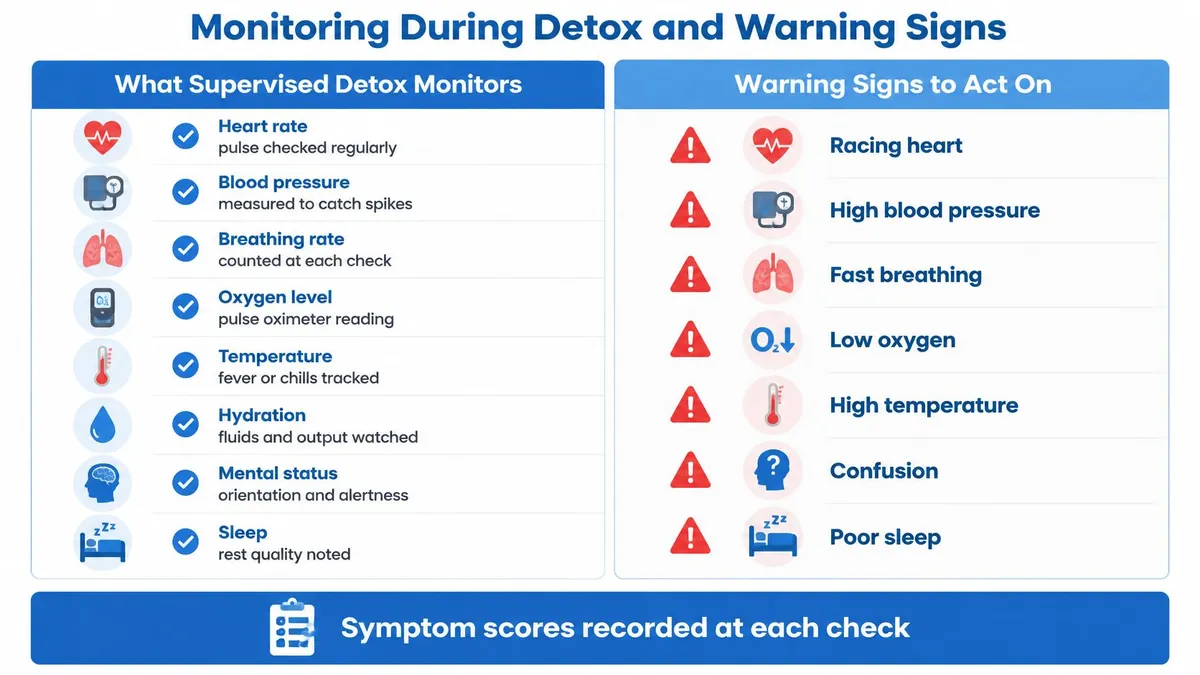
Supervised detox is mostly a monitoring job. Medication makes withdrawal safer; monitoring catches problems the medication itself can cause. The following items are tracked, and each earns its place on the list.
What Gets Checked and Why
- Heart rate. A climbing pulse is often the first measurable sign that withdrawal is escalating rather than settling.
- Blood pressure. Spikes track with severity and matter more for anyone with a cardiac history.
- Breathing rate and oxygen. Benzodiazepines and phenobarbital both suppress breathing, and these two numbers catch it before it becomes an emergency.
- Temperature. Fever with confusion points toward delirium tremens rather than ordinary withdrawal.
- Hydration and output. Sweating, vomiting and poor intake add up to dehydration and electrolyte problems quickly.
- Mental status and sleep. Orientation and rest get checked together, because confusion is the more serious finding of the two.
When to Call for Help
Some signs need emergency care rather than a scheduled check-in: a seizure, confusion or disorientation, hallucinations with agitation, fever, a fast or irregular heartbeat, chest pain, vomiting blood, or an inability to keep fluids down. Families should know the list even when the person is at home, and calling 911 is the right move when any of it appears. For a mental health crisis without an immediate medical emergency, call or text 988.
Detox typically takes several days, and the length depends on what was used, for how long, and the person's overall health. If you can't tell whether what you're seeing is ordinary withdrawal or something worse, review the alcohol detox symptoms timeline before deciding to wait it out. The most dangerous detox is the one nobody is monitoring.
Medications That Prevent Relapse After Detox
Detox ends the acute phase. It doesn't lower the chance of drinking again, so maintenance medication and ongoing treatment carry that work. The three medications below are the main options, and they work in completely different ways.

| Medication | How it works | When it starts | Key safety point |
|---|---|---|---|
| Naltrexone | Blocks opioid receptors and reduces the reward from drinking | After alcohol has cleared, usually once detox is complete | No opioid use; liver function check |
| Acamprosate | Helps stabilize brain signaling to support abstinence | Once withdrawal has passed and drinking has stopped | Dose adjusted for kidney function |
| Disulfiram | Causes a severe reaction if alcohol is consumed | Only after a period of abstinence | Never given to someone still drinking |
Naltrexone blocks opioid receptors and reduces the reward from drinking, so a drink delivers less of what the brain is chasing. It can't be started while opioids are in use, and liver function is checked before the first dose.
Acamprosate supports abstinence by stabilizing signaling in a brain that withdrawal has left unsettled. Kidney function determines the dose, which is why the prescribing physician will want recent labs before setting one. If you want the detail on how it's dosed and what the first weeks feel like, this explainer on what acamprosate is used for walks through it.
Disulfiram works differently again. It makes drinking unpleasant enough to act as a deterrent, which is exactly why it's started only after a stretch of abstinence and never given to someone still drinking.
For a plain-language walkthrough of how medication fits alongside counseling and peer support, this short video covers the basics of medication-assisted treatment.
Mind Matters - Addiction Medications for Relapse Prevention · Watch on YouTube
These medications perform best when they sit alongside counseling, support groups and a written relapse-prevention plan; 8 Warning Signs of Relapse to Watch For helps you use that plan early. Adjustments get made through coordinated discussion between the prescribing physician and the addiction counselor, because each sees a different part of the picture. Which of the three fits depends on the person's health, their other medications, and what they'll realistically keep taking.
Confirm Medical Supervision Before You Start Detox
Any of these makes supervision the default: heavy daily drinking, a previous attempt to stop that produced symptoms, or any history of seizures or delirium tremens. Detox is medical care for exactly that reason, and an initial assessment is a normal part of it; what medical detox involves explains how supervision works. Upon admission to a medical detox program, each client typically receives a full medical and psychological assessment, and the answers determine whether detox is necessary and where it should happen.
Ask these questions before committing to any program:
- Which medication will be used, and why? Get the name and what it's meant to prevent.
- How often will symptoms be scored, and by whom? Symptom-triggered dosing only works when trained staff reassess on a schedule.
- What happens if symptoms escalate? There should be a written answer, including transfer arrangements.
- Is there a private room and 24/7 monitoring by licensed professionals? It's a fair question anywhere you go.
- What's the plan for the week after detox ends? Detox without a next step tends to end with a return to the same routine, and what happens after detox maps the options.
Confirm the program is licensed and staffed around the clock. If seizure, confusion or breathing difficulty appears, call 911 first. Otherwise call the program's 24/7 line for an assessment. Starting outpatient treatment begins with that conversation: a thorough assessment and an approach matched to the person's needs.
Addiction Resource Center LLC offers outpatient, intensive outpatient (IOP), and partial hospitalization (PHP) care for adults 18+ at 1002 Live Oak Blvd Suite A, Yuba City. ARC does not provide medical detox, residential care, MAT or methadone. If you're weighing a detox drug for alcohol or helping someone who is, the team can assess the situation, explain the realistic options, and help determine whether medical detox is needed first. Visit Addiction Resource Center LLC or call 530-625-7910 to start with an assessment.
Talk with us
Addiction Resource Center offers intensive outpatient treatment (IOP) for adults 18+ at our Yuba City office or by telehealth. Call or text 530-625-7910.
Check my insurance