
What Is Drug Rehab Like: Levels, Routines and Costs
Reviewed by Tiffany Komba, LMFT #136055 · Last reviewed November 20, 2026
Published November 20, 2026
Contents
- Rehab Levels of Care at a Glance
- How Clinicians Decide Which Level Fits
- Detox and Medication Treatment Explained
- A Day Inside Residential Rehab
- Therapies, Groups and the Staff Who Run Them
- Privacy, Safety and What Happens If You Leave
- Costs, Insurance and Making the First Call
- Frequently Asked Questions About Rehab Life
If someone asked you what drug rehab is like, would you picture one locked building and a single 30-day stay? That picture is the gap. Rehab is a set of care levels that shift as withdrawal risk, health, and home life change. One person may start with round-the-clock monitoring and later attend evening sessions from home. Another may never spend a night in a facility.
This guide walks through those levels, how a clinician chooses one, what a residential day looks like, who is in the room, and how privacy, leaving early, and insurance work in practice. The language stays plain, for the person who is unsure and for the family member sitting beside them.
Rehab Levels of Care at a Glance
Drug rehab is a set of care levels, not one fixed program, and clients move between levels as stability and risk change. On March 31, 2023, SAMHSA's National Substance Use and Mental Health Services Survey counted 1,592,193 clients in care across 14,620 substance-use treatment facilities. Outpatient services were offered by 12,166 facilities, 83.2% of them, and served 1,479,758 clients, 92.9% of everyone recorded that day. Residential care was available at 3,503 facilities, 24.0%, and hospital inpatient treatment at 1,068 facilities, 7.3%.
| Level | Setting | Typical length | Weekly structure | Best fit |
|---|---|---|---|---|
| Medically supervised detox | Hospital or detox unit | About 3 to 7 days | 24-hour monitoring | Physical dependence and withdrawal risk |
| Residential rehab | Live-in facility | Set by clinical need, authorization, and engagement | Daily scheduled therapy, groups, and skills | Severe use, unstable housing, or co-occurring conditions |
| Partial hospitalization | Day program at a facility | Several weeks | Most weekdays, several hours a day | Needs daily structure but has a stable home |
| Intensive outpatient (IOP) | Home, in person or by telehealth | Several weeks to months | 9 to 20 hours per week | Stepping down from residential or stable at home |
| Outpatient counseling | Clinic or telehealth | Several months | One or two sessions a week | Mild use with strong support |
| Medication treatment (MAT) | Clinic, ongoing | Months to years | Regular dosing visits plus counseling | Opioid or alcohol use disorder with medication eligibility |
| Telehealth care | Video or phone | Matches the assigned level | Scheduled virtual sessions | Rural residents or people who cannot travel |
Counseling is the thread that runs through almost every row. In that same survey's 2023 United States profile, 14,045 facilities, 96.1%, reported individual counseling, and 13,366, 91.4%, reported group counseling. Cognitive behavioral therapy was reported as a frequently used approach by 12,320 facilities (84.3%) for opioid use disorder and by 12,174 facilities (83.3%) for other substances. Facilities also combine relapse-prevention education, recovery planning, medication, and continuing-care support. Talk therapy is common. It is not the whole program.
Three factors set the starting level: withdrawal risk, medical or psychiatric needs, and the home environment. Work, family duties, and transport decide which format is realistic, but clinical risk sets the floor. A stable job does not make a dangerous withdrawal safe to manage at home. If a case is tied to a court date, a documented level of care may matter to a judge, but the clinical assessment should still decide the setting.
How Clinicians Decide Which Level Fits
Placement is a sequence of checks, not a preference form. The ASAM Criteria frame that work as a multidimensional assessment of intoxication and withdrawal risk, medical and psychiatric conditions, cognitive functioning, current use, the recovery environment, and the chance of continued risky use. The setting that follows sets staffing, monitoring, intensity, and access to medical management.
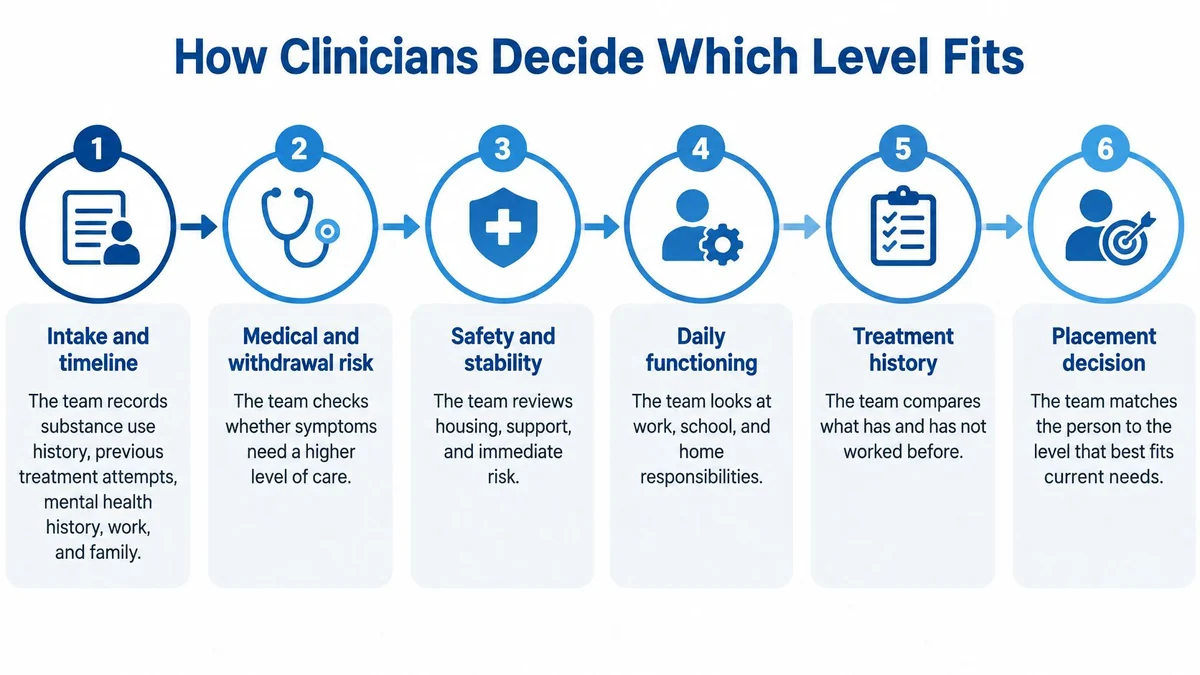
- Intake and timeline. The first conversation covers the substance use timeline, previous treatment attempts, mental health history, work situation, family structure, housing stability, and personal recovery goals. Those details show what has already been tried and what the person wants next.
- Withdrawal check. The team decides whether detox is necessary before the main program. Alcohol, benzodiazepine, and opioid withdrawal can create serious safety risks, so a medical evaluation comes before admission when withdrawal is expected.
- Medical and psychiatric screen. Conditions and thinking problems change how safely care can be delivered, including whether a higher level of monitoring is required.
- Recovery environment. Housing, transport, safety at home, and available support decide whether a home-based level is realistic.
- Placement. The matched level may be outpatient counseling, intensive outpatient treatment of about 9 to 20 hours a week while living at home, residential rehabilitation with a controlled substance-free routine, or hospital-level care.
- Reassessment. As withdrawal resolves or stability improves, the person steps down to outpatient therapy, recovery housing, or continuing medication management. After detox, the next step is a direct move into residential or outpatient treatment, not a gap with no plan.
Bring a substance use timeline, a medication list, prior treatment records, and notes on recent health events so the assessment can finish in one visit. A written level of care determination is easier to follow when those papers are already in the folder. Someone answering a court referral can keep the clinical questions and the legal paperwork separate.
Practical rule: An assessment names a starting level. It is not a lifetime assignment, and it should be redone when symptoms, housing, transport, or mental health needs change.
Detox and Medication Treatment Explained
Detox is withdrawal management. It is not treatment of the disorder by itself. After assessment, a personalized detox plan is built around the substance and the person's health conditions. That plan may include medication-assisted treatment (MAT) to ease withdrawal and reduce cravings, and the dose is adjusted in real time as symptoms shift.
What the hours look like
Licensed professionals provide 24/7 monitoring, symptom relief, and emotional support. During those days the person is checked for vital signs, cravings, sedation, and other adverse effects. A private room and medical supervision are part of that setup, including for alcohol withdrawal, which is managed so it can be as comfortable as safety allows. The first medical question is always the same: could this withdrawal become dangerous. Alcohol, benzodiazepine, and opioid withdrawal are the cases where that question is most urgent.
For opioid use disorder, stopping the drug is not the same as treating the condition. A Cochrane review found moderate-quality evidence that buprenorphine maintenance improved retention compared with detoxification or psychological treatment alone. The risk ratio for leaving treatment was 0.33, with a 95% confidence interval of 0.23 to 0.47. Buprenorphine or methadone can continue during and after rehab, alongside counseling. Interrupting medication can leave someone exposed to opioids at a time when tolerance is lower.
Medication and counseling together
Counseling still matters. It covers triggers, a written relapse plan, coping skills, family strain, and psychiatric symptoms. It should sit beside medication for eligible clients, not automatically replace it. A full account of the first days is in what happens during detox.
Before discharge, ask the team these questions out loud:
- Which medication: Name, dose, and who changes it if sedation or cravings show up.
- Who follows up: The clinician who sees you after you leave, and how soon.
- Prescription continuity: Where the next fill comes from if a visit is missed.
- Overdose prevention: What education and naloxone plan you leave with.
- Return to use: The exact steps if cravings spike in the first week home.
Leaving with a medication name and no follow-up clinician is an unfinished plan, not a completed detox.
A Day Inside Residential Rehab
After detox, residential days are built from therapy, education about the phases of recovery, and relapse-prevention tools. The integrated model starts that work right away, rather than waiting for a later phase. Times below are one illustrative weekday. Each program sets its own clock.

Morning usually opens with medication and personal care, then a shared breakfast. A process group follows so people can name triggers and the day's friction before it piles up. The middle of the day is where personal work and skills sit side by side.
| Time | Typical activity | Purpose |
|---|---|---|
| 10:30 | Individual counseling | Personal goals and relapse-prevention work |
| 12:00 | Lunch | Rest and informal peer contact |
| 15:00 | Free time or family call | Rest, contact, and planning |
A skills or education block covers coping and the phases of recovery, from the first days of detoxification through long-term maintenance. Evening often holds a peer support meeting, then quiet hours. Weekends are usually lighter, with fewer clinical blocks and more rest.
How the weeks change
The first weeks focus on stabilizing and learning the routine. That pace can feel strict and tiring. Later weeks shift toward discharge planning and aftercare. Say a warehouse worker arrives exhausted, sleeps through free time, and can barely finish a group. By week three the same person has more energy and a written plan for the drive home past the old liquor store. The building did not change. The task did.
Outpatient days keep the group and counseling blocks, then end at home or in a clinic. Intensive outpatient care asks for roughly 9 to 20 hours a week, so work, school, and family have to be scheduled around attendance rather than replaced by it. Partial hospitalization fills more of the weekday and still sends the person home at night.
A short walk-through of a typical treatment day makes the blocks easier to picture before you compare programs.
What is a Day in Drug Rehab Like? · Watch on YouTube
Therapies, Groups and the Staff Who Run Them
Therapies are tools with different jobs, and the staff share one plan rather than running separate ones. The team behind that plan brings over 50 years of combined experience in addiction treatment.
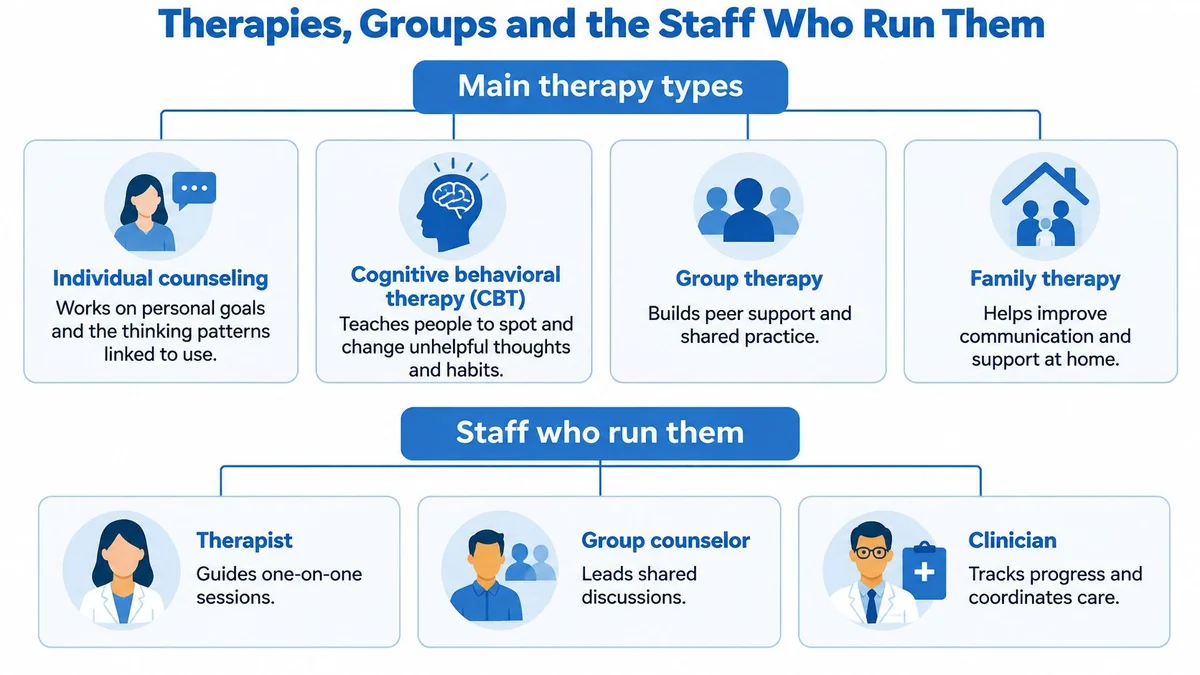
Individual counseling works on personal goals and the thinking patterns tied to use. Cognitive behavioral therapy (CBT) teaches people to spot a trigger and change the next action, such as calling a mentor instead of driving to a dealer. Motivational interviewing is for ambivalence. The counselor helps the person hear their own reasons for change instead of arguing them into it. Group therapy supplies peer feedback and shows that the story in the room is not unique. Family therapy takes on trust, communication, and household patterns, and only when the family agrees to take part. Relapse-prevention planning turns those sessions into a written plan for high-risk hours, people, and places. Co-occurring care treats depression, anxiety, or trauma alongside substance use, because the two often feed each other.
| Role | What they handle | How often you see them |
|---|---|---|
| Physician | Medical assessment and medication decisions | Regular check-ins, more often during detox |
| Registered nurse (RN) | Withdrawal monitoring, vital signs, and medication administration | Daily, around the clock during detox |
| Licensed counselor (CADC) | Individual and group counseling, relapse prevention | Several sessions a week |
| Licensed marriage and family therapist (LMFT) | Family and relationship therapy, co-occurring issues | Weekly or as scheduled |
| Recovery mentor | Daily structure, peer support, and accountability | Daily |
Ask each program who is licensed, which credentials are on the team, and who coordinates the plan. 8 Questions to Ask a Drug Rehab Center Before Admission turns that into a checklist. Say someone drinks to blunt depression. If the counselor chases only the drinking and a separate clinician chases only the mood, the person gets two half-plans. When those clinicians share one goal, the evening plan covers both the drink and the low mood that usually comes first.
Privacy, Safety and What Happens If You Leave
Plenty of people walk in unsure they have a problem at all. SAMHSA's 2025 national survey estimated that 47.2 million people in the United States aged 12 or older needed substance-use treatment, yet only 7.6 million received it, 16.0%. Among adults with a substance-use disorder who did not receive treatment, only 5.5% perceived an unmet need. Ambivalence is common. Cost, insurance confusion, transport, work, caregiving, stigma, and fear of withdrawal keep people out as often as motivation does.
An initial assessment is not the same as agreeing to admission. You can ask questions and leave with a recommendation.
Records and who can see them
Federal rule 42 CFR Part 2 generally bars programs from sharing substance use treatment records without written consent. Limited exceptions include medical emergencies and some court orders. You sign release forms that name who may receive information, such as a partner, an employer, or a primary doctor. If a name is not on the form, staff should not discuss your care with that person.
Safety on the unit
Detox includes round-the-clock monitoring, medication storage, and written steps for a medical emergency or a psychiatric crisis. Inpatient detox is especially useful when use is severe or a mental health disorder is present at the same time, because both need eyes on them overnight.
If you decide to leave
Adults can usually leave. Staff should explain the risks first, especially while withdrawal is still active. Ask for a discharge plan, referrals, and a written relapse plan before you walk out. If you are starting over instead of leaving, How to Get Into Drug Rehab: A Practical Guide covers the first steps. Families can attend sessions only with the person's consent, and they should expect staff to protect the record even when the worry is real.
Costs, Insurance and Making the First Call
Cost follows intensity. More monitoring usually means a higher bill, so detox and residential care cost more than outpatient counseling or telehealth. The insurer and the length of stay change the number again. How Much Does Drug Rehab Cost with Insurance? breaks down what plans typically cover. In 2025, SAMHSA's release on the national survey reported that 4.4 million people received outpatient treatment, 3.6 million received telehealth treatment, and 2.2 million received inpatient treatment. Living at a facility is one path, not the only effective one. For someone far from a clinic, or unable to take time off, telehealth can be the practical start. Acute withdrawal or psychiatric instability still needs in-person monitoring.
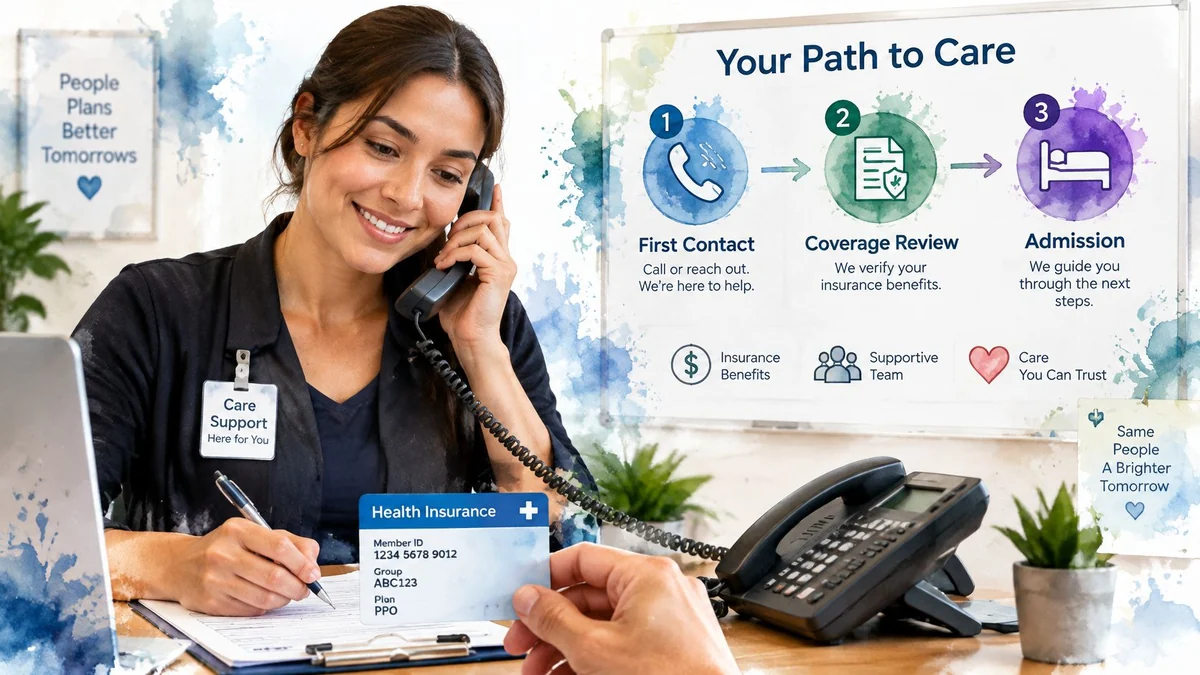
From first call to a plan
- Call and describe the situation. Name the substances, any withdrawal worries, and mental health history. Experienced staff use that call to start a thorough assessment and a treatment approach matched to the person.
- Finish the assessment. Bring the medication list and recent records so the level can be set without a second trip.
- Verify coverage. Ask the insurer which levels are covered, whether prior authorization is required, and what you would pay for detox, residential care, and IOP. A walk-through of how to pay for rehab helps you line up those questions before you dial the plan.
- Understand length. How long rehab lasts depends on willingness to engage, insurance authorization, and clinical necessity. It is not a preset 30 days.
- Plan the transition. Aftercare planning, alumni support, and outpatient services continue after the first episode ends, including therapy, support groups, and relapse-prevention work.
You can reach Addiction Resource Center LLC any time by phone or text at 530-625-7910, or visit the Yuba City office at 1002 Live Oak Blvd Suite A. Staff can answer questions before you commit to a level of care.
Frequently Asked Questions About Rehab Life
Phones, visits, work, and coming back are the questions families ask first. Levels of care change as stability and risk change, so people usually move between them rather than staying in one fixed program.
Can you keep your phone? Each program sets its own rule. Many allow limited use at set times. Some restrict phones during detox or the first residential weeks so groups are not interrupted. Ask at intake, and ask whether emergencies still get through.
Can family visit? Visiting hours and family sessions depend on the program and on written consent. A relative who wants to help can be invited to a session. They cannot demand one.
Can you keep working or going to school? Partial hospitalization and intensive outpatient care are built around daytime or evening commitments, so many people keep a job or classes. Residential care usually means stepping away for the length of that stay.
Can you choose your counselor? Many programs let you request a different clinician if the fit is poor. Staff should tell you how to ask, and how soon a change can happen. A poor fit is a scheduling problem you can fix while you stay in care.
Can you take a break and come back? Many people return after leaving or after a relapse. Programs usually reassess the level rather than making you repeat an entire stay. You come back to the level that matches current risk. That return may be shorter, or more structured, than the first time.
Addiction Resource Center LLC offers outpatient, intensive outpatient (IOP), and partial hospitalization (PHP) care for adults 18+ at its Yuba City office, in person or by telehealth. ARC does not provide detox, residential care, MAT, or methadone. If you are sorting out what drug rehab is like for yourself or for someone you love, a conversation can match the level to the risk before treatment begins. Visit Addiction Resource Center LLC to ask a question, check insurance, or set a time to talk.
Talk with us
Addiction Resource Center offers intensive outpatient treatment (IOP) for adults 18+ at our Yuba City office or by telehealth. Call or text 530-625-7910.
Check my insurance