You might be standing in a hallway right now, trying to keep your voice calm while someone you love says the neighbors are watching them, the car outside is part of a setup, or a hidden camera is in the smoke detector. Or you might be the one pacing, not sleeping, checking windows, and feeling …

You might be standing in a hallway right now, trying to keep your voice calm while someone you love says the neighbors are watching them, the car outside is part of a setup, or a hidden camera is in the smoke detector. Or you might be the one pacing, not sleeping, checking windows, and feeling certain that something is wrong even though nobody else sees it. Paranoia and methamphetamine can turn an ordinary night into a frightening one, and it often leaves families unsure whether they're dealing with intoxication, a psychiatric emergency, or both.
The good news is that this pattern has a clinical explanation. Meth can push the brain into a state where neutral events feel loaded with threat, and that state can improve with the right care. If you need a place to start, treating methamphetamine dependence is a useful primer, and stimulant addiction treatment guidance can help you think through what kind of support fits the situation.
Table of Contents
- What Methamphetamine Paranoia Actually Feels Like
- How Methamphetamine Changes the Brain and Triggers Paranoia
- Acute Paranoia, Meth-Induced Psychosis, or Something Else
- Warning Signs Families and Loved Ones Can Recognize
- When Paranoia Becomes a Medical Emergency
- Evidence-Based Treatment From Detox Through Recovery
- Supporting a Loved One Without Burning Out
- Getting Help in Yuba City and Northern California
What Methamphetamine Paranoia Actually Feels Like
At 3 a.m., the room is quiet, but the mind isn't. A person keeps moving from window to window, listening for footsteps, convinced someone is outside, convinced the silence itself means danger. They're not choosing drama, and they're not trying to be difficult. Meth-related paranoia is an intense, unfounded suspicion that other people are watching, following, listening, or plotting.
That experience can look different from one person to the next. Some people accuse a specific neighbor, ex-partner, or coworker. Others start avoiding rooms, covering cameras, checking locks again and again, or refusing to answer the phone because every ring feels like a threat. The emotional tone is usually fear, not anger, even when the behavior looks defensive or suspicious.
People often misread it as a moral failing, stubbornness, or “just bad behavior.” In clinical terms, it's a predictable neurochemical event, not a character flaw. It can happen during active use, during the come-down, or in a pattern that keeps repeating with repeated exposure.
A helpful next step is to think about care the same way you'd think about other substance-related problems. If meth is driving the fear, the solution isn't to argue harder, it's to get the person evaluated and stabilized. A good treatment setting for paranoia and methamphetamine should be able to address both substance use and the fear state together.
Practical rule: when someone's fear rises with meth use, treat the fear as medically real even if the beliefs are not accurate.
Families in Northern California often start with education, then move quickly to an evaluation if the person is sleeping poorly, getting more suspicious, or acting on those fears. If you're trying to understand what a stimulant program should include, the basics of dual diagnosis and addiction treatment are laid out well in this clinical overview.
How Methamphetamine Changes the Brain and Triggers Paranoia
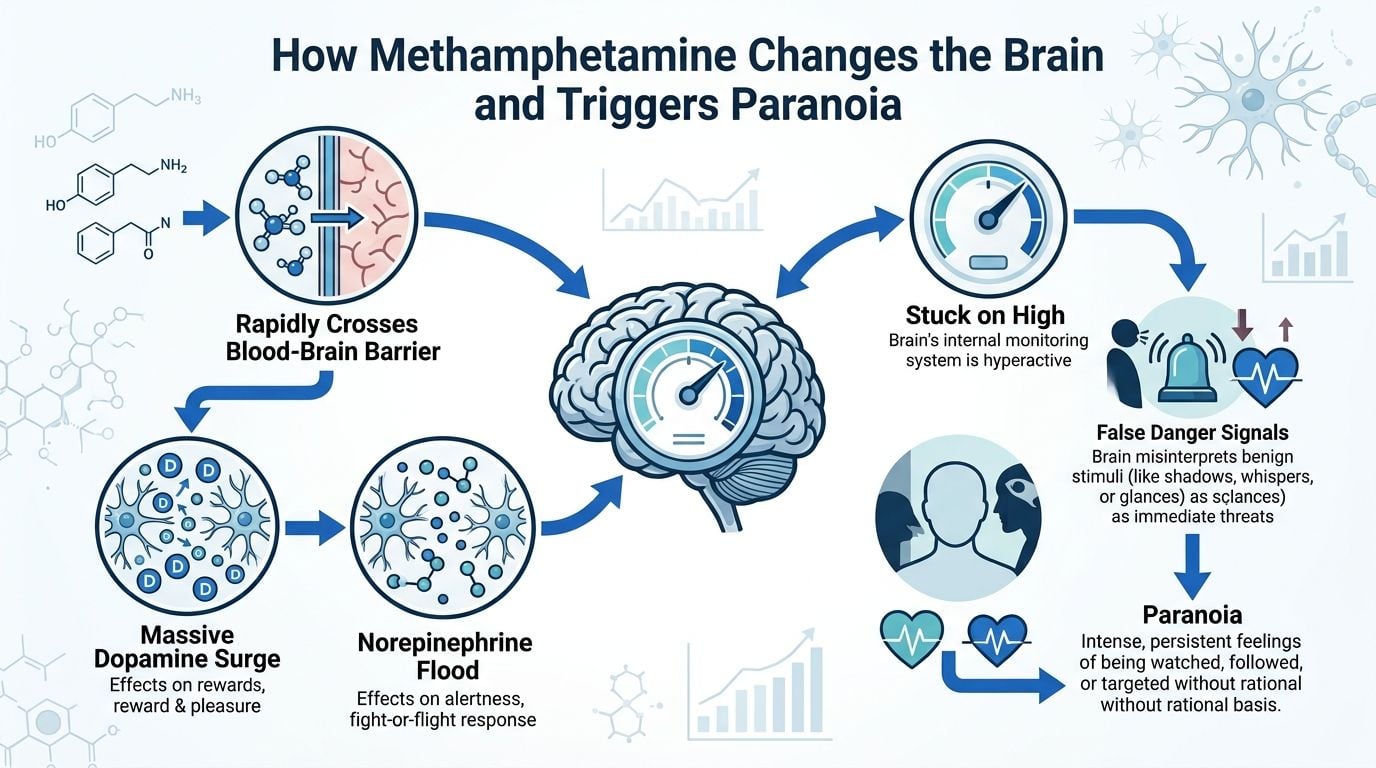
Methamphetamine disrupts the brain's natural regulatory systems, pushing it into a state where ordinary sights, sounds, and pauses can register as danger signals. That shift helps explain why a person may suddenly seem watchful, suspicious, or convinced that harmless events have a hidden meaning.
Dopamine and threat detection get overloaded
Methamphetamine rapidly crosses the blood-brain barrier, reverses monoamine transporters, and drives excess dopamine release in mesolimbic and mesocortical circuits, the pathways involved in reward, attention, and reality testing. One PMC review links paranoia to doses above roughly 55 mg and notes that about one-third of users develop psychotic symptoms such as paranoia, hallucinations, and persecutory delusions. In plain language, the brain starts over-interpreting events as meaningful threats.
That helps explain why paranoia often gets worse with higher doses and faster routes of use. In a cohort study, first episodes were more often tied to intravenous use, while later episodes were linked to higher doses, which suggests a pattern of escalating risk over time. The same study reported that meth-induced paranoia was common across experienced users, and some people with paranoia obtained or used weapons while in that state.
Chronic exposure can keep the alarm stuck
There is a second layer that matters when paranoia does not fade quickly. Chronic meth exposure can create glutamate-dopamine neurotoxicity in cortico-striatal networks, amplify glutamate release into the cortex, and overwhelm GABAergic interneurons, which can lead to thalamocortical dysregulation and paranoia-like psychosis according to a mechanism review. Families often miss that part. Even when the immediate high wears off, the brain may still be stuck in a threat-heavy pattern.
The person is not “making it up.” The brain's alarm system has become unreliable.
For people trying to understand treatment options, this is why co-occurring conditions and dual diagnosis care matter so much. The paranoia is not separate from the stimulant use. It is part of the clinical picture.
Acute Paranoia, Meth-Induced Psychosis, or Something Else
A lot of articles blur all meth-related fear into one bucket. Clinically, that's a mistake. The treatment path changes depending on whether the person is having acute intoxication paranoia, a methamphetamine-induced psychotic disorder, or an underlying primary psychotic illness that meth has uncovered.
The timeline tells you a lot
Acute paranoia usually tracks closely with recent use and starts to ease as the drug leaves the system and sleep returns. Meth-induced psychotic disorder is more persistent, with symptoms that can outlast the high and continue for days or longer. A primary psychotic disorder is different again, because the symptoms are not limited to meth exposure and may have appeared before stimulant use ever started.
That distinction is harder than it sounds. Peer-reviewed reviews note that psychotic symptoms can happen even without prior psychosis, may affect up to about 40% of meth users, and need temporally sensitive interviewing plus collateral information to separate meth-induced psychosis from a primary psychotic disorder (review). In practical terms, that means a clinician needs the story, the timeline, and sometimes family input.
What clinicians look for
A careful evaluation usually asks a few blunt questions.
- Did the paranoia start before meth use?
- Does it improve with abstinence and sleep?
- Are hallucinations, disorganized thinking, or fixed delusions showing up outside intoxication?
- What do family members remember that the patient might not be able to report clearly?
Those questions aren't academic. They decide whether the right next step is detox, psychiatric stabilization, or a longer-term psychosis workup. If someone is still suspicious after a period of sobriety, that doesn't automatically mean schizophrenia, but it does mean they need a more careful assessment.
When people are trying to pick a program, this distinction affects everything from medication choices to the level of supervision. A clinic that can handle both substance use and psychiatric symptoms is usually a safer place to start than a program that only treats one side of the problem.
Warning Signs Families and Loved Ones Can Recognize
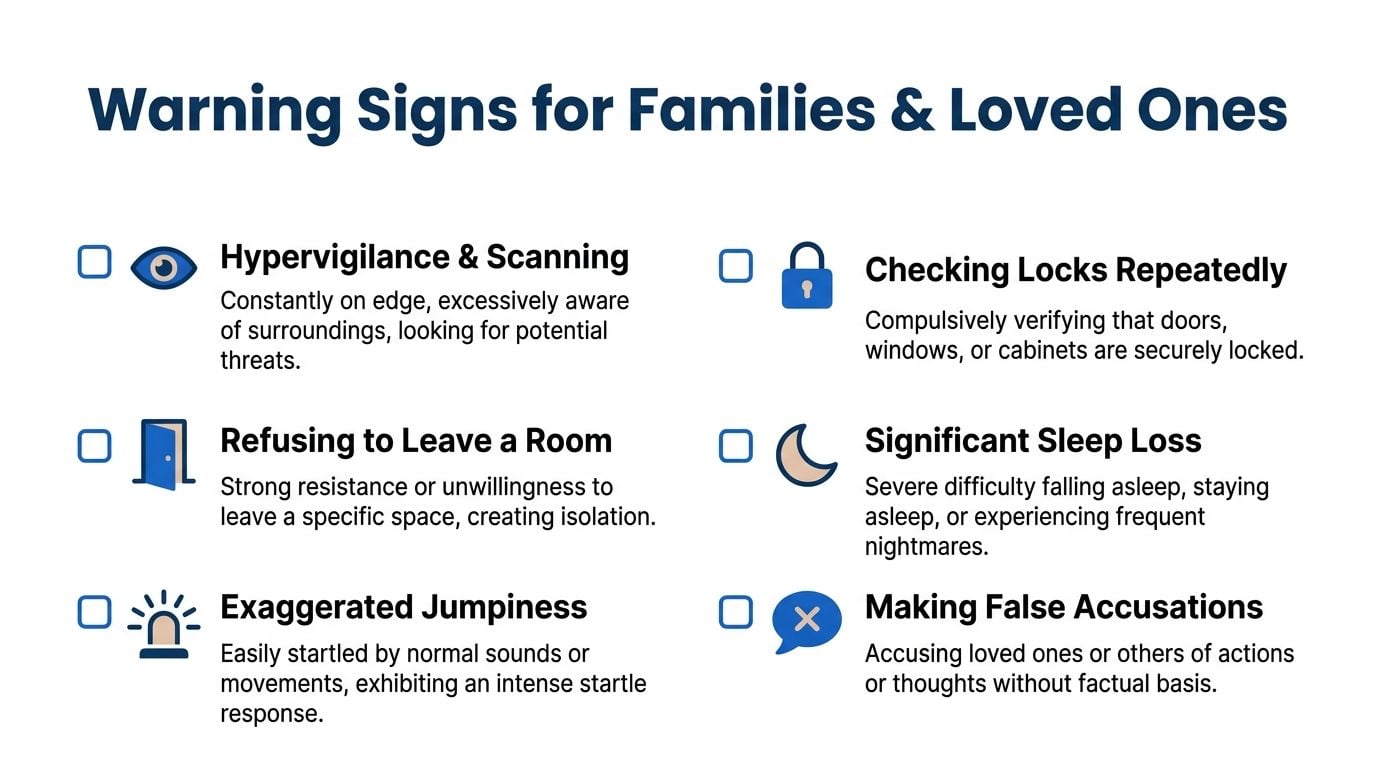
Families usually see the change before the person can explain it. The signs often start small, then get more organized around fear. A person may stop sleeping, start scanning every room, and accuse one specific person of betrayal or surveillance.
What to watch for
- Hypervigilance and scanning: the person keeps looking out windows, watching doors, or jumping at ordinary sounds.
- Checking locks repeatedly: doors, windows, and vehicles get checked over and over, often with rising agitation.
- Refusing to leave a room: fear narrows their world until they feel safest in one controlled space.
- Significant sleep loss: the person may go through the night without real rest, which can make paranoia intensify.
- Exaggerated jumpiness: small noises, texts, or footsteps trigger a big reaction.
- False accusations: the person starts naming specific people as spies, thieves, or conspirators without evidence.
These signs become more concerning when they're paired with drug use, because the risk isn't just emotional distress. In the cohort study noted earlier, some people with meth-induced paranoia obtained weapons, and some used them while paranoid (cohort study). That's why families should take the pattern seriously even before there's a direct threat.
Meth use is common enough in the U.S. that families shouldn't assume they're seeing a rare event. A CDC-based estimate cited by OHSU reported 1.6 million U.S. adults used methamphetamine in the past year, with the highest rates among men ages 35 to 49, and 27.3% of past-year users reporting use on 200+ days in that year (OHSU brief).
When Paranoia Becomes a Medical Emergency
Some situations need more than a phone call or a same-day appointment. If the person has a weapon, is making credible threats, is talking about suicide, can't care for basic needs, or has sudden hallucinations with confusion, call 911 or go to the emergency department.
Use the urgency level that matches the risk
If the person is frightened but not actively dangerous, the 988 Suicide and Crisis Lifeline can help with immediate crisis support. If you're in the Yuba City area and need substance-use guidance outside business hours, the Addiction Resource Center's 24/7 line at 530-625-7910 is an option for rapid connection to care. The point is to match the response to the risk, not to wait until the situation gets worse.
A same-day psychiatric evaluation makes sense when the person is disorganized, not sleeping, intensely suspicious, or becoming impossible to redirect. The emergency addiction treatment resource is worth reviewing if you're trying to decide whether this is a crisis now or a call that can wait a few hours.
What the ER usually does
Emergency teams focus on immediate safety first. That can include calming medications, a brief psychiatric assessment, hydration, observation, and, if needed, a hold for safety while the team figures out whether the symptoms are driven by intoxication, withdrawal, or a longer psychiatric disorder.
If the person is talking about revenge, carrying a weapon, or can't tell what's real, don't wait for them to “sleep it off.”
Families often worry about overreacting. In this setting, it's better to overcall than undercall. Meth-related paranoia can shift quickly, and once the person is agitated, reasoning with them usually gets harder, not easier.
Evidence-Based Treatment From Detox Through Recovery
The right care depends on how severe the paranoia is, how much meth is being used, and whether the person can stay safe at home. That's why treatment usually needs more than one level of care, not a single office visit.
Detox, residential care, and outpatient support
Medical detox is the first stop when someone is medically unstable, sleep deprived, or too overwhelmed to stop on their own. The goal is stabilization, symptom relief, and monitoring while the body clears meth and the nervous system settles. When clinically indicated, medication-assisted treatment can support withdrawal management and reduce the chance that distress pushes the person right back to use.
For people who need round-the-clock structure, residential rehabilitation offers a protected setting away from triggers, access to staff, and time to rebuild sleep and routine. In Northern California, one option is the partner facility Ona Treatment Center in Browns Valley, CA, which provides that higher level of containment for clients who can't stay safe or stable at home.
Why therapy still matters after the acute phase
Paranoia doesn't disappear just because the drug does. That's why outpatient care matters after stabilization. The Intensive Outpatient Program can be delivered in person or via telehealth, which helps people who can't commute daily but still need frequent structure, coaching, and relapse prevention.
Useful therapies include cognitive behavioral therapy for psychosis, contingency management, motivational interviewing, relapse prevention, and family education. These approaches help people challenge threat-based thinking, reward sober behavior, identify triggers, and rebuild trust with the people around them.
A strong program doesn't argue with the fear. It treats the fear, the meth use, and the life pattern together.
A multidisciplinary team also makes a difference. Addiction Resource Center LLC in Yuba City uses medical and counseling staff, along with recovery mentors, to coordinate care for adults 18+ who need help with stimulant use and co-occurring mental health symptoms. That mix matters when paranoia has blurred the line between addiction and psychiatric care.
Supporting a Loved One Without Burning Out
Families often get trapped between compassion and exhaustion. They keep answering the same frantic calls, covering the same expenses, and hoping the next conversation will be the one that works. You can care without becoming the person who absorbs every consequence.
What to say and what to avoid
Use short, calm statements like, “I'm concerned about you,” “I want to help you get checked out,” or “I can talk when you're sober and safe.” Avoid labels like “crazy,” “manipulative,” or “just being paranoid,” because those tend to escalate fear and shame. If the person is convinced of a threat, don't argue the belief, focus on safety and next steps.
Boundaries are part of care
Set clear limits around money, housing, and rides if those things are being used to support ongoing use. If there's repeated violent behavior, threats, or weapon access, step back and involve emergency services or a welfare check rather than trying to manage it alone. Family support helps most when it's paired with your own support, sleep, and backup plan.
For more practical family guidance, advice from Still Water Wellness can help you spot the difference between concern and enabling without losing your footing.
If meth contamination or polysubstance use is possible, keep naloxone on hand, don't let the person use alone, and pay attention to fentanyl test strip awareness and safe disposal of paraphernalia. Those aren't signs of giving up. They're signs that you're reducing risk while the person is still in motion.
Getting Help in Yuba City and Northern California
If you're in or near Yuba City, the next step can be concrete instead of overwhelming. Addiction Resource Center LLC is located at 1002 Live Oak Blvd., Suite A, Yuba City, CA, and the team can be reached 24/7 by phone or text at 530-625-7910. The first contact usually covers a confidential screening, insurance verification, and tour scheduling, so you don't have to figure out the whole system at once.
The program welcomes adults 18+ and accepts plans including Anthem, Blue Cross, Blue Shield, Aetna, United Healthcare, and Tricare for veterans and military families. If distance is the problem, the Intensive Outpatient Program can be done via telehealth, which makes it easier for people outside the immediate commuting area to get started. Family consultations are also available before a loved one agrees to treatment, which can help you plan safely instead of waiting in limbo.
A person who's stuck in paranoia is not broken beyond repair. The brain can recover, especially when sleep, safety, and abstinence start coming back into place. If you're ready to talk to someone who understands stimulant use and co-occurring fear states, reach out to Addiction Resource Center LLC and ask what level of care fits the situation now.
Addiction Resource Center LLC offers detox, residential rehab through its partner facility, and outpatient care for stimulant use and co-occurring mental health concerns. If paranoia and methamphetamine are affecting your family, visiting Addiction Resource Center LLC is a direct next step toward a confidential screening and practical treatment planning.