
How to Drug Detox Safely: Steps, Risks and Next Steps
Reviewed by Tiffany Komba, LMFT #136055 · Last reviewed November 20, 2026
Published November 20, 2026
Contents
Many ask how to drug detox with one substance in mind, and it is usually the one they fear most. The fear is aimed at the wrong target. Opioid withdrawal is a brutal, days-long ordeal that rarely kills anyone by itself. Alcohol withdrawal, treated by many as the manageable habit, is the one that can put an otherwise healthy adult into a seizure or delirium.
That mismatch is where home plans copied from a forum fall apart. What works for opioids does not work for alcohol or benzodiazepines, and there's no universal cleanse schedule that fits all three. What follows is the order a clinician works in, starting with the question most guides skip: how dangerous is withdrawal from this substance, for this person, right now?
Match Your Withdrawal Risk to the Right Level of Care
Withdrawal risk depends on the substance, your health, and how your body has adapted to use. Match the substance to the likely danger first, then have a clinician assess which setting can manage it safely.
| Substance | Main withdrawal danger | Usual safest setting | Medication role |
|---|---|---|---|
| Opioids | Intense discomfort, usually not lethal on its own | Outpatient or inpatient care selected after assessment | Buprenorphine or methadone when a clinician considers it appropriate |
| Alcohol | Seizures and delirium tremens | Inpatient or closely monitored medical detox | Medication selected after medical assessment |
| Benzodiazepines | Seizures and severe rebound anxiety | Medically supervised detox with a gradual taper | A scheduled taper, never an abrupt stop |
| Methamphetamine | Depression, fatigue and suicidal thoughts | Supervised care with mental health monitoring | Symptom-based care; no standard withdrawal drug |
| Cocaine | Intense cravings and low mood | Supervised care with mental health monitoring | Symptom-based care; no standard withdrawal drug |
Detox services are available in different care settings, and medication is often part of withdrawal management. The 2020 National Survey of Substance Abuse Treatment Services found that 3,609 of 16,066 reporting facilities, about 22.5%, provided some form of detoxification. Among facilities offering detox, 91% routinely used medication. The survey also found that 96% treated opioid withdrawal, 71% alcohol withdrawal, 66% benzodiazepine withdrawal, 61% methamphetamine withdrawal and 60% cocaine withdrawal.
The loudest withdrawal is rarely the deadliest
Opioid withdrawal can involve cramping, sweating, vomiting, restless legs, insomnia and a runny nose. It is generally not medically lethal on its own. Alcohol and benzodiazepine withdrawal can cause seizures, delirium and other life-threatening complications, according to SAMHSA's detoxification guidance.
Someone coming off opioids can often be managed in outpatient or low-intensity care with a clinician prescribing buprenorphine or methadone when appropriate, and the detox setting should be chosen with a medical assessment. Methadone should not be treated as a home detox remedy. For alcohol or benzodiazepines, a clinician needs to assess the risk and determine whether medically supervised detox is appropriate.
Alcohol and benzodiazepines need careful planning
Alcohol withdrawal can worsen quickly and unpredictably. Tremor and anxiety may progress to hallucinations, seizures or delirium tremens, which can involve fever and confusion. Medical assessment and monitoring help determine the right level of care and respond if symptoms change.
Benzodiazepine withdrawal also requires care. Regular use can make sudden stopping dangerous, so a clinician should guide any taper. The guide to medical detox for benzodiazepines explains why reducing the dose in steps is safer than stopping abruptly.
Methamphetamine and cocaine withdrawal are less often physically dangerous, but low mood, severe fatigue and cravings can raise mental health concerns, including suicidal thoughts. These symptoms call for monitoring and support. There is no standard withdrawal medication for either substance.
When someone uses more than one substance, the plan must account for each one, especially the substance with the greatest withdrawal danger. Combining opioids with alcohol or sedatives also raises breathing risks, so do not use an opioid-only home plan for mixed substance use.
Practical rule: If you drink daily or take a sedative every day, arrange the stop with a clinician before changing your use.
A safer path has clear stages:
- List every substance you use and how often, then identify the withdrawal risks that may apply.
- Seek a medical assessment to decide whether detox is needed and which setting fits your health and circumstances.
- Tell the clinician about other substances and health concerns so the plan accounts for combined risks.
- Follow the withdrawal plan under appropriate monitoring, with medication when clinically appropriate.
- Arrange ongoing treatment after detox. Detox is the first stage of care, not a complete treatment plan.
Warning Signs That Mean Detox Needs Emergency Care
Quitting fast at home can look like the clean choice. For alcohol and sedatives, it is the choice that can turn shivering into a seizure inside an hour. How bad yesterday felt does not predict that turn. Opioid withdrawal and alcohol or benzodiazepine withdrawal do not share a plan, and using an opioid-style home stop for either of those is how people get hurt.
SAMHSA guidance on detoxification and substance abuse treatment draws the line this way: serious alcohol and benzodiazepine withdrawal may involve seizures or delirium tremens and may require inpatient medically supervised withdrawal. Uncomplicated opioid withdrawal is generally not life-threatening, but it still needs assessment and treatment.
A smoke alarm works like this split. A chirp means check the battery. A full alarm means leave the building. Withdrawal has the same two speeds, and mixing them up is the mistake.
Call 911 now
- Seizures, or shaking that won't stop. A seizure during alcohol or sedative withdrawal is a medical emergency, even if it lasts seconds and the person seems fine afterward.
- Confusion, hallucinations or fever during alcohol or sedative withdrawal. This is the delirium tremens pattern. It needs an emergency department, not someone sitting nearby.
- Slow or stopped breathing, blue lips, unresponsiveness. Treat this as an overdose. Give naloxone if an opioid is involved and call 911 immediately. Naloxone does not reverse alcohol or sedatives, so the call comes first either way.
- Thoughts of self-harm or suicide. Call or text 988, or call 911 if there is immediate danger. Low mood in withdrawal is real. It can pass, but only with support in the moment.
Do not start at home if any of these apply
- A previous withdrawal seizure, delirium or hospitalization. The pattern often returns, and the next episode is often worse.
- Daily heavy alcohol or benzodiazepine use. This is the highest-risk category, and the one most often managed unsafely at home.
- Pregnancy. Withdrawal affects two people, so monitoring has to match that.
- Serious heart, liver, kidney or psychiatric conditions, or any mix of opioids with alcohol, benzodiazepines or other sedatives. That mix raises the risk of slowed breathing.
A same-day assessment is the fast way to learn whether home is safe. If you are unsure how urgently to move, ask for a same-day assessment when you call.
Many people who need withdrawal care never reach it, and overdose-reversal medicine reaches even fewer. Waiting to see how bad the night gets is not a plan when the substance is alcohol or a sedative.
Write your three most serious triggers on paper tonight and check them at every stage. A list you can hand to a nurse beats a memory rebuilt under stress.
How to Prepare for a Medically Supervised Detox
Most home attempts fail on preparation, not willpower. People skip the step where someone qualified decides how much monitoring the next few days require, then discover the gap at 3 a.m.
For the clinical picture behind these steps, see What Is Medical Detox and How It Works.
Here's the practical version of what a good intake covers.
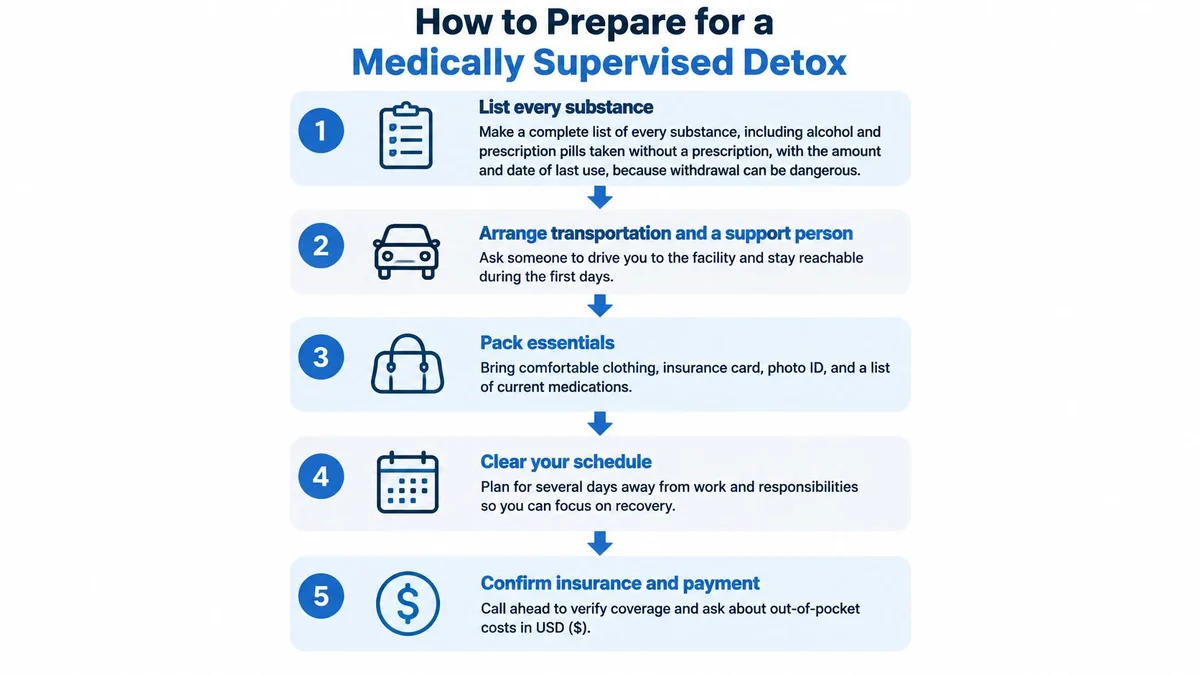
List every substance, with amounts and the date of last use. Include alcohol and any prescription pills you take more often or in larger doses than prescribed. The clinician uses that list to judge which withdrawal you're facing and how fast it could escalate. A vague "mostly pills" answer forces guesswork at the worst possible moment.
Flag any past withdrawal seizure, delirium or hospital stay. One previous seizure moves you into a higher level of care. It's the detail people most often leave out because it happened years ago and they felt fine afterward.
Bring your full medication list, supplements included, plus any mental health diagnoses. Interactions get checked, and untreated anxiety or depression changes how withdrawal is managed, sometimes from day one.
Book a same-week assessment rather than waiting for a crisis. At Addiction Resource Center, an initial assessment can help determine whether medical detox is needed before outpatient, IOP, or PHP care. That conversation covers your substance use timeline, previous treatment attempts, mental health history, work situation, family structure, housing stability and personal recovery goals.
Ask what the plan includes and how often it's reassessed. You want specifics: which medication for symptoms and cravings, how often vital signs are checked, who you call at 2 a.m., and what happens if symptoms worsen.
Arrange transport, a sober place to sleep and one person who knows the plan. Discharge often happens faster than expected, and going home to an empty apartment with a pharmacy bag and no plan is how the first week goes wrong.
Clear the house and keep naloxone within reach if any opioid use is possible. Leftover pills and alcohol in a cupboard are a decision made in advance by a version of you who wasn't thinking clearly.
What the clinician is actually doing
A complete detoxification protocol runs in three parts, according to SAMHSA's TIP 45 guidance on detoxification: evaluation, stabilization, and preparation for entry into ongoing treatment. Evaluation identifies substances, route, quantity, timing of last use, intoxication status, prior withdrawal complications, medical and psychiatric conditions, pregnancy risk, medications, overdose risk and your recovery environment.
Stabilization comes next, with monitoring intensity matched to how severe and how risky your withdrawal is. The last step is a confirmed handoff to medication treatment, residential care, intensive outpatient treatment or another appropriate level, not a referral slip. Detoxification alone isn't sufficient treatment, and skipping any of those three components leaves the process incomplete.
A ready start looks like three things: a written list, a booked appointment and a named person who knows where you'll be on Friday night.
Symptom Management Without Self-Medicating
The symptoms people dread most are rarely the ones that cause harm. The fixes people invent for them are.
| Symptom | Typical timing | Clinician-guided response | Dangerous home fix |
|---|---|---|---|
| Anxiety and restlessness | First few days | Medication chosen by the clinician | Drinking alcohol or taking sedatives to calm down |
| Sweating, tremor and nausea | First one to three days | Fluids, symptom medication and close checks | Tapering benzodiazepines alone |
| Insomnia | Up to a week or more | Structured sleep plan and prescribed options | Mixing sleep aids with opioids or alcohol |
| Cravings | Days to weeks | Cravings medication and counseling | Assuming detox ended the cravings |
Medication and monitoring have to be substance-specific, not a generic cleanse, as the ASAM practice guideline for the use of medications in the treatment of addiction sets out. Over-the-counter sleep aids and supplements are not a substitute for supervised withdrawal care, and Alcohol Withdrawal Over the Counter Medication: Is It Safe? explains why. Buprenorphine induction depends on timing it against existing withdrawal to avoid precipitated withdrawal, and combined use with benzodiazepines, alcohol or other sedatives needs extra caution because the breathing risk stacks.
The taper rule people break
Benzodiazepines taken regularly for more than a month should not be stopped abruptly. ASAM recommends a gradual, clinically supervised taper, because sudden discontinuation can produce severe withdrawal and medical risk. Home tapers fail for a predictable reason: the dose that felt fine on day two is wrong by day five, and nobody adjusts it.
In a medically supervised detox, clients receive continuous medical monitoring, symptom relief and emotional support, which is exactly what makes real-time dosing adjustments possible. Someone checks how you look, not just what you report.
Where self-medicating turns dangerous
The common errors are consistent. Unsupervised tapering. Using alcohol or sedatives to quiet withdrawal symptoms. Failing to disclose every drug, including the ones you don't consider a problem. Leaving without naloxone or a same-day route into treatment.
Worsening symptoms are a reason to call the care team immediately, not to wait it out until morning. If you hit seizures, delirium or thoughts of self-harm, that's the emergency list, not the wait-and-see list.
Plan the Transition From Detox to Ongoing Treatment
The hours after the sweating stops are often more dangerous than the first night. Tolerance is lower, cravings return, and the reason for using is still waiting at home. Detox works like a cast on a broken bone. It holds things still for a few days. It does not teach the bone how to carry weight again.
SAMHSA's 2024 opioid treatment guidelines are blunt about opioids: short-term medically supervised withdrawal alone is rarely effective and is associated with a high rate of return to illicit opioid use. People should be connected immediately to psychosocial treatment, with medication for opioid use disorder such as extended-release naltrexone, buprenorphine, or methadone considered when clinically appropriate. In the fentanyl era, a return to use after detox is more dangerous than it was before, because tolerance has dropped.
That opioid path is not a template for every drug. Alcohol and benzodiazepines still need a clinician-led taper that continues past the first comfortable day. Copying a short opioid plan and stopping those drugs at home can trigger seizures. The next level of care has to match the substance, not a generic calendar.
Before you leave the building
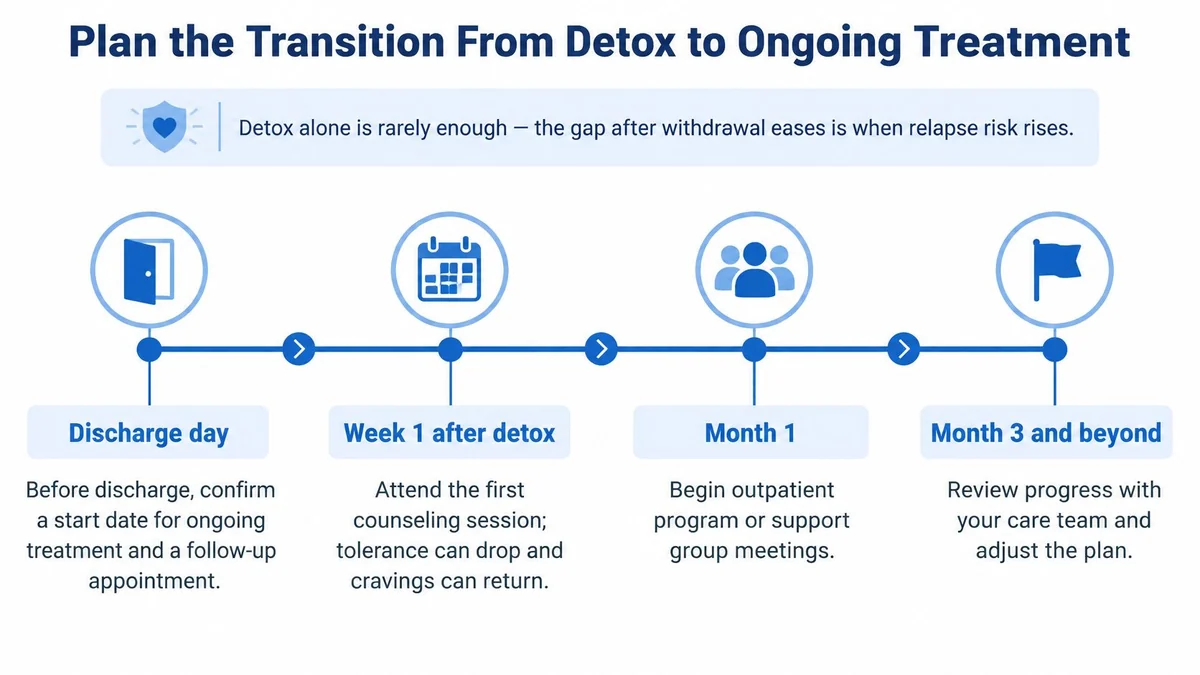
Confirm a start date, not a phone number. Whether the next step is medication, residential care, or intensive outpatient, you should know the date, the time, and who meets you. Take a naloxone kit and practice using it before you need it.
After detox, clients move directly into residential or outpatient treatment. Inpatient aftercare includes ongoing therapy sessions, support groups, and relapse prevention strategies. Therapy, education, and those relapse tools start right after detox, and clients learn the phases of recovery from detoxification through long-term maintenance.
The first week and the first month
Within seven days, attend the first counseling session and write a plan for cravings and sleep. Ask whether the medication is doing its job. Recovery plans include a scheduled reassessment of whether the chosen medications manage cravings. Dose changes happen in a discussion between the prescribing physician and the addiction counselor, not by guesswork at the kitchen counter.
By month one, step down to outpatient or telehealth if that fits work and family. By month three, review progress with the care team and adjust. When residential care is the next step, it teaches tools for long-term recovery and how to spot triggers before they run the day.
Sleep repair, food, movement, and structured group work cover what medication does not reach. A closer look at what happens after detox walks through those early weeks.
Access is still the bottleneck. SAMHSA's 2023 National Survey on Drug Use and Health found that among people aged 12 or older who were classified as needing substance use treatment in the past year, about 1 in 4 (23.6%, or 12.8 million people) received it. Booking the next appointment before discharge is how you avoid leaving without a second one.
============
Ask before you leave: What's the next appointment, what's the medication plan, and what should you do if you use again?
If use resumes, call the program. Don't try to out-dose it.
Book a Detox Assessment Before You Stop Using
Stopping first, then calling, is how people use the wrong plan. An opioid-style taper at home does not make alcohol or benzodiazepine withdrawal safe. Those withdrawals can be dangerous, and the substance decides the setting.
Call 530-625-7910 today, the 24/7 phone and text line at Addiction Resource Center LLC, 1002 Live Oak Blvd., Suite A, Yuba City, CA. Call for yourself or for someone you love. Ask for an assessment before you stop using, not after the third sleepless night.
Starting treatment begins with that contact. Experienced professionals conduct a thorough assessment and build an approach matched to the person. On admission, every detox client receives a full medical and psychological assessment covering substances and amounts, mental health, housing, work, and the support network.
Have four items ready: a written substance list with dates of last use, current medications, any past withdrawal seizures, and the name of your support person. Those details show whether alcohol, opioids, benzodiazepines, methamphetamine, or another drug is driving the risk, and whether home is even an option.
Then ask the questions that set the plan. Is detox needed at all, or can care start outpatient? What medication is available for withdrawal and cravings when it is clinically appropriate? Who monitors you through the day and night? Detox typically lasts 3 to 7 days, depending on the substance, length of use, and individual health factors, so ask what length of stay the team expects in your case. Drug Detox Timeline: What to Expect shows how that window changes by substance. Confirm insurance and Tricare eligibility on that first call, before you pack a bag.
One honest phone call to a clinician who has heard worse is enough to start. The assessment sorts the safe next step. The rest of recovery can wait until that answer is clear.
Addiction Resource Center LLC offers outpatient, intensive outpatient (IOP), and partial hospitalization (PHP) care for adults 18+ at 1002 Live Oak Blvd Suite A, Yuba City, in person or by telehealth. ARC does not provide medical detox or residential care. If you're in Yuba City or trying to work out whether you can stop safely at home, the team will assess you and tell you what level of care fits, including whether medical detox is needed first. Visit Addiction Resource Center LLC or call 530-625-7910 to schedule an assessment.
Talk with us
Addiction Resource Center offers intensive outpatient treatment (IOP) for adults 18+ at our Yuba City office or by telehealth. Call or text 530-625-7910.
Check my insurance