
How to Choose a Drug Rehab Facility: A Checklist for 2026
Reviewed by Tiffany Komba, LMFT #136055 · Last reviewed November 22, 2026
Published November 22, 2026
Contents
- Screen Licensing and Order Before You Compare
- Medication Options and Level of Care Match
- Treatment Approaches and Therapy Fit
- Length of Stay, Aftercare and Retention Numbers
- Staff Credentials, Co-occurring Care and Family Role
- Insurance, Privacy, Location and Telehealth Access
- Build Your Shortlist and Book the First Call
You're probably making these calls between work shifts, late at night, or from a hospital waiting room, with three facility websites open and a family member asking what you've decided. Everyone sounds compassionate. Everyone promises a bed. That first phone call is where you find out who's really running treatment and who's running sales.
If you or a loved one is in crisis, call or text 988 (Suicide & Crisis Lifeline) or call 911 for an emergency.
If you're learning how to choose a drug rehab facility under that kind of pressure, don't start with photos, amenities, or a claimed success rate. Start with hard questions, write down the answers, and walk away from any program that won't give them.
Screen Licensing and Order Before You Compare
Run these five checks in order before you compare price or tour a building. A facility that fails step one doesn't deserve your time on steps two through five.
1. Verify state licensure and national accreditation. 2. Confirm clinician credentials. 3. Require an individualized assessment. 4. Match the level of care to clinical need. 5. Get a written transition plan before admission.
Keep this table open during every call
| Step | What to verify | Red flag | Where to check |
|---|---|---|---|
| 1. Licensure and accreditation | State license for each level of care, plus CARF or Joint Commission status | No license named, or vague answers about which program is covered | State licensing agency, CARF and Joint Commission online directories |
| 2. Clinician credentials | Licensed physicians, nurses, counselors and therapists practicing in your state | Staff titles given without license details | State licensing board lookup |
| 3. Individualized assessment | Substance type, withdrawal risk, medical and psychiatric history, medications, housing and safety | Same plan offered to everyone, or no assessment before admission | Ask during the intake call |
| 4. Level of care match | Detox, residential, partial hospitalization, intensive outpatient or outpatient matched to clinical need | Only one level offered for every person | Ask for the recommended level and the reasons |
| 5. Written transition plan | Next level of care, appointment dates, medication supply and crisis contacts | Plan promised verbally or postponed until discharge | Request a copy before admission |
Why step one is the gate
A state license is the legal minimum. It should name each level of care the facility is authorized to provide, such as detoxification, residential treatment, outpatient services, or medication treatment. A license for outpatient counseling doesn't authorize residential detox, and a glossy brochure doesn't change that.
Don't assume oversight exists because a facility looks established. SAMHSA's 2020 National Survey of Substance Abuse Treatment Services found that 94% of U.S. facilities reported licensing, certification, or accreditation by at least one recognized agency, but 6% reported none. The most frequently reported oversight came from a state substance-abuse agency, cited by 77% of facilities, followed by a state health department at 48%. Independent national accreditors were less common, with 30% reporting CARF accreditation and 23% reporting Joint Commission accreditation.
Those numbers tell you what to ask. Which agency oversees this exact program? Does the credential cover the specific track you're considering, or a different program at the same address? When was the most recent review, and did it find deficiencies?
Practical rule: Verify the license number on the state agency's own lookup tool yourself. Don't accept a PDF the facility emails you as proof.
Accreditation means external standards for staffing, safety, documentation, and quality management have been evaluated. It does not guarantee a particular outcome or abstinence rate. If a program quotes results, demand the outcome definition, the denominator, the follow-up interval, and retention data before you compare it to anyone else.
Check the people, then demand a real assessment
Confirm that physicians, nurses, counselors, and therapists are licensed in the relevant state, especially if you're comparing facilities across jurisdictions where terminology and requirements vary. Titles aren't credentials. Ask for license types and look them up.
SAMHSA's guidance on finding quality treatment identifies licensure/accreditation, evidence-based therapies, FDA-approved medications for opioid and alcohol use disorders, family involvement, and continuing care as core quality indicators. It also supports this screening sequence: verify licensure, confirm credentialed clinicians, require an assessment covering substance type, withdrawal risk, medical conditions, psychiatric symptoms, medications, housing, and safety, match the level of care, and obtain a written transition plan.
A serious intake sounds like ours. Starting treatment begins with contacting Addiction Resource Center, where experienced professionals conduct a thorough assessment and develop a treatment approach matched to the person's needs. The initial consultation covers the person's substance use timeline, previous treatment attempts, mental health history, work situation, family structure, housing stability, and personal recovery goals.
If intake skips most of that and offers instant admission, that's not efficiency. That's a sales close.
Before you hang up, write down the answers to steps one through three, ask who provides 24/7 medical coverage, how emergencies are transferred, and what happens after a relapse. Also test any claim of integrated care directly. For co-occurring conditions, the facility should coordinate medical and mental health treatment rather than treating addiction in isolation. A program that gets vague here won't get clearer after admission.
Medication Options and Level of Care Match
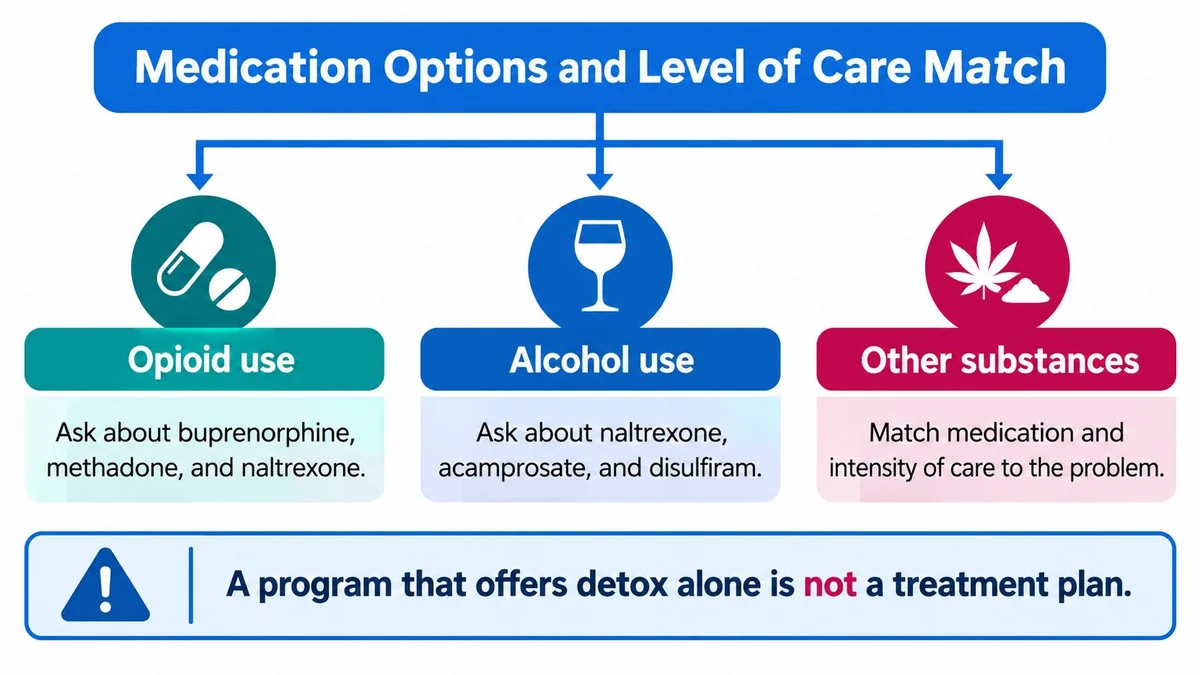
Match your situation to a row first, then confirm the medication access for that row. A program that offers detox alone is not a treatment plan.
The chart below maps the medication questions by substance so you can ask them by name on the call.
| Level of care | Typically fits | Medication to confirm |
|---|---|---|
| Medically supervised detox | Significant withdrawal risk or unsafe withdrawal at home | Withdrawal medication and medication treatment started during detox |
| Residential rehab | Needs 24-hour structure, unstable housing or repeated relapse | Ongoing prescriber, refill plan and transfer of prescriptions at discharge |
| Partial hospitalization | Daily treatment, but able to sleep at home safely | Prescriber visits on site during the program |
| Intensive outpatient (IOP) | Work or family obligations with a stable home | Scheduled prescriber visits and monitoring such as urine testing |
| Standard outpatient | Lower risk, stable recovery, or stepping down from a higher level | Local or telehealth prescriber follow-up with a named contact |
Ask about medications by name
For opioid use disorder, ask about methadone, buprenorphine, and extended-release naltrexone. For alcohol use disorder, ask about naltrexone and acamprosate, and about disulfiram where appropriate. If the person on the phone can't discuss these, ask to speak with someone clinical.
Medication isn't an optional add-on for opioid addiction. According to SAMHSA's overview of opioid treatment programs, the National Institute on Drug Abuse states that medication should generally be the first-line treatment for opioid addiction, usually combined with behavioral therapy or counseling. SAMHSA also reports that its Division of Pharmacologic Therapies supports certification and accreditation of more than 1,900 opioid treatment programs, which collectively treat more than 600,000 people annually. Detox alone is not sufficient for recovery, and without continuing care it commonly results in renewed drug use.
Use our guide to level of care determination to sanity-check a recommendation before you agree to it. Then confirm four things: Does the program evaluate medication options? Does it have qualified prescribers? Does it monitor clients during treatment? Does medication continue after discharge without a gap?
The short video below walks through how medication and counseling fit together in a complete plan.
A good intake team assesses whether medically supervised detox is needed before a person starts an outpatient program and, if it is, explains where detox will happen and whether medication for withdrawal or cravings is part of the plan. Addiction Resource Center provides outpatient care rather than detox, so when detox is needed we refer to an appropriate medical setting first and coordinate the step into IOP or PHP afterward. Expect that level of specificity from any facility you choose. If they promise detox but won't say what starts during detox or who prescribes after it, keep calling.
Treatment Approaches and Therapy Fit
A program name tells you nothing. The weekly schedule tells you almost everything. Ask which therapies clients receive, how often, and who delivers them.
Therapies you should hear named
- Cognitive behavioral therapy: Teaches people to spot and change thought and behavior patterns linked to use, then practice alternatives before cravings hit.
- Motivational interviewing: Uses guided conversation to build readiness to change instead of arguing a person into it.
- Contingency management: Gives small, immediate rewards for verified abstinence, so progress gets reinforced right away.
- Family behavioral therapy: Brings relatives into home routines and communication, not just visiting hours.
- 12-step facilitation: Introduces peer groups and sponsorship as ongoing support outside formal treatment.
You don't need every approach. You need a team that can explain why a specific approach fits this person, this substance, and this history.
Turn the brochure into a schedule
Ask for numbers in plain language, even without published data. How many individual sessions per week? How many group hours? Are skills classes separate from process groups? Does that schedule change between residential, partial hospitalization, and IOP, or does everyone sit in the same room doing the same curriculum?
Then ask the harder fit questions. Which approach does the team use for co-occurring depression, anxiety, or trauma, and is that therapy delivered by licensed staff or trainees? How does the team measure progress beyond attendance? What changes when someone isn't responding after a few weeks? How do clinicians decide a client is ready to step down?
A good answer names a therapy, a frequency, and a decision point. A weak answer describes an atmosphere.
Say a client attends every group but keeps relapsing on weekends at home. A real clinical team can tell you what they'd adjust, whether that's family work, a medication review, a higher level of care, or a different therapy focus. A program offering one approach to everyone, or one that can't name its therapies at all, is offering a routine, not treatment.
Length of Stay, Aftercare and Retention Numbers
Don't fall for the idea that a fixed stay, quoted confidently, means a better program. Length only matters if people stay, step down, and keep showing up after discharge.
NIDA's Principles of Drug Addiction Treatment reports that residential or outpatient participation lasting less than 90 days is generally of limited effectiveness, while significantly longer treatment is often indicated. The appropriate duration still depends on the person's problems, needs, and response, and multiple treatment episodes may be required. At our center, length of rehab depends on willingness to engage, insurance authorization, and clinical necessity. That's the honest answer you should hear everywhere.
Ask for these numbers, not a completion slogan
| Metric | Why it matters | Ask for |
|---|---|---|
| Retention at 30, 60 and 90 days | Shows whether people stay long enough for treatment to work | Percent still in care at each point, reported for each program |
| Step-down rate | Shows whether clients move on to the next level of care | Share of residential clients who start IOP or outpatient care |
| Follow-up engagement at 3 to 6 months | Reveals how strong the aftercare is | Share attending at least one visit after discharge |
| Outcomes by setting and diagnosis | Separates strong programs from average ones | Results split by residential, IOP and co-occurring diagnosis |
| Completion rate | Can be distorted by early administrative discharges | The written definition of completion and how early exits are counted |
Completion rates are easy to inflate. A program can exclude people who leave early or count an administrative discharge as finished. Ask how completion is defined in writing, and whether outcomes are reported separately by treatment setting and diagnosis. Blended numbers hide weak programs inside strong averages.
What a real continuum looks like
Withdrawal management should connect directly to residential or intensive outpatient care, followed by continuing counseling, medication management when indicated, recovery monitoring, and practical supports such as housing or employment assistance. If you need detox first, ask both the detox program and the outpatient program how the handoff will work, so there's no gap where motivation dies.
Before admission, request a written plan covering the next level of care, appointment dates, medication supply, transportation, family participation, crisis contacts, and relapse-response procedures. Our explanation of discharge planning shows what that document should contain.
If a program can't name its step-down partner, its aftercare sessions, or who owns the first post-discharge appointment, your stay effectively ends at the exit door. Serious medical or mental illness raises dropout risk, so ask what intensive retention support exists for those clients too. Even a clinically sound detox cannot substitute for sustained treatment.
Staff Credentials, Co-occurring Care and Family Role
You're not buying a building. You're trusting a team. Ask about the roles by name and listen for how they work together.
Who does what on a competent team
- Physician or prescriber: Evaluates medication options, orders treatment, and adjusts doses based on response.
- Registered nurses: Handle daily medical monitoring, withdrawal symptoms, and escalation when something changes.
- Licensed counselors: Certified alcohol and drug counselors and similar licensed clinicians run therapy and track the treatment plan.
- Licensed marriage and family therapists: Lead family work and repair communication patterns at home.
- Recovery mentors: Provide day-to-day support, structure, and lived guidance between clinical sessions.
Ask who provides 24/7 medical coverage, how emergencies are transferred to a hospital, and whether that coverage is on site or on call. Then verify licenses through state board lookups. Checking a counselor's actual credential matters more than a job title.
Co-occurring care has to be coordinated, not parallel
Ask directly whether the team treats depression, anxiety, PTSD, or bipolar disorder at the same time as addiction, in the same plan. Sending a client across town for mental health care while treating substance use separately isn't integrated care.
Say a parent asks, "My son wants to stay on his medication, but his counselor seems unsure about it. What happens?" A good answer sounds like this: "The prescriber and counselor discuss it together before any change, we explain the reasoning to your son, and nobody adjusts medication in isolation."
That's how we work. Medication adjustments are made through coordinated discussion between the prescribing physician and the addiction counselor. If a facility can't describe that conversation, it probably isn't happening.
Fit and family involvement belong in intake
Our initial consultation identifies learning preferences, comfort with group versus individual therapy, and whether medication treatment, coordinated with the person's own prescriber, aligns with their values. Those answers shape the plan. A client who shuts down in large groups needs a different starting point than one who thrives on peer accountability.
For families, ask how involvement works in practice: scheduled family sessions, education, how updates are shared, and what written consent the program needs before it talks to relatives. Get that consent process explained before admission, not during the first crisis.
Insurance, Privacy, Location and Telehealth Access
A clinically strong program still fails if you can't pay for it, reach it, or trust it with your records. Work through these four barriers in the order you'll hit them.
Insurance and privacy come first
Ask whether the facility is in network, which levels of care need prior authorization, how length of stay gets decided, and what out-of-network coverage pays. Our walkthrough on how to verify insurance coverage helps you get answers in writing. Military families should confirm TRICARE acceptance in writing too, not from a verbal assurance.
On privacy, ask who can see your records, how the program protects substance use treatment records under federal confidentiality rules, and how family contact is consented. Before you sign anything, review the client rights policies on complaints and discharge. Addiction Resource Center publishes a Client Rights page, and any facility you consider should offer the same transparency.
Location math decides whether IOP survives
Calculate the actual daily travel time for an intensive outpatient schedule, including traffic and work. A long drive doesn't just inconvenience people. It gradually turns a full course of treatment into missed sessions and an early exit. Be honest about what's sustainable for months, not days.
Telehealth claims need testing
Don't accept "we offer telehealth" as proof of access. A 2025 analysis of 10,492 U.S. substance-use-disorder facilities found that 81% offered telehealth, yet facilities serving areas with greater racial and ethnic vulnerability were less likely to offer it, with each additional point on the vulnerability scale associated with 4% lower odds of telehealth availability.
Virtual care on a website doesn't prove virtual care works for your situation. Test the details.
Ask whether medical evaluations, medication visits, urine testing, crisis response, family sessions, and privacy protections work remotely. Ask what happens during an internet outage and when the team requires an in-person visit instead. For rural Northern California residents, a hybrid program can reduce transportation and stigma barriers, but only with dependable local clinical access, local testing arrangements, regular risk monitoring, and a documented pathway to higher or lower care.
Build Your Shortlist and Book the First Call
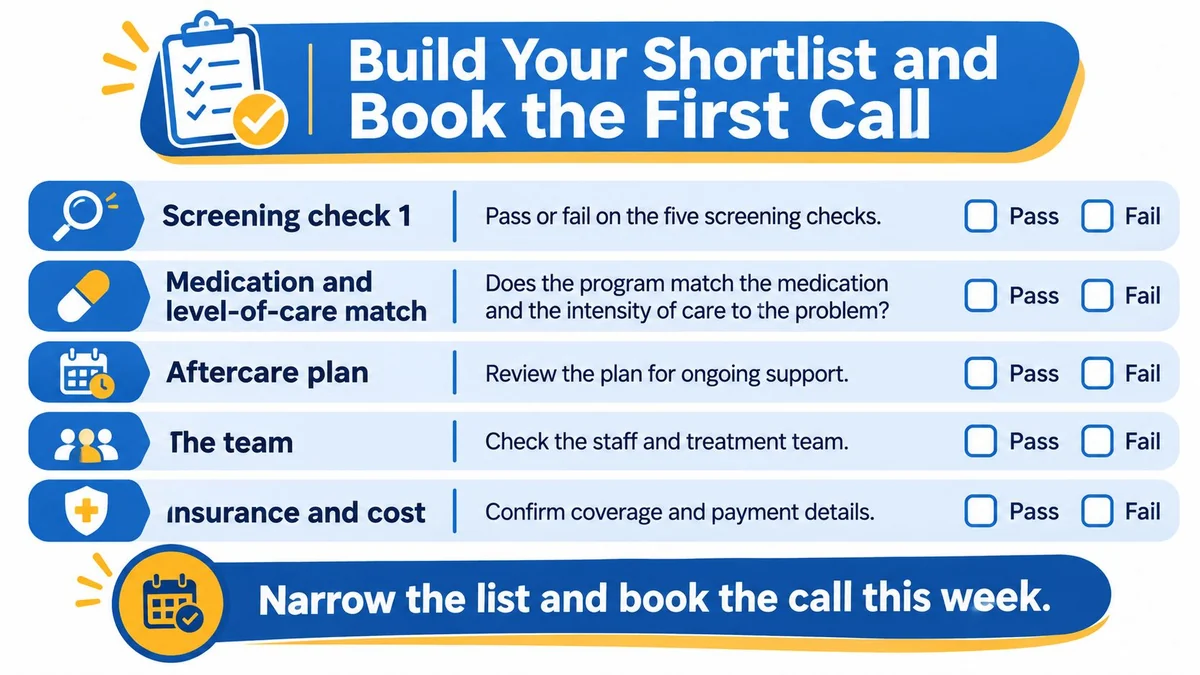
Stop researching endlessly. Score what you have, cut the list, and call this week.
Score each facility pass or fail on the five screening checks, the medication and level-of-care match, the aftercare plan, the team, and insurance and telehealth access. A fail on licensure, medication access, or transition planning eliminates a facility no matter how good everything else sounds. Keep the three strongest and call them in order.
This checklist mirrors the pass-or-fail scoring so you can work through it with a pen during each call.
Six questions to read aloud on the admissions call
- Which agencies license this exact program, and when was the last survey?
- Which medications will I start, and which continue after discharge?
- Who covers medical emergencies at night, and how are transfers handled?
- What does the written transition plan include, and who is my step-down contact?
- What are the retention numbers at 30, 60 and 90 days, and how is completion defined?
- What happens if I relapse during treatment?
Write the answers down word for word. Vague answers to questions two and four are the clearest warning signs you'll get. So is any reluctance to discuss question six, because a real program has a relapse-response procedure and isn't embarrassed by it.
Tour, then enroll without loose ends
On a tour, ask to see detox rooms and medication storage, meet a clinician rather than only an admissions staffer, and read the client rights policy on complaints and discharge before you commit. If you only meet sales staff, you haven't toured the treatment.
For enrollment, verify benefits in writing, get the assessment results and treatment plan, set a start date, and arrange transport. Bring a current medication list and identification, and agree on family contacts and consent up front. Small gaps here become big problems during the first difficult week.
If you're still unsure which level of care fits, start with an assessment rather than guessing. Confidential assessments are offered to help people understand their level of dependence and which recovery path is right for them. That's the fastest way to turn a shortlist into a decision you can defend.
Addiction Resource Center provides comprehensive outpatient care for adults 18+ at 1002 Live Oak Blvd Suite A, Yuba City, including an intensive outpatient program (IOP) with in-person, evening and telehealth options, and a partial hospitalization program (PHP). A confidential assessment can clarify which level of care fits before you commit to any program. Call or text 530-625-7910, start with admissions, or verify your benefits.
If you or a loved one is in crisis, call or text 988 (Suicide & Crisis Lifeline) or call 911 for an emergency.
Talk with us
Addiction Resource Center offers intensive outpatient treatment (IOP) for adults 18+ at our Yuba City office or by telehealth. Call or text 530-625-7910.
Check my insurance