You make it through work, answer a difficult message from someone you love, and feel shame rising before you've even reached the front door. The craving arrives with a simple promise: use, drink, or act impulsively, and the feeling will stop. In early recovery, that moment can feel less like a choice and more like …

You make it through work, answer a difficult message from someone you love, and feel shame rising before you've even reached the front door. The craving arrives with a simple promise: use, drink, or act impulsively, and the feeling will stop. In early recovery, that moment can feel less like a choice and more like an emergency.
Dialectical behavior therapy, or DBT, was built for moments like this. It teaches practical ways to notice emotional escalation, survive distress without making it worse, manage powerful feelings, and communicate before conflict turns into another crisis. For people with substance use and co-occurring mental health concerns, DBT can turn recovery from an idea into a sequence of actions you can practice when your nervous system is telling you to escape.
Table of Contents
- Why Emotions Drive Addiction and How DBT Changes the Pattern
- The Core Philosophy Behind Dialectical Behavior Therapy
- The Four DBT Skills Modules and How They Apply to Recovery
- Research Evidence for DBT in Substance Use and Co-Occurring Disorders
- What to Expect in a DBT-Informed Treatment Program
- Practical DBT Skill Exercises You Can Try Today
- Finding DBT-Informed Addiction Care Near You
Why Emotions Drive Addiction and How DBT Changes the Pattern
Maya had been sober long enough to believe the hardest part was behind her. Then her partner accused her of “acting like an addict again” after she missed an appointment. Shame hit first, followed by anger, panic, and a familiar thought: I can't stand feeling this way. Within minutes, she was searching her contacts for the person who could get her what she wanted.
The substance wasn't solving the argument. It was offering rapid distance from an emotional state that felt unbearable. That distinction matters. Many people in recovery understand the consequences of using, yet still struggle when fear, rejection, loneliness, or shame becomes physically urgent. The behavior may be harmful, but it often began as an attempt to regulate something that felt impossible to regulate.
DBT gives that pattern a name and a structure. Instead of asking you to reason your way out of a craving while your body is in alarm, it helps you identify what's happening, reduce the intensity, and choose a safer response. You learn to work with emotions rather than treating them as commands.
A useful recovery question: “What feeling am I trying to escape, and what can I do for the next few minutes without adding a new problem?”
Some people also experience anxiety about anxiety itself. Fear can become the trigger, with the person fearing that panic, craving, or emotional pain will become uncontrollable. This fear of fear anxiety explained resource can help clarify why the reaction to an internal feeling sometimes becomes a second source of distress.
DBT doesn't promise that cravings disappear or that relationships become easy. It teaches a pause between trigger and action. That pause may begin with noticing a clenched jaw, naming “shame,” moving away from an unsafe situation, or contacting support before the urge becomes behavior. These practical emotional regulation techniques for addiction recovery are most useful when practiced before a crisis, then repeated during one.
The Core Philosophy Behind Dialectical Behavior Therapy
The word dialectical refers to holding two truths that appear to conflict. In DBT, you can accept yourself as you are today and still work seriously to change behaviors that threaten your recovery. You can understand why you used and remain responsible for what you do next.
Think of recovery as balancing on a narrow path. Acceptance keeps you from falling into shame and self-attack. Change keeps you from using acceptance as an excuse to repeat the same pattern. If either side disappears, the path becomes unstable.
DBT emerged as an evidence-based treatment in the early 1990s, building on Marsha Linehan's work with people experiencing borderline personality disorder and parasuicidal behavior. In a landmark randomized clinical trial, 39 women were assigned to one year of DBT or treatment as usual. The DBT group showed significantly better outcomes during and after treatment, including less parasuicidal behavior, fewer inpatient days, and higher global functioning scores at the one-year follow-up. The trial is available through the original randomized DBT study on PubMed.
Acceptance and change in daily recovery
The acceptance side sounds like: “This craving is here. My nervous system is activated. I don't need to hate myself for having an urge.”
The change side sounds like: “I'm going to leave the argument, remove access to substances, use a crisis skill, and tell someone I need help.”
Neither statement cancels the other. DBT treats validation as a way to lower defensiveness so change becomes possible. A therapist might acknowledge that a person's reaction makes sense in light of trauma, invalidation, or learned survival strategies, while still helping that person examine the consequences of acting on the reaction.
DBT's biosocial theory describes emotional vulnerability interacting with an invalidating environment. Some people may react quickly and intensely, while repeated dismissal teaches them to distrust their feelings or express them through escalating behavior. Substance use can then become a powerful short-term regulator. DBT addresses both sides by validating the emotional experience and teaching behaviors that produce safer long-term outcomes.
The philosophy is demanding because it asks for honesty without self-condemnation. A diary card, a difficult conversation, or a refusal to follow an urge may feel small, but each one strengthens the ability to respond deliberately.
DBT also recognizes that addiction rarely occurs in isolation. Depression, anxiety, trauma symptoms, impulsivity, and relationship conflict can all intensify one another. A dialectical approach doesn't require you to solve every problem at once. It helps you identify the next behavior that will protect safety and move life in a more workable direction.
The Four DBT Skills Modules and How They Apply to Recovery
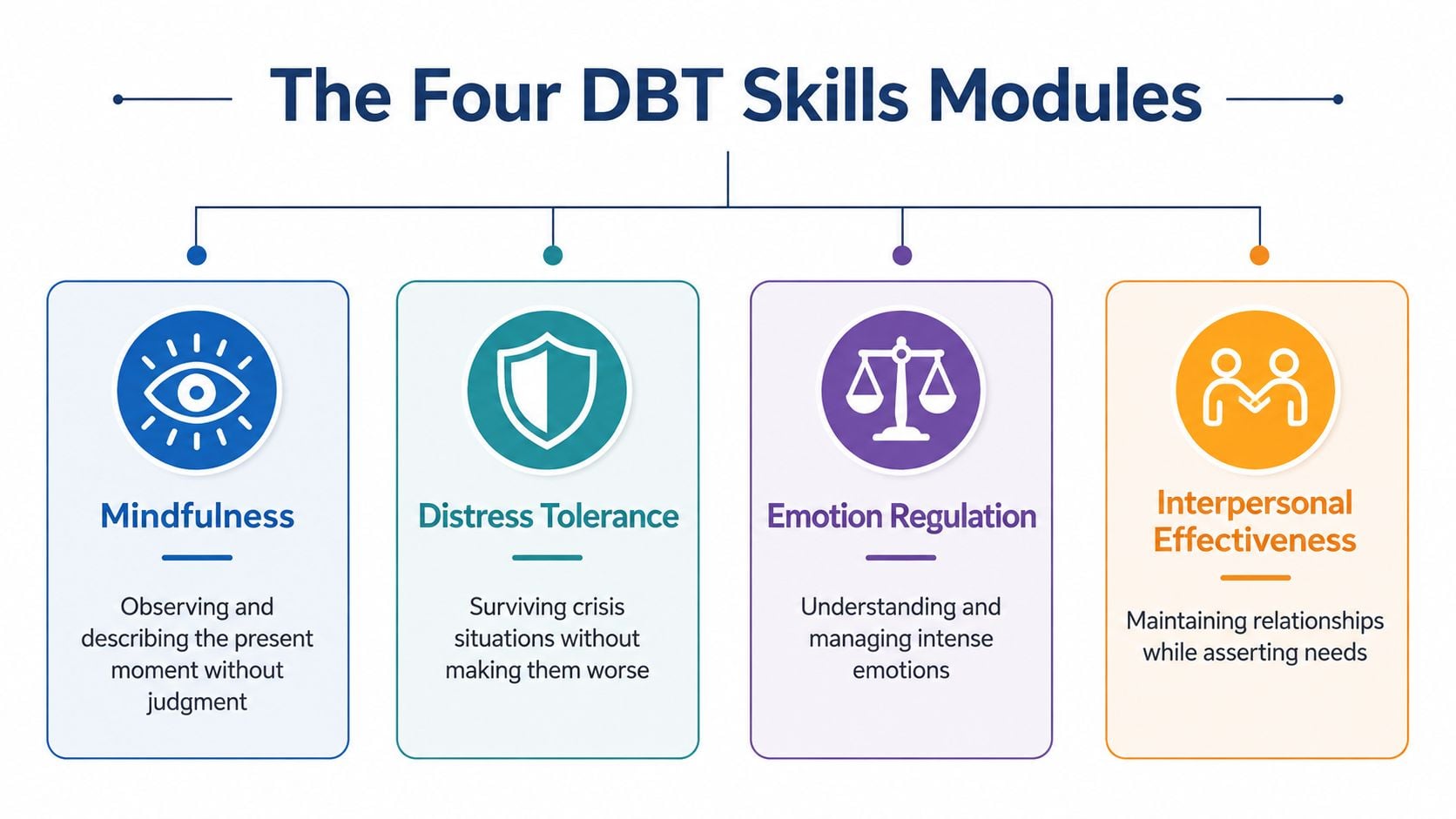
DBT skills work as a coordinated set. Mindfulness helps you notice the urge, distress tolerance helps you survive its peak, emotion regulation helps reduce future vulnerability, and interpersonal effectiveness helps you change the relationships and situations that keep triggering the cycle.
Mindfulness creates room for choice
Mindfulness isn't about emptying your mind. It means observing thoughts, sensations, and urges without immediately obeying them.
Suppose you notice, “I need to use right now.” A mindful response breaks that sentence into observations: “My chest feels tight. I'm thinking about using. I'm imagining relief. The urge is intense, and it's changing.” You haven't argued with the craving or promised it will vanish. You've created enough distance to choose an action.
A person might set a timer, sit away from the phone, and describe the craving in neutral language while contacting a support person. The practice is especially useful when thoughts feel fused with action.
For an everyday guide, these mindfulness practices for sobriety can help translate attention training into routines outside therapy.
Distress tolerance protects the next decision
Distress tolerance is for the moment when you're not ready to solve the entire problem. The aim is to survive the crisis without using, self-harming, escalating a conflict, or making another decision that creates more damage.
TIPP uses changes in body temperature, brief intense exercise, paced breathing, and paired muscle relaxation to help lower physiological arousal. Self-soothing uses the senses, such as a warm shower, calming music, a familiar scent, or a comforting texture. These aren't substitutes for treatment, medical care, or a safety plan. They're short-term tools for getting through a dangerous wave.
If a person receives a rejection text and immediately wants to buy drugs, distress tolerance might look like putting down the phone, using cold water safely, walking briskly, slowing the exhale, and asking someone to stay connected until the urge becomes more manageable.
Emotion regulation changes the conditions around urges
Emotion regulation starts with learning what emotions are doing. An emotion may signal a need, but its intensity doesn't always provide an accurate instruction.
“Check the facts” means separating what happened from the story your mind added. “My supervisor corrected my work” is different from “I'm worthless and will lose everything.” Opposite action means choosing a behavior that moves against an unjustified or unhelpful emotion. Shame may urge hiding and using; opposite action could mean telling a safe person the truth and attending the recovery meeting you wanted to avoid.
Emotion regulation also includes reducing vulnerability through regular routines, rest, nourishment, medication adherence when prescribed, and planned support. A tired, isolated person has fewer resources when a trigger arrives.
Interpersonal effectiveness repairs recovery relationships
Addiction often leaves families unsure whether to trust promises. Recovery, in turn, can become harder when every conversation feels like an accusation. Interpersonal effectiveness skills help you ask clearly, set limits, and protect self-respect without threatening, pleading, or disappearing.
DEAR MAN offers a structure: describe the situation, express your feelings, assert what you need, reinforce why cooperation helps, stay mindful, appear confident, and negotiate when appropriate. A person might say, “When conversations turn into insults, I leave and stop responding. I'm willing to discuss treatment and transportation, but I won't continue while we're yelling.”
The skill isn't about controlling the other person's response. It's about making your request understandable and choosing a boundary you can keep.
Research Evidence for DBT in Substance Use and Co-Occurring Disorders
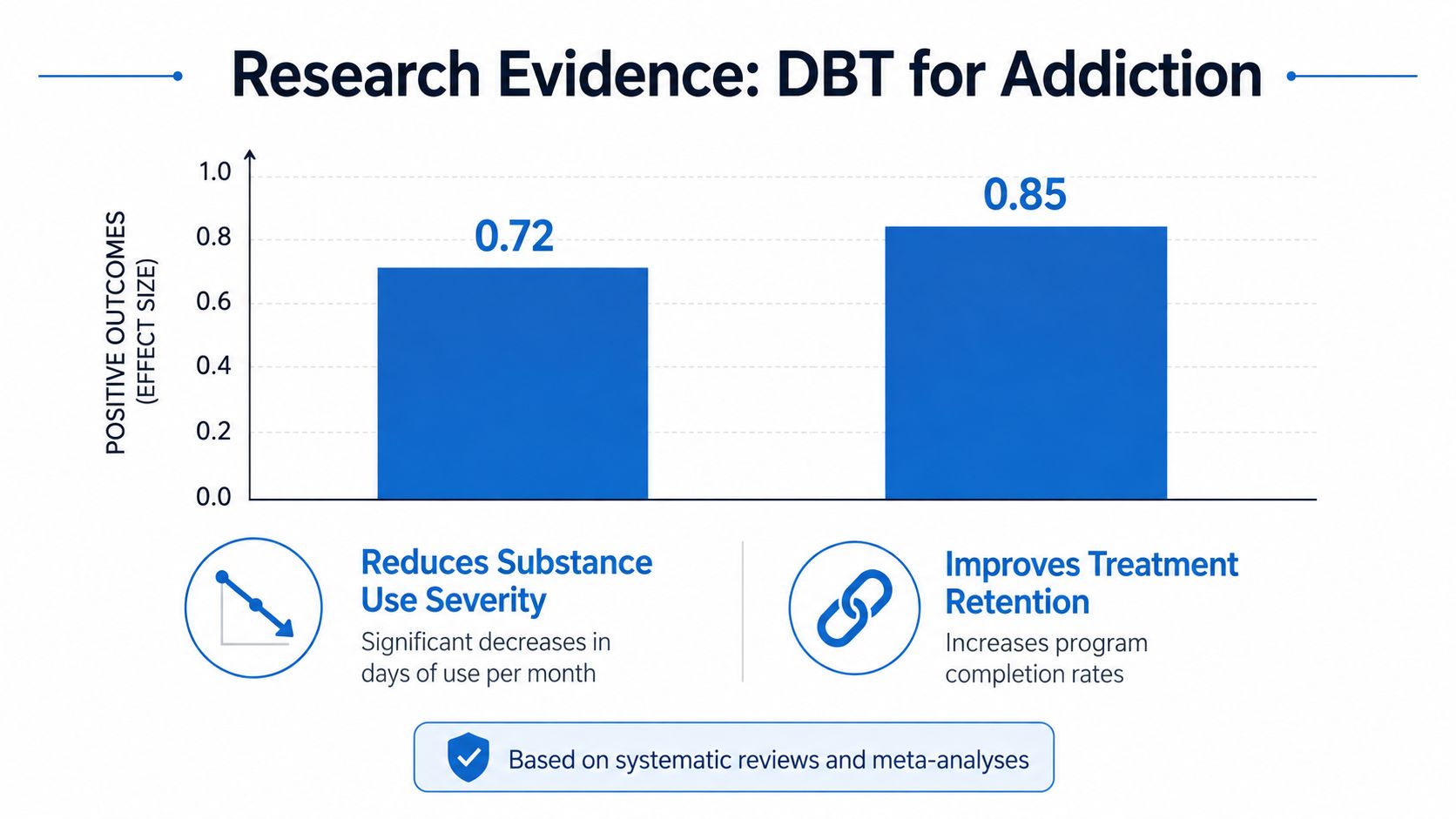
DBT has moved well beyond its original clinical population. A 2025 bibliometric analysis identified 2,723 DBT-related articles published from 1987 through 2024. The analysis reported growth from one publication in 1998 to 249 publications in 2021, with the 2021 total representing 11.32% of the full set. A 2024 review of adolescent DBT identified 72 studies published between 2000 and 2023. These publication findings are reported in the Frontiers bibliometric analysis of DBT research.
For substance use, a systematic review and meta-analysis of randomized controlled trials found a beneficial short-term effect on substance-use severity in one trial, with a standardized effect measure of β-equivalent SMD = -0.84, 95% CI [-1.64, -0.04]. Across two randomized controlled trials, the long-term effect was stronger, at SMD = -1.26, 95% CI [-2.13, -0.40], as reported in the systematic review and meta-analysis of DBT for substance use.
The practical meaning is important. DBT doesn't only ask whether a person feels less distressed in a therapy room. It targets the dyscontrol that can precede substance use, including difficulty tolerating pain, rapid escalation, impulsive action, and relapse-relevant conflict.
Crisis outcomes matter too
A separate meta-analysis of 18 controlled studies found that DBT reduced self-directed violence, with d = -0.324, 95% CI [-0.471, -0.176], and psychiatric crisis service use, with d = -0.379, 95% CI [-0.581, -0.176]. Overall effects on suicidal ideation weren't statistically significant. Those findings, available in the controlled-trial DBT meta-analysis on PubMed, support a careful conclusion: DBT may be especially actionable when programs target dangerous behaviors and crisis escalation, rather than treating thoughts as the only outcome.
People with co-occurring disorders often need treatment that can hold several problems at once. Someone may be managing cravings, panic, trauma reminders, depression, and family conflict in the same week. A dual-diagnosis guide for co-occurring conditions can help families understand why addressing mental health and substance use together matters.
Research doesn't mean DBT works identically for everyone. It means the approach has a substantial evidence base, clear targets, and skills that can be evaluated in real behavior. Treatment still needs to be adapted to medical risk, trauma history, cognitive needs, substance type, and available support.
What to Expect in a DBT-Informed Treatment Program
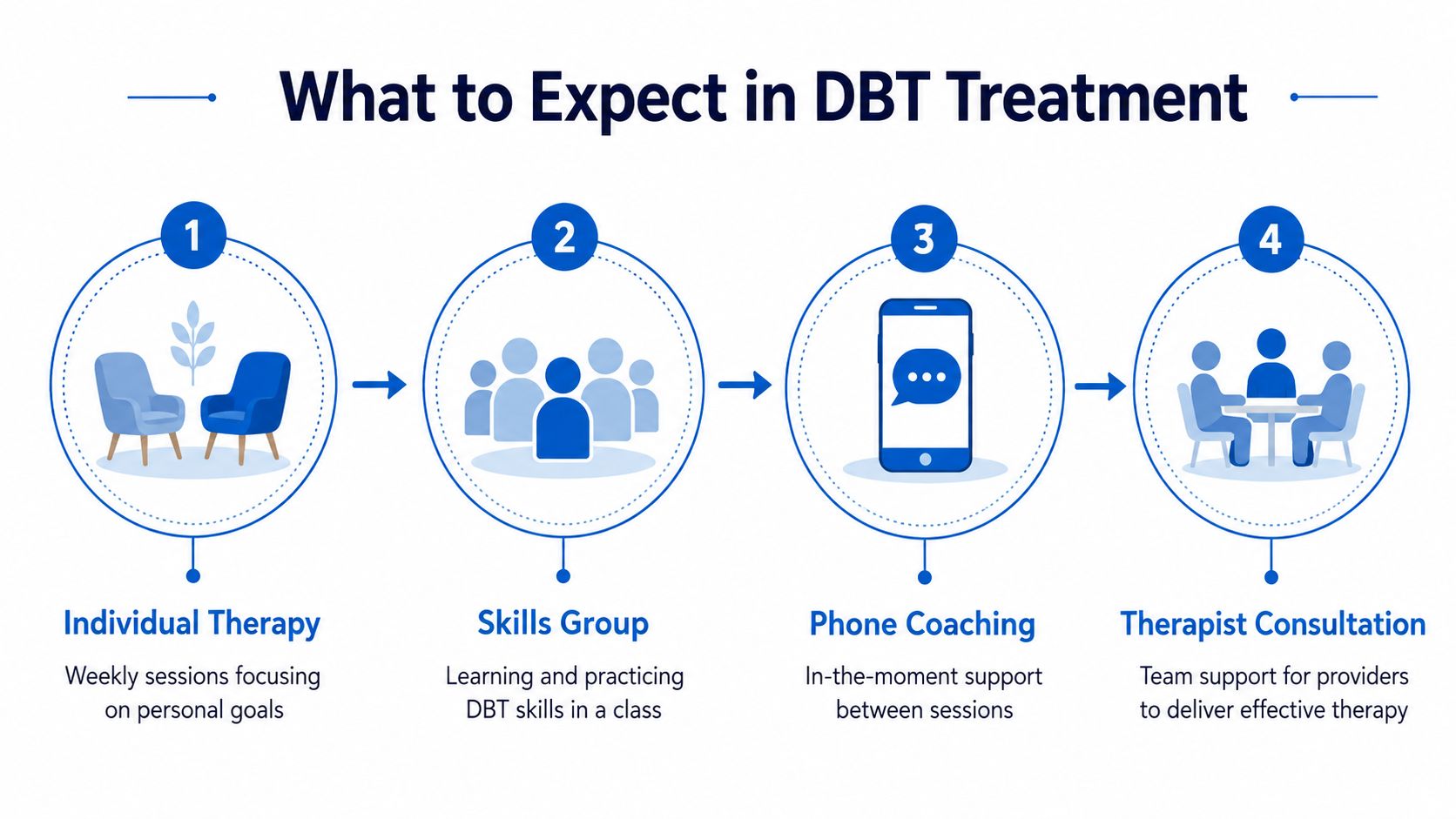
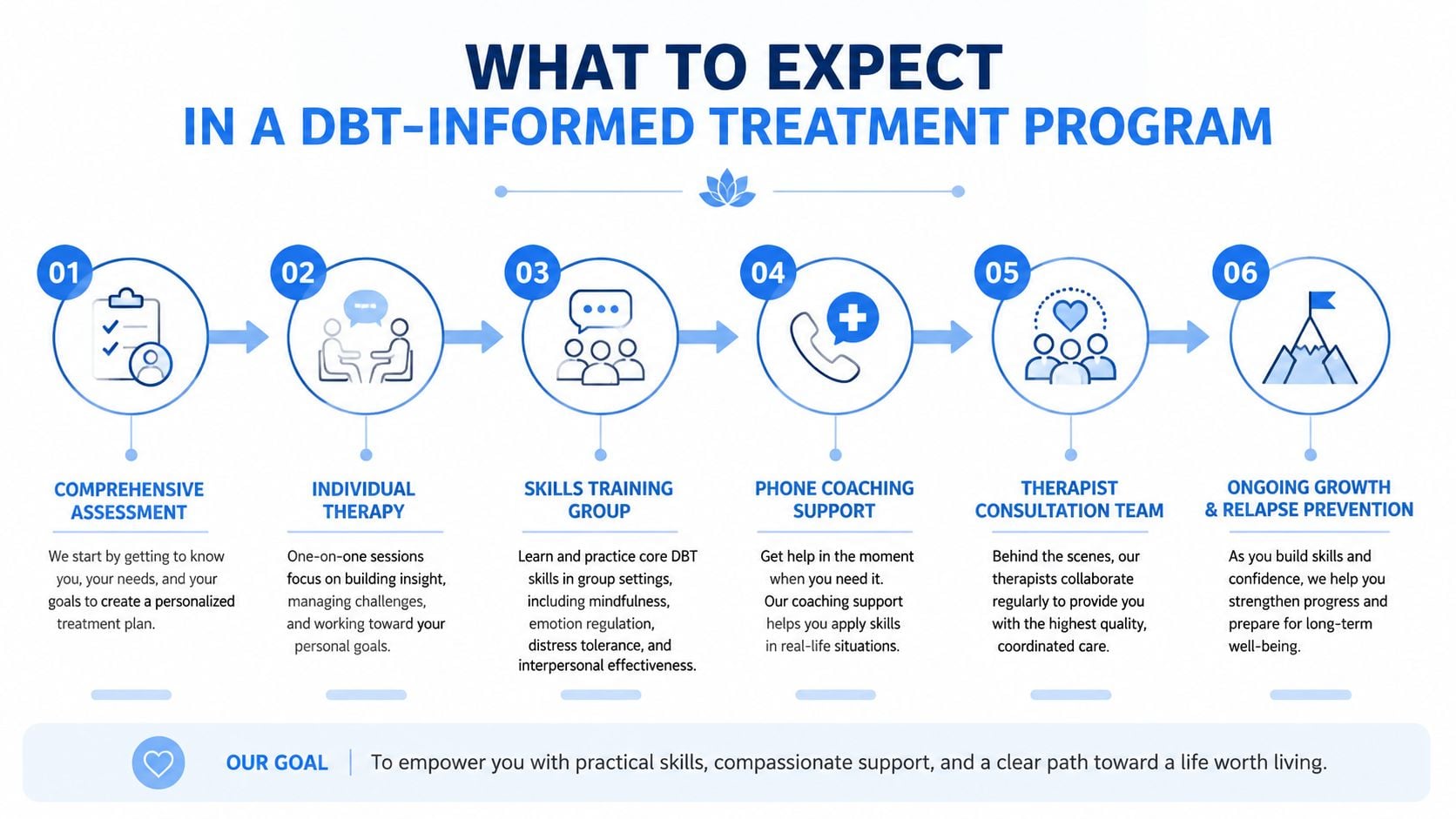
A standard DBT program typically has four connected parts. Individual therapy focuses on personal behavioral targets. Skills training teaches mindfulness, distress tolerance, emotion regulation, and interpersonal effectiveness. Phone coaching helps a person use skills between appointments, while a therapist consultation team supports clinicians in delivering treatment consistently.
Not every addiction program offers every component. Some programs are DBT-informed, meaning they use selected skills within a broader treatment plan. That can still be useful, but you should ask what the program includes rather than relying on the label.
A week built around practice
In an Intensive Outpatient Program, a person may meet individually to review a diary card, identify a recent trigger, and analyze the chain of events that led to an urge or lapse. The therapist and patient then select a behavioral target, such as contacting support before leaving work or using a specific distress-tolerance skill during conflict.
A skills group feels more like a class than a place where everyone must disclose personal history. The facilitator teaches one skill, demonstrates it, invites practice, and assigns homework. The next session gives participants a chance to examine what worked, what failed, and what needs adjustment.
Phone coaching is brief and focused. You might call before sending an angry message and ask for help choosing a skill. The purpose isn't unlimited crisis counseling or a replacement for emergency services. If you're in immediate danger, contact emergency services or a local crisis resource.
Access and fit
DBT-informed care may be offered in person or through telehealth, depending on the provider and clinical needs. Ask how privacy, medication management, withdrawal risk, technology access, and emergency planning are handled in the format you're considering.
DBT requires participation outside appointments. You'll likely be asked to track urges, complete assignments, rehearse communication, and bring honest information to sessions. That effort isn't a test of whether you deserve help. It's how skills move from a worksheet into the moment when your partner calls, a paycheck arrives, or an old contact reaches out.
Practical DBT Skill Exercises You Can Try Today
Start with one exercise, not all of them. The point is to build a repeatable response before the next high-pressure moment arrives.
Observe a craving without negotiating with it
Sit somewhere safe and place both feet on the floor. Describe the experience in short, neutral phrases: “There's pressure in my chest. I'm thinking about using. My hands feel restless. The urge is strong.” Notice where the sensation changes, and return to description whenever your mind shifts into planning.
Then add a choice statement: “I can have this urge and delay acting on it.” Contact a trusted person, move away from access to substances, or go to a safer environment while continuing to observe. You aren't trying to prove that the craving is harmless. You're practicing the difference between an urge and an order.
A pattern recognition journal may help you record triggers, emotions, body sensations, and actions so you can discuss recurring patterns with a clinician.
Use TIPP during acute distress
TIPP is designed for intense activation, not routine reflection.
- Temperature: Use a safe, brief temperature change, such as cool water on your face, while following medical guidance and avoiding anything that could harm you.
- Intense exercise: Walk briskly, climb stairs, or do another safe movement that fits your health.
- Paced breathing: Slow your breathing and make the exhale longer than the inhale if comfortable.
- Paired muscle relaxation: Tense and release muscle groups while noticing the difference between tightness and relaxation.
If you have a medical condition, ask a healthcare professional which parts are appropriate. These skills can lower the intensity of a moment, but they don't replace detoxification, medication, or emergency care.
Practice opposite action for shame
Write the emotion, its action urge, and a safe behavior that moves in the opposite direction. For example:
- Emotion: Shame after missing a counseling appointment.
- Action urge: Hide, lie, or use.
- Opposite action: Send an honest message, reschedule, and tell a support person what happened.
The goal isn't forced positivity. It's choosing behavior that supports recovery when shame is pushing you toward isolation.
Say no with a prepared script
Social pressure is easier to handle when you don't have to invent words under stress. Try: “No, I'm not using. I'm leaving now. Please don't offer again.” If the person argues, repeat the boundary rather than explaining your entire history. Arrange transportation and support before entering a situation where substances may be present.
Finding DBT-Informed Addiction Care Near You
Ask prospective providers whether they offer DBT or selected DBT-informed skills. Clarify whether individual therapy, skills training, between-session coaching, and therapist consultation are available. Also ask how the program treats withdrawal risk, medication needs, trauma, depression, anxiety, and other co-occurring concerns.
A provider should explain the commitment plainly. You can also ask about clinician training, group format, telehealth availability, crisis procedures, insurance, and what happens if you miss a session. If you're seeking peer connection alongside clinical care, resources for in-person mental illness support near you may provide another layer of community support.
Addiction Resource Center LLC in Yuba City offers DBT-informed addiction care within a continuum that includes medically supervised detox, medication-assisted treatment, residential rehabilitation through its partner facility, and an Intensive Outpatient Program available in person and through telehealth. Its multidisciplinary team includes medical, nursing, licensed counseling, marriage and family therapy, and recovery-support professionals. The center accepts most major insurance plans, including TRICARE, and provides a 24/7 phone and text line for treatment questions.
You don't need to wait until you feel completely ready. A first call can be used to ask about assessment, safety, program fit, and support for a loved one.
Addiction Resource Center LLC offers medically supervised detox, residential rehabilitation through a partner facility, and DBT-informed Intensive Outpatient care for adults managing substance use and co-occurring mental health needs. Visit Addiction Resource Center LLC to learn about in-person and telehealth options or contact the team for guidance on taking the next recovery step.