Master emotional regulation for addiction recovery with proven techniques that create lasting change and prevent relapse.


Most people in recovery don’t realize that unmanaged emotions are one of the biggest reasons they relapse. At Addiction Resource Center, we’ve seen firsthand how emotional regulation addiction recovery techniques can transform someone’s ability to stay sober long-term.
When you learn to handle difficult feelings instead of numbing them, everything changes. The strategies in this guide are proven to work, and we’ll show you exactly how to use them.
Why Emotions Drive Relapse
Unmanaged emotions are the fastest path back to substance use. Research across 22 studies involving nearly 1,936 people with substance use disorders shows they struggle significantly with emotion regulation compared to those without addiction. The problem isn’t that emotions feel bad-it’s that without real regulation skills, people default to the substance to make those feelings stop. When stress, grief, anger, or anxiety hits without a plan to handle it, relapse becomes the path of least resistance.
The Emotion-Substance Connection
People don’t use substances because they enjoy them. They use them because emotions feel unbearable without them. Your brain learns that the drug numbs pain faster than any other strategy available, so it keeps reaching for that solution. Addiction literally rewires how your brain processes emotions. The amygdala, which generates emotional responses, stays hyperactive while the prefrontal cortex-responsible for rational decision-making-weakens. That’s why someone in early recovery can feel devastated by a minor setback and immediately crave their substance of choice.
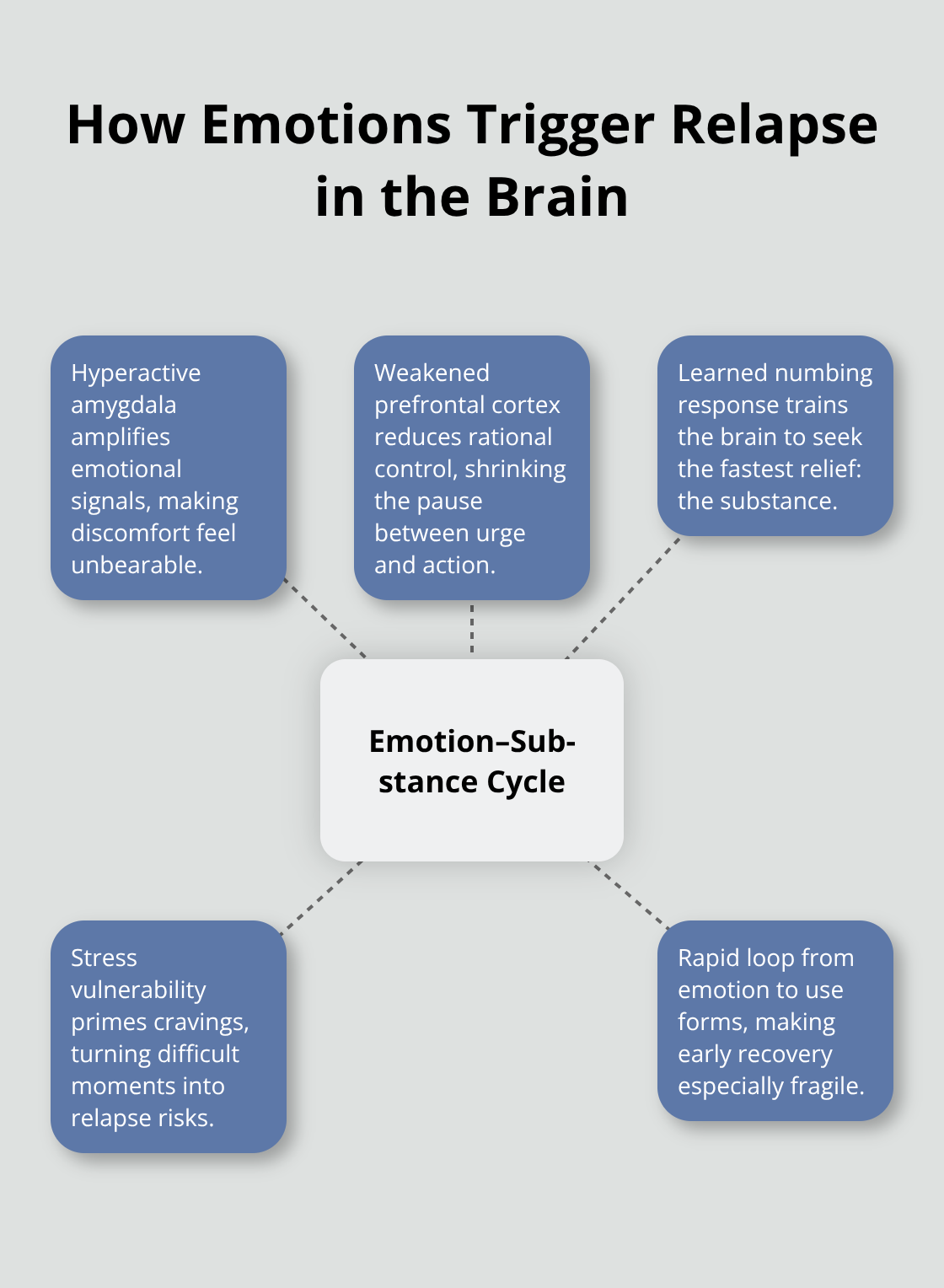
The emotion hits, the brain triggers the learned response, and relapse follows within minutes. Stress acts as a well-established relapse vulnerability, meaning that addressing emotion regulation directly addresses your biggest relapse risk. Without intervention, emotions will keep pulling you back toward the substance.
Why Sobriety Alone Isn’t Enough
Most people fail because they get sober, feel proud for a few weeks, then encounter a difficult emotion they don’t know how to handle. Emotion regulation techniques in evidence-based treatment like Cognitive Behavioral Therapy or Dialectical Behavior Therapy provide concrete tools instead of relying on willpower alone. These aren’t theoretical exercises-they’re specific skills that reduce the intensity of emotions and change how your brain responds to stress. Your emotion dysregulation didn’t develop overnight, and sobriety alone won’t make it disappear. Many people report persistent emotional difficulties even after 3 to 6 months sober because they never addressed the underlying regulation deficit. Professional treatment that explicitly teaches emotion management produces better outcomes than attempting recovery alone, which is why the next section covers the specific techniques that work.
Three Techniques That Actually Stop Cravings
Cognitive Behavioral Therapy: Rewiring Your Automatic Thoughts
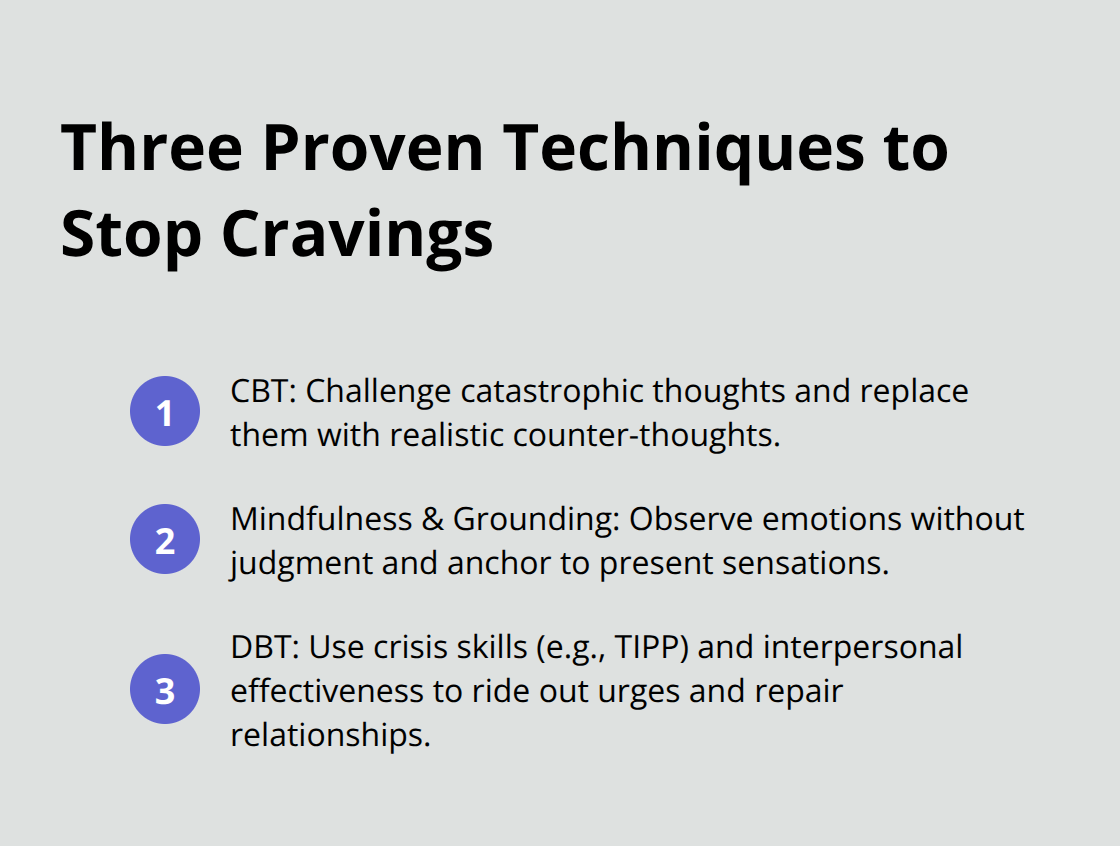
Cognitive Behavioral Therapy teaches you to identify the exact thought patterns that trigger cravings and emotional overwhelm. When anxiety hits, your brain automatically produces catastrophic thoughts-I can’t handle this, everything is falling apart, I need a drink right now. CBT doesn’t ask you to ignore these thoughts; instead, you learn to examine them like a scientist examining evidence. Is this thought actually true? What would I tell a friend in this situation? This shift from automatic reaction to deliberate questioning creates space between the urge and the action.
Cognitive Behavioral Therapy for substance use disorder and addiction recovery has demonstrated efficacy as both a monotherapy and as part of combination treatment strategies. You practice this skill repeatedly until challenging your own thinking becomes automatic. Start with one recurring thought that precedes your cravings-write it down, examine the facts, and develop a realistic counter-thought. You’ll notice the emotional intensity of that thought begins to weaken after two weeks of daily practice. The technique works because it interrupts the pathway from feeling to substance use, replacing it with rational evaluation instead.
Mindfulness and Grounding: Anchoring to the Present Moment
Mindfulness and grounding work through a completely different mechanism than CBT. Instead of fighting emotions, you observe them without judgment while anchoring yourself to physical sensations in the present moment. The 5-4-3-2-1 grounding technique pulls your attention away from craving narratives and into your immediate environment-identify five things you see, four you can touch, three you hear, two you smell, and one you taste.
Deep breathing activates your parasympathetic nervous system (the brake pedal on your stress response), lowering heart rate and anxiety within minutes. The 4-7-8 breathing pattern-inhale four counts, hold seven, exhale eight-produces measurable physiological calm. Mindfulness-based interventions reduce substance use because they fundamentally change your relationship with uncomfortable emotions. You stop viewing anxiety as a threat that requires numbing and start viewing it as a passing sensation you can tolerate. Physical exercise also resets your nervous system in ways that sitting through cravings cannot match.
Dialectical Behavior Therapy: Crisis Skills and Relationship Repair
Dialectical Behavior Therapy combines both approaches and adds two critical skills: distress tolerance and interpersonal effectiveness. Distress tolerance teaches you that you can survive intense emotions without acting on them-a game-changing realization for people in recovery. TIPP skills offer rapid regulation when emotions feel extreme: Temperature (splash cold water on your face to trigger a physiological response), Intense exercise (thirty seconds of jumping jacks), Paced breathing (slow, controlled breaths), and Paired muscle relaxation (tense and release muscle groups). These interrupt the craving cycle within seconds.
Interpersonal effectiveness addresses the reality that many people use substances to avoid difficult conversations or relationships. DBT teaches you to set boundaries, say no without guilt, and ask for what you need directly. Someone in recovery often avoids confrontation because conflict feels unbearable, so they use instead. DBT flips this by proving that direct communication actually reduces long-term emotional pain.
Integrating All Three Approaches for Maximum Impact
Treatment programs that integrate all three approaches-CBT for thought patterns, mindfulness for present-moment awareness, and DBT for crisis skills and relationships-produce the strongest outcomes. The key is practicing these techniques before you need them. When a craving hits hard, you won’t have time to learn; you’ll default to whatever skill you’ve drilled repeatedly. Journaling for 15-to-20 minutes daily helps you track which situations trigger cravings and which practices actually work for you.
Track which situations activate each technique-some people need cognitive reappraisal for work stress, grounding for social anxiety, and TIPP skills for acute cravings. This personalization is what separates lasting recovery from relapse cycles. Once you identify your strongest techniques, the next step involves building these skills into your daily life so they become automatic responses rather than conscious choices.
Making Emotional Regulation a Daily Practice
Techniques work only if you practice them consistently before a crisis hits. Most people wait until they face acute distress to try a new skill, which guarantees failure because your brain defaults to familiar patterns under pressure. We see this pattern repeatedly: someone learns DBT skills in a session, feels good about it, then encounters stress and reverts to old coping mechanisms because the new skill wasn’t automatic yet. Sustainable practice means treating emotion regulation like physical fitness-you wouldn’t expect to run a marathon after one training session, and you shouldn’t expect to handle a major trigger after one therapy appointment.
Start With a Morning Routine
A ten-minute morning routine creates the neural pathways that make regulation feel natural rather than forced. Spend three minutes on 4-7-8 breathing, five minutes journaling about yesterday’s emotional moments and what triggered them, and two minutes identifying one potential stressor for today and which technique you’ll use. This daily investment pays dividends because your brain strengthens the regulation circuits you activate repeatedly. Track which techniques actually work for your specific triggers by noting in a simple spreadsheet when you used CBT, mindfulness, or DBT skills and whether the craving intensity decreased. After two weeks of data, patterns emerge-maybe cold water (TIPP temperature technique) works better for anxiety than breathing, or cognitive reappraisal works better for social situations than grounding. Personalization transforms generic skills into your personalized toolkit.
Map Your Specific Triggers
Your triggers are specific to your history and brain chemistry, which means generic advice about stress management will fail you. Identify the exact situations that activate cravings through three questions: What happened right before the craving? What emotion did you feel?
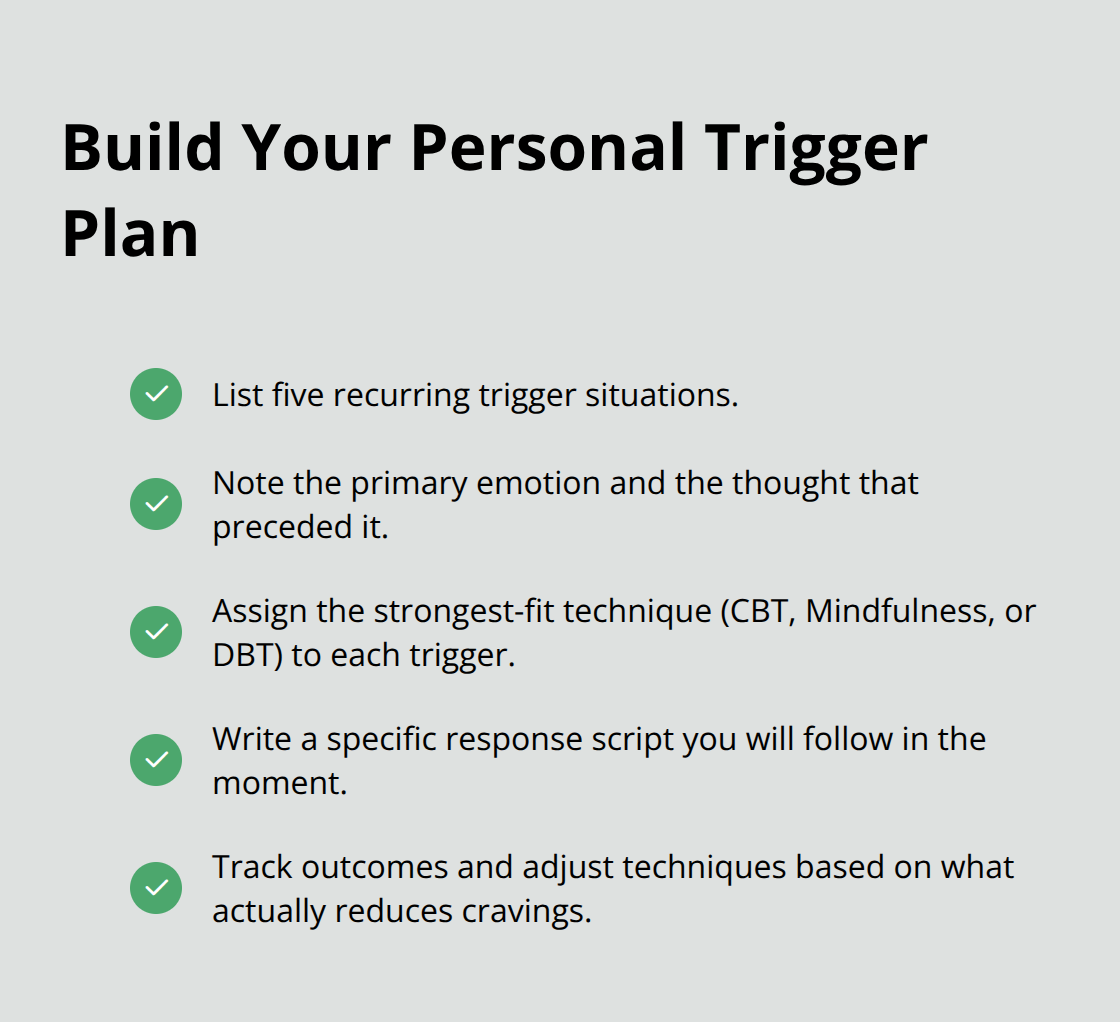
What thought preceded the emotion? A person might discover that work criticism triggers shame, which triggers the thought I’m a failure, which triggers the craving. That discovery means you need cognitive reappraisal specifically for perfectionism and shame, not general stress management.
Write down five situations that consistently trigger cravings, then assign your strongest technique to each one. This becomes your personal response plan-not something vague like I’ll cope better, but rather something specific like When my partner criticizes me, I’ll pause, ask myself what I’m afraid of, then write three pieces of evidence that the criticism isn’t proof I’m worthless. This specificity separates people who maintain sobriety from those who relapse repeatedly.
Work With a Professional Therapist
A counselor accelerates this process dramatically because a trained therapist identifies patterns you miss about yourself. Therapy for addiction provides safe, structured guidance to overcome substance use, manage triggers, and achieve long-term sobriety. The difference matters enormously. Some people need weekly sessions to build skills, while others need biweekly check-ins to maintain them. The frequency depends on your relapse risk and how quickly you develop automaticity with techniques.
Professional support isn’t a sign of weakness-it’s the difference between six months sober and six years sober. A therapist also adjusts your approach when one technique stops working, which happens as your brain heals and your triggers shift. What worked in early recovery may not work six months later, and a professional helps you evolve your toolkit accordingly.
Final Thoughts
Emotional regulation in addiction recovery isn’t a destination you reach after a few weeks of sobriety-it’s a skill you build, practice, and refine throughout your recovery journey. The techniques in this guide work because they address the root cause of relapse: your brain’s inability to tolerate difficult emotions without turning to substances. When you develop genuine regulation skills, you stop viewing emotions as threats that require numbing and start seeing them as manageable experiences you can navigate with concrete tools.
The evidence proves that people who practice emotional regulation consistently maintain sobriety at significantly higher rates than those who rely on willpower alone. Your brain physically changes through repeated practice, with neural pathways that connect your emotional response to substance use weakening while pathways supporting rational decision-making strengthen. This isn’t theoretical-neuroplasticity works in recovery when you commit to consistent skill-building.
Professional treatment accelerates this transformation dramatically because a therapist identifies your specific triggers, adjusts your approach when something stops working, and provides accountability during moments when relapse feels tempting. Contact Addiction Resource Center to learn how our personalized addiction therapy programs integrate CBT, mindfulness, and DBT skills into comprehensive treatment plans designed specifically for your recovery needs. Start with one technique tomorrow morning, practice it for two weeks, track what works, then reach out to a professional who can help you build a sustainable practice.