You're lying awake, replaying the same scenes. He pours a drink the second he gets home. He says he's fine because he still works, still pays bills, still shows up. You tell yourself maybe it's just stress, maybe it's a phase, maybe you're overreacting. Then the empty bottles, the mood swings, the excuses, and the …

You're lying awake, replaying the same scenes. He pours a drink the second he gets home. He says he's fine because he still works, still pays bills, still shows up. You tell yourself maybe it's just stress, maybe it's a phase, maybe you're overreacting. Then the empty bottles, the mood swings, the excuses, and the tension in your house tell you otherwise.
If you're asking, “Is my husband an alcoholic?”, that question usually didn't come out of nowhere. Wives ask it when something feels off for a long time. You've probably already spent months trying to explain it away.
The first thing I want you to hear is simple. Alcohol Use Disorder, or AUD, is a medical condition. It is not a character flaw, and it is not your fault. It is also common. According to the 2024 National Survey on Drug Use and Health, 27.1 million adults ages 18 and older in the United States had Alcohol Use Disorder in the past year, including about 16.4 million men, or 12.9% of adult men.
Table of Contents
- That Lingering Question in a Quiet House
- Beyond High-Functioning and Heavy Drinking
- An Objective Checklist for Alcohol Use Disorder
- How to Start the Conversation Without Starting a War
- Protecting Yourself and Your Family with Boundaries
- Understanding the Path to Recovery Treatment Options
- How to Get Immediate Help and Support Today
That Lingering Question in a Quiet House
You may not have a dramatic story. That's part of why this is so confusing. Maybe your husband hasn't lost his job. Maybe he isn't being arrested. Maybe he still coaches the kids, mows the lawn, and answers emails on time. But every night seems to orbit alcohol, and every conversation about it turns into denial, irritation, or silence.
That doesn't mean you're imagining the problem.

What your gut may already know
When a wife starts searching “is my husband an alcoholic,” she's usually not reacting to one bad weekend. She's reacting to a pattern. He drinks more than he says. He gets defensive fast. He promises to cut back, then slips back into the same routine. The house may look stable from the outside while you feel increasingly alone inside it.
That instinct matters.
Practical rule: If alcohol keeps creating tension, secrecy, broken promises, or fear in your home, you have enough reason to take it seriously.
This is a health issue, not a label contest
You do not need to win an argument over the word “alcoholic” before you act. Clinicians use Alcohol Use Disorder because it focuses on symptoms and severity, not stereotypes or shame. That matters because shame keeps families stuck. Clear assessment gets families moving.
Many wives delay action because they think the situation has to look worse before it counts. That is a mistake. Problems with alcohol often become obvious to the spouse long before they become obvious to coworkers, friends, or extended family.
If your home feels like you're constantly managing someone else's drinking, your concern is valid. Stop waiting for a rock-bottom scene to give yourself permission to respond.
Beyond High-Functioning and Heavy Drinking
The phrase high-functioning alcoholic confuses more families than it helps. It sounds reassuring. It isn't. It often just means the consequences haven't fully hit public view yet.
A man can keep a job, pay the mortgage, and still have a serious alcohol problem. According to Serenity Park Recovery's discussion of working adults with AUD, 70% of individuals with Alcohol Use Disorder remain employed. The same source notes that functional tolerance, such as morning shakes that vanish after a drink, is a definitive sign of physiological dependence regardless of status, income, or the kind of alcohol he prefers.
Success does not cancel addiction
I'm blunt about this because spouses waste years on the wrong question. They ask, “How can he be an alcoholic if he still goes to work?” The better question is, “What happens when he can't comfortably get through daily life without alcohol?”
If he needs alcohol to relax, celebrate, sleep, socialize, steady his nerves, or stop feeling bad physically, you're not looking at harmless habit. You're looking at alcohol taking over more territory in his life.
The label on the bottle doesn't matter either. Craft beer, top-shelf bourbon, and expensive wine still act on the same brain and body.
Gray area drinking is still dangerous
Some husbands don't fit the movie version of alcoholism. They aren't blackout drunk every night. They may rarely slur their speech. They may even look polished and disciplined. But they drink daily, structure evenings around drinking, and become irritable when alcohol is questioned or unavailable.
That middle zone traps a lot of families. It feels too serious to ignore and not dramatic enough to force action.
The absence of chaos does not mean the absence of dependence.
What often gets mistaken for “he handles alcohol well” is tolerance. Tolerance means the body has adapted. That isn't a sign of strength. It's a warning sign.
Here are the myths I want you to drop:
- “He can't have a problem because he earns good money.” Income doesn't protect the brain from dependence.
- “He only drinks quality alcohol.” Type and price don't change the risk.
- “He's never missed work.” Many men maintain routines long after alcohol has taken control privately.
- “He's just a heavy social drinker.” If drinking continues despite relationship strain, physical symptoms, or repeated failed attempts to cut back, this is bigger than social drinking.
If you've been waiting for permission to stop minimizing this, take it now.
An Objective Checklist for Alcohol Use Disorder
Feelings matter, but you also need something firmer than intuition. That's where the clinical standard helps. According to South Light's summary of DSM-5 criteria for Alcohol Use Disorder, AUD is diagnosed when a person meets at least 2 of 11 criteria within a 12-month period. Severity is classified as mild at 2 to 3 criteria, moderate at 4 to 5, and severe at 6 or more. The same source notes that withdrawal, craving, and drinking despite physical problems are high-risk markers for progression to severe AUD.
What clinicians actually look for
You are not diagnosing your husband at the kitchen table. But you can use the same framework clinicians use to judge whether your concern is based on real symptoms.
Ask yourself whether these patterns have shown up over the last year. Not once. Repeatedly.
DSM-5 Criteria for Alcohol Use Disorder Simplified
| Symptom Cluster | Simplified Question for a Spouse |
|---|---|
| Drinking more than intended | Does he say he'll have one or two, then keep going? |
| Failed attempts to cut down | Has he promised to cut back and then not followed through? |
| Time spent around alcohol | Does a lot of his day or week revolve around buying, drinking, recovering, or planning around alcohol? |
| Craving | Does he seem preoccupied with when he can drink next? |
| Work or home problems | Has drinking interfered with responsibilities, follow-through, or reliability at home? |
| Relationship problems | Does he keep drinking even after fights, tension, or repeated concerns from you? |
| Activities given up | Has he lost interest in hobbies, family time, or events that don't involve alcohol? |
| Risky use | Does he drink in situations where impairment creates danger or bad judgment? |
| Continued use despite physical harm | Does he keep drinking even though it worsens sleep, mood, blood pressure, pain, or other health issues? |
| Tolerance | Does he need more alcohol than before to get the same effect, or seem able to drink a lot without appearing drunk? |
| Withdrawal | Does he get shaky, sweaty, anxious, nauseated, or obviously better after drinking again? |
The signs that should move you faster
Some symptoms demand immediate attention because they suggest a deeper level of dependence.
- Withdrawal signs: Morning shakes, sweating, nausea, agitation, or needing a drink to feel normal.
- Craving: Alcohol isn't just present. It's mentally central.
- Drinking despite physical harm: He knows it's making something worse and does it anyway.
- Repeated failed control: He keeps setting limits he can't keep.
If you can clearly identify several of these patterns, stop arguing with yourself about whether it's “bad enough.” It is bad enough to address.
A checklist won't replace a professional assessment. It will, however, cut through the fog. That matters because confusion is one of addiction's favorite hiding places.
How to Start the Conversation Without Starting a War
If you come at him loaded with accusations, you'll probably get denial, anger, or a polished speech about how stressed he is and how much he “deserves” a drink. That approach fails because it turns the conversation into a courtroom fight.
A better strategy is compassionate confrontation. According to Alcohol Help's guidance on denial and spouse communication, spouses who use compassionate confrontation focused on shared future health rather than accusation have a 35% higher success rate in prompting treatment-seeking than those using ultimatums. The same source recommends open-ended questions such as “Do you think your alcohol consumption affects your sleep?” because they reduce defensiveness.
What works better than accusation
Your job is not to force a confession. Your job is to speak clearly, calmly, and specifically.
Try language like this:
- Lead with impact: “I'm worried about what alcohol is doing to your health and to our home.”
- Use recent examples: “You said you'd stop after two drinks on Saturday, and that didn't happen.”
- Stay in the present: “This is affecting us now.”
- Ask reflective questions: “What do you notice about your sleep, mood, or patience after drinking?”
- Make the next step concrete: “I want you to get a professional assessment.”
Notice what's missing. No character attacks. No long list of every bad memory from the last five years. No shouting.
“I'm not trying to punish you. I'm telling you that I'm scared, and I need this to change.”
That kind of sentence is firm without being chaotic.
What not to do
A lot of wives unintentionally make the situation worse because they're desperate to keep the family stable. Stop doing the following:
- Don't debate while he's drinking. You won't get honesty or accountability from an intoxicated person.
- Don't over-explain. The longer you talk, the more openings he has to deflect.
- Don't accept fake bargains. “I'll just switch to beer” is not a treatment plan.
- Don't clean up every consequence. Covering for him protects the drinking.
- Don't issue threats you won't enforce. Empty ultimatums weaken your position.
Pick a sober time. Keep your tone even. Have one clear goal. That goal is not to get him to agree with every point. It's to push the conversation toward assessment and action.
If he denies everything, don't spiral into proving your case. State your concern, state your limit, and move to boundaries.
Protecting Yourself and Your Family with Boundaries
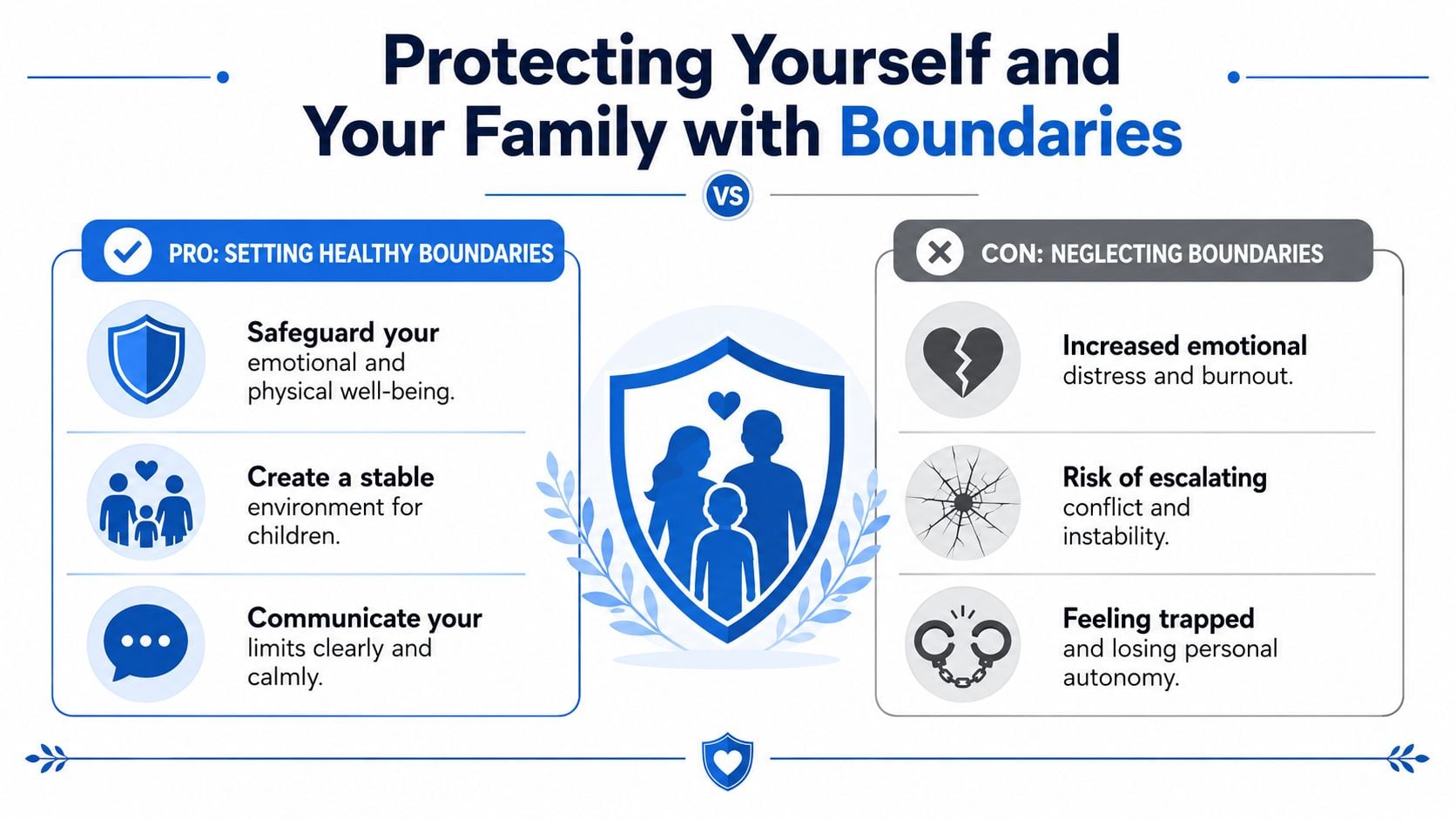
When alcohol dominates a household, spouses often spend all their energy trying to manage the drinker. That usually fails. Your real power starts when you protect yourself and your children instead.
Safety comes first
If he becomes aggressive, drives after drinking, passes out while supervising children, or creates chaos that feels unsafe, stop focusing on keeping the peace. Focus on safety.
Build a simple plan:
- Transportation: Keep your own keys, your own access to money, and a way to leave.
- Children: Decide in advance where they go if he's intoxicated or volatile.
- Communication: Tell one trusted person what's happening.
- Emergency threshold: Know what behavior means you leave for the night or call for help.
If alcohol is pushing your marriage toward legal separation or divorce, get informed early. Practical guidance on family law assistance for divorce involving alcoholism can help you understand your options before a crisis forces rushed decisions.
A boundary is about your action
A boundary is not “You need to stop drinking at family events.” That's a demand. He may ignore it.
A boundary is “If you drink at the family event, I will leave with the kids in a separate car.” That is your action. You control it.
Here are examples that work better than vague pleas:
- Around driving: “If you've been drinking, I will not ride with you.”
- Around children: “If you're intoxicated, you will not be alone with the kids, and I will make other arrangements.”
- Around money: “I won't cover alcohol-related charges or excuses.”
- Around home conflict: “If you start yelling or picking a fight after drinking, I will end the conversation and sleep elsewhere tonight.”
Boundaries are not punishment. They are protection.
Deliver boundaries calmly. Then enforce them. Repeating the same warning without follow-through teaches him that your limit is negotiable. It isn't.
Many spouses reclaim sanity. You stop organizing your life around his promises and start organizing it around what you know you will and won't live with.
Understanding the Path to Recovery Treatment Options
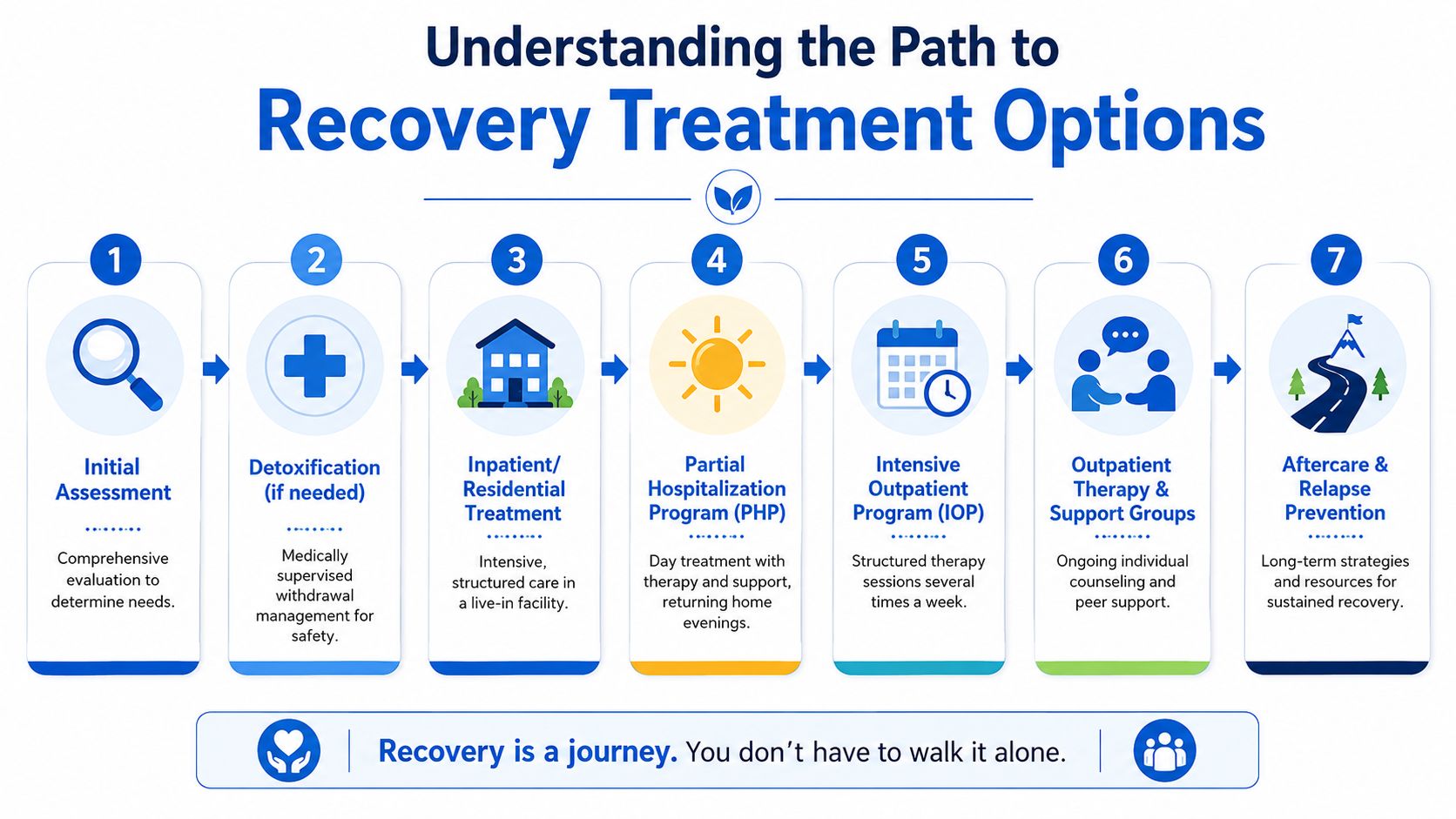
A lot of spouses know their husband needs help but have no idea what “help” means. That uncertainty keeps families frozen. Treatment is not one vague event. It is a sequence of care options matched to the person's level of need.
According to the Cleveland Clinic overview of Alcohol Use Disorder treatment, treatment is evidence-based and commonly combines FDA-approved medications such as naltrexone with behavioral therapies. The same source states that most individuals can reduce or cease drinking with appropriate treatment, which may include inpatient detox for safety, followed by structured care such as residential rehab or an intensive outpatient program.
What treatment usually includes
Not every husband needs the exact same path, but these are the main levels of care families should understand:
Assessment
A professional evaluates drinking patterns, withdrawal risk, mental health concerns, and daily functioning.Detox if needed
This is not just “toughing it out at home.” Alcohol withdrawal can become dangerous. Medical supervision matters when dependence is significant.Medication-assisted treatment
Medications such as naltrexone or acamprosate can support recovery by reducing cravings or helping maintain sobriety.Residential treatment
This is a live-in setting with structure, therapy, and distance from triggers.Intensive outpatient care
This offers a serious level of therapy while the person continues living at home.Ongoing therapy and aftercare
Recovery holds when the person learns coping skills, relapse prevention, and how to live without alcohol at the center of everything.
Recovery is management not magic
If you expect one detox stay or one emotional breakthrough to fix all of this forever, you'll be crushed. AUD is better understood as a chronic condition with relapse and remission. That means progress is possible, but it requires ongoing management.
That isn't bad news. It's realistic news.
The right question isn't “Can he be fixed in one shot?” It's “Will he enter treatment and stay engaged in recovery over time?”
A solid plan usually includes medical care, behavioral therapy, accountability, and family support. If he's willing, there is real hope. If he's not willing yet, you still need your own plan.
How to Get Immediate Help and Support Today
If you're in crisis, take the next right step today. Not next month. Not after one more ruined weekend. Today.

Start with a short list:
- Get support for yourself: Reach out to Al-Anon, a therapist, or a trusted family member who won't minimize what's happening.
- Request a professional assessment: Don't wait for him to “figure it out on his own.”
- Write down your boundaries: Keep them simple, specific, and enforceable.
- Prepare for safety: Have transportation, essentials, and a backup place to go if needed.
How to use your insurance
Many families delay treatment because they assume they can't afford it. Check before you decide that. Most major insurance plans may help cover treatment, and some programs also welcome TRICARE beneficiaries for military families. Ask what levels of care are covered, what authorization is needed, and what the next available assessment looks like.
You may also want a clearer sense of what recovery support can look like for families. This short video is a useful place to pause and regroup.
If your husband refuses help today, don't let that become your excuse to stay paralyzed. You still need support. You still need boundaries. You still deserve a home that isn't controlled by alcohol.
If you need a calm, confidential next step, Addiction Resource Center LLC offers guidance for individuals and families dealing with alcohol use. You can call or text 530-625-7910 any time, explore care options online, or visit them at 1002 Live Oak Blvd., Suite A, Yuba City, CA. If your husband is ready for detox, residential care through Ona Treatment Center, medication-assisted treatment, or IOP, or if you just need help figuring out what to do next, reach out now.