If you're reading this, you may be the person lying awake after everyone else has gone to bed, replaying the same thought: “How did things get this far?” Or you may be a spouse, parent, sibling, or friend who keeps trying to help but isn't sure what helps anymore. Addiction often shrinks life down to …

If you're reading this, you may be the person lying awake after everyone else has gone to bed, replaying the same thought: “How did things get this far?” Or you may be a spouse, parent, sibling, or friend who keeps trying to help but isn't sure what helps anymore. Addiction often shrinks life down to secrecy, damage control, and isolation. People start believing no one could understand what they're carrying.
That's one reason group counseling can feel so different from what many families expect. It isn't a room full of strangers taking turns giving advice. At its best, it's a structured, therapist-led space where people begin to recognize themselves in other people's stories. Shame loosens its grip when someone says out loud the thing you thought only you had done, felt, or feared.
Many of the most meaningful group counseling benefits come from that shift. Recovery stops being a private battle and becomes a shared practice. People learn how to tell the truth, accept support, give support, and stay accountable when motivation dips. Families often notice something important too: the person they love isn't just “attending treatment.” They're starting to reconnect with other human beings in a healthier way.
Table of Contents
- You Are Not Alone The Journey to Recovery
- The Core Power of Shared Experience
- Key Group Counseling Benefits for Addiction Recovery
- Finding the Right Fit Types of Counseling Groups
- What to Expect in Your First Group Session
- How Group Work Amplifies MAT and Residential Care
- Frequently Asked Questions About Group Counseling
- Begin Your Healing Journey at Addiction Resource Center
You Are Not Alone The Journey to Recovery
A lot of people arrive at treatment emotionally exhausted long before they arrive physically. They may still be going to work, answering texts, and trying to look normal. But underneath, they're managing cravings, guilt, broken trust, and the constant pressure of hiding.
Families often feel isolated too. A husband may think, “If I push harder, maybe she'll stop.” A mother may wonder whether every phone call means bad news. A son may stop asking questions because every conversation turns into an argument. Everyone is in the same storm, but each person feels alone inside it.
Group counseling interrupts that loneliness in a practical way. Instead of relying only on willpower, a person begins meeting with peers who understand relapse fear, denial, shame, and the strange mix of wanting help while resisting it. That kind of recognition can be deeply calming. It tells the nervous system, “I don't have to carry this by myself.”
Recovery often begins with a simple but life-changing realization: other people have felt this lost, and they found a way forward.
There's also a reason group care has become such a central part of modern treatment. According to an overview of group therapy outcomes, increasing access to group therapy by 10 percent would allow an additional 3.5 million Americans to access treatment, and group therapy often costs between one-half and one-third of the price of individual psychotherapy, with group sessions ranging from $40 to $50 per hour compared with individual sessions that can exceed $150 per hour.
That doesn't mean group replaces every other kind of help. It means group gives recovery something many people have been missing for a long time: a community where honesty becomes safer, hope becomes visible, and accountability becomes normal.
The Core Power of Shared Experience
A family may wonder how talking with strangers could possibly help with something so personal. That question makes sense. Addiction often teaches people to hide, protect, and explain away pain, so the idea of speaking in a group can feel exposed at first.
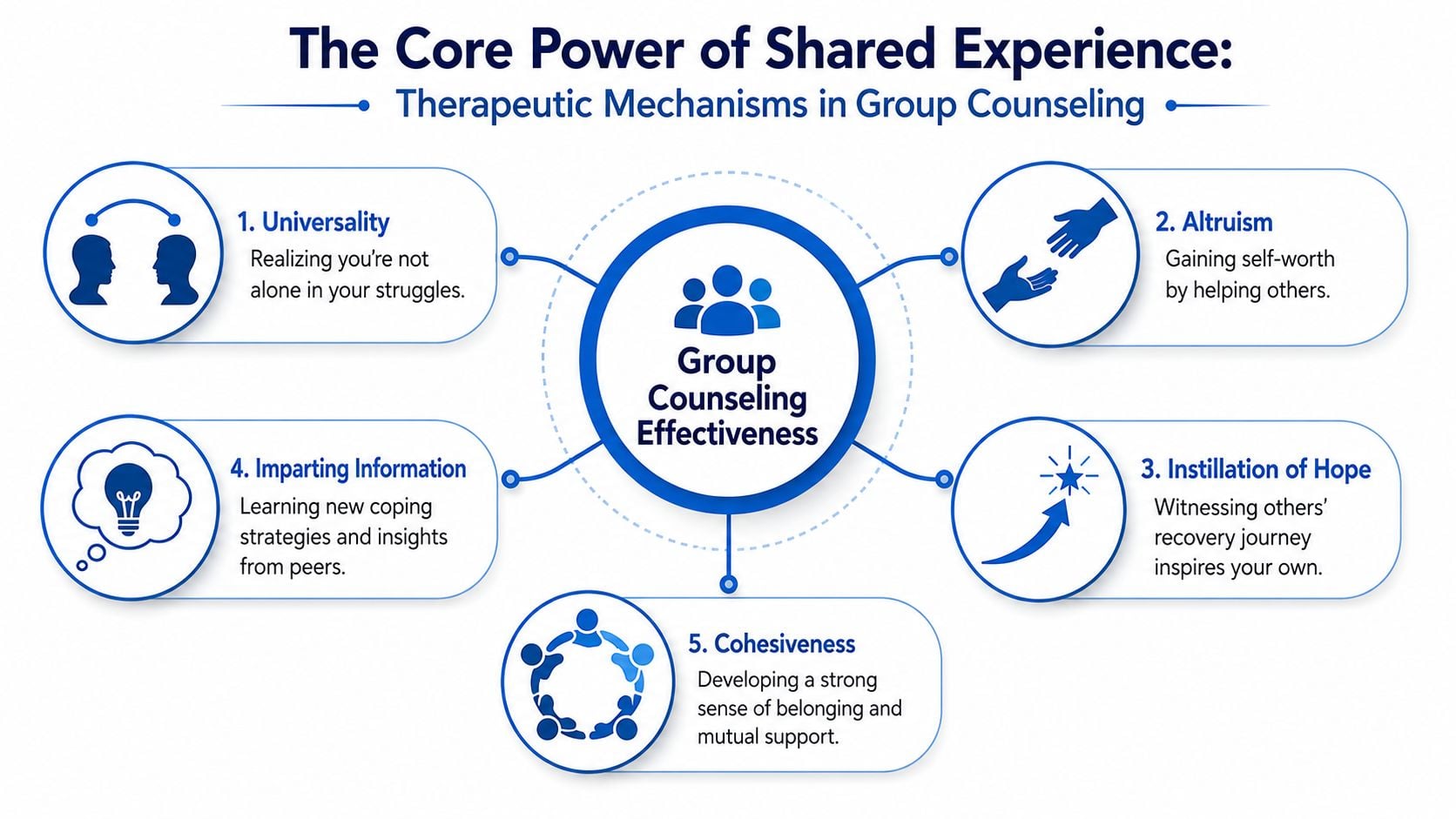
Group counseling helps because recovery happens between people, not only inside one person's mind. A person has to rebuild trust, notice patterns sooner, ask for help earlier, and stay steady during stress. Group gives them a place to practice all of that with real humans in real time, like a rehearsal room for everyday recovery.
Why shared struggle changes people
Shared experience does more than reduce loneliness. It organizes recovery. When one member names a craving pattern, another recognizes it in themselves. When one person describes making it through a hard weekend without using, the group gets a concrete example of what stability looks like. Healing moves in both directions. People receive help, and they also become part of someone else's progress.
That matters because addiction usually narrows a person's world. Group widens it again. Members start to see that shame, avoidance, anger, and fear are common human responses to pain, not proof that they are uniquely broken. Once that pressure drops, honest work becomes more possible.
A well-run group also gives feedback in a form people can absorb. A counselor may teach a skill, but peers show what that skill looks like under pressure. If someone is in medication-assisted treatment, group helps them talk through medication stigma, cravings, routines, and setbacks with people who understand the day-to-day reality. If someone is in residential care, group turns a structured program into lived practice by helping residents test new ways of speaking, listening, and taking responsibility before they return home.
Why accountability feels different in a group
Peer accountability often reaches places advice cannot. When another member says, "I heard myself in what you just said," or "That was the story I told right before I slipped," the message carries lived credibility. It is harder to dismiss because it comes from someone who has used the same defenses and knows their cost.
You can see a related principle in communities outside clinical care. HolyJot's church accountability insights describe how shared commitment and regular check-ins help people stay aligned with their values. The setting is different. The human pattern is similar. Change becomes more stable when people are seen, known, and expected to tell the truth.
Practical rule: Group works best when members show up honestly, practice consistently, and let the group support the rest of their treatment plan.
Key Group Counseling Benefits for Addiction Recovery
The value of group counseling becomes easier to understand when you look at what people gain from it in daily life. These gains aren't abstract. They show up in conversations at home, in moments of craving, and in the choices people make when stress hits.
A Built In Support System
Family support matters. Still, family members usually can't provide the same kind of understanding as people who've wrestled with the same urges and self-deception. In a counseling group, members often hear, “I've done that too,” or “I know what that thought spiral feels like.”
That doesn't remove responsibility. It removes the sense of being uniquely damaged. For many people, that shift lowers shame enough that they can finally be honest.
A Mirror for Accountability
Addiction thrives in secrecy and rationalization. Group gently disrupts both. When someone minimizes a risk, rewrites a recent event, or blames everyone else, peers often notice it quickly because they've used the same defenses themselves.
This kind of accountability isn't about humiliation. It's more like a mirror held at the right angle. People begin to catch their own patterns sooner, and that creates more room for better choices.
A Safe Place to Practice New Skills
Recovery involves skills, not just insight. A person may need to practice saying no, handling criticism, naming emotions, asking for help, or sitting with discomfort without escaping it. Group offers a real but contained place to try those skills.
That matters because new behaviors can feel awkward at first. In a group, a person can test healthier communication and get feedback before trying the same changes with a spouse, parent, coworker, or friend.
- Listening without defending: Members learn to stay present when feedback feels uncomfortable.
- Speaking with clarity: People practice saying what they feel and need without shutting down or exploding.
- Managing triggers in real time: Sessions often bring up emotion, which creates opportunities to use coping tools on the spot.
Healing Through Helping
One of the most overlooked group counseling benefits is that healing moves in two directions. People don't only receive help from the therapist. They help one another. A newcomer may offer raw honesty. A longer-term member may offer perspective. Both matter.
According to HealthWest's discussion of group therapy, a key benefit of group counseling is bidirectional role modeling. Peers at different recovery stages model coping strategies, and this significantly accelerates adherence. In plain language, people are more likely to use healthy tools when they see others using them in real life.
Sometimes the moment that strengthens your own recovery is the moment you realize your words helped someone else stay.
Finding the Right Fit Types of Counseling Groups
Not every counseling group feels the same, and that's a good thing. People in early recovery often need structure. People who already have some stability may need deeper interpersonal work. Others need a format that fits work schedules, parenting demands, or transportation limits.
A good treatment plan doesn't force everyone into one mold. It matches the group format to the person's current needs.
Comparison of Addiction Counseling Groups
| Group Type | Primary Focus | Format & Structure | Best For |
|---|---|---|---|
| Psychoeducational Group | Learning core recovery concepts such as triggers, relapse prevention, and coping tools | More structured, often centered on a topic or worksheet led by a counselor | People who want clear guidance and practical information |
| Process Group | Exploring feelings, relationships, and patterns as they show up in the group | Less scripted, with more open discussion and therapist facilitation | People ready for deeper emotional and interpersonal work |
| IOP Group | Building steady recovery routines while living at home | Frequent sessions with strong structure, accountability, and skill practice | People who need significant support without residential care |
| Telehealth Group | Maintaining connection and accountability with remote access | Therapist-led online sessions with scheduled participation | People balancing treatment with distance, work, childcare, or limited transportation |
How to think about fit
If you're new to treatment, a psychoeducational group can feel more comfortable because you aren't expected to jump into deep sharing right away. There is usually a clear topic, a beginning, and a takeaway.
Process groups can be powerful when a person keeps repeating the same relationship patterns outside treatment. The group becomes a live place to notice those patterns and try something different.
IOP groups often help people who need more structure than a weekly appointment can provide. Telehealth groups can be especially helpful for people who need consistency but can't always attend in person. The right fit depends less on personality labels and more on what kind of support will help you keep showing up.
What to Expect in Your First Group Session
The first session is often the scariest because the unknown leaves a lot of room for fear. Participants worry they'll be pressured to speak, judged by others, or expected to reveal painful details before they're ready. That's usually not how a well-run group works.
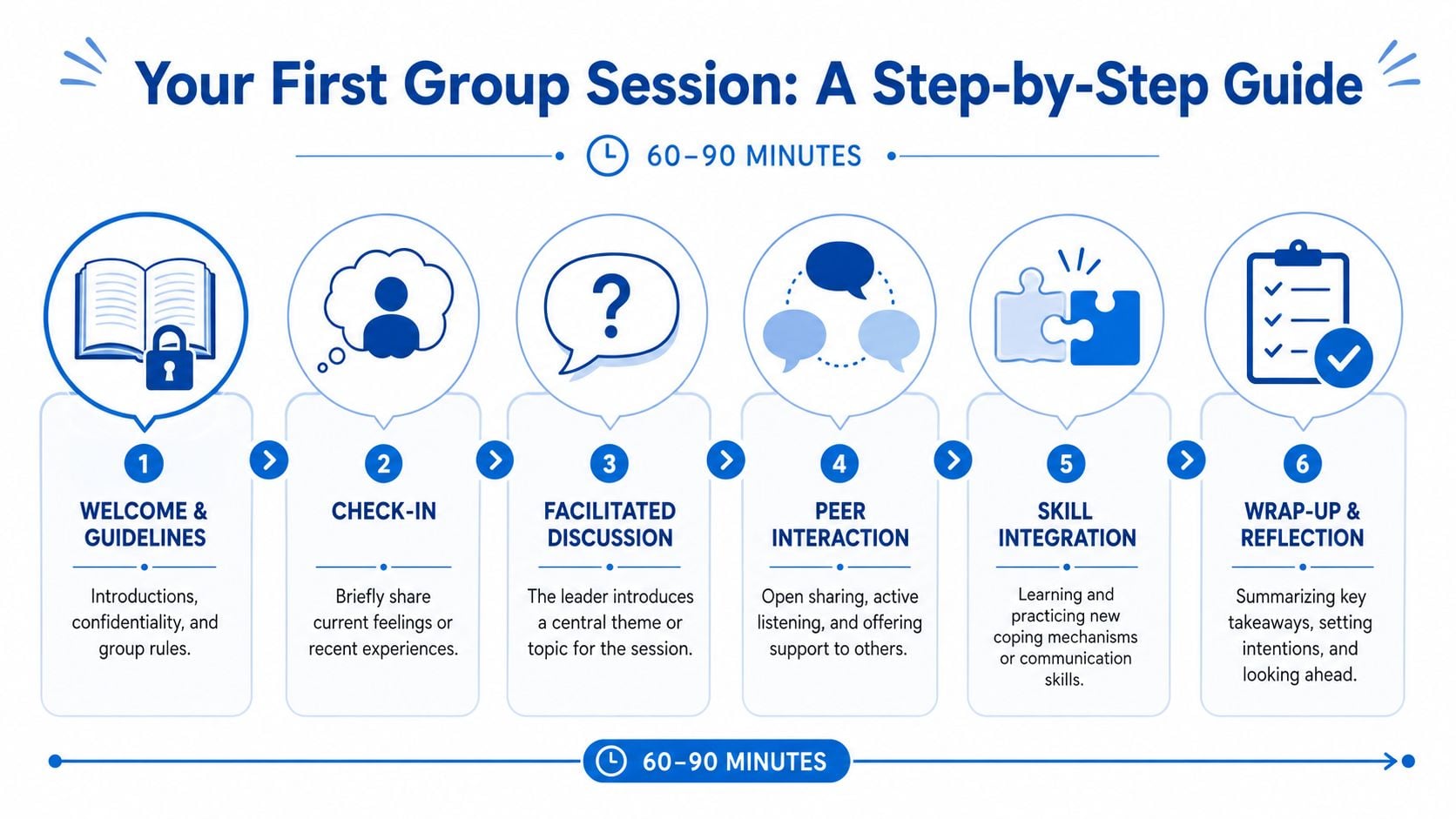
In many settings, group counseling is held in 60-to-90-minute weekly sessions with 6 to 12 individuals, according to Yeates Consulting's overview of group counseling benefits. That article also notes that the American Group Psychotherapy Association describes unique therapeutic factors in group that aren't replicable in one-to-one therapy, such as peer feedback and shared accountability.
A visual overview can make the process feel less mysterious.
Common fears before walking in
You might be wondering whether you'll have to tell your whole story on day one. You won't. Most facilitators invite participation, but they don't force it. Listening counts.
You may also worry about confidentiality. While no group can offer the same absolute control as your private thoughts, clear expectations matter. Group rules typically include privacy, respectful listening, no interrupting, and no shaming.
You don't have to impress the group. You only have to arrive willing to be honest at your own pace.
How a session usually unfolds
A first session often starts with introductions and a review of guidelines. The counselor explains the purpose of the group, how turn-taking works, and what members can expect. That helps settle nerves.
After that, there may be a brief check-in. People might share how their week has gone, what they're struggling with, or one thing they're working on. Some groups then move into a topic such as craving management, relapse warning signs, communication, or stress.
Later in the session, as members respond to one another, many newcomers realize the group is more thoughtful and less dramatic than they feared. People listen. They nod. They reflect back what they heard. The therapist keeps the room safe and focused.
If you'd like to see a brief example of group support in action, this video offers a helpful introduction.
The session usually ends with a wrap-up. Members may name one takeaway, one intention for the week, or one coping tool they plan to use. You don't have to leave feeling “fixed.” It helps enough to leave feeling less alone and a little more prepared.
How Group Work Amplifies MAT and Residential Care
People sometimes think of treatment as separate pieces. Medication here. Therapy there. Residential care somewhere else. In reality, the strongest recovery plans are connected. Group counseling often acts like the connective tissue that helps those pieces work together.
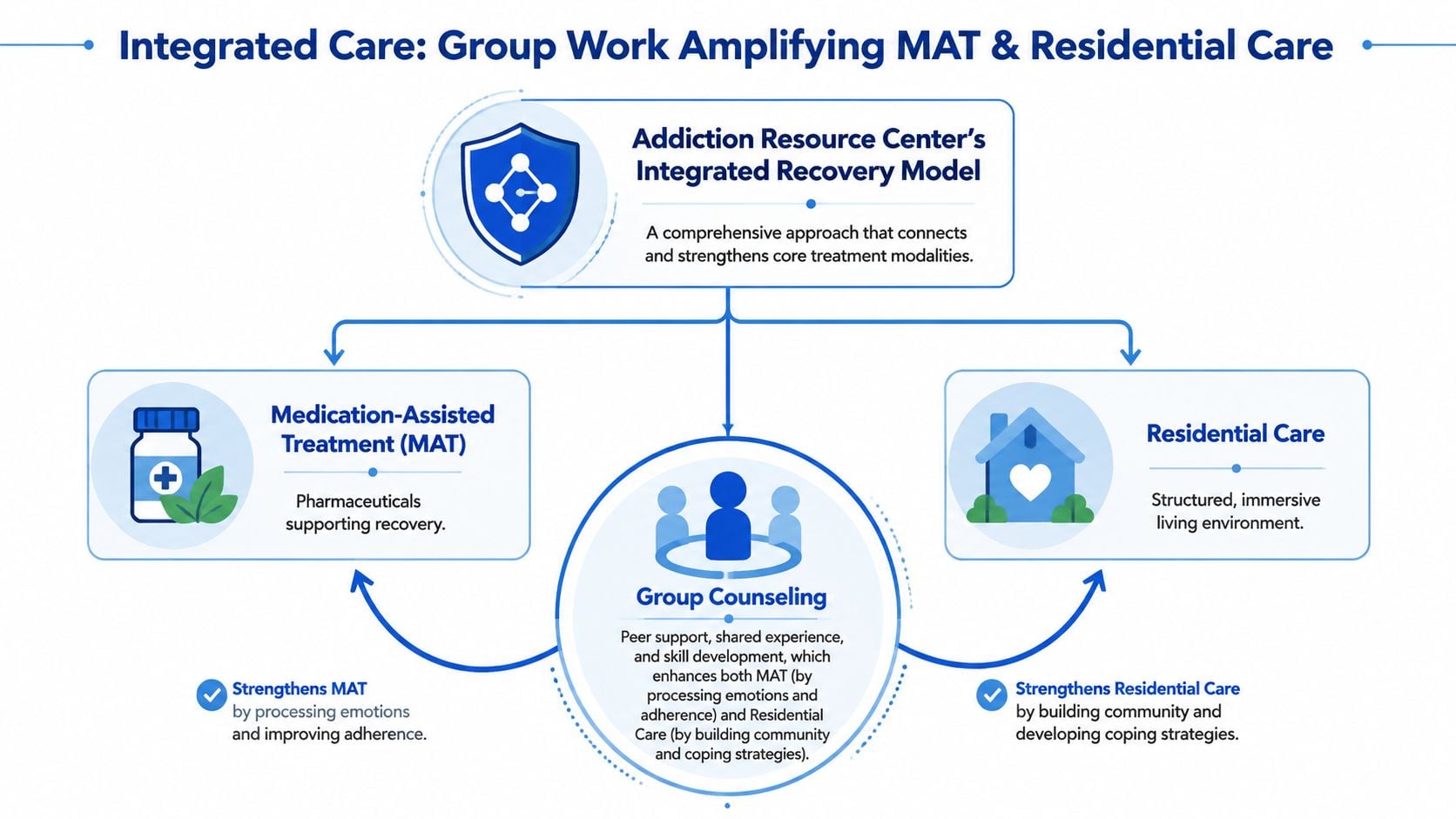
Why medication and group work fit together
Medication-Assisted Treatment, often called MAT, can help stabilize the body and reduce the chaos that makes recovery harder to sustain. But medication doesn't automatically teach a person how to repair relationships, notice thinking traps, handle shame, or build a sober routine.
That's where group work adds something concrete. People process resistance, learn coping tools, and hear from peers who are navigating the same challenges. According to research published in the National Library of Medicine, combining group CBT with pharmacotherapy is more effective for decreasing opioid use than pharmacotherapy alone.
That finding makes practical sense. Medication can reduce physiological pressure. Group can strengthen the daily behaviors that support recovery.
Why group matters after residential treatment
Residential care provides immersive structure. Meals are planned, schedules are set, and support is close by. The challenge often comes afterward, when a person returns to ordinary life and ordinary stress.
Group can ease that transition. It gives people a place to bring real-world problems as they happen. An argument at home, a paycheck, a lonely evening, a trigger on the drive home, all of these can be processed before they grow into relapse momentum.
- Structure after structure: Residential treatment creates routine. Group helps people keep one when they're back in the community.
- Reality testing: Peers can spot warning signs that someone might minimize on their own.
- Continuity of recovery language: People keep practicing the same skills instead of treating discharge like graduation from support.
This is why many clinicians see group counseling not as an add-on, but as a bridge. It connects stabilization to insight, and insight to daily action.
Frequently Asked Questions About Group Counseling
A family often asks the same question in different words on the first call. Will this feel safe. Will my loved one be pushed to talk. Will group help, or is it just a room full of people sharing stories.
Those are fair questions. Group counseling can sound exposed from the outside. In practice, a well-run group is usually more structured than people expect. It works like a guided classroom and a practice field at the same time. A therapist sets the tone, protects the space, and helps members turn real-life struggles into usable recovery skills.
Is Group Therapy as Effective as Individual Therapy
For many people with substance use disorders, yes. Group is a standard treatment method, not a lesser substitute for one-on-one care.
The reason is practical. Recovery rarely happens in isolation. People use substances in relationships, hide use in relationships, get triggered in relationships, and rebuild life in relationships. Group lets them practice honesty, boundaries, coping, and repair with other people in real time. Individual therapy still matters, especially for trauma history, private grief, or topics someone is not ready to say out loud in a room. For many clients, the strongest plan includes both.
That combination often creates a two-way healing process. A person brings insight from individual sessions into group, tests it in real conversations, then takes the feedback back to individual therapy. The same pattern can strengthen MAT and residential treatment. Medication may steady cravings. Residential care may provide safety and structure. Group helps connect those gains to daily life, week after week.
What If I Hate Talking in Front of People
That fear is common.
Many new members expect pressure to speak right away. Good groups do not work that way. In early sessions, listening counts. A person can learn a great deal by hearing how others describe cravings, shame, family stress, or small recovery wins.
Over time, silence usually becomes less intimidating because the room starts to feel less like a performance and more like a workshop. No one has to give a perfect answer. People speak when they are ready, and the counselor helps keep the pace safe and respectful.
Do Online Groups Really Work
For many people, they can. NCBI Bookshelf's overview of substance use treatment notes that telehealth and virtual care can improve access to treatment, which matters because recovery works better when people can attend consistently.
Online groups are often a good fit for people balancing work, childcare, transportation problems, health limitations, or long travel distances. The main question is not whether virtual care looks identical to in-person care. It does not. The better question is whether the format helps someone show up regularly, stay engaged, and keep recovery connected to daily life.
The best group is the one a person can attend consistently, speak honestly in, and use alongside the rest of the treatment plan.
Who Benefits Most From Group Counseling
Outgoing people are not the only ones who benefit. Quiet, thoughtful members often do very well because they listen closely, reflect, and speak with intention.
Group is often especially helpful for people who need:
- Connection. They feel cut off and need recovery support that includes other human beings, not just instructions.
- Structure. They do better with a regular place to check in, reflect, and reset.
- Feedback. They want help noticing patterns that are hard to see alone.
- Practice. They need a safe setting to try new coping skills, communication habits, and relapse-prevention responses.
Group is not the right starting point for every person at every moment. Someone in active withdrawal, severe psychiatric distress, or another acute crisis may need detox, medical support, or a higher level of care first. That is not a setback. It is careful treatment matching, the same way a doctor would stabilize a broken bone before starting physical therapy.
Begin Your Healing Journey at Addiction Resource Center
A family often arrives at this point in a very human way. A parent is watching for signs. A spouse is checking tone of voice and missed calls. The person using is tired of promises that hold for a day or two and then fall apart under stress. Everyone wants relief, but the treatment terms can sound like separate boxes instead of one plan.
Good care helps those pieces work together.
Group counseling often becomes the meeting place where recovery starts to feel real. Individual therapy can help a person speak about grief, shame, trauma, or fear in private. Medication for addiction treatment can lower cravings and ease the constant physical pressure to use. Residential care can create safety and distance from triggers. Group is where those gains are practiced with other people, in real time, with support and honest feedback.

That two-way process matters. A person receives support from the group, and the group also grows stronger when that person speaks openly, listens carefully, and shows what persistence looks like on a hard week. Recovery is not only about getting help. It is also about learning how to give trust, accept correction, and become part of a steady healing rhythm. Families often feel relief when they understand this, because it shows that progress is built through repeated practice, not perfect willpower.
Group works like the connective tissue in a treatment plan. It helps separate services move together. Someone on MAT can talk through side effects, stigma, or fears about dependency with peers who understand the difference between being sedated and being stabilized. Someone stepping down from residential care can use group to carry structure into ordinary life, where work stress, conflict, loneliness, and boredom return. That is often where treatment either starts to hold or starts to slip.
If you or someone you love is struggling with alcohol or drug use, the first step can stay simple. You can describe what has been happening, ask what level of care fits the situation, and learn whether detox support, MAT, residential treatment through a partner facility, IOP, or telehealth makes sense. For adults and families in Yuba City and across Northern California, Addiction Resource Center LLC offers substance use treatment with those options and can help you sort out the next step. You can call or text 530-625-7910 or visit 1002 Live Oak Blvd., Suite A, Yuba City, CA for confidential, practical guidance.