You're sitting with a Step 4 worksheet, and the page isn't blank anymore. It's crowded with names, old arguments, money fights, family injuries, and that one relationship that still has a hook in your ribs even after months of meetings. The temptation is to turn the whole thing into a story about how badly people …

You're sitting with a Step 4 worksheet, and the page isn't blank anymore. It's crowded with names, old arguments, money fights, family injuries, and that one relationship that still has a hook in your ribs even after months of meetings. The temptation is to turn the whole thing into a story about how badly people treated you, but AA's language pushes harder than that, because resentments are not just memories, they're active material in recovery.
The Big Book tells members to set resentments down on paper and list the people and institutions they're angry at, then AA's guide turns that into a structured inventory with the cause, the emotional impact, and your part in it (AA Step 4 guide). That structure matters because resentment can sit under the drinking without announcing itself. If you want a practical place to keep showing up, essential AA meetings for recovery can help anchor the work between inventories, and families who are trying to understand the same process often need a separate guide like AA for family members.
Table of Contents
- Why Resentments Matter in AA Recovery
- Building a Step 4 Resentment Inventory
- Sharing Your Inventory in Step 5
- Making Amends to Clear Resentments
- When Resentments Connect to Mental Health
- Everyday Coping Strategies for Resentment Triggers
- Relapse Prevention and Long-Term Recovery
Why Resentments Matter in AA Recovery
The person in front of me usually looks less angry than exhausted. They've got a worksheet on the table, a pencil that keeps going still, and the same sentence coming back in different forms. “I know I need to do Step 4, but I can't stop thinking about what they did.” For families trying to understand that pattern, this guide on AA for family members can help explain why resentments can keep recovery stuck.
Resentment is not treated as background noise
AA does not treat that loop as harmless. The Big Book directs members to write resentments down and examine them, and the AA Step 4 guide expands that work into columns that make the emotional chain visible (AA Step 4 guide). Resentment is rarely just anger, it blends hurt, pride, fear, shame, and the need to be right.
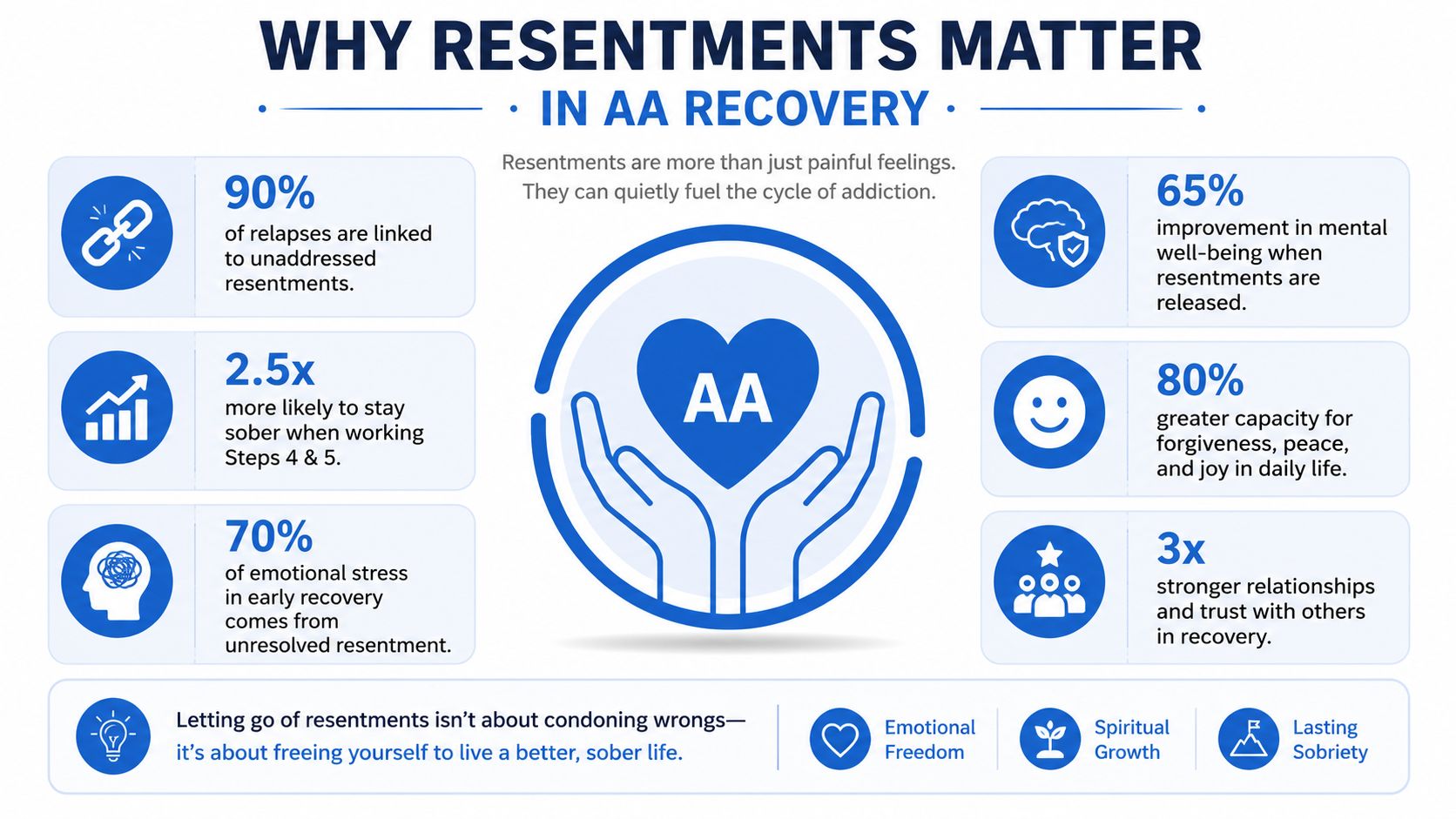
A clinical study of 180 adults in alcohol treatment found anger at the 98th percentile at baseline and still at the 89th percentile after 15 months, even though it improved over time (clinical study summary). The same study found that AA attendance was associated with better drinking outcomes, but attendance was not related to changes in anger itself. That split matters. It shows why a person can be getting sober while still carrying a lot of heat in the nervous system.
Practical rule: A resentment that feels emotionally justified can still be a relapse risk if it keeps repeating without being examined.
That's the part people miss. They think the feeling has to disappear before recovery can work. AA's logic is narrower and more usable. You can still be angry and still protect sobriety, but you can't keep feeding the story and expect your thinking to stay clean.
What the evidence says about AA and outcomes
A major review in Alcoholics Anonymous Effectiveness: Faith Meets Science reported that abstinence rates are about twice as high among people who attend AA, and that higher attendance is linked to higher abstinence across different samples and follow-up periods (review in PMC). That does not mean every Step 4 entry produces a spiritual breakthrough. It does mean AA's broader recovery model has a long track record of pairing inventory work with better alcohol outcomes.
The useful takeaway is blunt. A single resentful episode can become a private relapse trigger if it stays unspoken, unexamined, and rehearsed. AA's answer is not to deny the injury. It is to write it down, look at it clearly, and keep the drinking problem from feeding on it. In practice, that often runs alongside clinical care, especially when trauma, depression, anxiety, MAT, or IOP are part of the picture. That combination can keep a person honest about what is spiritual work, what is symptom management, and what needs outside treatment. Men and women who need a steady place to start often benefit from essential aa meetings for recovery, because the meeting room gives the resentment work somewhere to land before it hardens into isolation.
Building a Step 4 Resentment Inventory
A strong Step 4 inventory is not a memoir. It's a working document. The more it sounds like a courtroom closing argument, the less useful it becomes for Step 5, Step 8, Step 9, and later relapse-prevention work.
Use one episode, one cause, one defect
The Step 4 format works best when each resentment stays concrete. A helpful guide describes a four-column method that captures who or what you resent, the cause, what part of self was hit, and where you were at fault, with resentment often tied to injuries to self-esteem, pride, pocketbook, relationships, ambition, or security (Step 4 inventory guide). That breakdown keeps the inventory from becoming a blur of complaints.
Take a resentful ex-boss. One entry might read like this:
- Who or what: Former supervisor
- Cause: Public criticism in front of the team
- What it hit: Pride, self-esteem, ambition
- My part: I kept replaying it, fed the grievance, and started checking out at work
The point is not to soften the wrong. The point is to identify the exact pressure point. AA's inventory becomes more useful when it shows how the same kind of injury keeps happening across family, work, and relationships.
Keep the language short enough to use later
Write it like a field note, not a confession letter.
That rule matters because Step 4 is meant to be revisited, not admired. One cause per entry is cleaner than a whole paragraph of context. One emotional wound per line is better than a story that tries to prove the case.
A lot of people make the same technical mistake. They treat resentment as one big emotion. In practice, it's usually a chain. Something happens, the ego gets hit, fear kicks in, and the mind starts building a case. When the chain is visible on paper, it's easier to see the pattern before it shows up again at the next family dinner or staff meeting.
If you want a structured companion while you work through the page, self-care worksheets for addiction recovery success can sit alongside the inventory without replacing it. AA Step 4 is not about polishing your writing. It's about making the truth usable.
Sharing Your Inventory in Step 5
Writing the inventory is usually easier than reading it aloud. Once a person gets to Step 5, the true test shows up. Shame starts talking, the urge to minimize returns, and the old instinct to protect the image of being “fine” gets loud.
Choose one safe listener and keep it contained
Step 5 asks for sharing “to another human being,” and in modern practice that can mean a sponsor, clergy member, or a trusted counselor. The best choice is usually the person who can hear the material without rescuing, arguing, or turning it into a lecture. If you need help sorting that out, finding the right AA sponsor is a solid place to think through the decision.
Before you speak, simplify the inventory. Bring the worksheet, not the whole backstory. Pick a private setting. Set a rough time limit so the conversation doesn't sprawl into a crisis session.
A simple opening works better than an apology for taking up space:
- “I've got my Step 4 written out, and I need to read the resentment column first.”
- “I'm not looking for analysis, I need to say this out loud cleanly.”
- “If I get flooded, I may need to pause and keep going later.”
Know what to do if the room feels unsafe
If shame spikes, your body goes into panic, or you start thinking about drinking, stop and name what's happening. That's not failure. That's information. A sponsor or counselor can help you slow the pace, and if the inventory surfaces trauma, self-harm thoughts, or memories that feel bigger than a Step 5 share, the right move is to bring in clinical support rather than forcing the conversation.
Record what happened afterward. Note what triggered shame, where the conversation stayed useful, and where you need more structure. Those details matter when Step 8 and Step 9 turn the page into action.
Making Amends to Clear Resentments
An amend is not a polished apology. It's a repair attempt with boundaries, consequences, and changed behavior. People often try to use Step 9 to get emotional relief, but that usually backfires because the other person can feel the hidden agenda.
Direct amends and indirect amends are not the same thing
When it's possible and safe, direct amends means going to the person, naming the harm, and stating what changed. When direct contact would cause more damage, amends can be made indirectly through changed conduct, restitution, or another form that does not force contact. The point is repair, not self-display.
Practical rule: If your main goal is to be seen as sincere, you're probably using the amend to manage your image.
That distinction catches a lot of people. A “clean-up” amend often sounds like a long explanation that circles back to the speaker's pain. It can also dig up fresh resentment if the person on the other side doesn't respond warmly. That doesn't mean the amend failed. It means the amendment was never supposed to be a negotiation for emotional payoff.
Watch for the common traps
A Step 9 amend is probably being done for the wrong reason if it sounds like any of these patterns:
- Over-explaining: You keep adding context so you won't look bad.
- Seeking reassurance: You want the other person to tell you you're forgiven.
- Trading guilt for relief: The goal is to feel lighter, not to repair harm.
- Rewriting history: You soften the facts until the injury sounds accidental.
- Forcing contact: You push ahead even when the person is unsafe or unavailable.
When direct contact isn't appropriate, the work still counts. Changed behavior, restraint, and practical restitution can be more honest than a dramatic speech. Step 10 then becomes the daily version of this same work, because resentments that show up again need to be noticed early, not after they've hardened.
A good amend leaves less residue, not more. If you finish a conversation and feel the need to text ten explanations, that's usually a sign the motive was still tangled.
When Resentments Connect to Mental Health
AA language is useful, but it does not explain everything. A person can have a real resentment and still have trauma, depression, or anxiety driving how intense it feels. That is the point where the conversation has to get more precise.
The Big Book names bitterness, security, and depression, but it is not a clinical manual
The Big Book asks members to look at resentments tied to emotional and financial security and to examine whether bitterness, frustration, or depression are present, as described in the AA Step 4 guide. It does not offer clinical guidance for people whose anger is reinforced by trauma symptoms or co-occurring disorders. That gap matters because many people in treatment are dealing with substance use and mental health needs at the same time.
The clinical reality is that co-occurring disorders are common enough that a resentment cannot always be handled as a purely spiritual exercise. If a person is dissociating, panicking, stuck in trauma triggers, or cycling through major depression, Step 4 still has value, but it may not be enough by itself.
Bring in the right kind of help
A licensed clinician should be integrated into the plan when trauma symptoms or co-occurring disorders amplify resentment intensity. Therapy can help separate old injury from present-day danger, and medication-assisted treatment, or MAT, can support sobriety while the nervous system settles. An Intensive Outpatient Program, or IOP, can also fit well alongside AA, especially when the person needs structure, relapse-prevention skills, and regular clinical contact.
If you need a more detailed map of that overlap, dual diagnosis and addiction gives the right framework to hold in mind. When a sponsor and a counselor are both involved, they should not compete. The sponsor can help with the inventory and the steps, while the clinical team handles diagnosis, symptom management, and safety.
In Yuba City and across Northern California, integrated care often means exactly that kind of layering. AA gives peer support and spiritual structure. IOP, MAT, and counseling address the parts of resentment tangled with trauma, anxiety, depression, or unstable use patterns. When those pieces work together, the person is less likely to confuse a clinical trigger with a moral failure.
Everyday Coping Strategies for Resentment Triggers
The worksheet only matters if it shows up in daily life. Most resentment triggers are predictable once you've filled out enough inventory entries. Same person, same tone, same pressure point. Same story, different day.
Use the inventory as a trigger map
If a coworker makes a smug comment, ask which column it belongs in before you answer. If a partner brings up an old mistake, notice whether the hit is to pride, security, or relationships. If a family member asks about money, that may be pocketbook resentment, and the right response is often to pause before you defend yourself.
A simple reset helps:
- Name the feeling.
- Name the column.
- Choose one action, not ten.
HALT still earns its place here. Hungry, angry, lonely, and tired are the conditions that make resentful thinking louder and slower to interrupt. When a grievance starts looping, use a hard stop rule. Read a pre-written line, text a recovery contact, open a meeting app, or leave the room long enough to break the replay.
A thought that keeps circling without action is usually a signal, not a command.
That's where sustained meeting attendance matters. The broader AA evidence base links higher attendance with higher abstinence, so these little habits are not just self-help polish. They're part of a recovery pattern that has been studied for decades (review in PMC).
You do not need to win the argument in your head. You need to prevent the grievance from becoming the center of the day. That's a much smaller task, and it works better.
Relapse Prevention and Long-Term Recovery
Resentment is not a defect to erase. It's a signal to read. Step 4 gives you the decoder, and Step 10 keeps it in play after the page is finished.
Spot the early warning signs before they grow teeth
Early warning signs usually show up as rumination, isolation, and the slow replacement of recovery work with grievance rehearsal. When that happens, go back to the inventory. Update the entry instead of feeding the story.
For people looking for a broader relapse-prevention framework, relapse prevention strategies fit naturally beside the step work. The point is simple. The earlier you name the resentment, the less power it has to steer behavior.
If you're active in AA, the next move is usually ordinary, not dramatic. Write one resentful thought the way the inventory asks. Keep it concrete. Tell someone safe before the thought hardens into a plan to withdraw, use, or disappear. That single act is where long-term recovery starts to become real.
Addiction Resource Center LLC offers detox, MAT, residential rehabilitation through its partner facility, and IOP with support for co-occurring mental health needs. If resentments are getting tangled with anxiety, trauma, or relapse risk, visit Addiction Resource Center LLC to explore care that can work alongside AA and help you build a steadier recovery plan.