Nar-Anon meetings are free peer-support gatherings for friends and family of someone struggling with addiction, and they use the same 12-Step principles as Narcotics Anonymous while focusing on the loved one's healing rather than the person using drugs. Nar-Anon has grown from 20 regular weekly meetings in 1970 to about 77,000 meetings in 145 countries …


Nar-Anon meetings are free peer-support gatherings for friends and family of someone struggling with addiction, and they use the same 12-Step principles as Narcotics Anonymous while focusing on the loved one's healing rather than the person using drugs. Nar-Anon has grown from 20 regular weekly meetings in 1970 to about 77,000 meetings in 145 countries each week by 2024 (source), so if you're searching at midnight because someone you love has changed, you're not stepping into something tiny or isolated.
You may be staring at a phone screen, trying to decide whether you're overreacting. Maybe you've noticed missed calls, money missing, mood swings, or promises that never seem to hold. That search for answers is often the first sign that a family member needs support too, not just the person with the addiction.
Table of Contents
- Why You Are Searching for This Right Now
- What Nar-Anon Is and How It Works
- Meeting Formats and How to Choose
- What to Expect at Your First Meeting
- Finding a Meeting in Northern California
- How Nar-Anon Supports Your Recovery Journey
- Next Steps and When to Seek Additional Help
Why You Are Searching for This Right Now

You might be in the room with someone you love and still feel a mile away from them. The signs can be small at first, a changed routine, a shorter fuse, a growing pile of excuses. Then the worry gets louder than the explanation.
Nar-Anon meetings are free peer-support gatherings for friends and family of someone struggling with addiction, and they give loved ones a place to talk, listen carefully, and learn from people who already live this reality. They are built on 12-Step principles, but the focus stays on your recovery, not on fixing the other person.
That distinction matters. A parent, spouse, sibling, or adult child can spend months trying to control outcomes that aren't controllable. In a Nar-Anon meeting, the conversation shifts toward boundaries, emotional steadiness, and what to do next without carrying the whole situation alone.
If you're searching tonight, you probably don't need a lecture. You need a place where people understand why you're tired, confused, and still trying.
The reason Nar-Anon exists is simple. Addiction affects the whole family system, and loved ones often need support long before they know how to ask for it. Meeting after meeting, Nar-Anon gives people a way to speak without being judged and to hear from others who are also learning how to respond instead of react.
What Nar-Anon Is and How It Works
Nar-Anon is a 12-Step fellowship for people affected by someone else's drug use. It is not treatment for the person using substances, and it is not family therapy in the clinical sense. It is a mutual-support space where members help each other make sense of a painful situation and practice healthier ways of living through it.
The basic structure
Most meetings follow a similar rhythm. People open with readings, introduce the group format, and then share from personal experience. Some meetings use a topic, some use literature, and some leave more room for open discussion. That flexibility is part of the design, because no two families arrive with the same story.
Nar-Anon's scale has kept growing, from more than 70,000 weekly meetings in 144 countries in 2018 to about 77,000 meetings in 145 countries each week by 2024 (source). The organization also says it does not keep attendance records, so meeting volume is the clearest public sign of reach and accessibility (source).
How it differs from Narcotics Anonymous
Many newcomers get mixed up. Narcotics Anonymous is for people seeking recovery from drug use. Nar-Anon is for the people who love them. The principle is the same, shared experience, anonymity, and step-based growth, but the target of support is different.
Two different rooms in the same house. One room is for the person learning to stay sober. The other is for the family member learning how to breathe, listen, and set limits without losing themselves.
Practical rule: If your first question is, “How do I make them stop?”, Nar-Anon is where you learn how to take care of yourself while that question stays unresolved.
Why anonymity matters
Anonymity is more than privacy. It helps people speak without worrying that their story will be repeated at work, in the neighborhood, or inside the family. That is why the fellowship protects first names, personal sharing, and group trust so carefully.
Meeting Formats and How to Choose
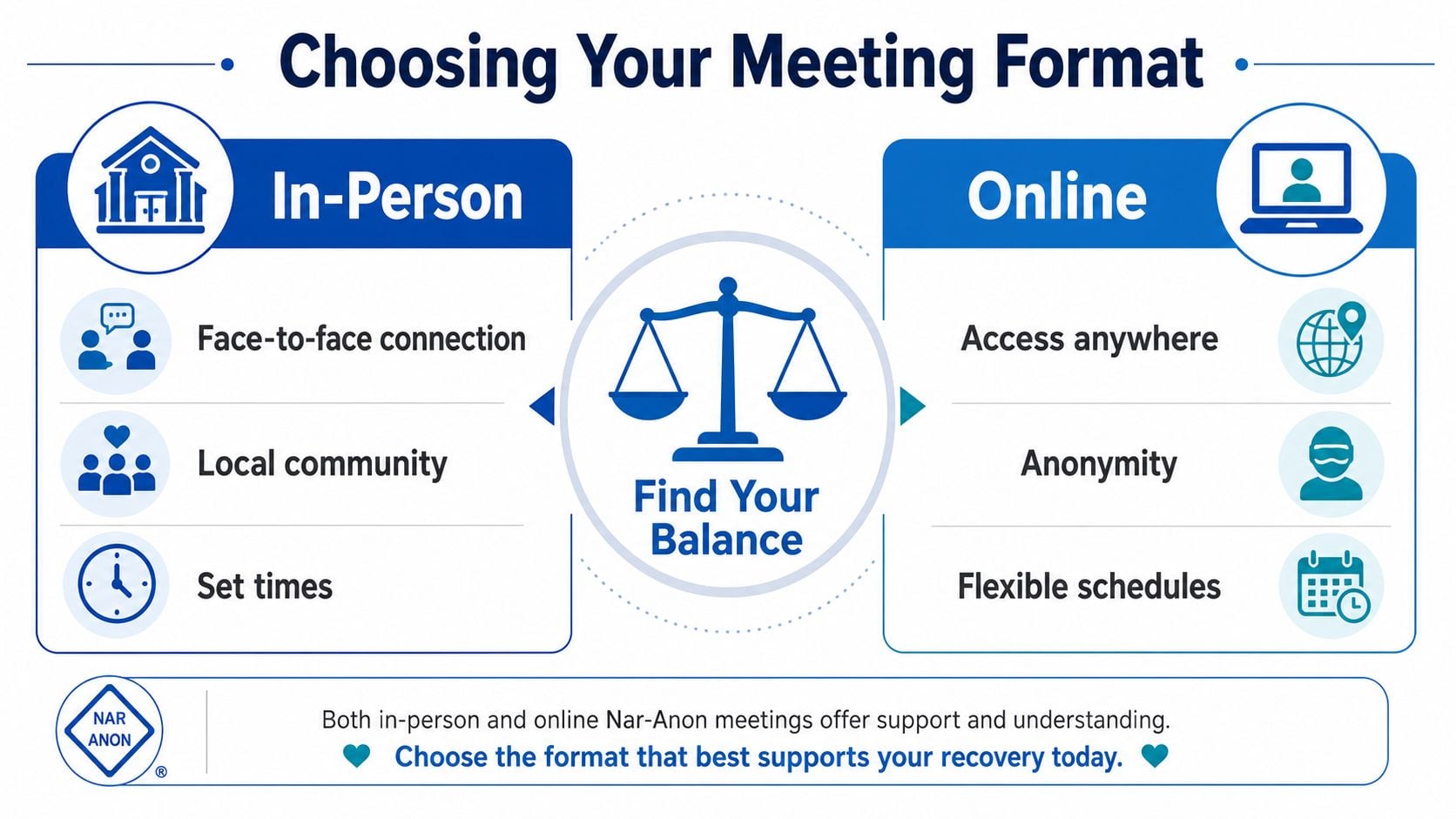
The right format is the one you'll use. Some people need the quiet accountability of sitting in a room with others. Some need the flexibility of a screen because they're caregiving, working odd hours, or protecting privacy at home.
In person, online, and phone meetings
In-person meetings can feel grounding because faces, tone, and body language are easier to read. They also help people connect with a local recovery community, which can matter when you need consistency.
Online meetings make access much easier when travel, childcare, distance, or privacy get in the way. Nar-Anon's virtual guidance shows that online meetings are not casual free-for-alls, they're managed by the group, area, region, or NSO, not by one individual (source).
Phone meetings work well for people who want anonymity without video or who have limited internet access. They can feel simpler, but you may lose some of the connection that comes from seeing other members.
How online safety and privacy are protected
Nar-Anon's virtual-meeting guidance uses specific controls to keep meetings orderly and private. Members are asked to display only a first name, optionally with location, and the group can approve audio-only recordings if group conscience allows it (source). A Technical Moderator can mute microphones, disable video, remove disruptive participants, and make sure someone can open and close the meeting if needed (source).
That matters because online support only feels safe when people know the rules are real. If a meeting is meant to protect anonymity, the structure has to match that promise.
A simple way to choose
- If privacy is your top concern: start with online or phone options.
- If you need human presence: try in-person first, then compare.
- If your schedule changes constantly: use virtual meetings that fit your day.
- If you feel unsure: start with whichever meeting you can attend this week, then adjust.
For a practical scheduling reference, use the NA meetings schedule guide.
The best format is often the one that lowers the number of excuses between you and the meeting.
What to Expect at Your First Meeting
A first Nar-Anon meeting usually feels less dramatic than people fear. You'll likely hear a welcome, a few readings, maybe an explanation of confidentiality, and then a chance to listen or share. If you don't want to speak, you usually don't have to.
The flow of a typical meeting
Most groups begin by orienting newcomers to the format, then move into the main topic or sharing time. Members speak from their own experience rather than arguing over the “right” way to handle addiction in a family. The point is not to debate, it's to make room for honest reflection.
Some meetings are speaker-based, some are discussion-based, and some center on literature or step work. Nar-Anon service materials also show that groups may address crosstalk, advice-giving, low attendance, member crisis issues, Narcan, finances, newcomers, outreach, service, and step work, so the topic can change from one meeting to the next (source).
Meeting etiquette that newcomers usually miss
Crosstalk is usually discouraged. That means members don't interrupt, correct, or directly advise one another during shares. The reason is simple, people need a protected space to speak without being managed by the room.
You don't have to tell your whole story on day one. Listening counts, and showing up counts too.
If you do share, keep it centered on your own experience. “This is what happened to me” works better than “Here's what you should do.” That shift helps the meeting stay safe for people who are already overwhelmed.
A realistic first-visit mindset
You may leave with more questions than answers. That's normal. The first meeting is often about reducing fear, not solving the whole family crisis in one hour.
If you're nervous, bring a notebook, plan to arrive a few minutes early, and give yourself permission to observe. You're not being tested. You're learning the room.
Finding a Meeting in Northern California
If you're in Yuba City or anywhere in Northern California, the most useful starting point is the official Nar-Anon meeting grid, because it reflects how the fellowship is organized across regions and time zones. The grid also shows that virtual access is now a core part of how many groups operate, not an afterthought (source).
How to search without getting overwhelmed
Start by looking for a meeting that matches your practical constraints. If you need privacy, choose a virtual option. If you want local accountability, search for an in-person group in your region and confirm the location, time, and contact method.
Nar-Anon's virtual system is decentralized, which means session access is often handled through a contact email listed for that meeting rather than one central dashboard (source). That setup can feel clunky at first, but it usually serves a purpose, it protects anonymity and lets groups manage their own schedules.
What to check before you join
- Meeting name and region: make sure the listing is Nar-Anon, not a different fellowship.
- Format: confirm whether it is in person, virtual, or phone-based.
- Access method: note whether you need to email, register, or use a direct join link.
- Age fit: if the family member is younger, look for Narateen options, which are meant for teens rather than adults.
- Privacy rules: check whether cameras are optional, required, or off by default.
If you're helping a young person, or you're a younger family member yourself, Narateen can be the better fit. If you're an adult supporting an adult child, spouse, or sibling, Nar-Anon is usually the right place to start.
For support on communicating with a loved one while you look for meetings, use how to support someone in recovery.
Verifying that a meeting is legitimate
A real Nar-Anon meeting will use Nar-Anon language, follow a recognizable group format, and protect anonymity. If a listing feels vague, contact the listed group email and ask direct questions before joining. You're allowed to be cautious.
How Nar-Anon Supports Your Recovery Journey
People often expect relief from one meeting, then feel discouraged when they still feel shaky afterward. That reaction makes sense. Family stress doesn't disappear on command, and support works best when it becomes part of a steady routine.
What regular attendance can change
The best available survey and review data point in the same direction, regular participation matters. In the 2018 NA Membership Survey, respondents attended an average of 2.19 meetings per week, and 32% had previously attended another 12-Step fellowship (source). A separate review found that three or more AA/NA meetings per week were associated with complete abstinence, and many people who started attending later stopped for at least a month, 85% for NA and 91% for AA (source).
Those numbers are about substance-use recovery, not Nar-Anon specifically, but they still matter here. They show a broader recovery truth, support tends to work better when people keep showing up. For loved ones, that often translates into more stability, clearer boundaries, and less isolation over time.
Where Nar-Anon fits beside treatment
Nar-Anon is not a substitute for professional care when someone needs detox, residential treatment, medication-assisted treatment, or structured outpatient support. It works best as a companion to those services, especially when the family system is strained and everyone needs a place to stay grounded.
That's where a provider like Addiction Resource Center LLC can fit into the picture for families in Northern California. Its programs include medically supervised detox with MAT, residential rehabilitation through Ona Treatment Center in Browns Valley, and an Intensive Outpatient Program available in person and via telehealth. For families looking for a direct next step, that kind of clinical support can run alongside a peer group instead of replacing it.
Why the combination can help
- Nar-Anon gives you peer connection, practical language, and emotional steadiness.
- Clinical treatment gives the person with addiction a structured care plan.
- Family education helps everyone stop guessing and start responding more calmly.
The family member's job is not to become a second clinician. It's to stay supported enough to make wiser choices.
If faith is part of your family's coping style, you may also want to understand how faith based recovery works as one possible framework alongside peer and clinical support.
Next Steps and When to Seek Additional Help
A father once called a support line after weeks of trying to “keep the peace” at home. He didn't need to know everything about recovery that day. He needed one clear move, and he needed to hear that asking for help wasn't betrayal. That's the spirit behind Nar-Anon too, small honest steps, taken before the situation gets any heavier.
If you've read this far, your next step can be simple. Pick one Nar-Anon meeting, check the format, and attend once without expecting perfection. If the person you love is also in crisis, or if your home feels unsafe, pair that meeting with professional help instead of waiting for the situation to settle on its own.
For a deeper look at what family support looks like in practice, review supporting someone in recovery. If you need treatment options for the person using substances, or you want guidance for a family member who's overwhelmed, Addiction Resource Center LLC offers detox, residential rehab, IOP, and telehealth support for adults 18+ in Yuba City and nearby communities.
If you're ready to talk through the situation, visit Addiction Resource Center LLC to learn about detox, residential treatment, and outpatient care. Their team can help you think through what fits your family's needs and how to move forward with less confusion.