
Dual Diagnosis Outpatient Treatment Explained
Reviewed by Tiffany Komba, LMFT #136055 · Last reviewed November 22, 2026
Published November 22, 2026
Contents
Only 9.1% of adults with co-occurring mental health and substance use disorders received both types of care in earlier national estimates reported by the National Institute on Drug Abuse. That gap reframes dual diagnosis outpatient treatment: the challenge isn't finding a therapist and an addiction counselor. It's getting both to work from the same plan, with enough support to keep someone safe while they live at home.
If you or a loved one is in crisis, call or text 988 (Suicide & Crisis Lifeline) or call 911 for an emergency.
Why Both Conditions Need One Outpatient Plan
In 2023, 35% of U.S. adults aged 18 and older with another mental disorder also had a substance use disorder, according to NIDA, citing the 2023 National Survey on Drug Use and Health. That overlap is why mental health care and addiction treatment shouldn't operate as separate tracks.
Dual diagnosis, also called co-occurring disorders, means a person has at least one mental health disorder and at least one substance use disorder. It describes conditions that need care, not the person's identity. It also doesn't mean that every episode of sadness, anxiety, or substance use establishes a diagnosis.
The relationship between the conditions is easier to understand through a practical example.
Treat the leak as well as the water
Say an adult drinks each evening to quiet anxiety. They stop drinking, but still dread work, avoid friends, and lie awake replaying conversations. An addiction-only plan might address alcohol while leaving the anxiety largely untouched.
That's like bailing water from a boat without fixing the leak. Stopping alcohol or opioids matters, but untreated depression, trauma symptoms, or anxiety can keep filling the hull. Mental health treatment alone can also miss intoxication, withdrawal, and patterns of use that affect symptoms.
Practical rule: A referral isn't a completed treatment plan. Someone must remain responsible for connecting the care.
Outpatient care means living at home while returning for therapy, medical or psychiatric coordination, and recovery planning. It's repeated contact, not a single appointment followed by instructions to find help elsewhere.
A written plan makes that coordination visible. The important question for a client is simpler: does the plan explain how both conditions will be treated, who handles each task, and what happens when symptoms change?
Outpatient IOP and Higher Levels Compared
| Level | Weekly hours | Where you live | Fits when |
|---|---|---|---|
| Standard outpatient | Scheduled appointments with less frequent contact | At home | An adult with stable symptoms can attend reliably and practice recovery skills independently |
| Intensive outpatient (IOP) | Multiple weekly treatment sessions | At home | A working adult with depression and alcohol use needs structure but can remain safe between sessions |
| Partial hospitalization | Substantial daytime programming with frequent clinical monitoring | Nights at home | An adult needs close daytime support but doesn't require overnight supervision |
| Residential or inpatient | Around-the-clock setting rather than appointment-based care | On site | A person needs a protected setting; withdrawal or an acute psychiatric crisis may require medically equipped inpatient care |
Program names don't establish safety on their own. Exact schedules and admission criteria should be confirmed during assessment. Residential rehabilitation, medical detoxification, and psychiatric inpatient care aren't interchangeable, even though each involves staying on site.
An adult with moderate depression and alcohol use might function at work yet struggle every evening with cravings and isolation. IOP may offer enough contact to practice skills, review symptoms, and respond before problems become a crisis. A person with unstable withdrawal needs medical evaluation first, not a fuller group calendar.
Match the setting to the time between visits
Standard outpatient treatment works best when someone can use coping strategies without frequent supervision. Their appointments support ongoing recovery rather than provide the main structure holding each day together. Reliable attendance, medication follow-through, and a workable home environment matter as much as a diagnosis.
IOP adds repeated opportunities to notice trouble. A counselor may learn that cravings intensify after a shift, that a medication causes daytime sleepiness, or that family conflict precedes missed sessions. The team can then change the plan while the person continues living in their community.
Partial hospitalization provides more concentrated daytime care. It can fit someone who needs frequent clinical observation but remains safe overnight. It still leaves evenings and nights outside the program, so clinicians must assess those hours rather than assume daytime attendance solves every risk.
Choose the level that can respond when you're struggling, not simply the one that sounds least disruptive.
Movement between levels is part of treatment
A person may complete medical detox, enter residential treatment, and later step down to IOP. Another may begin outpatient care and need a more intensive setting after psychiatric symptoms worsen. Neither path establishes success or failure by itself.
Useful placement questions include:
- Between-session safety: Can the person manage urges and symptoms when staff aren't present?
- Medical needs: Is withdrawal, intoxication, or a medication problem beyond the program's capabilities?
- Living conditions: Is there somewhere safe to sleep and enough stability to participate?
- Response capacity: Who evaluates a concerning change, and how quickly can the person reach appropriate care?
Unsafe housing deserves a concrete response, but it doesn't automatically establish a need for psychiatric hospitalization. The assessment should identify both the clinical setting and any housing support needed. The right placement addresses the actual risk, not just the available opening.
What Integrated Care Looks Like Day to Day
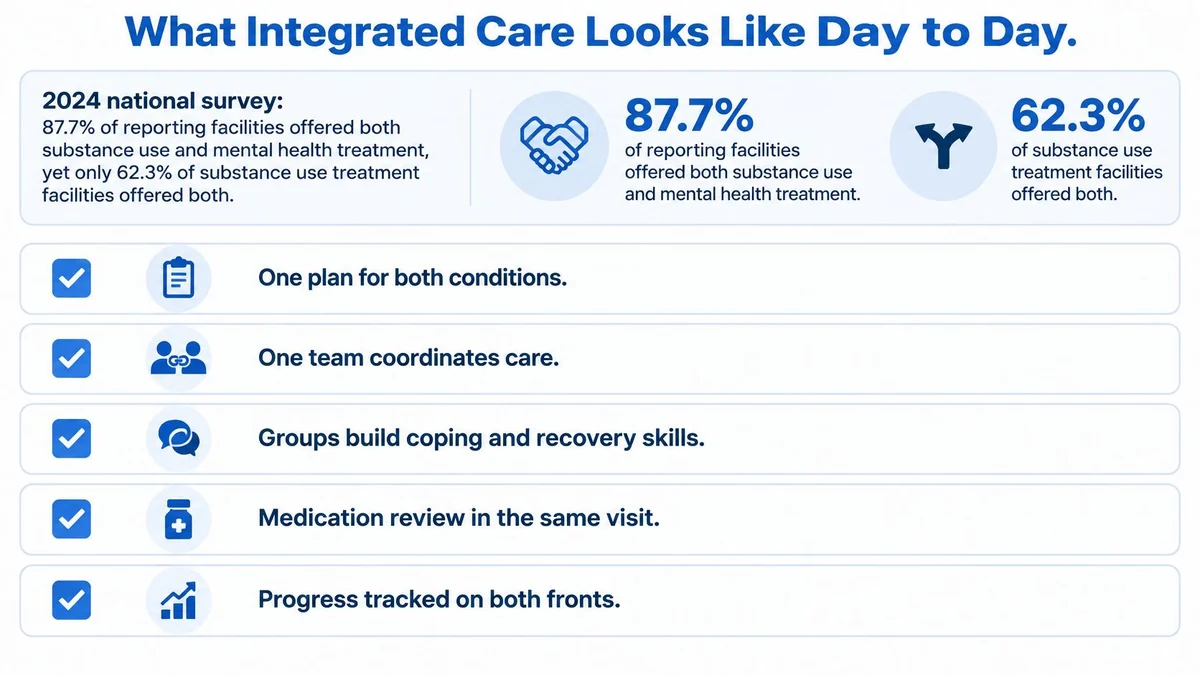
In the 2024 National Substance Use and Mental Health Services Survey, 87.7% of reporting facilities offered both substance use and mental health treatment, while 62.3% of substance use treatment facilities reported treatment for co-occurring disorders alongside serious mental illness or serious emotional disturbance. These measures cover different facility groups and service descriptions. They don't establish how many programs integrate care.
They do highlight an important distinction: offering both services isn't the same as coordinating them. A shared address doesn't guarantee a shared clinical plan.
A person might see a counselor early in the week and a psychiatrist later, yet still have to carry every update between them. That arrangement can leave medication changes, cravings, missed appointments, and safety concerns disconnected.
The practical difference is visible in the daily workflow.
Questions that reveal whether care is connected
Use these checks to distinguish a coordinated program from separate services:
- Shared assessment: Will the team assess substance use, psychiatric symptoms, medical history, and current safety together?
- Written plan: Will you receive a plan covering both conditions, with named responsibilities?
- Medication reconciliation: Who maintains the complete list of prescriptions, nonprescription products, and substances?
- Progress monitoring: Will clinicians review both mental health symptoms and substance use rather than track only attendance?
- Crisis pathway: What happens if withdrawal, severe panic, suicidal thinking, or psychosis develops?
- Team communication: How do clinicians exchange updates and decide when treatment needs to change?
At Addiction Resource Center, the clinical team, including therapists, counselors and psychiatric support when needed, communicates regularly, shares assessment information, and adjusts the plan collaboratively. Medication questions are coordinated with the person's prescriber rather than changed in isolation.
Test the answers with a scenario
A useful first-call question is: “If my anxiety worsens and my cravings increase, who evaluates the change?” The answer should identify a responsible clinician and a response process, not offer another telephone number.
Likewise, ask what happens if panic or unusual perceptions appear during early recovery. The team needs to evaluate the person rather than assume every symptom comes from either addiction or a preexisting psychiatric diagnosis.
For people whose concerns include trauma, understanding PTSD and substance use can help them describe symptoms and treatment priorities. They shouldn't have to recount traumatic details to every provider just to keep care connected.
Outpatient integration includes escalation. A team that shares information but can't arrange a timely response to deterioration still leaves an important gap.
Therapies and Medicines Inside One Plan
Therapy and medication management should proceed together when both are indicated. A person shouldn't have to finish addiction treatment before receiving psychiatric attention, or achieve complete psychiatric stability before anyone addresses substance use.
SAMHSA's issue brief on co-occurring disorders identifies motivational interviewing, integrated case management, dual-recovery supports, combined medication approaches, and assertive community treatment for appropriate high-need populations. It also notes that only about half of outpatient mental health and substance use facilities reported a dedicated co-occurring-disorder program in 2020. A service label therefore deserves a closer look at what clinicians do.
Match the approach to the problem
Motivational interviewing helps someone explore ambivalence without turning treatment into an argument. A person may want better sleep and fewer conflicts while still feeling unsure about changing alcohol use. The clinician connects those priorities to practical choices.
Cognitive behavioral therapy, or CBT, examines thoughts and situations that precede use. For example, someone who thinks “I can't get through a social event without drinking” can practice alternatives and test that prediction. Dialectical behavior therapy skills, or DBT skills, offer concrete ways to tolerate distress, regulate emotions, and handle conflict without acting on every urge.
Other supports solve different problems:
- Integrated case management: Connects clinical goals with barriers such as transportation, appointments, and housing.
- Dual-recovery supports: Make room for both psychiatric recovery and substance use recovery.
- Assertive community treatment: Brings intensive team support to appropriate people whose needs exceed a conventional clinic model.
Screening also goes both directions. Mental health clinicians need an accurate substance use history, while addiction clinicians need to assess mood, trauma symptoms, anxiety, and psychosis. With permission, information from family or previous providers can help clarify what existed before substance use and what changes during stabilization.
Review medicines as a complete list
Alcohol, opioids, sedatives, stimulants, psychiatric medicines, and addiction medicines can create clinically important interaction risks. Depending on the combination, concerns can include additive sedation, cardiovascular effects, overdose risk, and difficulty following the medication plan. This requires an individualized review, not a blanket instruction to avoid psychiatric treatment.
Bring the actual medication list, including medicines taken inconsistently. Explain missed doses, side effects, and recent substance use. Don't stop or change prescriptions on your own to make the list look simpler.
Clinicians should also leave room for diagnostic clarification over time. Symptoms during intoxication or withdrawal don't always establish a lasting psychiatric disorder, but uncertainty isn't a reason to withhold support.
Medication safety: The prescriber needs to know what the counselor is hearing, and the counselor needs to know what the prescriber changed.
A Week of IOP and When Telehealth Is Enough
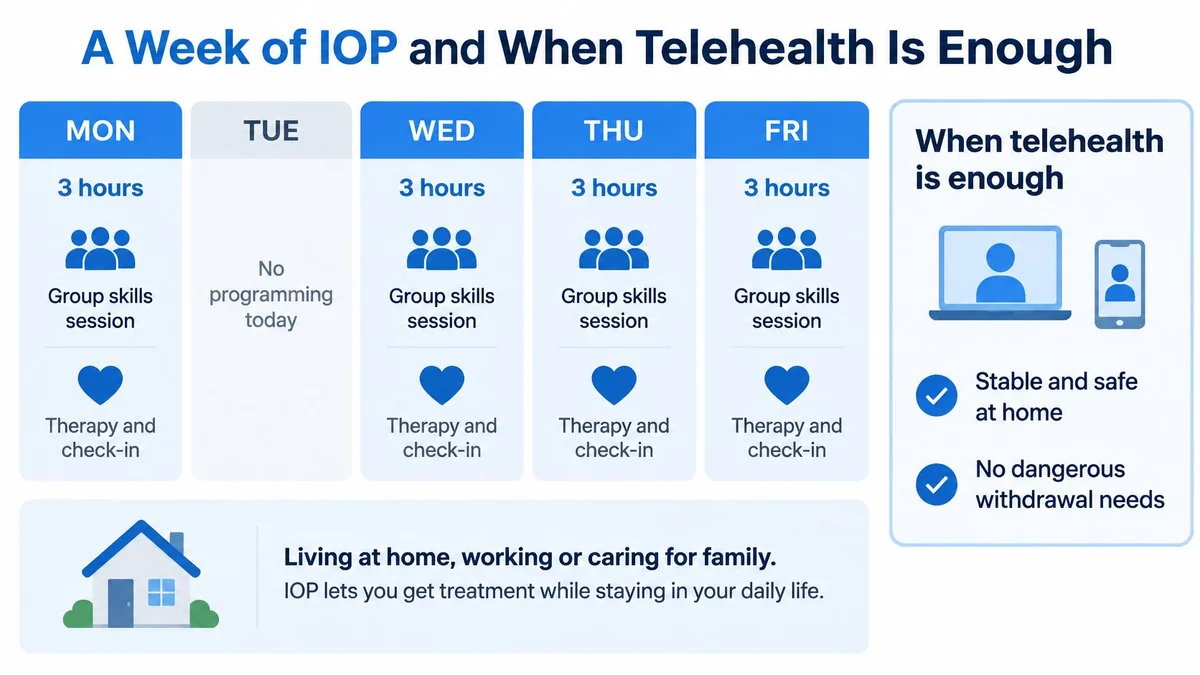
Consider a hypothetical adult who works during the day and attends scheduled treatment blocks in the evening. Group sessions focus on coping and relapse prevention, while an individual appointment addresses personal triggers. A medication review and recovery checks fit into the plan according to clinical need.
The exact calendar should be written down before treatment starts. Include travel, work, childcare, and time to practice skills outside appointments. A schedule that looks manageable on paper may become unrealistic if every visit requires arranging transportation or leaving a dependent without support.
What the sessions are for
The following is an illustrative planning guide, not a guaranteed schedule.
| Session | How often in IOP | Purpose |
|---|---|---|
| Group skills | Across the scheduled treatment week | CBT or DBT practice and peer accountability |
| Individual therapy | At an agreed recurring interval | Triggers, trauma-informed work, and plan updates |
| Medication visit | Scheduled according to symptoms and medication needs | Review psychiatric and addiction medicines together |
| Family session | As consented and clinically appropriate | Reduce conflict and align support at home |
| Recovery check | As clinically indicated | Review cravings, use, safety, and whether more support is needed |
Family participation should have a defined purpose and respect consent. A useful session might establish how a loved one can respond to a craving episode without interrogating, threatening, or taking over treatment.
This visual illustrates how treatment can fit around home responsibilities.
Judge video care by safety, not convenience
Access matters. The 2025 National Survey on Drug Use and Health annual report estimated that 7.8 million U.S. adults had co-occurring serious mental illness and a substance use disorder, and 28.7%, about 2.2 million people, received neither type of treatment.
Remote appointments can reduce travel, especially across Northern California or when military-family responsibilities complicate attendance. But video isn't automatically equivalent to in-person care. A workable remote plan needs:
- Privacy and connection: A confidential location, usable device, and reliable connection.
- Clinical monitoring: Medication follow-up and toxicology or other recovery accountability when indicated.
- Emergency readiness: Verification of the person's current location and a clear route to local crisis services.
- In-person access: A practical way to obtain an examination or urgent evaluation when needed.
Unstable housing, limited broadband, discomfort with devices, and heavy caregiving duties can make remote treatment harder rather than easier. Our guide to a telehealth IOP program can help readers consider the format alongside their daily circumstances.
Hybrid care is a sensible safety-first starting point for discussion, not a universal rule. Remote counseling can reduce travel while in-person medical evaluation remains available. Video may be sufficient when safety between appointments is established; it isn't a substitute for hands-on assessment when dangerous withdrawal, acute psychosis, or imminent suicide risk is present.
What Improvement Looks Like and When It Slips
Consider a hypothetical adult with anxiety, daily alcohol use, stable housing, and a day job. A medical assessment finds no dangerous withdrawal requiring a higher setting, and the person begins IOP. Their starting goals include reducing alcohol use, sleeping more consistently, and attending work without overwhelming anxiety.
A medical check is part of assessing the whole person, not a separate administrative step.

Look for observable changes
During early recovery, sleep disruption or irritability calls for evaluation, not an automatic conclusion that therapy has failed. The counselor reviews triggers and coping skills while the prescriber evaluates anxiety treatment, alcohol-related medication needs, and possible adverse effects.
Measurement-based care means repeating symptom and substance use assessments and using the results to change treatment. Useful signs include fewer drinking days, cravings the person can identify and manage, sustained attendance, and improved daily functioning.
SAMHSA's integrated treatment evidence summary defines integrated care as mental health and substance use interventions delivered by the same clinicians or a coordinated team in one setting, and associates it with reduced substance use, improved psychiatric symptoms and functioning, fewer hospitalizations and arrests, greater housing stability, and better quality of life. These are associated outcomes, not guarantees for an individual.
Treatment duration also needs careful interpretation. A 2025 outpatient study indexed in PubMed included 93,566 outpatients, of whom 5,429 had dual diagnosis, and reported average treatment-duration measures of 19.82 units for coordinated-care dual-diagnosis clients versus 13.17 for substance-use-disorder-only clients. Those units shouldn't be relabeled as weeks or visits, and the comparison doesn't establish an ideal treatment length.
The following video offers additional context for the discussion.
Separate a setback from an emergency
A return to use or a cluster of missed sessions calls for reassessment. It may signal that the schedule, medication plan, transportation arrangements, or level of care no longer fits.
Other changes require urgent evaluation:
- New suicidal intent or inability to stay safe: Seek emergency help rather than waiting for the next group.
- Psychosis or severe confusion: Arrange prompt medical or psychiatric assessment.
- Marked sedation or suspected overdose: Treat it as an emergency.
- Escalating withdrawal or medical instability: Obtain medical evaluation, not reassurance by messaging alone.
Progress is repeated contact plus a plan that changes. A longer course isn't automatically failure, but continuing the same schedule despite worsening safety isn't adequate treatment either.
Choose Outpatient or a Higher Level of Care
The placement decision isn't a test of motivation. It's a clinical judgment about what support someone needs now and what can safely happen outside treatment hours.
Use this decision sequence:
- Start outpatient care when the assessment supports it. A clinician should confirm medical stability, a safe place to sleep, the ability to attend, and psychiatric symptoms that scheduled care can manage between visits. Work and family obligations belong in this discussion, but they shouldn't override a serious safety concern.
- Stabilize urgent risks first. Severe withdrawal, imminent suicide risk, acute psychosis, or repeated inability to remain safe may require emergency, inpatient, or medically supervised care. Housing instability also needs a concrete plan. IOP can become a step-down option after stabilization rather than a substitute for it.
- Leave with an actionable plan. It should identify who prescribes, the session schedule, suitable evening or video options, and the route to urgent help. Our explanation of level-of-care determination describes the reasoning behind matching treatment intensity to current needs.
At Addiction Resource Center, treatment begins with an assessment and a recovery plan developed collaboratively with the person. Our comprehensive outpatient care for adults 18+ includes an IOP with in-person, evening and telehealth options and a PHP, with access to psychiatric support when needed. Outpatient care can fit people continuing care after detox or inpatient treatment elsewhere, as well as people who don't require 24-hour supervision.
For adults in Yuba City and Northern California, the next step is an assessment that considers both mental health and substance use, not separate intake decisions that never meet.
Addiction Resource Center provides comprehensive outpatient care for adults 18+ at 1002 Live Oak Blvd Suite A, Yuba City, including an intensive outpatient program (IOP) with in-person, evening and telehealth options, and a partial hospitalization program (PHP). If you're weighing outpatient care for co-occurring mental health and substance use concerns, our dual diagnosis IOP guide explains how integrated care works day to day. Call or text 530-625-7910, start with admissions, or verify your benefits.
If you or a loved one is in crisis, call or text 988 (Suicide & Crisis Lifeline) or call 911 for an emergency.
Talk with us
Addiction Resource Center offers intensive outpatient treatment (IOP) for adults 18+ at our Yuba City office or by telehealth. Call or text 530-625-7910.
Check my insurance