
Alcoholism and Family: How It Shapes Roles and Recovery
Reviewed by Tiffany Komba, LMFT #136055 · Last reviewed November 20, 2026
Published November 20, 2026
Contents
- How Alcoholism Reshapes the Whole Family
- Family Roles Alcoholism Creates in the Household
- Codependency and Why Caring Turns Into Control
- How Children and Partners Live With It
- Setting Boundaries and Helping a Relative Who Refuses Treatment
- Family Therapy, Intervention and Al-Anon Compared
- Start Your Family Plan With an Initial Consultation
Approximately 400 million people aged 15 and older worldwide lived with an alcohol use disorder in 2019, according to World Health Organization estimates summarized in NIAAA's Alcohol Facts and Statistics. The WHO also identifies family problems, financial problems, work problems and unemployment among the long-term social consequences of harmful drinking. Behind those categories are relatives trying to pay bills, protect children and decide whether another promise will hold.
Understanding alcoholism and family means looking beyond the person who drinks. A household can become organized around preventing the next crisis, sometimes long before anyone names the problem. Relatives don't have to wait for someone to accept treatment before getting support or making daily life safer.
How Alcoholism Reshapes the Whole Family
In 2024, 27.9 million people aged 12 and older in the United States, or 9.7% of that population, had a past-year alcohol use disorder, according to SAMHSA's National Survey on Drug Use and Health announcement. Many have partners, children, parents, siblings or friends who absorb consequences that aren't captured by the diagnosis.
Alcohol use disorder, or AUD, is the clinical term for a pattern of alcohol use that becomes difficult to control despite harmful consequences. Alcoholism is a familiar everyday term, but it can encourage people to focus on an identity rather than a treatable health condition.
A family is like a mobile hanging from a single hook. When one piece moves, the others shift to rebalance, even if nobody deliberately chooses to move.
A partner starts checking bank statements before buying groceries. A sibling keeps evenings free in case a ride is needed. A child listens for changes in a parent's voice before asking for help with homework.
Where the pressure lands
The first adjustments often involve ordinary household resources:
- Money: Someone covers missed wages, overdue bills or spending that wasn't agreed upon.
- Safety: Relatives assess whether driving, arguments or caregiving arrangements are safe.
- Time: Appointments, disrupted plans and crisis calls crowd out work and rest.
- Emotional energy: Family members spend attention anticipating what might happen rather than enjoying what's happening.
These responses can make sense during an immediate problem. The difficulty comes when emergency arrangements become the household's permanent operating system.
Adaptation isn't agreement
A spouse who handles every bill isn't necessarily comfortable with the drinking. A teenager who stays away from home isn't necessarily indifferent. Both may be trying to manage circumstances they can't control.
Relatives can become unpaid caregivers, crisis responders and record-keepers without preparation. They may know when someone last drank, which employer has called and which explanation was given to the children, while having little space to describe their own distress.
Recognizing the household pattern isn't an exercise in assigning blame. It helps separate what belongs to the person with AUD from what relatives can change. That distinction makes it possible to protect relationships without organizing every decision around drinking.
Family Roles Alcoholism Creates in the Household
Family roles are patterns people build to keep the household running, not fixed personality labels. One person can move between them as circumstances change.
Family roles in alcoholic households
| Role | What the Person Does | Effect on the Family | Healthier Response |
|---|---|---|---|
| Enabler | Covers bills, lies for the drinker and cleans up after binges | Keeps drinking hidden and removes some consequences | Stop covering avoidable consequences while protecting essential safety |
| Hero | Excels at work or school to offset family problems | Hides strain and can become exhausted | Name personal needs and seek private support |
| Scapegoat | Gets blamed for conflict and draws anger away from the drinker | Carries shame and may act out | Reject misplaced blame and maintain personal boundaries |
| Lost Child | Withdraws, avoids conflict and stays out of the way | Becomes isolated and overlooked | Connect with trusted adults, friends and meaningful activities |
| Mascot | Uses humor or distraction to ease tension | Masks pain and postpones difficult conversations | Speak plainly when safe and consider counseling |
Each response offers short-term protection. Someone pays the electricity bill, earns praise, absorbs an argument, avoids confrontation or gets everyone laughing again. That's why these patterns can be hard to recognize as costly.
Use the table as a reference, not a diagnosis. A quiet child isn't automatically a Lost Child, and a high-achieving adult isn't necessarily a Hero. Ask what the behavior accomplishes in this particular household and what it costs the person doing it.
When a useful response becomes a burden
Say a teenager keeps excellent grades because school feels predictable when home doesn't. Achievement itself isn't the problem. The concern is whether the teenager believes they must never struggle because the family already has too much to manage.
Similarly, humor can express genuine connection. It becomes restrictive when nobody can admit fear or sadness without someone immediately turning the conversation into a joke.
These patterns can continue into adulthood. An adult child may keep the peace at work by accepting unreasonable assignments, or avoid disagreement with a partner because disagreement once felt dangerous. Recognizing the connection creates room to practice a different response without treating every current difficulty as a product of childhood.
Roles can change
As drinking worsens, a Hero may become an Enabler. Success no longer keeps the problem out of sight, so the person starts making excuses or managing practical fallout instead.
Recovery can also unsettle familiar roles. Someone who has always handled everything may struggle to hand responsibility back, even when the other person is ready to take it.
A useful self-check is: What did you start doing when the drinking became a problem, and what are you still doing automatically? Discussing that question privately with a counselor can be more productive than assigning labels during a family argument.
Codependency and Why Caring Turns Into Control
Codependency is a term people use for a pattern in which a relative's sense of safety or self-worth becomes tied to managing another person's behavior. More and more energy goes into monitoring the drinking, leaving less for the relative's own life.
Think of someone continually bailing water from a leaking boat. Bailing may prevent an immediate sinking, but if that person becomes responsible for every bucket, nobody addresses the leak. The analogy has limits, especially when children or immediate danger are involved, but it captures why rescuing can become exhausting.
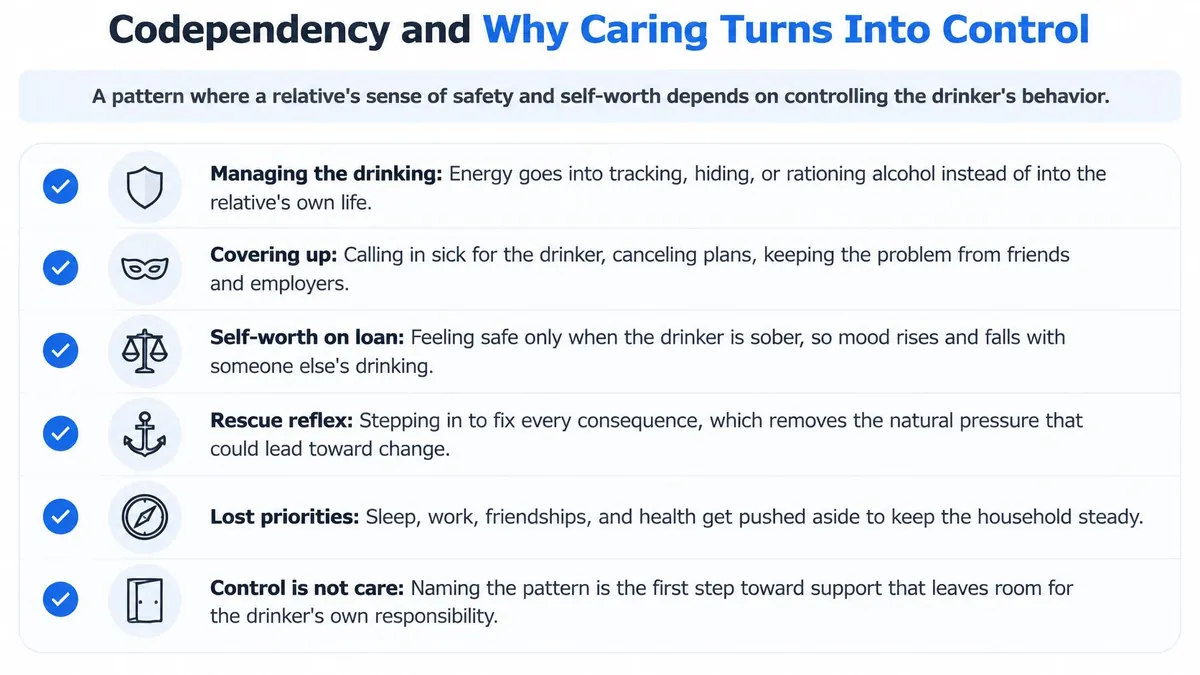
The checklist below illustrates how concern can turn into constant management.
Signs to examine without blaming yourself
Consider whether you regularly:
- Cover absences: Explain missed work or school on the drinker's behalf.
- Absorb financial fallout: Pay debts or bills repeatedly while neglecting your own necessities.
- Keep the explanation going: Lie to employers, relatives or friends about drinking-related incidents.
- Manage the alcohol: Hide, ration or pour out drinks in an effort to control consumption.
- Monitor before deciding: Check someone's breath or mood before making ordinary plans.
- Cancel your own life: Miss appointments, friendships or commitments to supervise the household.
- Carry responsibility for relapse: Treat another person's return to drinking as proof you failed.
No single action establishes a pattern. Paying an urgent bill may protect children, and monitoring someone's mood may be a response to real danger rather than an attempt to control them.
Support leaves responsibility in the right place
Supportive care might mean offering transportation to an assessment while expecting the person to arrange their appointment. Enabling might mean repeatedly explaining away missed appointments and taking responsibility for every next step.
The difference isn't whether you're kind. It's who carries responsibility, and whether helping requires you to abandon your own safety or needs.
Codependency isn't a diagnosis to give yourself or a character flaw. It's a description that may help you recognize learned responses, although it shouldn't replace assessment of coercion, trauma or abuse. Our explanation of codependency in recovery offers further context for separating care from control.
Al-Anon and individual counseling can provide places to practice detachment, meaning that you remain concerned without trying to direct every outcome. Detachment doesn't require emotional coldness or ignoring an emergency.
How Children and Partners Live With It
A child comes home unsure whether a parent will be available that evening. They heat food for a younger sibling, skip inviting friends over, and tell a teacher they forgot their homework. What looks like maturity is often an adult job shifted onto a small person.
The partner is running a parallel calculation: whether groceries will last, who can collect the children, and whether last night is safe to mention. The household has reorganized around the drinking. Each person takes a role that keeps the day moving, the way a tent stays up when everyone leans on a different pole. That adaptation can look like coping. It can also hide how much fear is doing the work.
In 2023, approximately 19 million U.S. children lived with a parent who met criteria for a substance use disorder, including more than 12 million whose parent's disorder involved alcohol, according to NIAAA's overview of parental alcohol consumption and consequences in youth. The same overview describes higher risks of mood, anxiety and attention-deficit/hyperactivity disorders among children of parents with AUD. Family risk also raises a separate question about inheritance, which Can Alcoholism Be Genetic and What Your Family Risk Means addresses directly.
Children need explanations, not assignments
Children may keep secrets, track a parent's mood, or lose focus at school. Those habits grow when nobody names what is happening. Adults can tell a child that alcohol is changing the adult's health and behavior, and that the child did not cause it. A relative, school counselor, or trusted caregiver should be named as a safe adult outside the house. Meals, rides, and a reliable place to sleep stay with adults. Children are not asked to count drinks, search for bottles, referee arguments, or watch an impaired parent.
A child can love a parent and still feel frightened or angry. Loyalty and honesty can sit side by side. Nobody has to make them pick one.
While a drinker is still months from agreeing to care, protecting a child's ordinary day is already a form of help. A steady bedtime does not fix the addiction. It reduces the harm the child absorbs in the meantime.
Partners need room for their own experience
A partner may lose sleep, pull away from friends, or blame themselves for not finding the right words. That self-blame is a common trap: if only the conversation had gone better, the drinking might have stopped. The drinking is not a puzzle the partner failed to solve.
Fear of being alone with someone who is intoxicated, or of getting in the car with them, needs a direct safety response. Better phrasing will not make an unsafe ride safe.
Trauma-informed counseling can help a partner or adult child describe these experiences without making the drinker's treatment the only topic.
For caregivers: A child's job is to grow, learn and have relationships, not to keep an adult sober.
Seek a professional assessment when a child becomes persistently withdrawn, loses interest in usual activities, has falling grades, or shows marked changes in sleep or behavior. Talk of self-harm requires prompt attention: call or text 988, and call 911 if anyone is in immediate danger. If there is immediate danger or the child can't remain safe, contact emergency services rather than waiting for a routine appointment.
Setting Boundaries and Helping a Relative Who Refuses Treatment
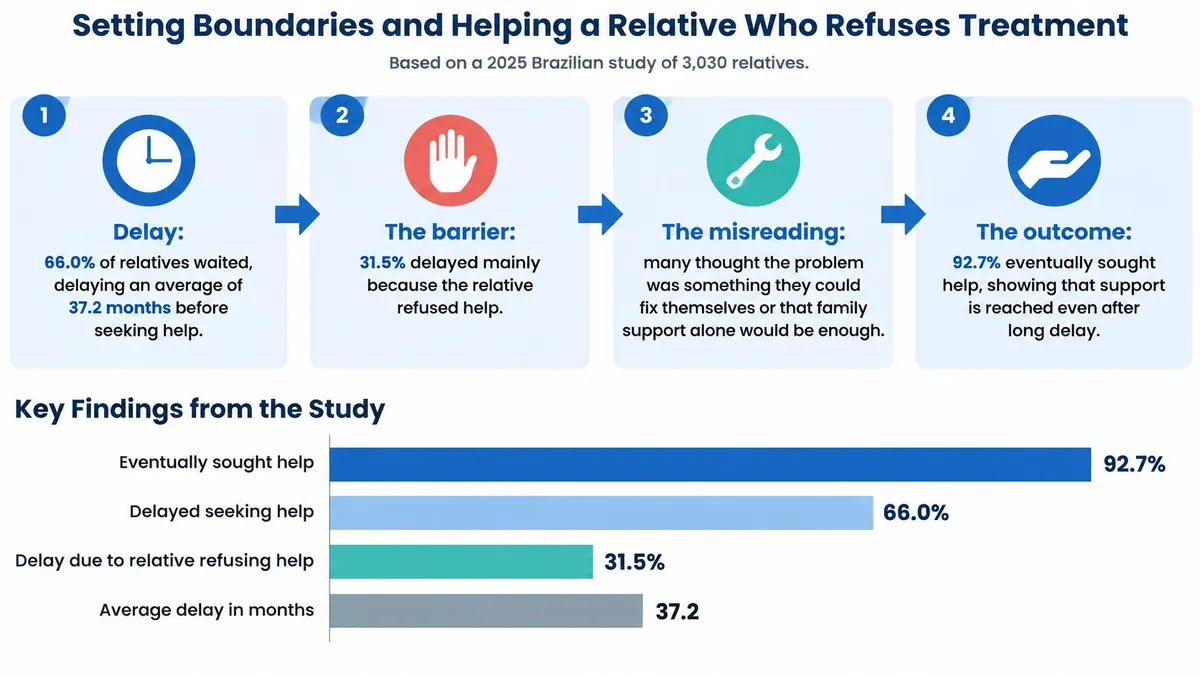
A 2025 Brazilian study of 3,030 affected family members found that 92.7% eventually sought help, but 66.0% delayed for an average of 37.2 months; the most common barriers were the relative refusing help, at 31.5%, and the belief that help was unnecessary, at 20.6%. Those findings describe the people studied, not a timetable every family will follow.
The practical question is what relatives can do during that gap. Waiting for agreement doesn't have to mean postponing every protective decision.
The visual below summarizes the study's findings on help-seeking delay.
Handle immediate danger separately
A medical emergency, seizure, serious threat, violence or a child in immediate danger takes priority over a family discussion. Call 911 when danger is immediate. A domestic-violence service can help with confidential planning when there is intimidation, surveillance or fear of retaliation.
Don't attempt a home detox plan because someone finally agrees to stop drinking. Alcohol withdrawal can require medical management, and a clinician should assess the appropriate setting.
Make a boundary you can carry out
A boundary describes your action, not a rule you can force another adult to obey.
- Choose a specific behavior. Focus on lending money, driving after drinking or providing childcare while impaired rather than demanding a complete personality change.
- Choose a sober, safe moment. Avoid negotiating during intoxication or an escalating argument. If speaking directly could provoke violence, make a safety plan with professional support first.
- State your action plainly. For example, explain that you won't lend cash, but you can help arrange a treatment assessment. Keep the statement brief.
- Decide the response beforehand. Write down what you'll do if the situation occurs. Don't announce an outcome you can't safely or legally carry out.
- Protect essential arrangements. Keep access to your own funds, transportation and documents where possible. Arrange sober childcare and get legal advice before changing shared housing or financial access.
- Follow through consistently. If you won't ride with someone who has been drinking, arrange another way home. Don't physically struggle over keys.
- Document safety concerns. Record dates, observable behavior, threats and effects on children, if doing so is safe. Store records somewhere the person can't access.
Money, transportation, childcare and housing need separate plans. Refusing a cash loan shouldn't accidentally leave children without food, and a housing boundary shouldn't be improvised during a confrontation.
Offer help without forcing agreement
Support can include describing concerns, giving treatment information and offering practical help with access. It doesn't include confinement, humiliation, threats against children or secretly giving medication.
If you're considering a structured meeting, our guide to staging an intervention can help you identify preparation questions. A meeting isn't a substitute for assessing risk.
For an additional discussion of approaching a loved one, the following video is available.
5 Tips for Dealing with an Alcoholic Parent or Family Member · Watch on YouTube
When someone monitors phones or money, confidential support may require a device and account they can't access. Ask about safe contact methods before scheduling calls; abrupt account changes or deleted browsing history may also draw attention. A study of web-based support for affected friends and family identifies privacy and accessibility as important reasons to develop these options.
Less harm counts as progress. Safer childcare, fewer financial crises and a relative getting their own counseling matter even before treatment begins. Family participation never makes you responsible for controlling another adult's drinking.
Family Therapy, Intervention and Al-Anon Compared
Family support options compared
| Option | Best For | Format | What It Changes |
|---|---|---|---|
| Al-Anon meetings | Relatives who want peer support | Group meetings, in person and online | Coping and detaching from the drinker's choices |
| Family therapy | Families with conflict or broken communication | Sessions with a licensed therapist, sometimes with the drinker present | Communication, roles and boundaries |
| Professional intervention | Families considering a structured treatment invitation after unsuccessful conversations | Planned meeting prepared with a trained professional | Seeks treatment entry, without guaranteeing agreement |
| Individual counseling for relatives | Partners and adult relatives who need private support; children need age-appropriate care | Individual sessions in person or by telehealth | Personal coping, safety planning and caregiver stress |
Choose support according to the problem you're trying to address. Peer meetings may help someone feel less isolated, while private counseling allows a person to discuss experiences they can't safely raise in front of the drinker.
Family therapy serves a different purpose: people practice communicating and changing interactions together. Our guide to using family therapy for addiction recovery explains how joint sessions can fit into care.
Family participation needs a purpose
Family involvement isn't automatically effective. A systematic review of family-based interventions describes favorable findings for some approaches, but also reports a meta-analysis in which family-involved interventions weren't significantly superior to controls for reducing alcohol-use frequency among adolescents aged 12–17 at the longest follow-up.
That finding doesn't mean relatives shouldn't participate. It means the design, delivery and fit of the intervention matter, and evidence about adolescents shouldn't be treated as a promise about adult treatment.
Useful sessions address concrete interactions: how concerns are expressed, what happens after a missed commitment, which responses unintentionally reinforce drinking and how mental health symptoms affect the household. Clinicians should also track family conflict and caregiver distress, rather than assuming that fewer drinking days resolve every relationship injury. How to Handle Family Conflict with Practical Skills covers skills families can practice between sessions.
Match the format to safety and readiness
A professional intervention should be prepared, not staged as an ambush. Participants need clear goals, a plan if the person declines and an actual treatment pathway if they agree. A professional should evaluate whether confrontation could increase danger.
Joint counseling isn't the right starting point when someone can't speak freely because of threats or coercive control. Separate safety-focused support may be necessary before any shared session.
A useful measure of care: Can each family member describe what is improving for them, not only whether the person with AUD is drinking?
At Addiction Resource Center LLC, when family conflict drives substance use, family therapy sessions can sit alongside individual counseling, and loved ones can be kept informed with the client's consent.
Combining options can be useful. A partner might attend individual counseling while participating in selected family sessions, with separate education about avoiding behaviors such as supplying alcohol or repeatedly rescuing someone from avoidable consequences. Privacy and consent remain important even when everyone wants recovery.
Start Your Family Plan With an Initial Consultation
Contact Addiction Resource Center for an initial consultation, whether you're seeking treatment for yourself or guidance about a relative. Starting treatment begins with a thorough assessment by experienced professionals, followed by a treatment approach matched to the person's needs.
You don't need a perfectly organized history before making contact. A family member can explain what they know, distinguish observations from assumptions and describe the concern that prompted the call. If the person drinking isn't ready to participate, say that at the outset so the discussion can focus on appropriate guidance rather than an appointment they haven't agreed to attend.
Gather information without becoming an investigator
Prepare what you already have access to safely:
- A dated incident list: Include drinking-related events that affected health, work, driving or caregiving. Describe observable behavior rather than assigning motives.
- Medication information: Gather current medication names and available medical information without searching private belongings or creating conflict.
- Previous treatment records: Bring available discharge paperwork or a simple account of earlier treatment attempts.
- Family participation preferences: Note who is willing to take part and whether anyone needs separate, confidential contact.
Don't delay the call because records are missing. The purpose of preparation is to make the conversation clearer, not to prove a case against someone.
What the consultation covers
Our initial consultation covers the person's substance use timeline, previous treatment attempts, mental health history, work situation, family structure, housing stability and personal recovery goals. These topics help us understand what a workable plan needs to account for.
For example, unstable housing may affect where someone can recover safely. A demanding work schedule may shape practical arrangements, while past treatment experiences can clarify what the person found helpful or difficult. Family structure matters because an adult who lives alone may need different support arrangements from someone caring for children.
Our services are for adults aged 18 and older. Relatives can ask for guidance even when the person drinking isn't ready, and families seeking help for a child should identify that need clearly when requesting an appropriate referral.
You can call or text our 24/7 line at 530-625-7910. Our Yuba City location is 1002 Live Oak Blvd., Suite A. If your communications are monitored, arrange a safe way to contact us rather than relying on a shared device.
Before the week ends, write down one boundary you can safely carry out and one support option you'll contact. Those are concrete actions you can take without waiting for another person to agree that there's a problem.
Addiction Resource Center LLC offers outpatient alcohol treatment, family counseling and guidance for loved ones navigating the effects of drinking. Visit Addiction Resource Center LLC to request an initial consultation and discuss a next step that addresses both treatment needs and the family's well-being.
Talk with us
Addiction Resource Center offers intensive outpatient treatment (IOP) for adults 18+ at our Yuba City office or by telehealth. Call or text 530-625-7910.
Check my insurance