
Alcohol and Dilated Pupils: What to Know
Reviewed by clinical staff
Published June 10, 2026 · Updated September 29, 2026
Contents
- How This Guide Reviewed Alcohol and Dilated Pupils
- How Alcohol Actually Affects Your Pupils
- Comparing Pupil Responses Alcohol vs Other Drugs
- When Pupil Changes Are a Sign of Danger
- Pupil Cues in Long-Term Alcohol Use and Recovery
- Recognizing When to Seek Professional Help for Alcohol Use
- Find Compassionate Alcohol Addiction Treatment in Yuba City
- Frequently Asked Questions
You notice someone's eyes look different after drinking. Maybe their pupils seem wide, maybe they don't react normally to light, and now you're wondering whether that's expected, dangerous, or a sign of something else.
That's a reasonable question. Alcohol and dilated pupils often get discussed as if the answer is simple, but it isn't. Alcohol can affect pupil size, yet it doesn't cause one single, predictable response in every person. In some situations, pupils may look larger. In others, they may look smaller. Sometimes the bigger clue isn't size at all, but how slowly the pupils react.
The safest way to think about it is this: pupil changes can happen with alcohol, but pupil size alone should never be used to judge how intoxicated someone is or whether they're "just drunk." Context matters, and so do the rest of the symptoms.
How This Guide Reviewed Alcohol and Dilated Pupils
The practical question is what pupil changes after drinking can tell you, and what they cannot. Clinical ophthalmology, emergency medicine, public-health guidance, and peer-reviewed addiction research inform the answer rather than blog-level claims that treat eye appearance as a shortcut diagnosis.
Across those sources, the most consistent point was not "alcohol always dilates pupils" or "alcohol always constricts them." It was that alcohol can affect autonomic control and visual reflexes in ways that make pupils look bigger, smaller, or unchanged depending on lighting, timing, dose, and whether other substances are involved.
This guide also separates acute intoxication from laboratory pupillometry. That matters because a person glancing at someone across a room is not doing the same thing as a clinician or researcher measuring light response under controlled conditions.
How Alcohol Actually Affects Your Pupils
Short answer: alcohol can make pupils look larger, smaller, or fairly normal. The more dependable change is often that the pupils react to light more slowly or less consistently, not that they move in one fixed direction.
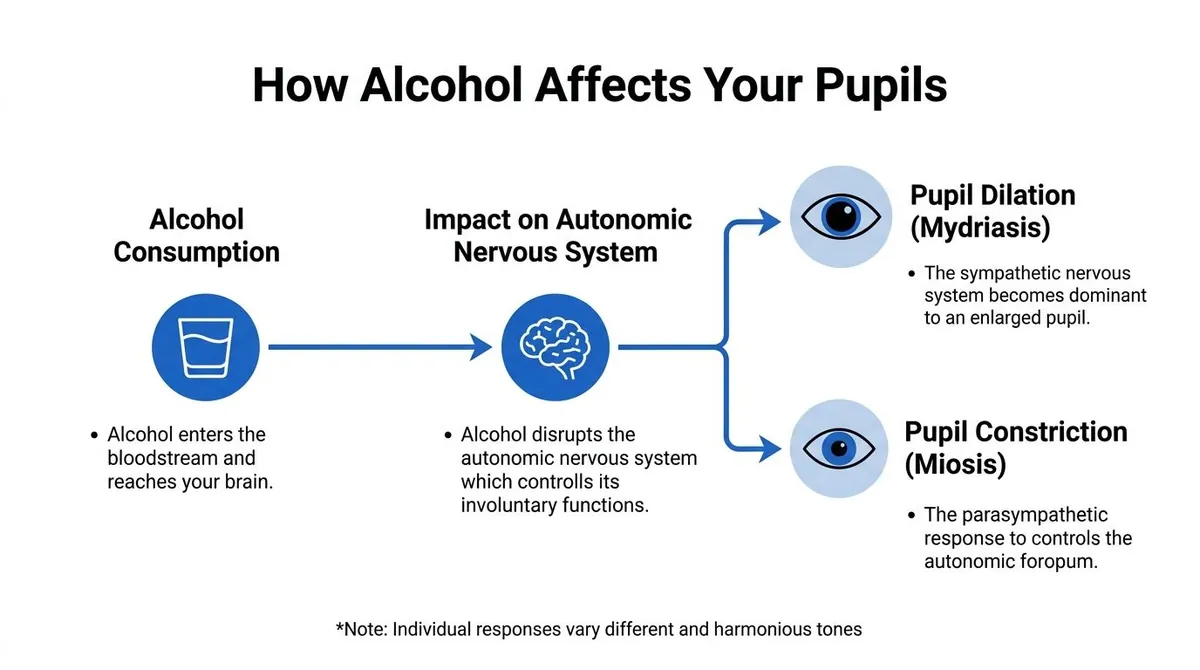
If someone is drunk in a dim bar, their pupils may look larger because the room is dark, and alcohol may blunt normal adjustment. In bright light, the same person may not show dramatic dilation at all, but their pupils can still seem sluggish.
Major references on pupil examination emphasize that size has to be interpreted with lighting, neurologic status, medications, and possible drug exposure in mind. The Merck Manual overview of pupillary abnormalities, MSD Manual discussion of pupil findings, and StatPearls on anisocoria and pupil assessment all reinforce that pupils must be read in context rather than isolation.
One reason for the confusion is that the pupils are controlled by the autonomic nervous system. Alcohol can interfere with that system indirectly through central nervous system depression, changing how the iris muscles respond. Educational explanations of alcohol-related mydriasis describe this in this discussion of alcohol-related mydriasis, but clinical eye exams do not treat alcohol as a clean "dilates every time" substance.
Why the same substance can cause different pupil changes
The main point is variability. Alcohol depresses the central nervous system, but the visible effect in the eyes doesn't always look the same from one person to another.
A few factors can change what you see:
- Dose and timing: Early in drinking, one effect may dominate. Later, a different one may show up.
- Individual physiology: Some people are more sensitive to alcohol's effects on nerves, reflexes, and vision.
- Lighting conditions: In a dark room, pupils naturally enlarge, which can make alcohol-related changes seem stronger than they are.
- Other exposures: Medications, other drugs, fatigue, or underlying neurologic issues can change pupil size and reactivity.
Practical rule: If someone has been drinking and their pupils look unusual, pay attention to the whole person, not just the eyes.
That's where many readers get tripped up. They expect one neat answer, but the more reliable observation may be sluggish pupil reactivity, not whether the pupils are definitely big or definitely small.
Mixed-substance use is one of the biggest reasons people misread eye signs. Alcohol plus stimulants may leave someone looking wide-eyed and overactivated. Alcohol plus opioids may push the pattern toward pinpoint pupils, sedation, and dangerous breathing problems.
What your eyes may feel like during intoxication
Alcohol can also slow the pupillary light reflex. In everyday terms, the pupils may not adjust as briskly when light changes. That helps explain why some people report glare sensitivity, blurry vision, or discomfort in bright settings when they've been drinking.
This is why alcohol and dilated pupils can be confusing in real life. A person might not have dramatically enlarged pupils, yet their eyes still aren't responding normally.
Pupil changes from alcohol are supportive clues, not stand-alone proof of intoxication.
That distinction matters because many other substances and medical conditions can cause similar eye findings. In practical terms, someone who seems "off" in public may be dealing with more than simple drunkenness; for legal context around related situations, Bada Bing Bail Bonds has an overview of California public intoxication issues.
There's also a public-health reason not to dismiss early drinking signs. That does not make pupil changes a screening tool, but it does underline why adults should take visible intoxication seriously rather than assuming young people will "look obviously drunk" in one consistent way.
Comparing Pupil Responses Alcohol vs Other Drugs
When people look at someone's pupils, they're often trying to answer a bigger question: is this alcohol, another drug, a combination, or something medical?
Alcohol is harder to read from the eyes alone because its pupil effects are less consistent. Other substances often get associated with more recognizable patterns. That doesn't mean the eyes can diagnose the cause, but it does help explain why alcohol can be misleading.
Why alcohol is less predictable
How pupils when drunk differ from sober pupils is usually less about a dramatic size difference and more about response quality. A sober person's pupils should constrict briskly in bright light and enlarge appropriately in darkness. After drinking, that reaction can become slower or less crisp.
So, does alcohol dilate pupils? Sometimes. Do pupils dilate when drunk? They can. But do your pupils get smaller when drunk can also be a fair question, because constriction can happen too. In other words, do pupils get bigger or smaller when drunk does not have one universal answer.
For comparison, opioids are widely associated with pinpoint pupils, while stimulants and some hallucinogens are more often associated with dilation. If you're trying to understand stimulant-related eye changes in more detail, this overview of methamphetamine pupil dilation gives a useful comparison point.
The most useful comparison is not "which drug causes what eye size," but "which findings stay recognizable even when alcohol is added." Alcohol tends to blur the picture rather than sharpen it.
Pupil Response to Common Substances
Real people don't read like textbooks. A sleepy person with small pupils after drinking could be showing alcohol effects, but opioids might also be involved. A restless person with large pupils after drinking might reflect low light and alcohol, or it might fit stimulants better if behavior is unusually energized.
The eyes can suggest a pattern. They can't reliably tell you the full story.
Alcohol plus other drugs can create especially misleading signs. Authoritative emergency guidance from the National Institute on Drug Abuse on overdose response supports the same caution: do not try to diagnose the cause of intoxication from eye appearance alone.
When Pupil Changes Are a Sign of Danger
Sometimes unusual pupils are just one part of intoxication. Sometimes they're a signal that something more serious may be happening.
What raises concern isn't just that the pupils look large or slow. It's when eye changes show up alongside signs that the brain and body aren't functioning safely.
Warning signs that matter more than pupil size
If someone has been drinking, these findings deserve immediate attention:
- Trouble waking them up: They don't respond normally to voice or touch.
- Breathing concerns: Breathing seems slow, irregular, shallow, or stops for stretches.
- Vomiting with reduced awareness: They may not be able to protect their airway.
- Skin changes: Pale, bluish, or cold skin suggests the body is under strain.
- Abnormal pupils with other neurologic signs: Unequal pupils, fixed pupils, confusion out of proportion, collapse, or signs of head injury are not things to brush off as "just alcohol."
A useful five-sign checklist for possible alcohol poisoning or another medical emergency is this:
- The person cannot be awakened or stays barely responsive.
- Breathing is slow, irregular, noisy, or absent for stretches.
- They are vomiting repeatedly, especially while drowsy or unconscious.
- They have a seizure, collapse, or may have hit their head.
- Their pupils are fixed, very unequal, or eye changes come with bluish skin, severe confusion, or limpness.
Unequal pupils deserve special respect. Alcohol alone doesn't neatly explain one pupil being larger than the other. That can point to head trauma, a neurologic emergency, or another substance.
For families trying to understand broader patterns around drinking, Oceans Luxury Rehab's alcohol abuse insights can be a useful background read.
Emergency care references such as the Mayo Clinic guidance on alcohol poisoning support urgent medical evaluation when alcohol-related symptoms include unresponsiveness, seizures, slow breathing, or abnormal vital function.
When to call 911
Call 911 if the person is hard to wake, has slow or abnormal breathing, has a seizure, collapses, may have a head injury, or has pupils that are fixed or very unequal.
Don't wait for the pupils to "go back to normal." Don't assume sleep will fix it. If you think alcohol is involved, stay with the person until help arrives.
The public safety stakes are real. In the United States, 11,904 people died in alcohol-impaired driving crashes in 2024, and about 30% of all traffic crash fatalities involved drunk drivers with BACs of 0.08 g/dL or higher, according to NHTSA's drunk driving data.
If something feels off, treat it as a medical problem first and a drinking problem second.
Pupil Cues in Long-Term Alcohol Use and Recovery
Concern often focuses on one night of drinking rather than lab studies. Research on pupils in addiction treatment usually involves pupillometry under controlled conditions, which is very different from trying to judge whether someone is drunk by looking at them.
Pupil responses and alcohol cue reactivity
Researchers have studied whether pupils change when people with alcohol dependence see alcohol-related cues. The idea is simple: the eyes may reveal fast, automatic brain responses that a person can't fully describe on a questionnaire.
An independent study found that among alcohol-dependent patients, greater pupillary dilation to alcohol cues predicted relapse better than questionnaires alone, adding 27% of variance to a model that already explained 47% of the variance in relapse outcomes, according to the published study on pupillary responses and relapse. The strongest signal appeared in a very early window, 150–250 milliseconds after stimulus onset.
Why this matters in recovery
That doesn't mean someone's pupils can diagnose relapse risk by simple observation. The study used pupillometry, which is a structured way of measuring pupil response.
Still, the idea is important. The eyes may sometimes reflect how strongly the brain reacts to alcohol-related triggers. For people in treatment, that can help explain why cravings can feel sudden and powerful even when they're trying hard to stay on track.
Recovery isn't only about willpower. The brain can react before a person has time to talk themselves through the urge.
Recognizing When to Seek Professional Help for Alcohol Use
A person doesn't need dramatic pupil changes to need help with alcohol. In fact, the signs that matter most usually show up in behavior, relationships, health, and daily functioning.
Patterns that matter more than eye changes
Consider getting professional support if any of these sound familiar:
- You keep drinking despite harm: Arguments, missed work, risky decisions, legal trouble, or worsening health haven't led to lasting change.
- Cutting down hasn't worked: You've tried to stop or limit alcohol, but the pattern keeps returning.
- More alcohol is needed for the same effect: Tolerance often changes how a drinking problem looks from the outside.
- Life starts revolving around alcohol: Plans, sleep, mood, and relationships begin to organize around drinking or recovering from it.
- Loved ones are worried: Other people often notice a pattern before the drinker is ready to name it.
If you're unsure, ask a simple question: is alcohol making life smaller, less stable, or less safe?
That's enough reason to talk with a professional. Seeking help isn't a sign that things are hopeless. It's often the moment things start getting clearer.
Find Compassionate Alcohol Addiction Treatment in Yuba City
If alcohol has moved from an occasional concern to an ongoing problem, local treatment can make the next step feel manageable. Some people need a safe place to get through withdrawal. Others need outpatient structure, counseling, or a plan that addresses both substance use and mental health.
What supportive treatment can look like
A good treatment program usually starts by asking practical questions. Is detox needed? Are there co-occurring mental health symptoms? Would in-person care help most, or would telehealth fit real life better?

For people comparing options, this guide from Still Water Wellness Group can help frame what to look for in rehab and how to think through the search process.
Treatment is rarely one-size-fits-all. Others need residential rehabilitation, an intensive outpatient program, family support, relapse prevention work, or a combination of these.
Local next steps
The care model is practical and personal. Certified counselors stay in constant communication with clients during the program. An alumni program continues for 12 months after IOP ends. Addiction Resource Center is a TRICARE West Region network provider through TriWest Healthcare Alliance for adult substance use disorder intensive outpatient and partial hospitalization treatment. TRICARE referral and prior authorization requirements depend on your plan. Network participation does not imply endorsement by the Department of Defense or the Defense Health Agency.
If you're worried about yourself or someone you love, it helps to start with a real conversation instead of trying to decode every physical sign alone.
Frequently Asked Questions
Do pupils dilate when drunk?
Sometimes, yes. Alcohol can make pupils appear larger in some people or situations, especially in dim light, but it can also leave them looking normal or even somewhat smaller. The more reliable clue is often slowed reaction to light rather than dramatic dilation.
Do your pupils get bigger or smaller when drunk?
Either can happen. There is no single alcohol-only pupil pattern that works across every person. Lighting, dose, timing, fatigue, medications, and other drugs can all change what you see.
How do drunk pupils differ from sober pupils?
Sober pupils usually respond briskly to light changes. After drinking, pupils may react more slowly, less evenly, or in a way that does not match the environment as cleanly. That difference is often more noticeable than size alone.
What are the early signs of alcoholic eyes?
People often mean bloodshot eyes, glare sensitivity, blurry vision, watery eyes, or sluggish pupil reaction. Those signs can happen with alcohol, but none of them confirm how intoxicated a person is, and none rule out another substance or a medical problem.
What are the five signs of alcohol poisoning?
Five emergency signs to watch for are unresponsiveness, slow or irregular breathing, repeated vomiting with reduced awareness, seizures or collapse, and fixed or unequal pupils with other neurologic warning signs. If those are present, call 911.
Learn more about our outpatient addiction treatment services, or contact Addiction Resource Center.
Talk with us
Addiction Resource Center offers intensive outpatient treatment (IOP) for adults 18+ at our Yuba City office or by telehealth. If you need detox or residential care first, we coordinate it with our partner, Ona Treatment Center in Browns Valley, CA. Call or text 530-625-7910.
Check my insurance