You may know the pattern by heart. A difficult conversation leaves you tense, ashamed, or furious. A craving arrives before you've had time to think. You promise yourself that one drink, pill, or hit will quiet the feeling, then wake up facing more consequences and less trust. The problem isn't a lack of willpower. Often, …

You may know the pattern by heart. A difficult conversation leaves you tense, ashamed, or furious. A craving arrives before you've had time to think. You promise yourself that one drink, pill, or hit will quiet the feeling, then wake up facing more consequences and less trust. The problem isn't a lack of willpower. Often, the missing piece is a reliable way to move through emotional pain without letting the urge make the decision.
Dialectical behavior therapy, often shortened to DBT, gives people that practical bridge. In addiction treatment, it combines acceptance of what you're experiencing with active work toward safer choices. The approach is especially useful when substance use occurs alongside intense emotions, impulsivity, relationship conflict, or another mental health condition. The skills aren't meant to erase cravings or difficult feelings. They help you notice what's happening, tolerate the moment, and choose your next action with more control.
Table of Contents
- Why Emotional Regulation Matters in Recovery
- Core DBT Skills for Overcoming Substance Use
- Clinical Evidence for DBT and Co-Occurring Disorders
- Integrating DBT Across the Continuum of Care
- Choosing the Right DBT Format for Your Needs
- Practical Expectations for Patients and Families
- Accessing Compassionate Care in Yuba City
Why Emotional Regulation Matters in Recovery
Relapse often begins before a person picks up a substance. It may start with an argument, a frightening memory, loneliness after work, or the thought that recovery has already failed. The emotional pressure rises, the body becomes restless, and the mind searches for immediate relief. If substances have provided that relief before, the craving can feel less like a choice and more like an emergency.
DBT addresses the space between feeling and acting. Instead of asking someone to stop being angry, anxious, or hurt, a therapist helps them identify the emotion, understand its function, and use a skill before the reaction becomes destructive. That distinction matters. You can validate the pain without approving the behavior that follows it.
A useful DBT principle: Your feelings make sense in context, and you're still responsible for what you do next.
The word “dialectical” refers to holding two truths together. A person can accept where they are today and still work toward change. They can acknowledge that substance use has helped them survive unbearable moments while also recognizing that it now causes serious harm. This balanced stance reduces the shame that often makes people hide cravings or abandon treatment after a setback.
From emotional surge to workable choice
Suppose someone receives a critical text from a family member. Their first impulse is to use, but they pause and name the sequence: “I feel rejected. My chest is tight. I'm thinking that nobody trusts me.” That observation creates information. The person might then leave the room, contact a counselor, use paced breathing, or delay responding until the intensity drops.
DBT doesn't promise that one exercise will make recovery easy. It builds repetition. With practice, a patient learns to recognize vulnerability earlier, reach for support sooner, and recover from emotional spikes without automatically returning to substances. The emotional regulation techniques for lasting change can complement this work by helping patients connect emotional awareness with daily recovery habits.
Core DBT Skills for Overcoming Substance Use
DBT skills become useful when they're tied to real situations, not memorized as clinical vocabulary. A person in recovery may use more than one skill during the same craving. The aim is to slow the chain of events, reduce immediate risk, and make the next safe step easier.
Mindfulness creates the pause
Mindfulness means observing thoughts, sensations, and urges without immediately obeying them. During a craving, you might note, “I'm having the urge to use,” rather than “I have to use.” Notice where the urge appears in your body, what thoughts accompany it, and how it changes as you breathe and remain present.
This practice doesn't require a perfectly calm mind. It helps you separate an internal event from an instruction. A mindfulness approach to sobriety can support this ability to observe cravings while staying connected to recovery goals.
Distress tolerance provides an emergency brake
Distress tolerance skills help you survive an intense moment without making it worse. You might step away from an escalating argument, use a sensory grounding exercise, take a brief walk in a safe setting, or contact a support person. Radical acceptance can also help when the immediate reality cannot be changed. Acceptance doesn't mean approval. It means stopping the fight with the fact that the moment is painful, so your energy can go toward a safer response.
During detox or early stabilization, clinicians may adapt these skills to the person's medical needs. DBT tools don't replace withdrawal monitoring, medication, or emergency care.
Emotion regulation lowers vulnerability
Emotion regulation begins with learning to identify emotions accurately. Anger, grief, fear, shame, and exhaustion can produce similar urges, but they may call for different responses. A diary card or daily log can help track sleep, stress, cravings, interpersonal conflict, and skill use so the treatment team can identify patterns.
Patients also work on reducing avoidable vulnerability through consistent routines, nutrition, rest, medical follow-up, and connection with supportive people. These basics don't solve every emotional problem, but they can make intense reactions easier to manage.
Interpersonal effectiveness protects recovery
Recovery often requires difficult conversations. You may need to ask a partner not to keep substances in the home, decline an invitation that feels unsafe, or explain that rebuilding trust will take time. Interpersonal effectiveness skills teach clear requests, respectful boundaries, assertive communication, and ways to preserve self-respect during conflict.
For clinicians and families seeking deeper background, an addiction medicine training guide can provide broader context for how behavioral skills fit within coordinated substance use care.
Clinical Evidence for DBT and Co-Occurring Disorders
The clearest addiction-related evidence for DBT involves people with substance use disorders and borderline personality disorder, especially when emotional dysregulation and impulsive behavior increase relapse risk. That evidence does not restrict DBT to one diagnosis. It does show why clinicians should describe its strongest research base accurately rather than present it as a universal solution.
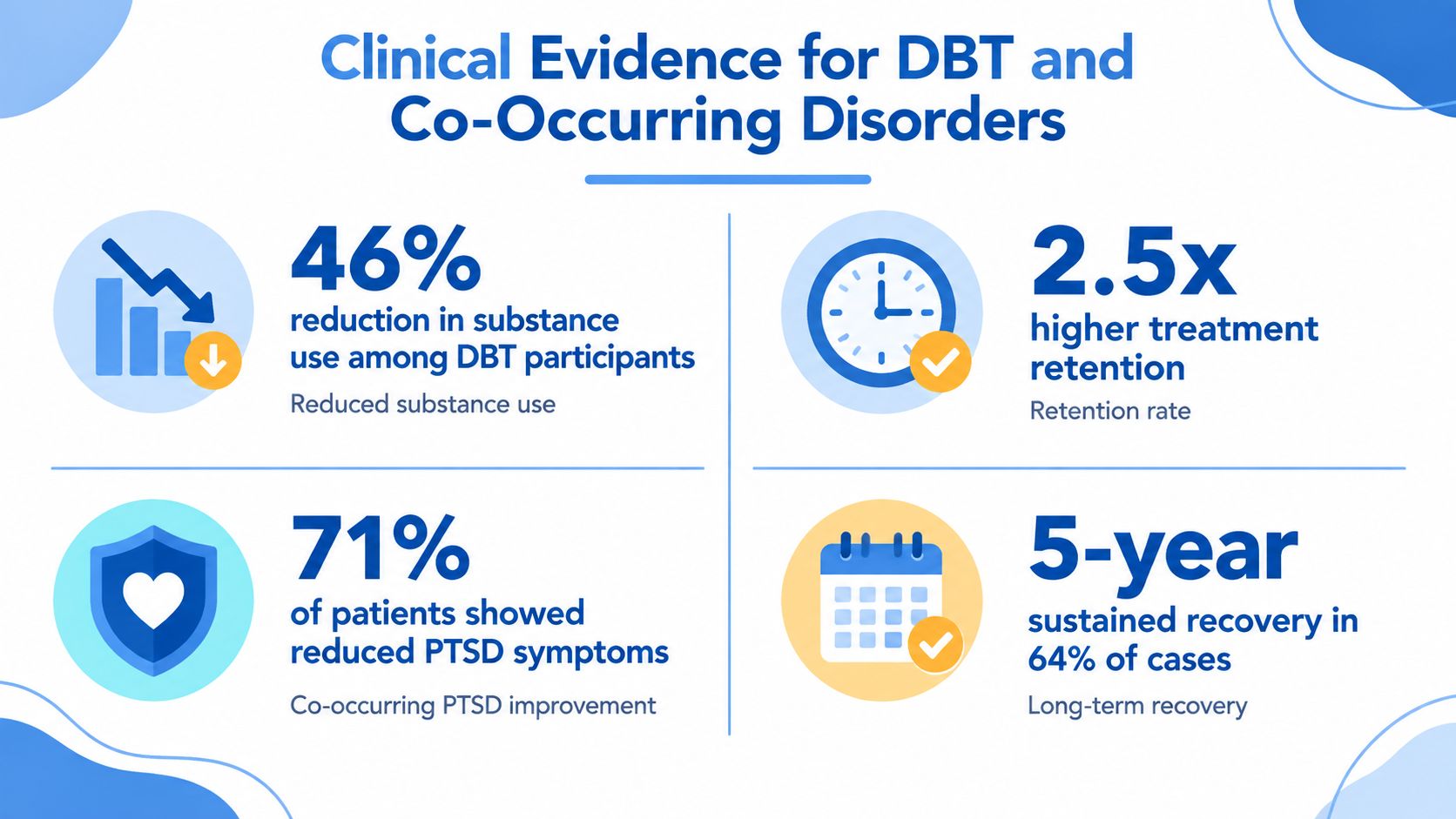
A 2020 meta-analysis examined six between-groups studies. At the end of treatment, DBT significantly improved substance abstinence compared with comparison conditions. The standardized mean difference was 0.66, with a 95% confidence interval of 0.27 to 1.04 and p = .001. At follow-up, the effect was smaller and no longer statistically significant, with an SMD of 0.34 and a 95% confidence interval of -0.02 to 0.71. The findings are reported in the 2020 meta-analysis of DBT for substance use disorders.
What the earlier trials tell us
DBT-SUD developed during the late 1980s and 1990s, as clinicians adapted Linehan's model for substance use disorders. An influential summary of early trials reported that patients receiving DBT were more likely to remain in treatment than controls, 64% versus 27%. One study found that 87.5% of participants with substance dependence who received DBT achieved full remission for at least four weeks, compared with 33.3% in comparison treatment. The review of DBT and substance use treatment provides the historical and clinical context.
Treatment engagement matters because a therapy cannot help consistently if a patient leaves before practicing its skills. The same review reported that borderline personality disorder prevalence among people entering substance use treatment ranged from 5% to 65%. It also described 615 heroin users in Sydney, Australia, among whom 42% met criteria for borderline personality disorder. These findings help explain why a treatment built for severe emotional instability became relevant to addiction care.
Evidence needs careful interpretation
The research supports DBT as a serious behavioral option, not a promise of guaranteed abstinence or permanent remission. The smaller follow-up effect shows why recovery planning, continuing support, and access to care still matter after structured treatment ends. DBT can strengthen the emotional and behavioral conditions that support recovery, while medication, medical monitoring, housing, trauma care, and peer support address other needs.
People with depression or another co-occurring condition may need targeted mental health services, such as depression support for Kelowna residents, based on their location and assessment. Integrated care is generally more practical than treating substance use and mental health symptoms as unrelated problems; dual diagnosis treatment basics explains integrated care for co-occurring disorders in practice. Across detox, residential treatment, and IOP, the evidence is most useful when it guides coordinated care rather than replacing clinical judgment.
Integrating DBT Across the Continuum of Care
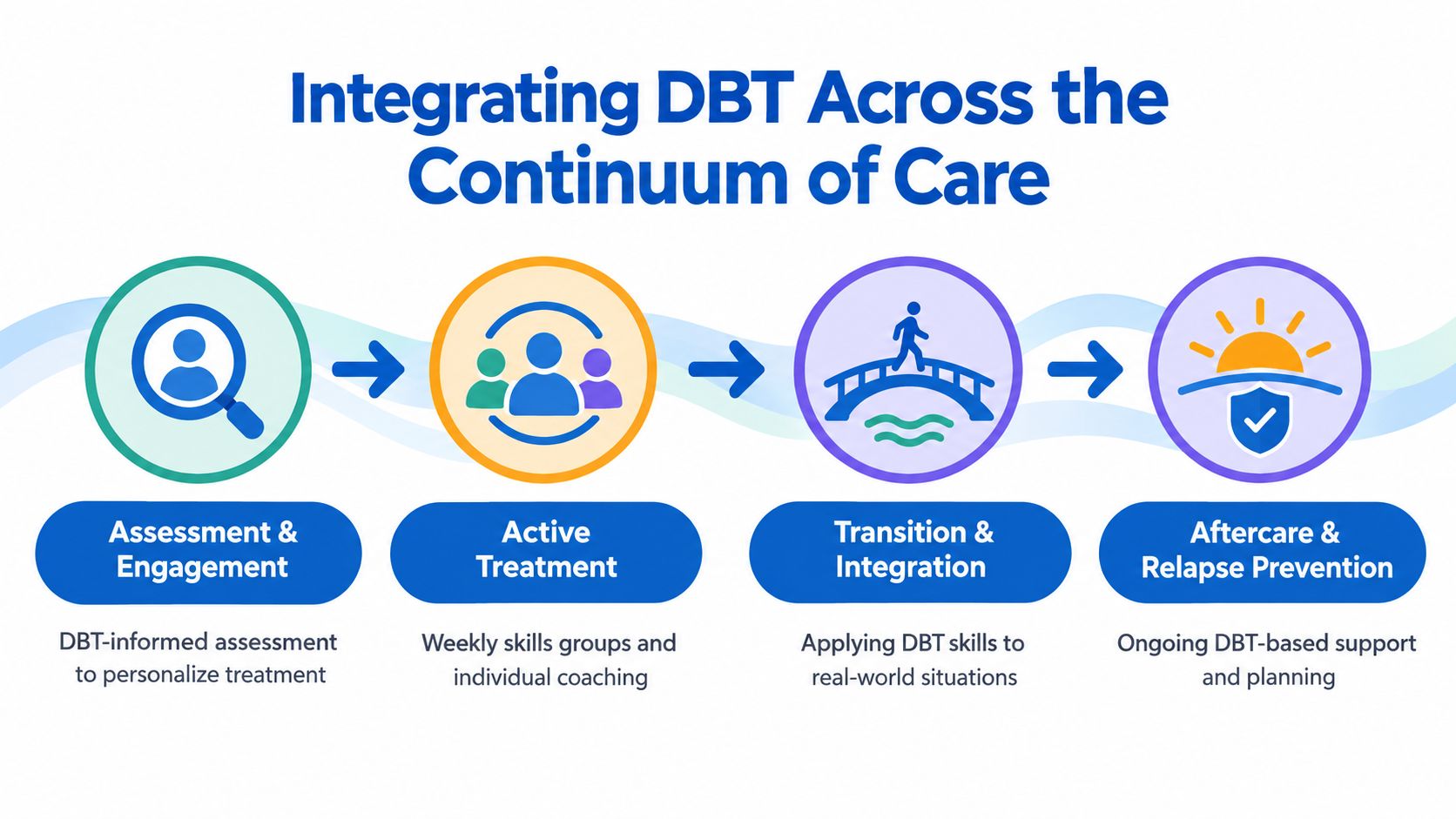
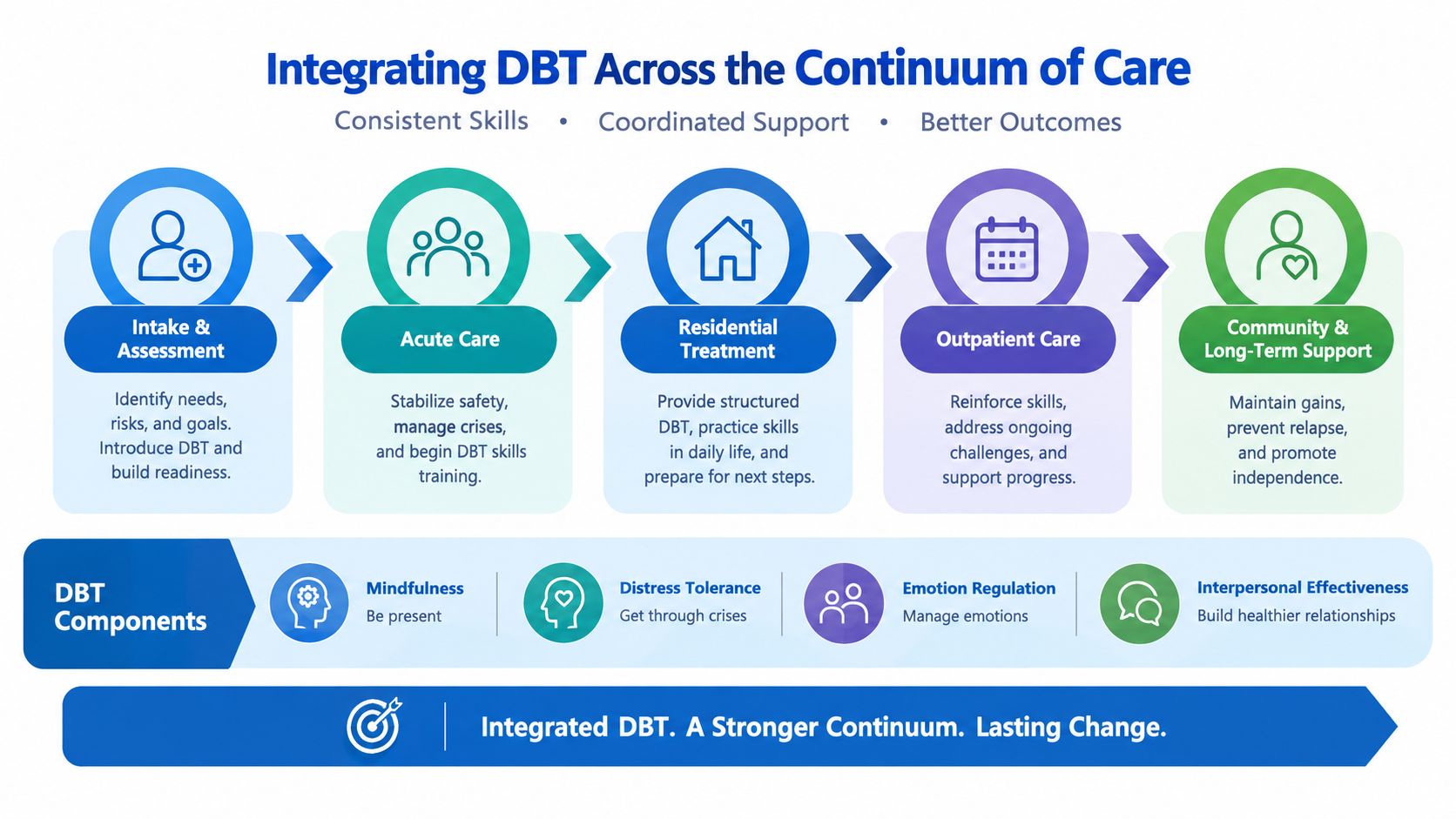
DBT should adapt as a patient's needs change. The skills used during medically supervised detox won't look identical to those practiced in an IOP. Early care prioritizes safety and stabilization. Later care asks the person to apply skills in ordinary environments where stress, access to substances, and strained relationships may return.
Detox and early stabilization
During detox, medical staff focus on withdrawal risks, physical symptoms, medication needs, hydration, sleep, and immediate safety. A DBT-informed approach can add simple mindfulness and distress tolerance practices without placing responsibility for medical stabilization on the patient. Staff might help someone identify a rising panic response, orient to the room, use paced breathing, and communicate discomfort before it becomes overwhelming.
The treatment team should also identify common triggers and preferred supports. A patient may create a short crisis plan that names warning signs, people to call, grounding strategies, and steps for reducing access to substances. The plan must remain realistic for the person's medical condition and level of alertness.
Residential rehabilitation
Residential treatment offers more structure for learning the full DBT skill set. Patients can practice emotion regulation after a difficult group, interpersonal effectiveness during a family call, and distress tolerance when they receive upsetting news. Staff members can reinforce the same language across the day, so the skill doesn't stay confined to a therapy room.
A multidisciplinary team may combine individual counseling, skills groups, medical care, recovery mentoring, medication support, and family involvement. The point isn't to make every interaction feel like a formal DBT session. It's to help patients recognize that skills belong in meals, phone calls, appointments, conflicts, and quiet evenings.
IOP, MAT, and community life
Intensive outpatient care tests whether skills work outside a protected setting. Patients may attend sessions while returning to work, caring for children, using public transportation, or living with family members. In medication-assisted treatment, DBT can sit alongside medical management by addressing the emotional triggers and relationship stressors that medication alone doesn't resolve.
Telehealth can make participation more accessible for some patients, but the program still needs clear expectations for privacy, attendance, crisis communication, and practice between visits. Before leaving a higher level of care, patients and families should know who handles urgent concerns, how prescriptions are managed, and what happens after a lapse.
Choosing the Right DBT Format for Your Needs
Not every program using the term DBT provides the same level of care. Some offer a model with individual therapy, skills training, between-session coaching, and therapist consultation. Others use DBT-SUD adaptations designed around craving, treatment engagement, relapse interruption, and substance-related behaviors. A third option may provide skills training without individual DBT.
The right format depends on risk, diagnosis, treatment history, access to support, and the complexity of the person's recovery needs. Someone with repeated crises and severe relationship instability may need a more structured approach. Someone who already has individual counseling and medical care may benefit from a focused skills group.
| Format Type | Core Components | Best Suited For |
|---|---|---|
| Comprehensive DBT | Individual therapy, structured skills training, coaching when available, and therapist consultation | People needing coordinated support for severe emotional dysregulation, impulsivity, or recurring crises |
| DBT-SUD | DBT principles adapted for cravings, substance-related behaviors, abstinence goals, and relapse interruption | People whose substance use is closely connected to emotional intensity and difficulty staying engaged |
| DBT skills training | Mindfulness, distress tolerance, emotion regulation, and interpersonal effectiveness practice | People seeking concrete coping tools alongside other counseling, medical, or recovery services |
Questions worth asking a provider
Research formats carefully because studies often implement full DBT, DBT-SUD, and skills training differently. A recent synthesis of third-wave therapies found small-to-moderate overall benefits for abstinence and craving, larger gains in emotion regulation and mindfulness, and low-to-moderate certainty, while calling for trials that clarify which mechanisms produce change. The findings are summarized in this review of third-wave therapies for substance use disorders.
Ask whether the program includes individual therapy, how skills practice is assigned, whether clinicians receive consultation, and how the team responds to a lapse. Also ask how DBT connects with medication management, trauma treatment, psychiatric care, family sessions, and discharge planning. A program should be able to explain what it delivers rather than relying on the label alone.
Practical Expectations for Patients and Families
DBT works through practice, not passive attendance. A typical week may include a skills group, individual counseling, medical or psychiatric follow-up, recovery support, and assignments that connect sessions to daily life. Patients may track cravings, emotions, urges, actions, and skill use on a diary card, then review the patterns with a clinician.
A workable routine for patients
Start small and make the skill observable. Instead of writing “manage stress,” record the situation, the emotion, the urge, the skill attempted, and what happened afterward. If the skill didn't help enough, that's useful information for treatment. The team can adjust the plan rather than treating the difficulty as a personal failure.
Patients should also tell clinicians when they're thinking about using, skipping medication, leaving treatment, or avoiding a difficult conversation. Early disclosure gives the team more options. Waiting until a crisis peaks makes every decision harder.
Families can reinforce DBT without becoming unpaid therapists. Ask, “Do you want listening, problem-solving, or help contacting your counselor?” Use validating language such as, “I can see why that felt overwhelming,” while keeping boundaries around threats, intoxication, unsafe behavior, or substance access.
- Support practice: Ask which skill the person is working on, then give them room to use it.
- Protect boundaries: Don't provide money or cover consequences in ways that support continued substance use.
- Notice effort: Recognize attendance, honesty, and repair attempts, not only abstinence.
- Create safer routines: Discuss medication storage, transportation, appointments, and plans for high-risk situations.
Families may also want alcohol-free social options, including a guide to the best NA beers, but nonalcoholic products aren't appropriate for everyone. Ask the patient and treatment team whether those beverages could trigger cravings or fit the person's recovery plan.
Accessing Compassionate Care in Yuba City
Choosing care becomes easier when the program can address medical safety, emotional regulation, substance use, and aftercare in one coordinated plan. In Yuba City, Addiction Resource Center LLC offers medically supervised detox with medication-assisted treatment, 24/7 wellness monitoring, residential rehabilitation through its partner facility, Ona Treatment Center in Browns Valley, and an IOP delivered in person or through telehealth.
The team includes a medical doctor, registered nurse, licensed counselors, a licensed marriage and family therapist, and recovery mentors. That range of roles matters for patients who need more than weekly counseling. A care plan can include assessment, withdrawal support, DBT skills such as mindfulness and distress tolerance, relapse prevention, accountability, education, and customized aftercare planning.
Practical access for patients and families
The center serves adults 18 and older and welcomes TRICARE beneficiaries. It accepts most major insurance plans, including private coverage such as Anthem, Blue Cross, Blue Shield, Aetna, and United Healthcare. Coverage and authorization depend on the individual plan, so families should call to discuss benefits rather than assume a service is covered.
The setting emphasizes privacy, a calm environment, and down-to-earth support. Patients can contact the 24/7 phone and text line at 530-625-7910 to ask about current needs, schedule a tour, or get guidance for a loved one. The location is 1002 Live Oak Blvd., Suite A, Yuba City, California.
You don't need to arrive with the right diagnosis or know which DBT format you need. A qualified intake team can help determine whether detox, residential care, MAT, IOP, telehealth, or another level of support fits the situation. If there's immediate danger, severe withdrawal, or a medical emergency, call emergency services first.
Addiction Resource Center LLC connects medically supervised detox, MAT, residential partnerships, IOP, telehealth, and DBT-informed skills for adults navigating substance use and co-occurring mental health needs. Visit Addiction Resource Center LLC to learn about available care, or call or text 530-625-7910 for confidential guidance and a practical next step.