In the United States, 100 proof means 50% alcohol by volume (ABV) because proof is double ABV. “100 percent proof” is a common misphrasing, not a separate alcohol category. Why does that wording matter? Because a shopper may see “100 percent proof” and assume it describes a special type of liquor, a safety rating, or …

In the United States, 100 proof means 50% alcohol by volume (ABV) because proof is double ABV. “100 percent proof” is a common misphrasing, not a separate alcohol category.
Why does that wording matter? Because a shopper may see “100 percent proof” and assume it describes a special type of liquor, a safety rating, or even alcohol that is entirely pure. It doesn't. The standard U.S. label term is 100 proof, and it identifies a spirit with 50% ABV.
That distinction becomes practical as soon as you pour a drink. A higher-proof spirit contains more alcohol in the same volume than a lower-proof spirit, so using an ordinary glass or free-pouring at home can make it easy to consume more than intended. The number also helps you compare bottles, understand cocktail recipes, and recognize why a drink may affect you faster than expected.
Proof has an unusual history, too. The word began with a physical test involving gunpowder, then developed into formal systems that differed between Britain and the United States. That history explains why proof numbers can be confusing when you read older material or encounter spirits from different markets.
This guide will clarify the language, show the simple proof-to-ABV calculation, compare U.S. and historic British standards, and connect the label to serving size and intoxication risk. If alcohol is already affecting your health, relationships, or daily life, the effects of alcohol addiction on the mind, body, and relationships may offer useful context.
Table of Contents
- Introduction to 100 Percent Proof and What You Really Mean
- How Alcohol Proof Works in Plain Language
- Why Proof Exists and How the Gunpowder Test Shaped It
- United States Proof Versus Other Systems You Might See
- Common Bottles and Labels That Show 100 Proof
- What 100 Proof Means for Pouring Safety and Intoxication
- Key Takeaways About 100 Proof and Next Steps for Mindful Choices
Introduction to 100 Percent Proof and What You Really Mean
What does 100 percent proof describe? The phrase blends two measurements. Percent belongs with ABV, or alcohol by volume, while proof is a separate U.S. labeling number. Combining them is like putting “miles” and “miles per hour” on one label. The meaning may be clear, but the wording is not standard.
The clearer terms are 100 proof alcohol and a 100-proof spirit. In the modern U.S. system, proof is twice ABV, so dividing the proof number by two gives the alcohol percentage by volume. Britannica's explanation of liquor proof describes this U.S. calculation.
The pattern is easy to check:
- 100 proof = 50% ABV
- 80 proof = 40% ABV
- 120 proof = 60% ABV
A 100-proof bottle is therefore stronger than an 80-proof bottle poured in the same amount. That difference affects how quickly alcohol adds up in a cocktail or glass, even though proof does not tell you whether the spirit is bourbon, vodka, rum, or another category.
Proof describes strength, not identity. Two bottles can share the same proof while differing in ingredients, production methods, flavor, and suggested uses. The number also does not mean the spirit is pure alcohol.
The useful translation: On a U.S. bottle, 100 proof means the liquid is 50% ABV, or half alcohol by volume.
This translation helps when a label gives proof but a recipe uses ABV, or when you compare pours from different bottles. A standard-looking pour from a higher-proof spirit can deliver more alcohol than the same volume from a lower-proof one, which may affect intoxication speed and serving decisions. If alcohol is affecting your health, relationships, or daily life, learn more about the effects of alcohol addiction on the mind, body, and relationships.
How Alcohol Proof Works in Plain Language
What does a bottle's proof number tell you? Start with ABV, or alcohol by volume. It describes the portion of a liquid that is alcohol. A spirit labeled 40% ABV contains alcohol at that concentration, along with water and compounds that contribute to its aroma, color, and flavor.
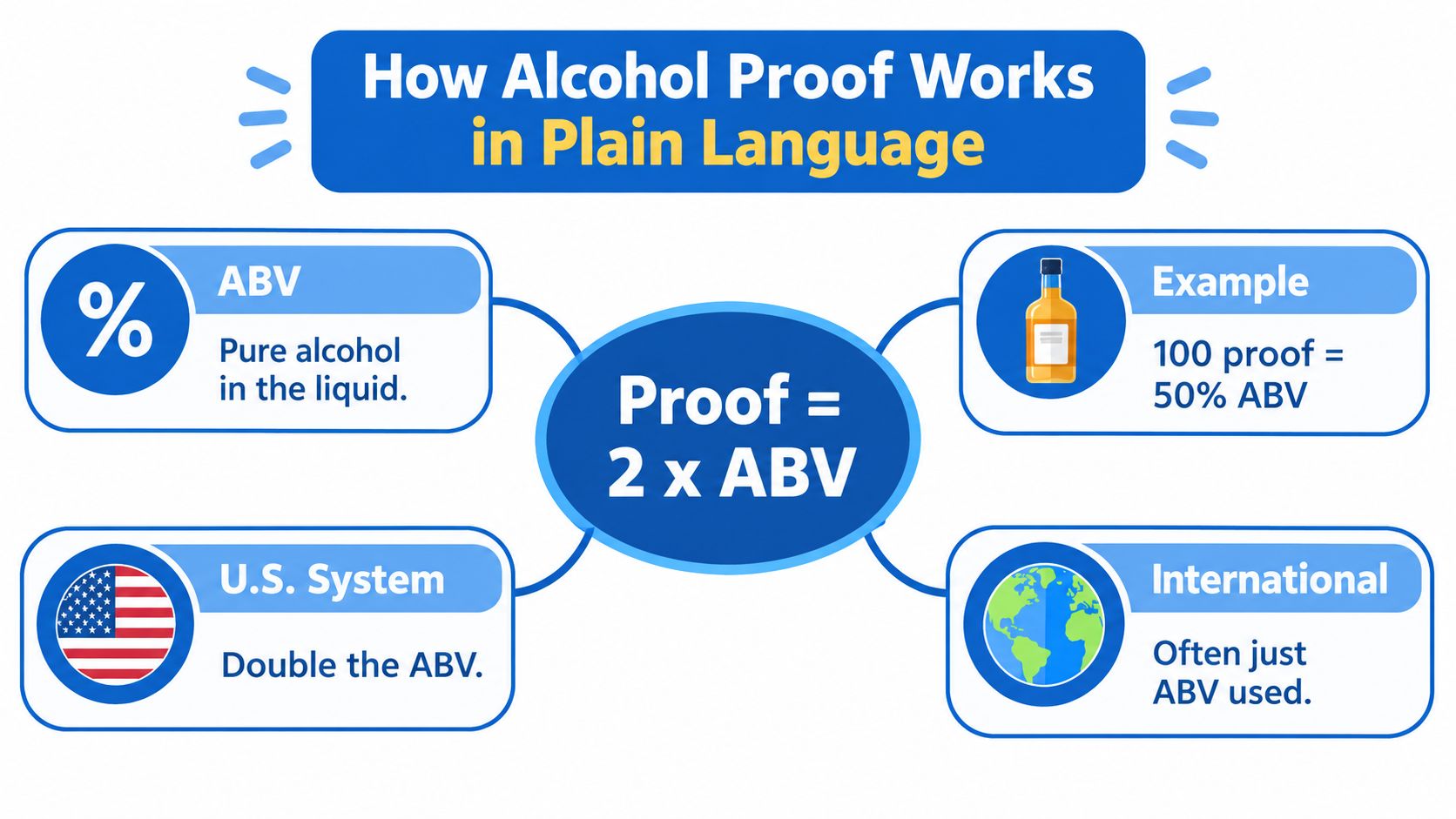
Proof is another way to express the same strength in the United States. It works like a doubled label for ABV. The larger number does not change the liquid. It gives you a second way to describe its alcohol concentration.
The simple formula
U.S. proof = 2 × ABV
To convert proof into ABV, reverse the operation:
ABV = proof ÷ 2
For a bottle marked 100 proof, divide 100 by 2. The result is 50, so the bottle is 50% ABV.
A label may display both figures, placing the proof statement near wording such as “alc./vol.” Read the percentage when you need the actual alcohol concentration. Use the proof number as a quick U.S. labeling shortcut.
You do not need a chemistry background to apply the formula. If the proof number rises, the alcohol concentration rises with it.
Why the same pour matters
Suppose two bottles provide the same volume, one at 40% ABV and one at 50% ABV. The 50% ABV spirit contains more alcohol in that pour because its concentration is higher. The glasses may look identical, but they do not contain the same amount of alcohol.
That difference matters in a shot, a rocks-glass pour, or a cocktail. Volume alone cannot show the whole picture. Proof supplies the missing context before mixers, ice, or other ingredients increase the drink's total volume.
A higher-proof pour can reach the bloodstream with more alcohol in the same amount of liquid, potentially increasing how quickly intoxication develops. Pour size still matters, because a smaller amount of a stronger spirit can contain a similar amount of alcohol to a larger amount of a weaker one. Check both the label and the amount poured rather than treating every standard-looking serving as equivalent.
Outside the United States, bottles commonly show ABV directly instead of proof. An imported spirit may therefore list only a percentage. Read that ABV as written, and apply the U.S. formula only to a U.S.-style proof label.
Why Proof Exists and How the Gunpowder Test Shaped It
Why did alcohol strength ever need a word like proof? The answer begins with a practical problem: in 16th-century England, officials needed to judge spirits without modern laboratory equipment. Tax collectors used gunpowder as a rough test by soaking it in liquor and trying to ignite it.
If the damp gunpowder still burned, the spirit was considered strong enough to be “proved.” Liquor that passed was described as above proof, and the result became tied to taxation. Stronger spirits could therefore receive different treatment from weaker ones.
The test was crude, but the flame made the result visible and repeatable enough for officials and sellers to use. It worked like a simple pass-or-fail check, even though it could not measure alcohol concentration as precisely as a modern label.
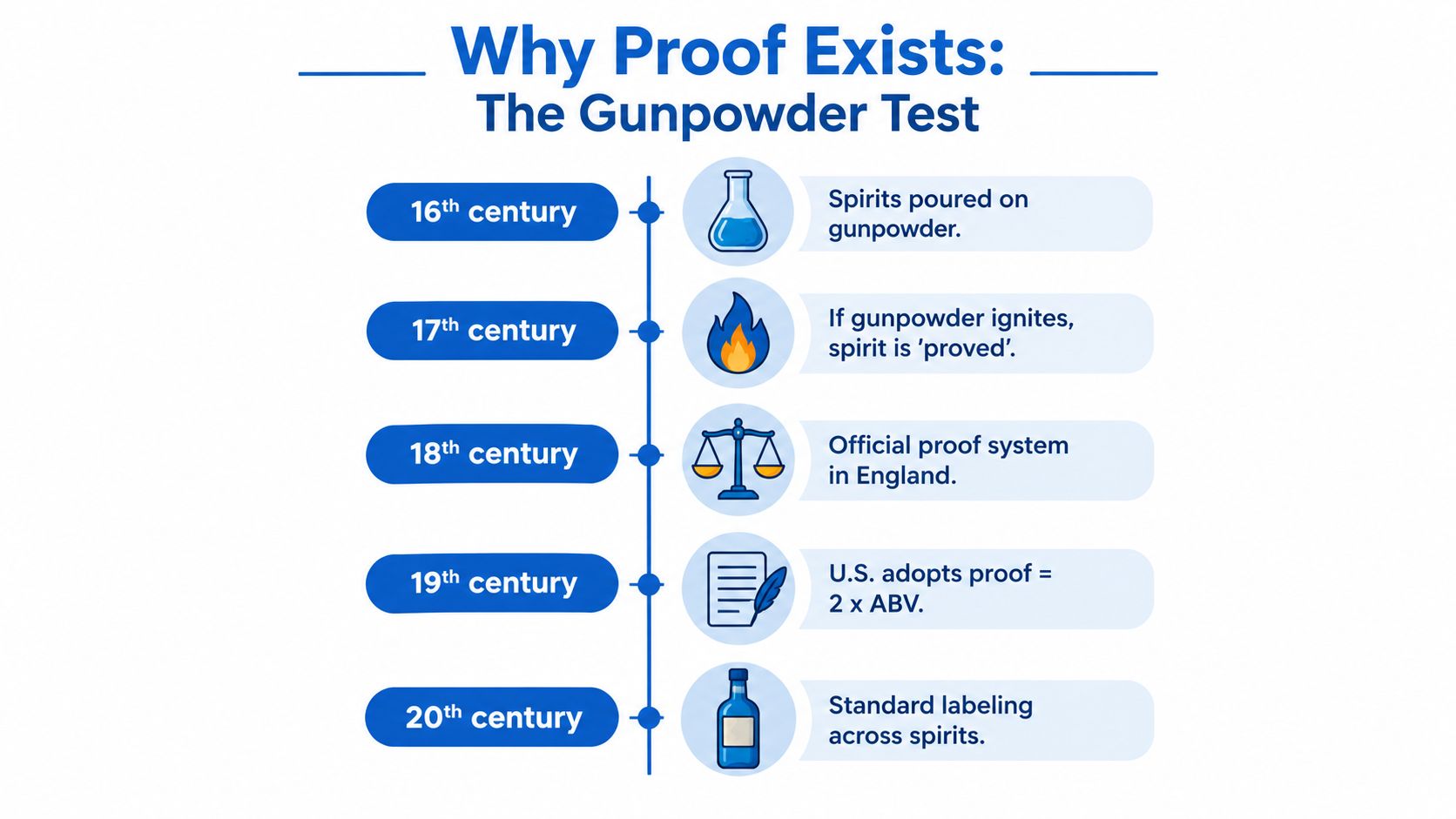
From fire test to formal measurement
As measurement improved, proof shifted from ignition to density and alcohol concentration. By 1816, British proof had been standardized at about 1.75 times ABV, according to the historical account in this academic paper on the development of proof.
Later British methods used specific gravity, which compares a liquid's density with a reference. That approach made the result more dependable than watching a gunpowder flame, while the older word remained on labels and in regulations.
The United States adopted a separate definition. In 1848, U.S. proof was set at exactly double ABV. Under that rule, 50% ABV became 100 proof. In practical terms, “100 proof” on a modern U.S. bottle identifies a 50% alcohol concentration, not 100% alcohol.
Why the old story still matters
The history explains why proof is not a universal number across every place and period. The same proof figure can describe different strengths when the underlying system changes. A historic British label and a modern U.S. label may therefore share a number without describing the same drink.
That distinction also clears up the phrase “100 percent proof.” It combines percentage language with an older measurement term. A percentage expresses alcohol concentration, while proof belongs to a particular labeling system. Treating proof as system-specific helps you read historical references and bottle labels without assuming that the number means the same thing everywhere.
United States Proof Versus Other Systems You Might See
What does 100 proof mean outside the United States? The answer depends on the system behind the label. In the U.S., it identifies 50% ABV. Historic British proof followed a different scale, so the same number described a stronger spirit.
A side-by-side comparison
| ABV | U.S. Proof | Historic British Proof |
|---|---|---|
| 40% | 80 proof | About 70 proof |
| 50% | 100 proof | About 87.5 proof |
| 57.15% | About 114.3 proof | 100 proof |
| 60% | 120 proof | About 105 proof |
The table makes the wording mistake clear. Modern U.S. 100 proof means 50% ABV, while historic British 100 proof meant about 57.15% ABV. A shared number does not guarantee a shared strength.
That difference matters when you read an old book, compare a historic bottle, or examine an imported spirit. The proof number works like a label key, and the country or era tells you which key to use.
Reading unfamiliar labels
For a U.S. bottle, divide proof by two to estimate ABV. If the label already lists ABV, use that percentage directly. It states the alcohol concentration without requiring conversion between systems.
A simple bottle example helps. A U.S. bottle marked 100 proof contains 50% alcohol by volume. A historic British reference marked 100 proof points to a different concentration, so treating both labels as identical could make a pour seem weaker than it is.
This matters at the glass as well as on the shelf. A stronger spirit places more alcohol in the same pour, which can affect how quickly intoxication develops. Standard drink size depends on the amount of pure alcohol, not the proof number alone. Check the ABV and the volume poured before comparing drinks.
For travelers and collectors, the country, era, and labeling convention complete the meaning of proof. Without that context, the number is only part of the information.
Common Bottles and Labels That Show 100 Proof
What does a 100 proof label look like on an actual bottle? In the United States, it can appear on bourbon, whiskey, vodka, or rum. The number describes alcohol strength, not the spirit's category, flavor, or production method. A 100-proof bourbon and a 100-proof vodka both contain 50% ABV, yet one may taste rich and grain-forward while the other is comparatively neutral. A 100-proof rum may work well in a cocktail because its flavor and alcohol presence remain noticeable after dilution.
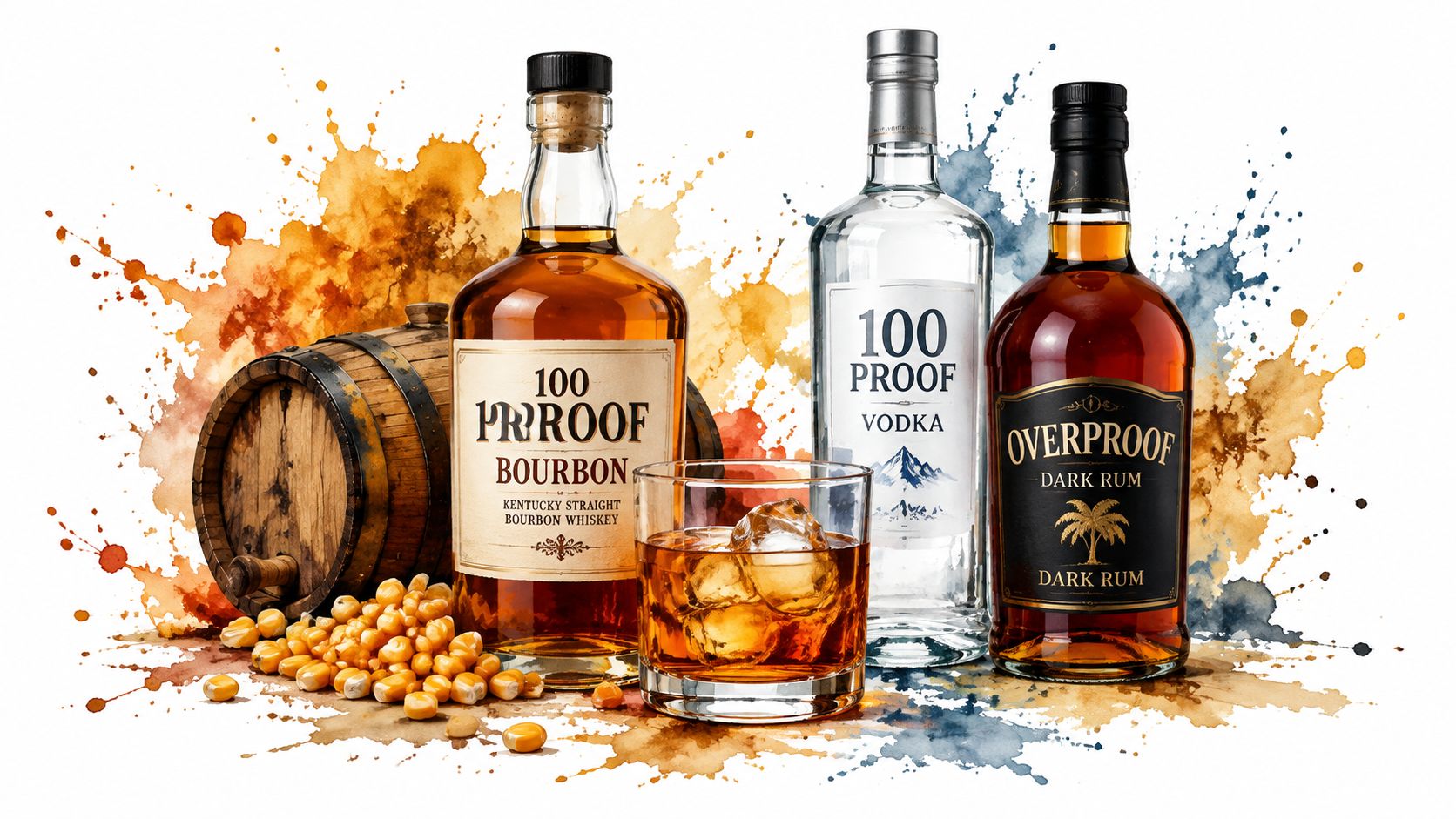
Bourbon and whiskey
A U.S. bourbon or whiskey labeled 100 proof contains 50% alcohol by volume. Some drinkers prefer this strength neat or with a little water because it can give the pour a fuller flavor and firmer texture. Those are sensory qualities, not a separate definition of proof.
Bottled-in-bond whiskey often appears in conversations about 100-proof whiskey because that category is associated with the same proof level. The terms still describe different things. Proof indicates alcohol concentration, while other label terms identify legal, production, or aging requirements.
Vodka and neutral spirits
A 100-proof vodka also equals 50% ABV in the United States. Its relatively neutral taste can hide the strength more easily after mixing with juice, soda, or another flavored ingredient. The mixer changes the drink's flavor and total volume, but the vodka's alcohol remains.
A bottle may show “100 proof” in large type and “50% alc./vol.” in smaller type. These are not two competing strength measurements. They express the same concentration in the U.S. system. That wording also helps correct a common mistake: 100 percent proof is not the standard way to describe a bottle with 100 proof. The usual label terms are 100 proof or 50% ABV.
Rum used in cocktails
Overproof rum is another common example of high-strength spirits. Market coverage projects that the overproof rum market could reach $19.36 billion by 2025, with a 7.4% CAGR through 2033, according to the overproof rum market projection. Because that source describes a projection, the figures are not a confirmed current market total.
Read the bottle and the recipe together:
- Find the proof: It gives the U.S. strength number.
- Find the ABV: It states the alcohol percentage directly.
- Check the recipe: The listed proof may affect the intended balance and alcohol content.
- Measure the pour: A stronger spirit places more alcohol in the same volume, so free-pouring can change how quickly a drink affects you.
The bottle's category guides flavor expectations. The proof guides alcohol concentration. Serving volume determines how much of that alcohol reaches the glass.
What 100 Proof Means for Pouring Safety and Intoxication
The most important practical point is simple: higher proof puts more alcohol into the same volume of liquid. A person who pours by eye may therefore consume more ethanol than intended, even when the glass looks ordinary. A neat pour can be especially difficult to judge because there's no mixer or ice to make the volume more visible.
Neutral health guidance cited in the medical literature treats 1 ounce of 100-proof spirits as one standard drink, compared with 1.5 ounces of 80-proof spirits. The distinction appears in this medical reference on alcohol exposure and standard drink calculations.
Why speed and serving size can change
If someone substitutes a 100-proof spirit for an 80-proof spirit without changing the pour, they're increasing the amount of alcohol in that serving. Higher ABV can produce a faster peak blood alcohol concentration and greater impairment, even when people compare drinks by similar volume.
That doesn't mean proof alone predicts exactly how someone will feel. Body size, food, medications, drinking pace, tolerance, and other factors affect alcohol's impact. It does mean the label gives you a clear reason to slow down and measure rather than assume one glass equals another.
Practical rule: Measure a high-proof pour instead of relying on the height of the liquid in the glass.
A jigger is a simple tool for cocktails, and a marked measuring cup can help when preparing drinks at home. Keep the bottle visible while mixing so you can check the proof before adding it. If a recipe was written for a lower-proof spirit, don't assume the same volume will have the same effect.
Making safer decisions in real situations
Higher-proof spirits can be easy to underestimate in mixed drinks because fruit juice, soda, sugar, and ice soften the taste. The drink may seem mild while still containing a concentrated spirit. Drinking it quickly can further reduce the time available to notice impairment.
The same concern applies to driving and work-related transportation. Anyone who operates a commercial vehicle should review specialized guidance about commercial DUI penalties in Santa Clara County, because legal consequences can depend on the driver's status and circumstances.
If you're worried about withdrawal symptoms after regular drinking, don't try to manage severe symptoms alone. Information about alcohol detox symptoms can help you recognize why professional medical guidance may be important.
A useful home routine includes measuring each drink, spacing drinks with nonalcoholic beverages, eating before drinking, and avoiding driving after alcohol. These steps don't make high-proof alcohol harmless. They make the amount easier to see and reduce the chance that an unmeasured pour becomes several servings.
Key Takeaways About 100 Proof and Next Steps for Mindful Choices
Does 100 percent proof mean alcohol is pure? No. In U.S. labeling, the standard term is 100 proof, which equals 50% ABV because proof is twice the alcohol-by-volume percentage.
Use these reminders when reading a bottle or pouring a drink:
- Divide proof by two: 100 proof becomes 50% ABV.
- Read both numbers: Proof and ABV express the same strength in different formats.
- Connect strength to the pour: One ounce of 100-proof spirits is treated as one standard drink in the cited health guidance.
- Check the measurement system: Historic British proof followed a different relationship, so older labels may not match modern U.S. numbers.
- Measure instead of guessing: Free-poured 100-proof liquor can add more alcohol than expected, especially in a sweet, easy-drinking cocktail.
A bottle label gives the concentration. Your glass determines how quickly that alcohol reaches you. A measured ounce of 100-proof spirit contains the alcohol strength described above, while a larger or repeated pour increases the total amount, even if juice, soda, sugar, or ice hides the taste. That connection matters for intoxication speed and standard drink counting.
If you regularly drink more than planned, conceal how much you drink, experience cravings, or worry about withdrawal, steps to stop drinking safely can help you consider support without making the change alone.
Addiction Resource Center LLC offers consultation, medically supervised detox, medication-assisted treatment, residential rehabilitation through a partner facility, and Intensive Outpatient Program care in person or through telehealth. It also supports co-occurring mental health needs, relapse prevention, and aftercare planning for adults and families in Northern California.
If alcohol is difficult to measure, control, or stop, visit Addiction Resource Center LLC to request a confidential consultation.