You're standing at a point many people reach after detox, during an IOP intake, or late at night after another relapse scare. You want something that lowers overdose risk, but you also don't want to feel like you're signing up for a medication that replaces one problem with another. That tension is exactly why medication …

You're standing at a point many people reach after detox, during an IOP intake, or late at night after another relapse scare. You want something that lowers overdose risk, but you also don't want to feel like you're signing up for a medication that replaces one problem with another. That tension is exactly why medication assisted treatment effectiveness gets misunderstood so often, and why the evidence needs to be read in plain language, not clinic jargon.
For opioid use disorder, MAT means FDA-approved medication plus counseling and behavioral support. It isn't a single pill, and it isn't one fixed program. In practice, effectiveness gets judged across several outcomes at once, including overdose risk, retention, opioid use, remission, and broader recovery, because different people care about different endpoints at different stages of care.
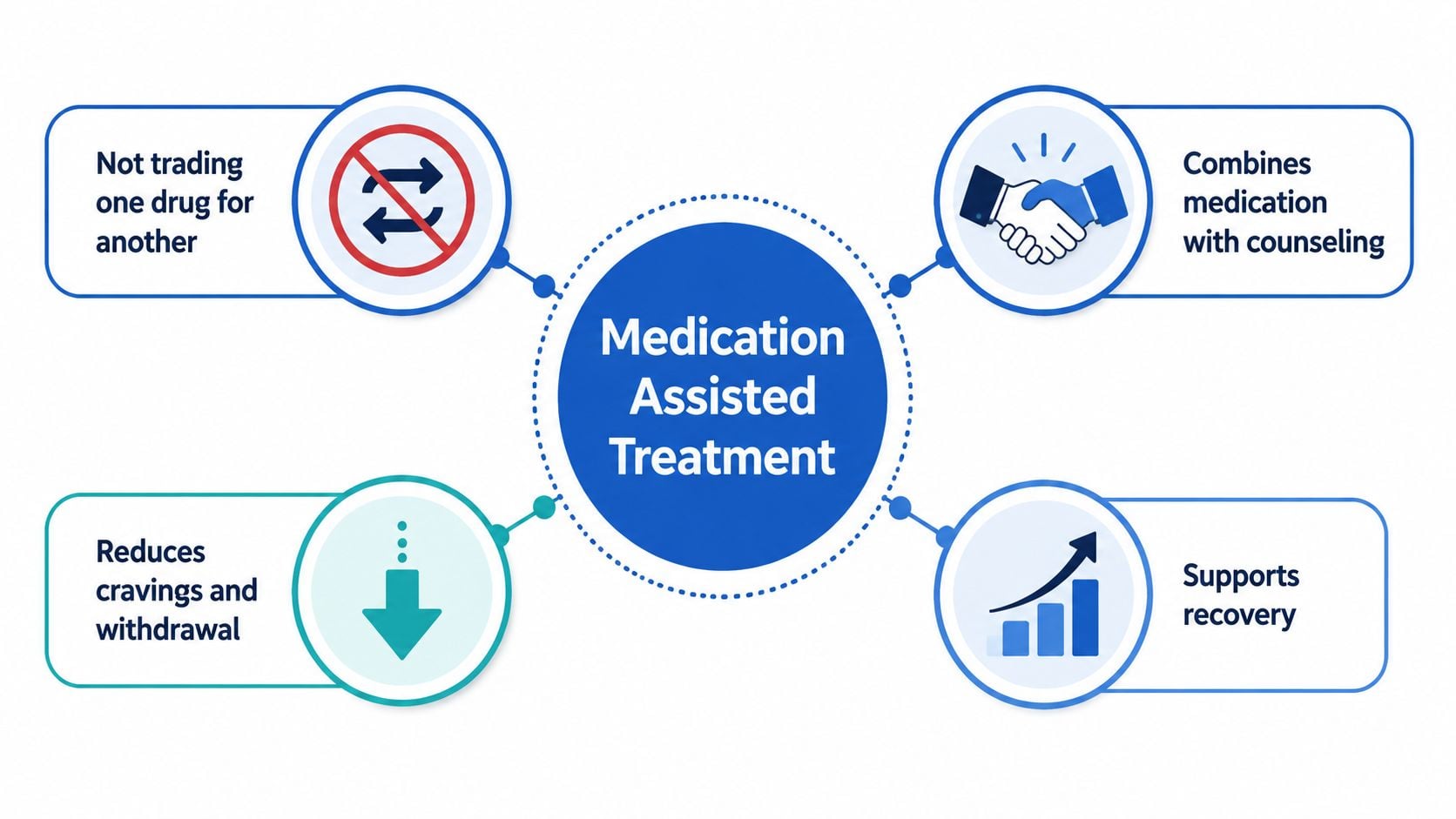
Table of Contents
- What Medication Assisted Treatment Actually Does
- How the Three Main MAT Medications Work
- What the Strongest Research Shows
- The Recovery Question the Evidence Barely Answers
- Where and How MAT Works in Real Life
- Common Misconceptions About MAT Effectiveness
- Choosing a MAT Program That Actually Fits
- Frequently Asked Questions About MAT Effectiveness
What Medication Assisted Treatment Actually Does
The first question patients ask me is usually the bluntest one. “Am I just trading one drug for another?” That concern makes sense if you've seen withdrawal, cravings, and relapse cycle through someone's life, because any medication that acts on opioid receptors can sound suspicious at first.
MAT is a treatment system, not a single medication
Medication assisted treatment combines medication with counseling, monitoring, and behavioral support. The medicine helps stabilize the brain and body, while therapy and recovery support help people rebuild routines, reduce triggers, and stay connected to care. That combination matters because MAT isn't trying to do one narrow job. It's trying to make recovery possible in a body that's still vulnerable to cravings, withdrawal, and overdose.
The best way to think about effectiveness is to ask, “Effective for what?” A medication can reduce illicit opioid use, improve retention, and lower overdose risk, yet still leave open questions about work, parenting, sleep, or daily functioning. Those aren't minor details. For many people, they're the whole point of treatment.
Practical rule: if a program only talks about urine screens and attendance, it's leaving out part of the recovery picture.
The same treatment can look “successful” from one angle and incomplete from another. Someone may stop using illicit opioids and stay in care, but still need help with housing, pain, anxiety, or rebuilding trust with family. That's why good MAT programs don't treat the medication as the finish line.
Why the same treatment can mean different things to different people
For one person, effectiveness means surviving the next month without overdose. For another, it means holding a job long enough to stabilize a household. For someone else, it means getting through early recovery without feeling constantly sick or panicked.
That's why medication assisted treatment effectiveness should never be reduced to a slogan. It's not just “Does it work?” It's “Which outcome are we measuring, and over what time frame?” That question keeps people from overpromising on recovery and underestimating what the medication can realistically do.
How the Three Main MAT Medications Work
The three main medications for opioid use disorder don't work the same way, and that's a good thing. People often want a best drug, but the more accurate question is which medication fits the person's history, tolerance, goals, and safety needs.
Buprenorphine, methadone, and naltrexone in plain English
Buprenorphine acts like a dimmer switch. It activates opioid receptors enough to reduce withdrawal and cravings, but not in the same all-or-nothing way as a full opioid. That's why people often describe it as steadier and less intense. It can be a strong fit when someone needs office-based treatment and a medication that's easier to prescribe and maintain in the community.
Methadone is more like a carefully tuned steady signal. It strongly activates opioid receptors, which is why it can be especially useful for people with high opioid tolerance or long, severe use histories. It needs close medical oversight because the dose and timing matter. The goal isn't to create intoxication. The goal is to prevent the roller coaster of withdrawal and craving that drives repeated use.
Naltrexone works differently. It acts like a lock on the door, blocking opioids from attaching to receptors. That means it doesn't relieve withdrawal the way buprenorphine or methadone do, and it usually makes the most sense after full detox or for people who can stay fully opioid-free before starting.
Here's a simple way to compare them:
- Buprenorphine: steadier, lower-intensity receptor activation.
- Methadone: stronger, longer-acting receptor activation with close supervision.
- Naltrexone: blocks opioid effects instead of activating receptors.
The chemistry matters, but the person matters more. A medication that fits a patient's stage of recovery can feel life-saving. The wrong fit can feel impossible, especially if someone is still in withdrawal, unstable after detox, or trying to recover with little support.
Why matching beats ranking
People sometimes ask which medication is “strongest.” That framing usually leads them in the wrong direction. Strength isn't the point. Fit is the point. If someone needs daily structure and close monitoring, methadone may be appropriate. If someone needs easier access through outpatient care, buprenorphine may be a better start. If someone wants an opioid-blocking option after detox, naltrexone may be worth discussing, and this overview of naltrexone for addiction gives a helpful plain-language primer.
All three are meant to be paired with counseling and recovery support. None of them should be treated as a magic fix on their own.
What the Strongest Research Shows
Families usually want a simple answer to a hard question. Does medication assisted treatment lower the risks that matter most, or is it just another label for treatment that sounds better than it performs? The strongest evidence focuses on outcomes that are easy to measure and hard to argue with, especially death, overdose, and remission.
Mortality and overdose are where MAT is most convincing
A major evidence review found that people with opioid use disorder were less likely to die when they were in long-term treatment with methadone or buprenorphine than when they were untreated, and it estimated an overall mortality reduction of approximately 50% among people receiving agonist medication. That matters because mortality is the clearest hard endpoint in this field, and the review also linked long-term retention on medication with better outcomes. The strongest evidence in that review was for agonist treatment, which means medication that activates opioid receptors in a controlled way rather than blocking them. NCBI evidence review on opioid agonist treatment and mortality
A large 2020 study of 40,885 adults with opioid use disorder found that only buprenorphine and methadone were associated with reduced risk of overdose and serious opioid-related acute care use compared with no treatment during follow-up. That distinction matters in real life. A patient may hear “MAT” as if every option has the same effect, but the comparative research does not support that assumption. For a clearer overview of how evidence-based treatment options are judged, see this guide on effective addiction treatment outcomes. JAMA Network Open study on comparative outcomes in OUD care
Plain-language takeaway: the strongest real-world evidence consistently favors buprenorphine and methadone for major safety outcomes.
What remission data add to the picture
A newer national analysis across 112 U.S. health-care organizations found that buprenorphine and methadone were each independently associated with significantly higher remission than no treatment, with adjusted hazard ratios of 2.33 for buprenorphine and 2.50 for methadone. A hazard ratio above 1 means remission was more likely in the treatment group than in the comparison group. That does not tell you everything about work, parenting, or daily functioning, but it does show that these medications are linked to meaningful clinical change in real-world care.
This is why I tell families to stop thinking in terms of “MAT works” or “MAT doesn't work.” The better summary is that methadone and buprenorphine have the most consistent evidence for lowering overdose risk, supporting remission, and keeping people alive long enough to recover. That is the strongest reading of the data currently available.
The Recovery Question the Evidence Barely Answers
A lot of people do not stop at the question of survival. They want to know whether treatment will help them feel like themselves again, hold a job, parent with steadiness, and get back to ordinary routines without feeling ruled by cravings or withdrawal. That is a reasonable question, and the evidence is thinner there than it is for overdose prevention or staying in treatment.
What we know less well than people assume
A systematic review found that evidence for functional outcomes such as work, family functioning, and quality of life was low or very low quality. That does not mean MAT has no effect on those areas. It means the studies have not answered the question with much confidence yet. A treatment can look strong on abstinence or retention while still leaving a patient unsure whether daily life is improving. Systematic review on functional outcomes in opioid agonist treatment
That gap matters in the exam room and in family conversations. Patients are not only trying to avoid positive urine tests. They want mornings that feel manageable, school pickups they can count on, and enough stability to make plans without wondering whether withdrawal will undo the week.
The question of why patients fail treatment plans often comes down to that same gap between clinical goals and lived recovery. A person may be taking medication correctly and still feel stuck if sleep, anxiety, housing stress, or daily structure have not improved.
Medication plus therapy may help most, but the proof is still incomplete
Real-world analysis of pharmacologic treatment and psychotherapy in remission suggests that medication plus structured psychotherapy may be linked with the strongest remission benefit, compared with no treatment. The catch is that this kind of study is observational, so it cannot fully separate the effect of the treatment itself from the effect of who is able to access both care and follow-up in the first place. Real-world analysis of pharmacologic treatment and psychotherapy in remission
A clearer way to say it is that medication may steady the body, while therapy helps organize the rest of recovery. That pairing can matter most for patients who need help translating stability into habits, relationships, and daily functioning.
For readers who are trying to understand how these pieces fit across substance types, the same logic applies in MAT treatment for alcohol, where medication can reduce the pull of drinking but still needs the right support around it.
The honest middle ground is simple. MAT clearly reduces opioid use and improves adherence to care. It probably helps people rebuild function by making stability possible. The evidence for broader recovery outcomes is still weaker than the evidence for mortality, overdose prevention, and remission, so the best answer is not a slogan. It is a careful, case-by-case view of what treatment is helping a person do in real life.
Where and How MAT Works in Real Life
A medication can make sense on paper and still fall short in daily care if the delivery model does not match the patient's situation. Telehealth, rural access, and the period right after detox are all places where the way treatment is delivered can shape the result.
Telehealth and rural care change the equation
A 2022 review of tele-MOUD found that it generally improved retention and abstinence, while also making clear that the evidence is limited by nonrandomized designs, uneven outcome measures, and access barriers such as technology gaps and unreliable internet for underserved patients. That matters because telehealth can remove one barrier and reveal another if the patient does not have a stable phone, a private place to meet, or a dependable connection. Tele-MOUD review on outcomes and access barriers
Rural treatment access shows the same pattern in a different setting. In a comparative-effectiveness study of adults with opioid use disorder, buprenorphine or methadone was associated with lower risk of overdose and serious opioid-related acute care use at 3 and 12 months, while access to care remained constrained. That is a practical reminder that delivery matters, but medication choice still matters too when the surrounding system is thin.
After detox is where people often drop off
Detox can make someone physically safer for a short period, but it does not create recovery by itself. The harder part comes after the acute withdrawal phase, when a person is expected to hold the whole plan together without enough follow-up or structure.
After detox, effectiveness depends on continuity, not just medication choice.
That is why good post-detox planning stays concrete. It includes a handoff to ongoing care, a plan to start or continue medication, and a way to stay connected when cravings rise. If you want a plain-language explanation of the adherence problem itself, why patients fail treatment plans is useful because it separates human behavior from blame.
For readers comparing pathways, the question is not whether MAT can work in telehealth, rural settings, or after detox. It can. The better question is which program has enough structure to keep people engaged long enough for the medication to do its job. For alcohol-related care questions, this MAT overview for alcohol treatment can help distinguish where medication fits and where it does not.
Common Misconceptions About MAT Effectiveness
The most common pushback I hear is emotional, not technical. Families worry that medication means “not really sober.” Patients worry they'll be stuck on something forever. Both reactions deserve a clear answer.
Three beliefs that keep people from getting care
“It's just trading one addiction for another.” Physical dependence and addiction aren't the same thing. Addiction is compulsive use despite harm. Dependence means the body has adapted to a medication, which can happen with many legitimate treatments. In MAT, that controlled dependence is often what allows the brain and body to stabilize.
“It's only a short-term fix.” The mortality and retention evidence argues against that idea. People do better when treatment is sustained, and long-term agonist treatment is where the strongest survival benefit shows up. Trying to force a quick taper because it feels neater is often more about comfort with the plan than success with the patient.
“Willpower should work better.” The comparative data don't support that. In the large observational studies, buprenorphine and methadone outperformed non-medication pathways on overdose, acute care use, and remission. That doesn't mean motivation doesn't matter. It means motivation works better when it's paired with medication that lowers withdrawal and craving.
Patients also sometimes worry that MAT without therapy isn't enough. That concern is partly right. Medication is powerful, but recovery usually needs more than medication alone. The problem is not medication. The problem is pretending medication can carry every part of recovery by itself.
Choosing a MAT Program That Actually Fits
A good MAT decision starts with a medical assessment, not a guess. The right program should match the person's opioid history, mental health needs, safety risks, and ability to attend care consistently.
What to ask before you start
- Level of care: Can the program handle detox, residential rehab, intensive outpatient care, or telehealth if your situation changes?
- Co-occurring needs: Does the team treat anxiety, depression, trauma, or other mental health concerns alongside substance use?
- Aftercare planning: Is there a clear plan for follow-up after the first stabilization phase?
- Access and coverage: Does the program take your insurance or TRICARE, and can they explain the next steps clearly?
- Team structure: Will you see clinicians who can monitor medication safely and adjust the plan when needed?
That checklist matters because the best medication in the wrong setting can still fail. For some people, the safest starting point is medically supervised detox with MAT. For others, the right path is ongoing outpatient care with medication and therapy.
Addiction Resource Center LLC in Yuba City offers medically supervised detox with MAT, residential rehabilitation through its partner facility Ona Treatment Center in Browns Valley, and an IOP in person or via telehealth. Its multidisciplinary team includes a medical doctor, registered nurse, licensed counselors, an LMFT, and recovery mentors, with 24/7 phone and text support at 530-625-7910 and care at 1002 Live Oak Blvd., Suite A, Yuba City, CA. That kind of structure is what makes medication assisted treatment more than a prescription.
Frequently Asked Questions About MAT Effectiveness
How long do people stay on MAT? It varies. The strongest mortality evidence is tied to long-term treatment, not rushed tapers, so the timeline should be based on stability, not a calendar.
Is MAT safe during pregnancy? Medication decisions in pregnancy need specialist oversight. Methadone and buprenorphine are used in pregnancy in appropriate care settings, and the right option depends on the patient's situation.
What if someone uses opioids while on MAT? It's a warning sign, not a reason to assume treatment failed. The dose, timing, counseling, and level of support may need adjustment.
How do I explain MAT to skeptical family members? Focus on safety, stability, and the evidence that treatment reduces overdose and supports remission. People respond better when the conversation is about survival and functioning, not labels.
If you're trying to decide whether MAT is the right next step, Addiction Resource Center LLC can help you sort through detox, residential care, and outpatient options without pushing you into a one-size-fits-all plan. Visit Addiction Resource Center LLC to talk with a team that offers medically supervised detox with MAT, IOP, and coordinated aftercare for adults and families in Northern California.