You may be reading this late at night, after another promise to cut back didn't hold. Maybe you've tried stopping on your own, made it a few days, then found yourself drinking again and wondering what's wrong with you. Usually, nothing is “wrong” with your character. Alcohol use disorder is a medical condition, and many …

You may be reading this late at night, after another promise to cut back didn't hold. Maybe you've tried stopping on your own, made it a few days, then found yourself drinking again and wondering what's wrong with you.
Usually, nothing is “wrong” with your character. Alcohol use disorder is a medical condition, and many people need more than willpower to get traction. That's where MAT treatment for alcohol can change the conversation. It gives your brain and body support while you do the hard work of recovery.
A lot of people never hear about this option. Even though it works, only 2.5% of an estimated 28.0 million people with alcohol use disorder in 2024 received medication-assisted treatment, according to NIAAA alcohol treatment statistics in the United States. If you've felt like information about alcohol-focused MAT is oddly hard to find, you're not imagining it.
Table of Contents
- A Hopeful Path Forward from Alcohol Use Disorder
- What Is Medication-Assisted Treatment for Alcohol
- Key MAT Medications for Alcohol Use Disorder
- Is MAT the Right Path for Your Recovery
- What Your MAT Journey Looks Like Step by Step
- Start Your Recovery at Addiction Resource Center
- Frequently Asked Questions From Patients and Families
A Hopeful Path Forward from Alcohol Use Disorder
A common story sounds like this. Someone notices alcohol is taking up more space in life than it used to. They try setting rules. Only weekends. Only two drinks. Never alone. Then stress hits, sleep gets worse, cravings build, and the rules fall apart.
That cycle creates shame fast. People start thinking, “If I really wanted to stop, I would.” But alcohol use disorder doesn't work that way. The brain adapts to repeated alcohol exposure, and those changes can make craving, irritability, and relapse feel overwhelming even when a person is sincere about wanting help.
MAT treatment for alcohol gives people another option besides white-knuckling it. Instead of asking you to fight every urge with sheer determination, it uses medication to reduce some of the biological pressure that keeps the cycle going. That can make room for counseling, accountability, and healthier routines to stick.
Many patients feel relief just hearing that needing medication doesn't mean they've failed. It means the treatment is being matched to the illness.
Alcohol-focused MAT is still overlooked, a situation with critical implications. Many people know medications exist for opioid use disorder, but fewer realize there are FDA-approved medications for alcohol use disorder too. That gap in awareness leaves people suffering longer than they need to.
If you've been searching for answers and finding mostly vague advice about “just stop drinking,” there's a better framework. Think of recovery as medical care plus emotional support plus practical structure. Medication doesn't replace the inner work. It makes the inner work more possible.
What Is Medication-Assisted Treatment for Alcohol
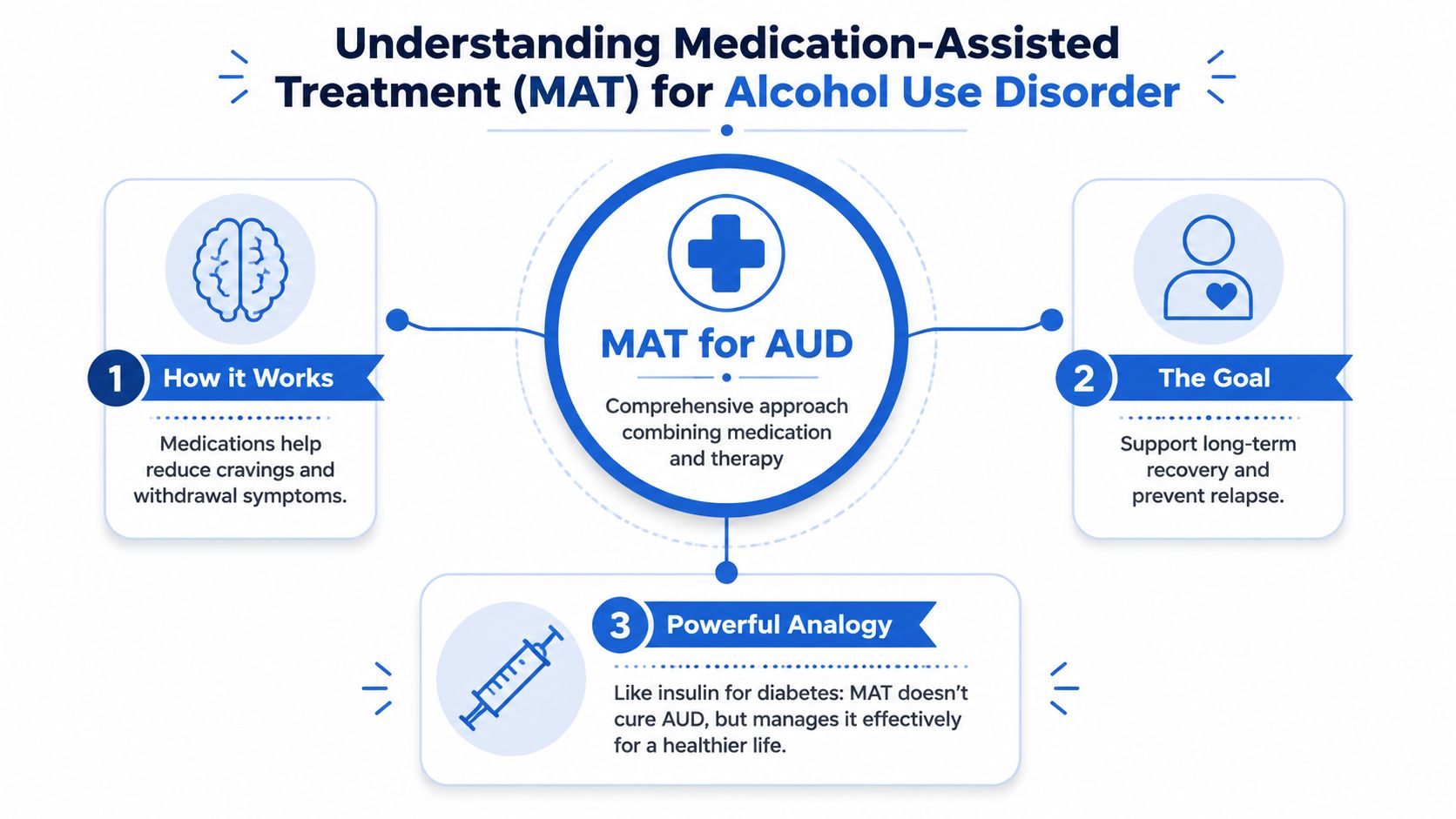
Medication-assisted treatment for alcohol means using FDA-approved medication together with counseling and behavioral support. It is not a shortcut, and it is not a way to avoid recovery work. It is a treatment model that addresses both the physical and psychological sides of alcohol use disorder.
Why medication can help
A simple analogy helps here. If someone has diabetes, using insulin isn't “cheating.” It's treating a medical condition with an appropriate medical tool. MAT treatment for alcohol works in a similar spirit. The medication supports the body and brain while the person builds recovery skills.
Some medications reduce craving. Some make drinking less rewarding. Another creates a strong deterrent by causing an unpleasant reaction if alcohol is used. The point is not to change who you are. The point is to lower the noise so you can think clearly, sleep better, participate in therapy, and make decisions with less pressure from cravings.
Practical rule: Medication is part of treatment. It isn't the whole treatment.
That's why the strongest version of MAT includes therapy, family support when appropriate, and a plan for stress, triggers, sleep, relationships, and mental health.
What the full treatment approach looks like
For many patients, the formula looks like this:
- Medical evaluation: A clinician reviews your drinking pattern, withdrawal risk, health history, and current goals.
- Medication choice: The provider picks a medication that fits your body, your drinking status, and your ability to follow the dosing plan.
- Counseling support: Therapy helps you understand triggers, repair routines, and practice ways to respond differently.
- Ongoing follow-up: The treatment team checks how the medication feels, whether cravings are changing, and what needs adjustment.
A short video can make the concept easier to grasp in plain language.
Some people worry MAT means “replacing one drug with another.” For alcohol use disorder, that framing misses the point. The approved medications for AUD are used to support recovery, not to create intoxication. They are tools that help stabilize the condition so you can engage in treatment with a steadier footing.
Key MAT Medications for Alcohol Use Disorder
There are three FDA-approved medications for alcohol use disorder: naltrexone, acamprosate, and disulfiram. They do not work the same way, and they are not equally suited to every patient. The right choice depends on your current drinking, your medical history, and what kind of support you'll realistically be able to follow.
Naltrexone
Naltrexone works by blocking opioid receptors, which reduces the rewarding effects of alcohol. In everyday language, people often describe this as alcohol feeling less reinforcing or less compelling when they're on it.
This medication requires careful timing. Naltrexone requires complete detoxification from alcohol before starting, while acamprosate can be started as soon as drinking stops, according to California DHCS guidance on MAT use for alcohol. That detail matters because patients often assume all alcohol medications start the same way.
A patient might be a good fit for naltrexone if they:
- Need craving support: They feel a strong pull toward heavy drinking after stopping.
- Want help reducing reinforcement: They describe alcohol as feeling intensely rewarding or hard to walk away from.
- Can complete detox first: They're medically ready for a provider to consider this option.
Many people know naltrexone as a daily pill. Some settings also use an injectable form, but the exact format and schedule should come from the prescribing clinician.
Acamprosate
Acamprosate works differently. It modulates glutamate and GABA systems, which are involved in the brain's balance and can be disrupted by chronic alcohol use. In practical terms, it's often used to help reduce ongoing craving and support stability after someone has stopped drinking.
Acamprosate tends to make the most sense for someone who has already stopped drinking and wants help maintaining that progress. It can be a strong option for a person who says, “I can get through stopping, but I don't trust what happens next when stress hits.”
There is one practical catch. Acamprosate usually requires a three-times-daily dosing schedule. For some patients, that's manageable. For others, it becomes a barrier. If a person already struggles with remembering medication, work shifts, or childcare chaos, that dosing pattern becomes part of the decision.
Good medication matching is less about finding the “best” drug and more about finding the one a person can safely start and consistently use.
Disulfiram
Disulfiram takes a very different approach. Instead of reducing craving directly, it acts as a deterrent. If a person drinks alcohol while taking disulfiram, they can have a very unpleasant physical reaction.
That can make it useful for some patients, especially those who want a firm external barrier between themselves and impulsive drinking. It may also help when the person has strong motivation, clear structure, and support around daily adherence.
Disulfiram is not a casual medication. It requires honest planning. A patient and provider need to talk through whether the person can avoid alcohol reliably, including hidden alcohol in some products, and whether this approach fits their lifestyle and medical situation.
Comparison of FDA-Approved MAT Medications for Alcohol
| Medication | How It Works | Who It's For | Administration | Key Considerations |
|---|---|---|---|---|
| Naltrexone | Blocks opioid receptors and makes alcohol less reinforcing | People who have completed detox and want help reducing heavy drinking pull | Commonly taken as a pill, with clinician-directed options depending on care setting | Must be started only after detoxification; requires medical review |
| Acamprosate | Modulates glutamate and GABA activity to reduce craving and support stability after stopping | People who have already stopped drinking and want support maintaining abstinence | Taken by mouth on a repeated daily schedule | Best for patients who can stick to three-times-daily dosing |
| Disulfiram | Creates an unpleasant reaction if alcohol is consumed | People seeking a deterrent approach with strong motivation and structure | Taken by mouth | Requires careful education, planning, and strict avoidance of alcohol |
When patients get confused, it's usually because they expect one medication to fit every stage of recovery. It doesn't. A person who is still drinking, a person who just completed detox, and a person who has been sober for a stretch may each need a different plan.
Is MAT the Right Path for Your Recovery
The best question usually isn't “Is MAT good or bad?” It's “Does MAT fit what I'm dealing with right now?” That shift matters. Recovery works better when treatment matches the actual pattern of drinking, craving, relapse, and daily life.
When MAT often makes sense
MAT may be worth discussing if any of these sound familiar:
- You stop and restart often: You can quit for a short time, but cravings or stress keep pulling you back.
- Therapy alone hasn't been enough: You understand your triggers, but the physical urge still feels too strong.
- You want a medical layer of support: You're ready to work on recovery and want help that goes beyond motivation.
- You have co-occurring stressors: Anxiety, depression symptoms, unstable routines, or relationship strain make relapse more likely.
Evidence supports this approach when it's part of a broader plan. MAT delivers its strongest benefits when combined with psychosocial interventions, and naltrexone reduced the risk of return to heavy drinking by 19% compared with placebo, while the number needed to treat to prevent one person from returning to any drinking was 11 for acamprosate, according to the University of Colorado MAT overview.
What MAT does and does not do
MAT can lower cravings, reduce relapse risk, and help stabilize early recovery. It can make counseling more productive because you're not spending every hour wrestling with the next urge to drink.
It does not erase grief, repair trust overnight, or remove every trigger from your life. It also doesn't work well as a “pill only” strategy. A person who takes medication but avoids therapy, honesty, and follow-up usually feels disappointed because the rest of the recovery system never gets built.
The medication helps open the door. You still have to walk through it with support, structure, and practice.
If you're unsure, that's normal. Uncertainty doesn't mean MAT isn't right for you. It usually means you need a careful conversation with a qualified provider who can sort through your goals, your health history, and your fears without judgment.
What Your MAT Journey Looks Like Step by Step
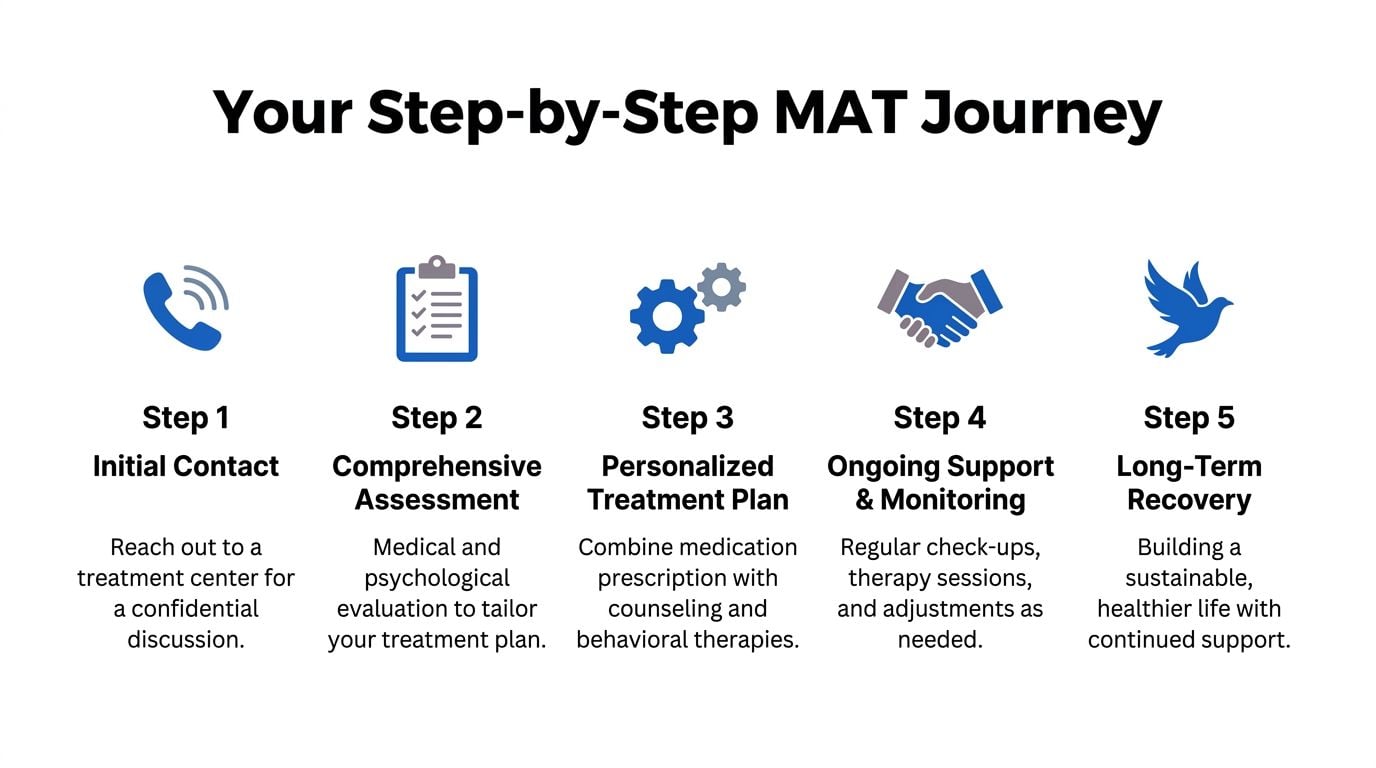
Individuals often feel less anxious when they know what the process looks like. Treatment is rarely one dramatic leap. It's a sequence of manageable steps.
The first conversations and evaluation
The process usually starts with a confidential call or intake visit. You'll talk about how much and how often you drink, whether you've tried to quit before, what withdrawal has looked like, and whether there are mental health or medical concerns that need attention.
That first conversation is not a test. You do not need the perfect words. You do not need to prove you're “bad enough.” You just need to be honest enough for the treatment team to build a safe plan.
From there, the clinician looks at several practical questions:
- Do you need detox first because withdrawal could be risky or because a medication like naltrexone must wait until after detox?
- Have you already stopped drinking, which could make a medication like acamprosate more appropriate?
- What will you follow, including pill schedules, appointments, transportation, and support at home?
Starting treatment and building momentum
Once the provider chooses a medication, the early phase is about watching closely and adjusting. Some people feel relief quickly because cravings ease. Others need time, dose adjustments, or a different medication strategy. That's normal.
At the same time, therapy begins doing its own job. You might work on identifying the hour of day you usually drink, the argument that triggers a binge, the loneliness that shows up on weekends, or the thought pattern that says one drink won't matter. Medication lowers the volume. Therapy teaches you what to do with the quieter space.
A typical recovery rhythm often includes:
- Regular medical check-ins: The prescriber asks how the medication feels and whether side effects or cravings are changing.
- Counseling sessions: Individual or group work helps you build coping skills and relapse prevention habits.
- Daily structure: Sleep, meals, movement, and routines become part of treatment, not an afterthought.
- Longer-term planning: If the medication is helping, you and your team decide how long to continue and how to protect progress.
Some patients stay on medication for a meaningful stretch because stopping too soon can leave them vulnerable. Others eventually taper under medical guidance. What matters most is that the timeline is thoughtful, not rushed.
Start Your Recovery at Addiction Resource Center
If you've been trying to sort through treatment options on your own, it helps to talk with a team that can handle the full picture instead of offering only one piece of care.

Care that covers the full process
Addiction Resource Center LLC provides care for adults dealing with alcohol and drug use disorders, including people who also need support for co-occurring mental health concerns. The team includes a medical doctor, registered nurse, licensed counselors, an LMFT, and recovery mentors, which means patients can receive medical oversight and counseling support in one connected treatment path.
Services include medically supervised detox with MAT, outpatient care, and an Intensive Outpatient Program available both in person and through telehealth. For people who need a higher level of support, residential rehabilitation is available through its partner, Ona Treatment Center in Browns Valley, California.
Patients also get practical support, not just prescriptions. That includes individualized treatment planning, relapse prevention work, aftercare planning, privacy, and a calm setting focused on long-term change rather than quick fixes.
Simple ways to get started
Addiction Resource Center LLC accepts most major insurance plans and welcomes Tricare beneficiaries, which removes one of the biggest barriers people worry about before they ever make contact.
If you want to ask questions before committing, you can. If you need help deciding between detox, outpatient treatment, or a more structured setting, you can ask that too.
You can reach the team by phone or text at 530-625-7910, day or night. The office is located at 1002 Live Oak Blvd., Suite A, Yuba City, CA.
Frequently Asked Questions From Patients and Families
Will I be trading one addiction for another
For alcohol use disorder, MAT medications are used to support recovery, not to create a high. The goal is to reduce craving, reduce reinforcement, or create a deterrent to drinking. When prescribed and monitored appropriately, they are part of treatment, not a substitute addiction.
How long will I need medication
That depends on your relapse history, your response to treatment, and your broader recovery stability. In general, treatment isn't something to rush. A thoughtful provider will look at how you're doing over time instead of setting an arbitrary finish line on day one.
Do I need a specialist
Some primary care clinicians can prescribe medications for alcohol use disorder, but not every office has experience with careful selection, detox timing, counseling integration, and relapse planning. If your situation is medically or emotionally complicated, a treatment program with addiction expertise can make the process smoother and safer.
How can family help
Family can help most by learning, listening, and supporting treatment instead of policing it. That may mean encouraging medication adherence, participating in family sessions if invited, removing alcohol from the home, or responding calmly when recovery feels uneven.
Recovery usually goes better when the people closest to you understand that progress is built through treatment, consistency, and support, not shame.
If you're looking for clear answers about MAT treatment for alcohol, Addiction Resource Center LLC offers compassionate, practical help for adults and families in Yuba City and Northern California. Whether you need detox, outpatient care, telehealth IOP, or guidance on whether medication-assisted treatment is a fit, their team can walk you through the next step without pressure. Call or text 530-625-7910 any time to start a confidential conversation.