Out-of-pocket cost is the part of medical care you pay directly from your own money, including deductibles, copays, and coinsurance, but not monthly premiums. For Marketplace plans in 2026, the annual out-of-pocket maximum can reach $10,600 for an individual or $21,200 for a family for covered care. A family member may call after receiving a …


Out-of-pocket cost is the part of medical care you pay directly from your own money, including deductibles, copays, and coinsurance, but not monthly premiums. For Marketplace plans in 2026, the annual out-of-pocket maximum can reach $10,600 for an individual or $21,200 for a family for covered care.
A family member may call after receiving a $3,000 bill for a week of detox treatment, convinced the bill must be wrong because they have insurance. That confusion is understandable. “Covered” doesn't mean “free,” and an insurance card doesn't reveal what the patient must pay before the plan begins covering care.
Addiction treatment can involve medical detox, medication-assisted treatment (MAT), residential services, therapy, and an intensive outpatient program (IOP) over an extended period. Each service may have a different cost-sharing rule. Learning how those rules work before admission gives you a clearer view of the financial commitment and helps you ask better questions when speaking with a treatment provider or insurer.
Table of Contents
- Understanding Out-of-Pocket Costs in Health Insurance
- Breaking Down the Four Main Components
- How Out-of-Pocket Costs Apply to Addiction Treatment
- Estimating Your Costs Before Starting Treatment
- Strategies to Minimize Your Financial Burden
- Getting Started with Addiction Resource Center
Understanding Out-of-Pocket Costs in Health Insurance
Out-of-pocket cost means the portion of an allowed medical expense that you pay yourself. In health insurance, that usually includes a deductible, copayments, and coinsurance. Your monthly premium generally pays for having insurance and doesn't count as an out-of-pocket treatment expense.
The distinction matters because a plan can have an affordable premium but substantial costs when you use care. A person entering detox may owe the remaining deductible first, then share costs through copays or coinsurance. If treatment continues into MAT appointments and IOP sessions, repeated charges can add up even when every service is covered under the plan.
Practical rule: “Covered” describes whether the plan recognizes a service. It doesn't tell you the exact amount you'll owe.
The World Health Organization defines out-of-pocket health spending as the share of current health expenditure paid directly by households at the point of care, and the World Bank and WHO track it as a global health-financing indicator. In OECD countries, households funded just under one-fifth of health spending through out-of-pocket payments in 2021, while healthcare goods and services represented about 3% of average household spending in that year. The burden varied sharply, from 41% of health spending in Mexico to below 10% in France, the Netherlands, and Luxembourg. WHO's indicator metadata provides the definitions and country context.
Why addiction treatment needs a closer look
Detox may involve facility-based medical monitoring and medications. MAT may involve medication and recurring clinical visits. IOP may include individual counseling, group sessions, care coordination, and drug testing. Your insurer may apply a different benefit category or cost-sharing rule to each service.
Start with your plan documents, then compare them with the provider's estimate. A consumer reviewing individual coverage can also use a resource such as Duncan & Associates Insurance Brokers to better understand individual health insurance options and plan terminology.
Four terms deserve special attention:
- Deductible: What you pay for eligible care before the plan starts sharing costs under the applicable benefit.
- Copay: A fixed amount for a covered service, such as an office visit.
- Coinsurance: A percentage of the allowed amount that you pay after applicable deductible rules are met.
- Out-of-pocket maximum: The plan-year limit on eligible cost sharing for covered services.
Knowing these terms won't eliminate every bill, but it can prevent you from entering treatment without understanding your likely exposure.
Breaking Down the Four Main Components
Insurance cost sharing becomes easier to follow when you separate the four parts and then place them in order.
The deductible comes first
A deductible is the amount you pay for eligible care before the insurer begins paying according to the plan's cost-sharing rules. Suppose a plan has a $2,000 deductible and an eligible detox stay has an allowed amount of $5,000. If the deductible hasn't been met, you may be responsible for the first $2,000, subject to the plan's rules. The remaining amount may then be split through coinsurance or handled under another benefit category.
The facility's billed charge isn't always the number used for your calculation. Insurers generally apply the plan's allowed amount, which is the negotiated or otherwise recognized amount for the service.
Copays are fixed charges
A copay is a set dollar amount for a covered service. For example, if your plan charges a $30 copay for an IOP group session, each eligible session may create that fixed patient responsibility, subject to the plan's benefit design.
The frequency of care matters. A single copay may feel manageable, but repeated IOP groups, therapy appointments, medication visits, or other services can create a regular stream of expenses. Ask whether the copay applies per appointment, per day, or per service.
Coinsurance is a percentage
Coinsurance is a percentage of the allowed amount that you pay after the applicable deductible requirement is satisfied. With 20% coinsurance on an $85 allowed visit, your share would be $17 for that visit. CMS explains these insurance terms and cost-sharing mechanics.
For a $1,200 allowed MAT medication cost under an 80/20 arrangement, the patient share would be 20% of the allowed amount, or $240, assuming the deductible has been met and the medication is covered under that rule. Formulary status, prior authorization, and pharmacy requirements can change the result, so treat the example as a calculation method, not a promise of coverage.
The out-of-pocket maximum limits eligible cost sharing
An out-of-pocket maximum caps what you pay during the plan year for covered services that count under the plan. For Marketplace plans in 2026, the federal cap is $10,600 for an individual and $21,200 for a family. After the applicable maximum is reached, the plan pays 100% of covered services for the rest of that plan year. Healthcare.gov explains the out-of-pocket maximum.
The maximum doesn't necessarily include premiums, out-of-network care, non-covered services, or charges above the allowed amount. Always confirm which expenses count.
A practical way to manage the numbers is to categorize spending by month, separating premiums from treatment cost sharing and tracking each bill against your deductible and maximum. A monthly budgeting method can make recurring MAT or IOP expenses easier to see. Koru's guide to monthly budget categories offers a general framework you can adapt to healthcare expenses.
How Out-of-Pocket Costs Apply to Addiction Treatment
Two plans can cover the same addiction treatment services while producing very different bills. The examples below use hypothetical allowed amounts and service patterns to show how plan design affects exposure. They aren't quotes for care or predictions of a patient's final responsibility.
Assume the same treatment timeline: a 30-day residential detox and rehabilitation stay, followed by 8 weeks of IOP, with MAT medication, individual therapy, and group sessions. Plan A has a high deductible and higher maximum. Plan B has a lower deductible, fixed copays, lower coinsurance, and a lower maximum.
| Cost Component | Plan A: High Deductible | Plan B: Low Deductible |
|---|---|---|
| Deductible | $5,000 | $1,500 |
| Coinsurance | 20% | 10% |
| Copay structure | Not specified in example | $40 per applicable visit |
| Out-of-pocket maximum | $8,000 | $4,500 |
| Likely pressure point | Early detox costs before deductible is met | Repeated visits and copays over time |
With Plan A, the patient may pay eligible costs toward the $5,000 deductible before the plan begins applying its 20% coinsurance. A large detox episode could consume much of that deductible quickly. Subsequent eligible costs, including certain MAT, therapy, or IOP services, may then generate 20% coinsurance until the patient reaches the $8,000 out-of-pocket maximum, assuming the services are covered, in network, and count toward the maximum.
Plan B shifts more of the responsibility into a lower deductible and recurring charges. The patient may reach the $1,500 deductible sooner, then pay 10% coinsurance on applicable allowed amounts plus $40 copays for services governed by that copay. The lower $4,500 maximum gives a smaller upper boundary for eligible cost sharing, but repeated visits can still matter before that limit is reached.
Addiction care often involves several service types at once. A detox facility may bill facility services, a clinician may bill medical care, a pharmacy may process medication separately, and an IOP may submit claims for multiple forms of therapy. Before admission, verify insurance coverage and ask which benefit category applies to each part of the treatment plan.
The important comparison isn't “Does the plan cover rehab?” Ask instead, “How much could this plan require me to pay if treatment continues as clinically recommended?”
Estimating Your Costs Before Starting Treatment
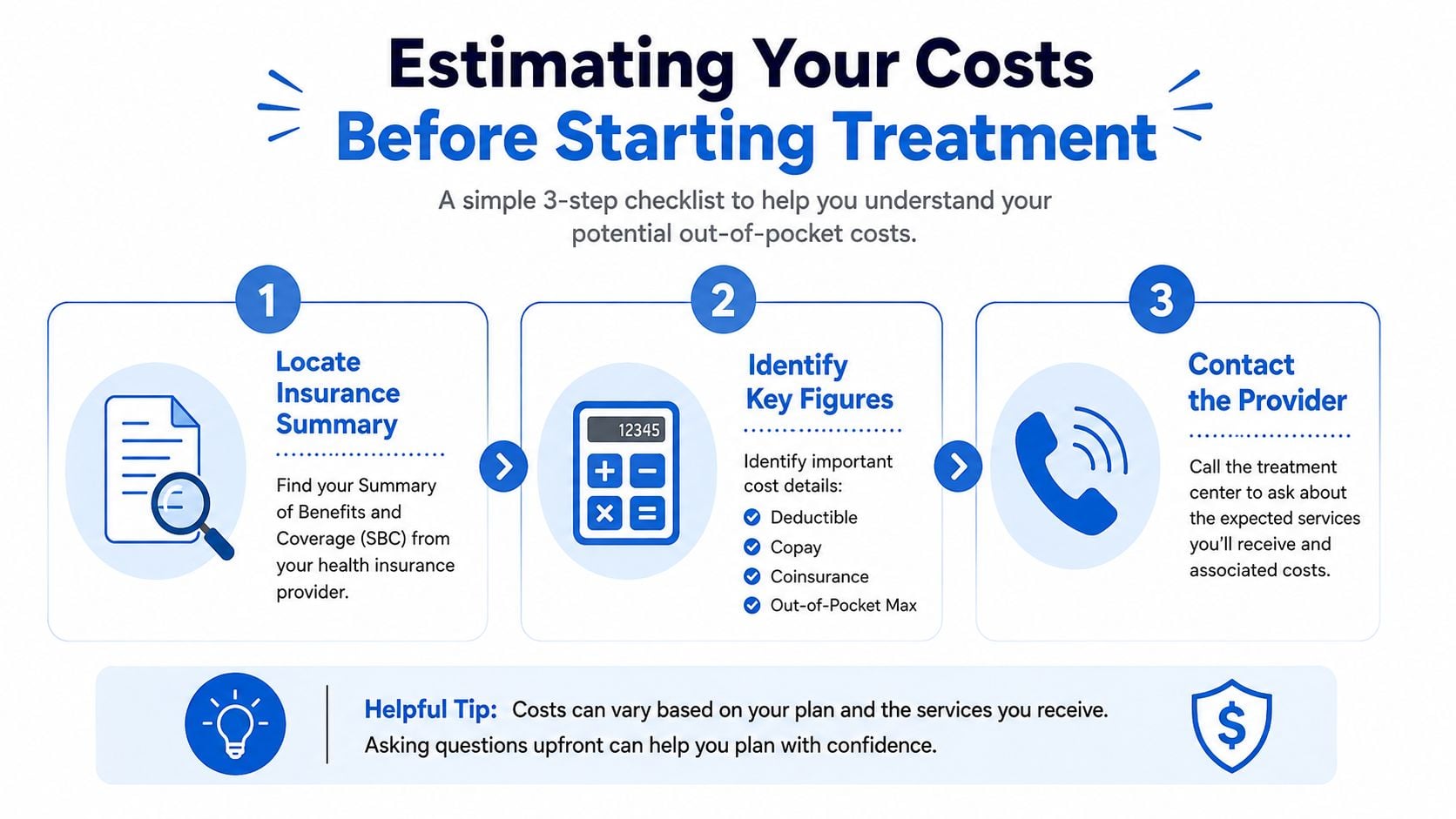
Begin with your Summary of Benefits and Coverage and the insurer's member portal. Find the individual or family deductible, the amount already applied during the current plan year, the applicable copays, the coinsurance rates, and the remaining out-of-pocket maximum.
Then call the number on your insurance card. Keep a pen and paper ready, and use direct questions:
- “Is this treatment facility in network for my exact plan?”
- “Which benefits apply to medical detox, residential treatment, MAT, individual therapy, and IOP?”
- “Does detox, MAT, or IOP require pre-authorization or a utilization review?”
- “What deductible amount remains?”
- “What is my remaining out-of-pocket maximum for this plan year?”
- “Which services and providers will count toward that maximum?”
- “Can you give me a reference number for this call?”
Write down the representative's name, the date, and the answers. A phone estimate isn't the same as a guarantee of payment, but careful documentation gives you a useful record if the claim later differs from the explanation you received.
Build a provider-side estimate
Ask the treatment center's billing department for a written estimate. Request separate information for the facility, clinicians, laboratory work, medications, therapy, and any services handled by outside providers. Then compare each item with the insurer's benefit description.
For example, suppose a 30-day IOP program has an allowed amount of $5,000, your remaining deductible is $1,500, and the plan applies 10% coinsurance after the deductible. The first $1,500 could apply to the deductible. If the remaining $3,500 is subject to 10% coinsurance, the estimated coinsurance would be $350, producing an estimated patient responsibility of $1,850, before considering copays, non-covered services, or amounts that don't count toward the maximum.
This kind of calculation only works when the allowed amount and benefit rules are accurate. For more context on the variables that affect an IOP bill, review this guide to intensive outpatient program cost.
Ask the provider to explain what happens if the insurer pays less than expected. Get payment policies, deposits, cancellation rules, and assistance options in writing before you commit funds.
Strategies to Minimize Your Financial Burden
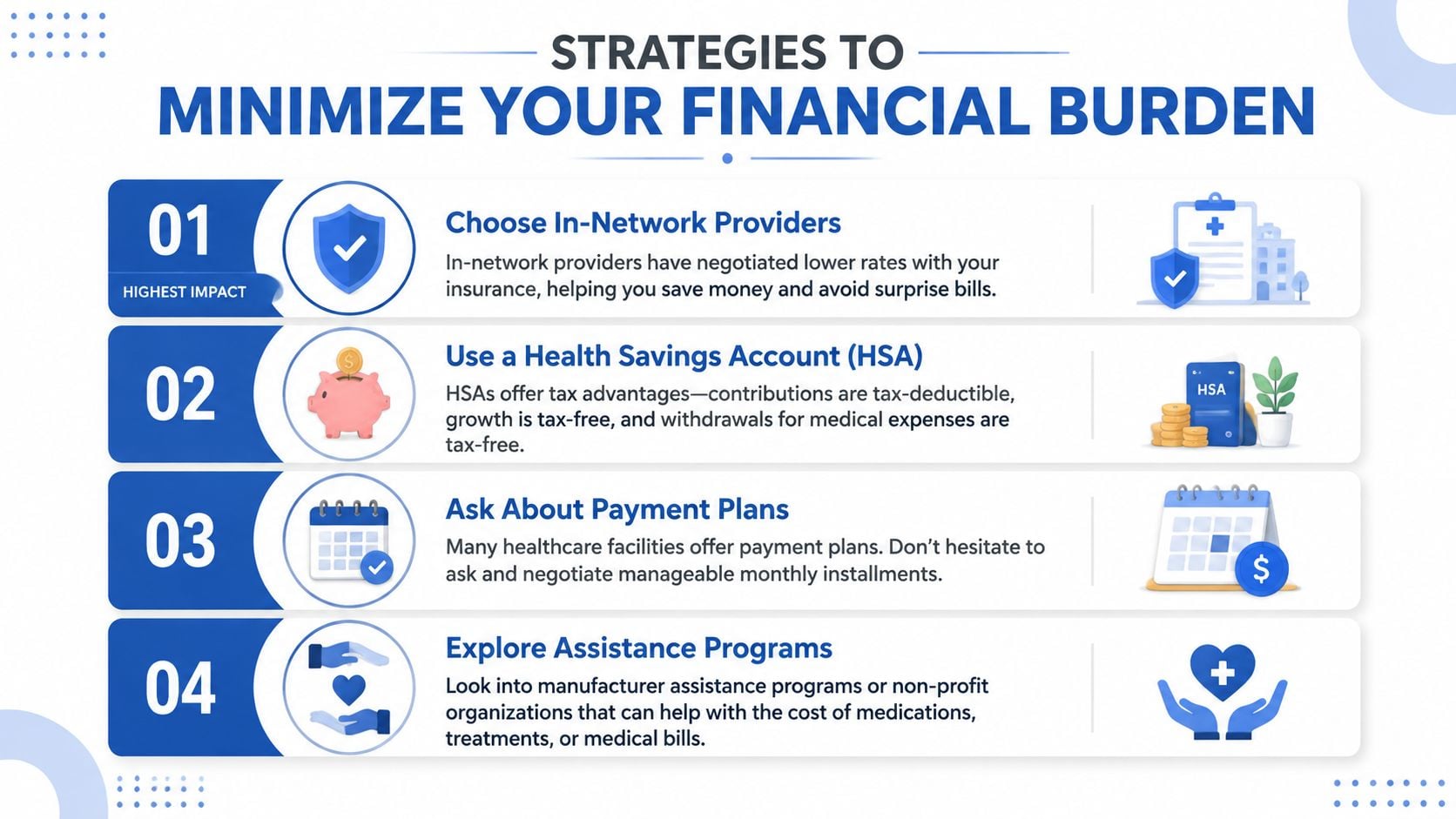
The most effective approach combines insurance verification with practical billing preparation. Start with the provider network. In-network care generally uses the insurer's negotiated allowed amounts and plan cost-sharing rules, while out-of-network care may involve higher patient responsibility, separate deductibles, limited benefits, or no coverage for some non-emergency services.
Pre-authorization deserves equal attention. Ask who submits it, which services require it, when approval must be obtained, and whether the authorization covers the full expected treatment period. Treatment that proceeds without a required authorization can result in a denied claim or a bill that the patient must challenge.
Use the plan year to your advantage
If you've already paid a substantial part of your deductible, additional eligible treatment may be priced differently than it would have been at the beginning of the year. If treatment can be scheduled safely and clinically, ask the provider and insurer how the plan-year reset affects your estimate. Recovery decisions should never be delayed when urgent care is needed, but timing can matter for planned continuing services.
Review every explanation of benefits. Compare the dates, services, provider names, allowed amounts, and patient responsibility with the care you received. If the insurer denies a claim, request the written reason, ask whether missing authorization or coding caused the denial, and follow the plan's appeal instructions. Your provider's billing team may be able to submit clinical records or correct an administrative error.
Reduce the balance that remains
Ask the treatment center about a payment plan, sliding-scale policy, prompt-pay arrangement, or financial assistance process. Some facilities may also direct families toward nonprofit resources or medication assistance, depending on eligibility and the service involved.
Health Savings Accounts and Flexible Spending Accounts may provide tax-advantaged ways to pay eligible healthcare expenses, but account rules vary. Confirm eligibility and allowable expenses with your plan administrator or tax professional before using funds.
Combining an in-network provider, completed pre-authorization, a written estimate, careful claim review, and available account or assistance resources can reduce avoidable costs. For families weighing payment options, this guide to how to pay for rehab can help organize the questions to ask.
Getting Started with Addiction Resource Center
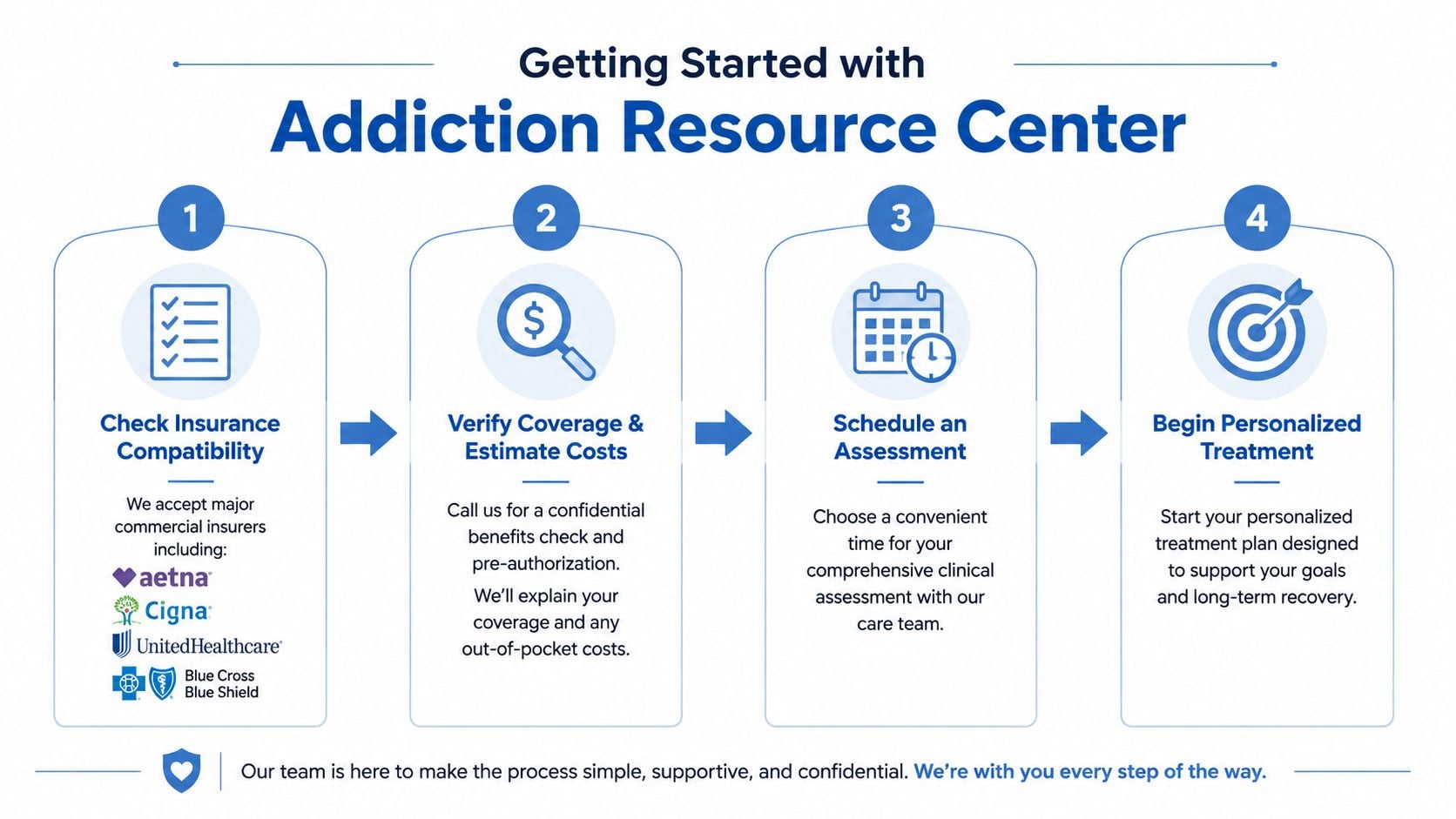
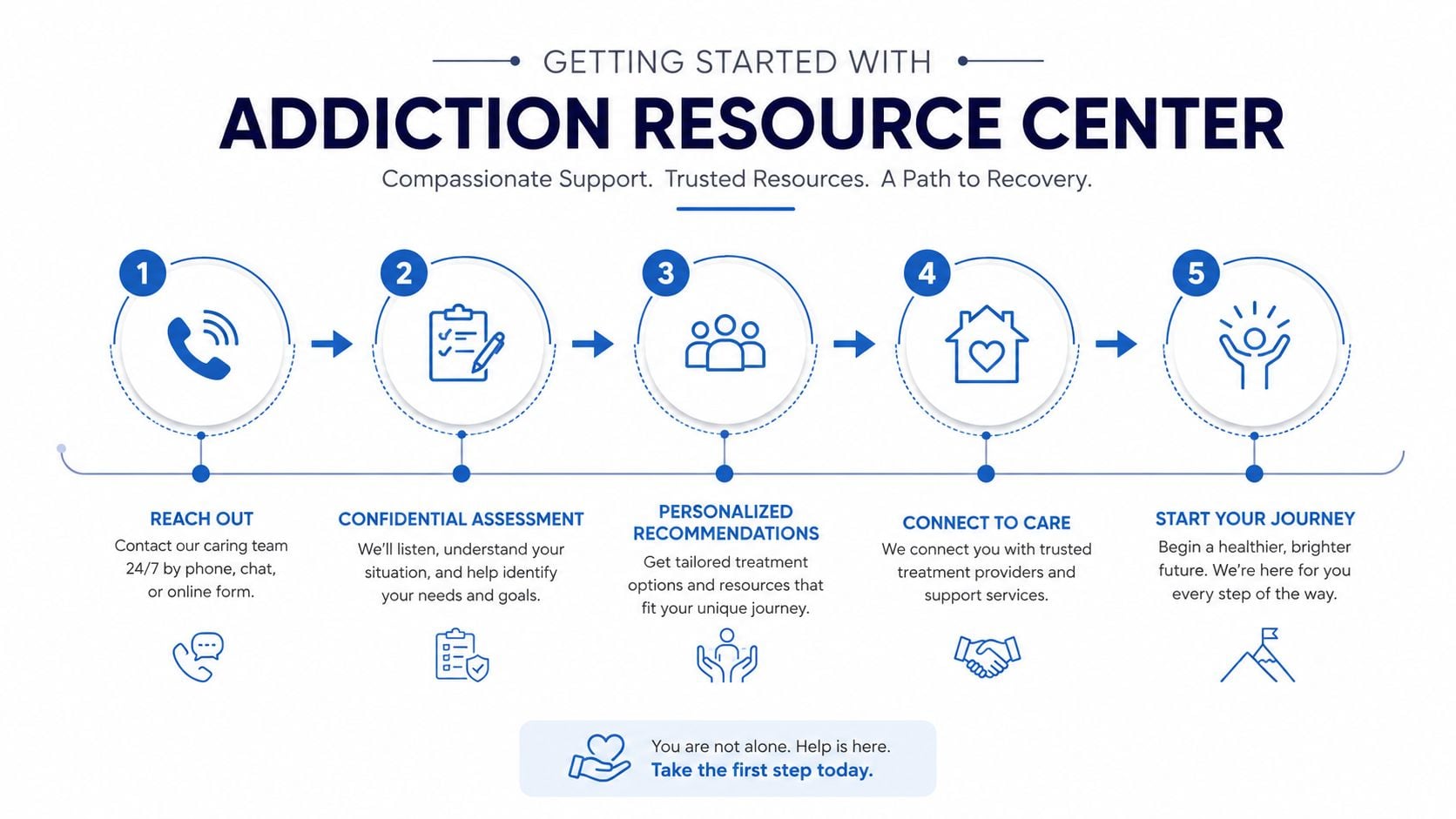
A prospective client may begin with a short call while a family member is still deciding whether treatment is possible. The admissions team can review insurance information, explain the next steps, and help identify likely cost-sharing before the caller makes a financial commitment.
Addiction Resource Center accepts most major commercial insurance plans, including plans associated with Aetna, Cigna, UnitedHealthcare, Anthem, Blue Cross, and Blue Shield, and welcomes TRICARE beneficiaries, including military families. Coverage depends on the specific policy, network status, authorization requirements, and the service being provided.
What the intake process looks like
The first call or text typically starts an insurance and treatment conversation. The team can help verify benefits, discuss the requested level of care, and coordinate an assessment. Benefits verification typically happens within 24 hours, according to the center's stated intake process, although the insurer's final claim decision still depends on the plan and submitted documentation.
Have these items available:
- Insurance card: Include the member ID, group number, and insurer phone number.
- Medication list: Note current prescriptions, dosage information if available, and recent medication changes.
- Treatment records: Bring prior discharge summaries, diagnoses, medication history, or other records that may help the clinical team.
- Basic contact details: Include the patient's preferred phone number and the best time to reach them.
The center offers a continuum that can include medically supervised detox with MAT, residential rehabilitation through its partner facility, Ona Treatment Center in Browns Valley, California, and an IOP available in person or through telehealth. These services may process under different benefits, so ask for an estimate for each stage rather than assuming one approval covers everything.
The multidisciplinary team includes a medical doctor, registered nurse, licensed counselors, licensed marriage and family therapist, and recovery mentors. Services emphasize wellness monitoring, individualized planning, relapse prevention, education, accountability, and aftercare planning for adults seeking substance use and co-occurring mental health support.
Addiction Resource Center LLC offers insurance verification guidance and treatment options that may include medical detox, MAT, residential rehabilitation through a partner facility, and IOP in person or by telehealth. Visit Addiction Resource Center LLC or call or text 530-625-7910 for a free, confidential insurance check before starting care.