You've made the difficult decision to seek help for substance use, but the next question feels just as overwhelming: What kind of treatment is appropriate? A person experiencing withdrawal may need medical supervision, while someone who is medically stable may benefit from outpatient counseling, an intensive outpatient program, or residential support. The answer depends on …

You've made the difficult decision to seek help for substance use, but the next question feels just as overwhelming: What kind of treatment is appropriate? A person experiencing withdrawal may need medical supervision, while someone who is medically stable may benefit from outpatient counseling, an intensive outpatient program, or residential support. The answer depends on more than the substance involved or a diagnosis on paper.
Level of care determination is the clinical process used to match a person with the safest and least intensive setting that can effectively meet their needs. It considers withdrawal risk, physical health, mental health, motivation, relapse risk, and the living environment. Understanding that process can make the first conversation with a treatment provider feel less uncertain and help families ask better questions.
Table of Contents
- Why Level of Care Determination Matters for Recovery
- Understanding the ASAM Criteria Framework
- The Six Dimensions That Shape Placement Decisions
- Treatment Levels From Early Intervention to Intensive Inpatient Care
- What to Expect During the Assessment Process
- Insurance Coverage and Accessing Appropriate Care
Why Level of Care Determination Matters for Recovery
Maria knows her alcohol use has become unsafe. She's missed work, argues with her family, and feels anxious when she tries to stop. Her brother finds an outpatient program online and assumes that attending counseling a few evenings a week will be enough. A clinician asks more questions first. Maria has previously experienced severe withdrawal symptoms, lives alone, and has untreated depression. Those details may change the recommendation entirely.
This is why level of care determination isn't a simple choice between “rehab” and “therapy.” A clinical team must determine how much structure, monitoring, and medical support Maria needs at the beginning of treatment. A lower-intensity program could leave her without adequate withdrawal support, while a more intensive setting may provide stabilization and protection during a vulnerable period.
The practical rule: Placement should follow the person's current safety and support needs, not the family's preferred setting or the first available opening.
Under-placement can create serious problems. Someone with significant withdrawal potential, medical complications, psychiatric instability, or an unsafe home environment may not be able to remain safe in routine outpatient care. Co-occurring mental health needs matter especially because anxiety, depression, trauma symptoms, cognitive problems, or psychiatric risk can affect both safety and treatment engagement.
Over-placement can also be difficult. A person who is medically stable, has reliable support, and can participate safely in outpatient services may not need the disruption of a highly supervised setting. The appropriate decision should account for clinical needs, daily responsibilities, available supports, and the person's preferences.
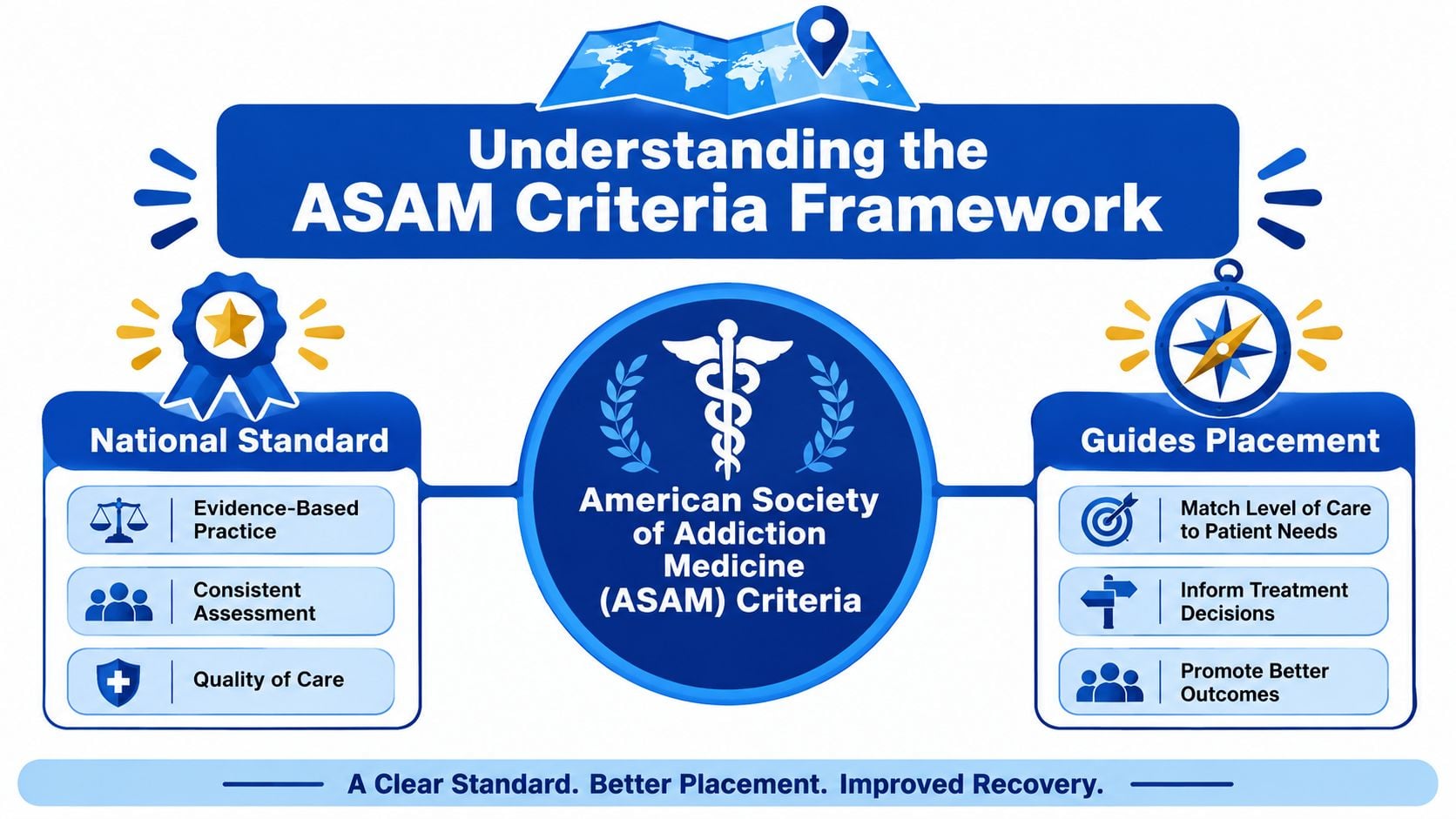
The process is grounded in the ASAM Criteria, a national clinical standard developed to guide placement, continued service, and transfer for people with addiction and co-occurring conditions. Clinicians use a structured, multidimensional assessment rather than relying on a single severity score. That approach gives families a clearer explanation of why a provider recommends detox, residential care, IOP, telehealth, or another setting.
Understanding the ASAM Criteria Framework
The American Society of Addiction Medicine Criteria provides the foundation for modern level of care determination. Current ASAM guidance describes the Criteria as a widely used and extensive set of standards for placement, continued service, and transfer of patients with addiction and co-occurring conditions. You can review the organization's overview of the ASAM Criteria and its placement guidance.
The central idea is straightforward: choose the least intensive level of care that remains safe and effective. “Least intensive” doesn't mean minimal help or inadequate treatment. It means avoiding a setting that offers more restriction or supervision than the person needs while ensuring the program can manage the risks that are present.
A standard built around the whole person
The framework's historical foundation was the ASAM Patient Placement Criteria, Second Edition, Revised, or PPC-2R, published in 2001. It formalized a consensus-based method for matching patients with an appropriate setting and intensity of care using six assessment dimensions, as documented in the National Library of Medicine discussion of ASAM placement criteria.
That history matters because clinicians aren't making placement decisions from personal preference alone. The framework has provided a structured method for determining safe care for more than two decades. It also introduced five adult detoxification levels within the withdrawal dimension, ranging from ambulatory detoxification without extended onsite monitoring to medically monitored inpatient detoxification.
The model later expanded into a broader continuum that includes early intervention and multiple treatment intensities. For someone seeking care, this means the assessment looks beyond the question, “How much is this person using?” It asks what could make treatment unsafe, what support is available, and what type of setting gives the person a realistic opportunity to stabilize and participate.
For a plain-language look at how people may move between services, this guide to navigating the continuum of care for addiction recovery can help families understand why placement may change over time.
The Six Dimensions That Shape Placement Decisions
A person's substance use history is only one part of the assessment. The ASAM framework examines six dimensions, then considers how they interact. The most urgent or severe need can drive placement when a lower-intensity setting wouldn't provide adequate safety.
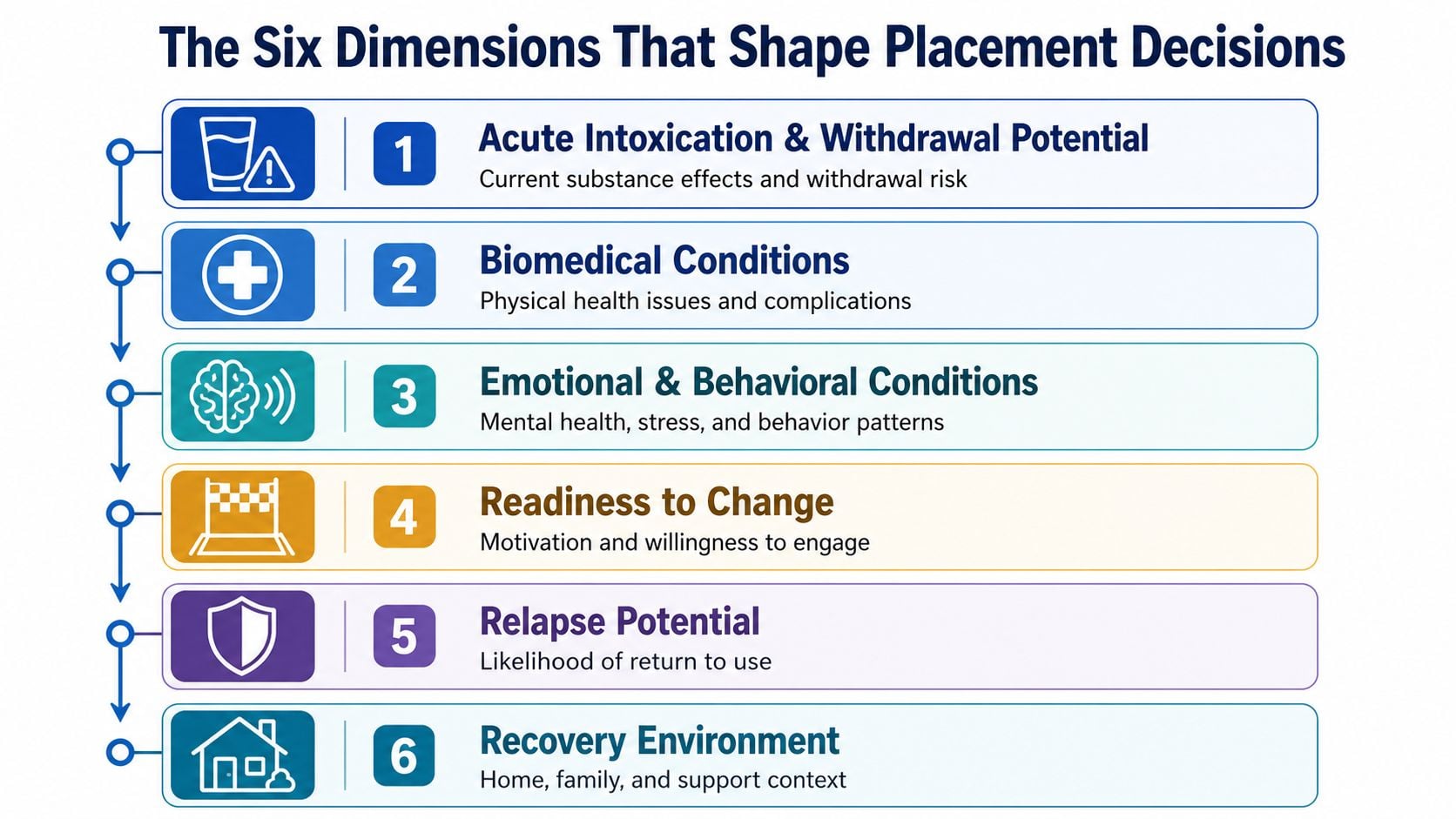
Dimension 1 and Dimension 2
Acute intoxication and withdrawal potential is often the first safety question. The clinician asks what substances the person uses, how recently they used them, whether they've had withdrawal before, and whether symptoms could become medically dangerous. Someone with substantial withdrawal risk may need detoxification with medical monitoring rather than beginning in routine outpatient counseling.
Biomedical conditions and complications include physical health problems that may affect treatment. A person with unstable medical needs, pregnancy-related concerns, medication complications, or other conditions requiring close observation may need a setting with appropriate medical capabilities. The issue isn't whether the person has a diagnosis. It's whether the condition changes what can be provided safely.
Dimension 3 and Dimension 4
Emotional, behavioral, and cognitive conditions include depression, anxiety, trauma symptoms, psychosis, suicidal thoughts, impulsivity, or difficulty understanding and following a treatment plan. Co-occurring psychiatric instability may require specialized psychiatric care instead of treating substance use in isolation. ASAM's newer guidance distinguishes general inpatient addiction care from psychiatric inpatient care and includes a distinct Level 4 Psych category.
Readiness to change addresses how willing and able the person is to participate. A person who is uncertain about treatment may need motivational counseling and a setting that can engage them without relying only on personal determination. Readiness isn't a moral judgment, and reluctance doesn't mean someone can't recover.
Dimension 5 and Dimension 6
Relapse and continued-use potential considers past attempts to stop, current cravings, patterns of returning to use, and whether the person can apply coping strategies outside treatment. Someone who repeatedly returns to use despite outpatient support may need more structure.
Recovery and living environment covers housing, family support, exposure to substances, transportation, safety, and daily stressors. Two people with similar withdrawal risk may receive different recommendations because one has a stable, substance-free home and the other returns to an environment filled with triggers.
A useful way to understand the combined assessment is to compare those two situations. Low withdrawal risk doesn't automatically mean low overall need. High relapse risk or an unsafe environment may support a more structured setting, while stronger supports may allow safe treatment at a lower intensity.
For families dealing with substance use and mental health symptoms together, this resource on dual-diagnosis addiction treatment offers additional context.
Treatment Levels From Early Intervention to Intensive Inpatient Care
The ASAM continuum ranges from Level 0.5 early intervention through Level 4 medically managed intensive inpatient care. The modern process also uses dimensional admission criteria and shared decision-making, so the final recommendation reflects both clinical findings and the person's circumstances.
Level 0.5 is intended for people who may have a substance-related problem but don't yet have a diagnosed substance use disorder. From there, services become more structured as medical, psychiatric, behavioral, or environmental needs increase.
| Level | Setting | Intensity | Typical Use Case |
|---|---|---|---|
| Level 0.5 | Early intervention | Education, screening, and brief support | A person may have a problem but doesn't yet meet criteria for a diagnosed SUD |
| Level 1 | Outpatient care | Scheduled counseling and clinical services while living at home | Stable individuals who can participate safely with limited structure |
| Level 2 | Intensive outpatient or partial hospitalization services | More frequent contact and greater structure than standard outpatient care | People needing regular support while remaining outside residential care |
| Level 2.7 | Medically managed intensive outpatient care | Intensive outpatient treatment with medical management | Individuals needing substantial outpatient structure and medical involvement |
| Level 3 | Residential services | Living at a treatment setting with consistent structure and support | People who need a protected environment but not acute hospital care |
| Level 4 | Medically managed intensive inpatient care | Hospital-based care with intensive medical management | Acute withdrawal, biomedical instability, or other needs requiring hospital-level treatment |
| Level 4 Psych | Psychiatric inpatient care | Intensive psychiatric and medical support | Significant psychiatric instability occurring alongside substance use |
The table shows why “inpatient” can be confusing. ASAM's fourth edition separates Level 4 acute hospital care from Level 4 Psych, while residential care and outpatient tiers address different needs. A person may need psychiatric stabilization, medical detoxification, residential structure, or frequent outpatient treatment, and those are not interchangeable services.
Treatment isn't a permanent label. It's a response to the person's needs at that point in time.
Placement can change as withdrawal resolves, medical conditions stabilize, psychiatric symptoms improve, motivation develops, or the living environment becomes safer. A person may move from detox to residential care, then to IOP or standard outpatient services. Conversely, worsening symptoms or new safety concerns may require transfer to a more intensive setting.
ASAM guidance states that if a relevant subdimension requires Level 4 care, the person should be referred or transferred accordingly. The key question remains consistent across the continuum: What setting can safely meet the person's needs right now?
What to Expect During the Assessment Process
A level of care assessment usually feels less like an exam and more like a detailed conversation. A qualified professional, such as a licensed counselor, social worker, or other trained clinician, gathers information about the person's recent substance use, health, mental state, motivation, relapse history, and living situation.
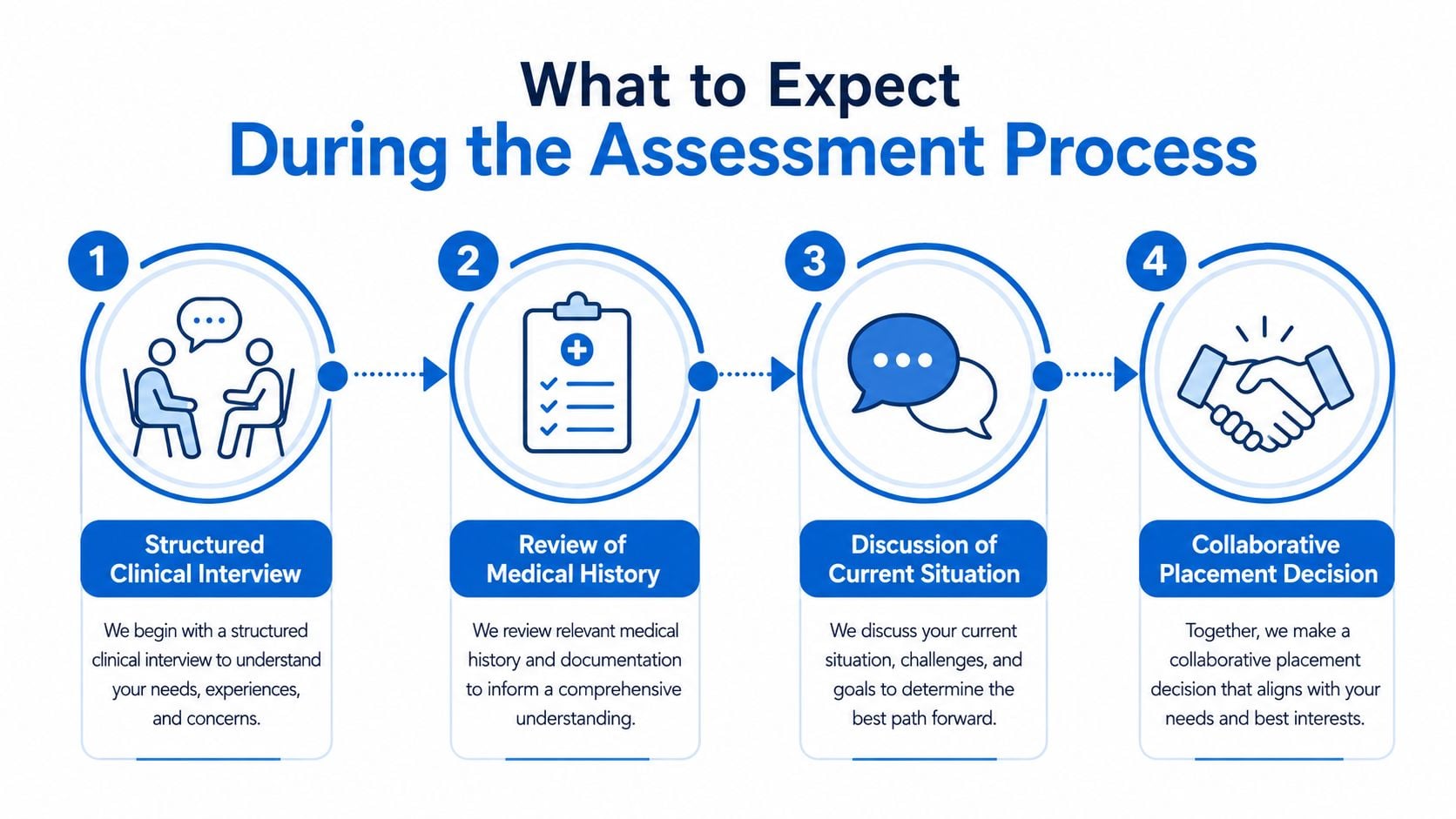
The conversation is structured, not punitive
ASAM's Fourth Edition assessment guide describes collecting “just enough information” across the dimensions to select an appropriate level of care. That doesn't mean the clinician ignores important details. It means the assessment is designed to gather information relevant to safety, treatment needs, and placement rather than making the person repeat every part of their life without purpose.
Expect questions such as:
- Substance use: What substances are involved, how often are they used, and when was the most recent use?
- Withdrawal: What symptoms have occurred during previous attempts to stop?
- Physical health: Are there medical conditions, medications, injuries, or complications that require attention?
- Mental health: Are there depression, anxiety, trauma, psychosis, cognitive, or safety concerns?
- Motivation: What does the person want to change, and what makes treatment feel difficult?
- Relapse history: What happened during previous treatment attempts or returns to use?
- Environment: Where does the person live, who provides support, and what risks are present there?
Honest answers help the clinician avoid underestimating risk. Families can bring medication lists, prior treatment information, discharge paperwork, and observations about recent behavior, but the patient should be treated as a participant rather than a problem to be reported.
How the recommendation is made
The assessment asks whether the patient meets criteria for the least intensive level capable of meeting their needs safely and effectively. If a higher level is needed in an important dimension, that concern can drive the recommendation. The clinician should explain the reasoning in understandable language, including what the program can manage and what would require a different setting.
The process may also include insurance verification, medical screening, psychiatric evaluation, and an initial treatment plan. If you're looking for broader mental health support alongside addiction services, a resource such as the Coral Gables psychology practice from Wald Behavioral Health may help you compare questions to ask a behavioral health provider.
You can ask, “Which dimension is driving this recommendation?” and “What would need to change before stepping down to a less intensive service?” Those questions turn a confusing decision into a collaborative discussion.
Insurance Coverage and Accessing Appropriate Care
Insurance can affect which programs are available, but it shouldn't replace clinical judgment. Most major insurance plans cover some substance use treatment, yet coverage varies by plan, network, authorization rules, and level of care. A plan may treat outpatient counseling differently from residential services or inpatient detoxification.
Providers often need documentation of medical necessity before an insurer authorizes a higher level of care. ASAM-based assessment findings can help show why a particular setting is appropriate, especially when withdrawal risk, medical complexity, psychiatric instability, relapse potential, or environmental danger makes routine outpatient treatment insufficient.
Questions to ask before admission
Call the treatment provider and insurer with specific questions:
- Network status: Is the program in network for the patient's plan?
- Covered services: Does the plan cover detox, residential treatment, IOP, medication-assisted treatment, or telehealth?
- Authorization: Is prior authorization required before admission or continued care?
- Clinical documentation: What information must the provider submit to support medical necessity?
- Patient responsibility: Are deductibles, copayments, or other costs involved?
A treatment center's insurance verification team can often explain benefits and identify documentation requirements. Patients and families can also review this patient guide to insurance and medication coverage from FindMyScript when they're trying to understand how plan rules may affect access to care.
Veterans and military families should ask specifically about TRICARE benefits and participating providers. Many treatment centers accept TRICARE beneficiaries, but eligibility, network participation, and authorization requirements still need confirmation for the intended service.
More practical questions are covered in this guide to verifying insurance coverage for addiction treatment. Keep the clinical assessment at the center of the conversation. If the recommended level isn't immediately available or covered, ask the provider about safe interim support, alternatives, and the process for transferring to the appropriate setting rather than choosing a lower level solely because it's easier to access.
Addiction Resource Center LLC offers consultation-based assessment and a continuum that includes medically supervised detox, residential rehabilitation through its partner facility, MAT, and IOP in person or through telehealth. Visit Addiction Resource Center LLC to discuss level of care options, insurance questions, and the next safe step for yourself or a loved one.