A treatment episode succeeds 61% of the time with contingency management, compared with 39% with other modalities, according to a meta-analysis summarized in the clinical literature (reviewed evidence). That result reframes a question many families ask with discomfort: can tangible rewards really help someone stop using drugs? The answer is yes, but access is far …

A treatment episode succeeds 61% of the time with contingency management, compared with 39% with other modalities, according to a meta-analysis summarized in the clinical literature (reviewed evidence). That result reframes a question many families ask with discomfort: can tangible rewards really help someone stop using drugs?
The answer is yes, but access is far less consistent than the evidence. Contingency management is an evidence-based behavioral treatment, yet clinics may struggle to fund incentives, train staff, document progress, or fit frequent testing into patients' lives. Understanding both sides of that gap can help you recognize a credible program and ask better questions when searching for care.
Table of Contents
- What Contingency Management Is and Why It Works
- The Science Behind Positive Reinforcement in Recovery
- Types of Incentives and Program Models
- How Clinics Implement Contingency Management
- Addressing Ethical and Legal Considerations
- Finding Contingency Management Support in Northern California
What Contingency Management Is and Why It Works
Contingency management links a clearly defined recovery behavior to an immediate, tangible reward. A participant may provide a drug-free urine sample, attend a scheduled visit, take medication as prescribed, or complete another agreed goal. Once staff verify the behavior, the program delivers the reward according to written rules.
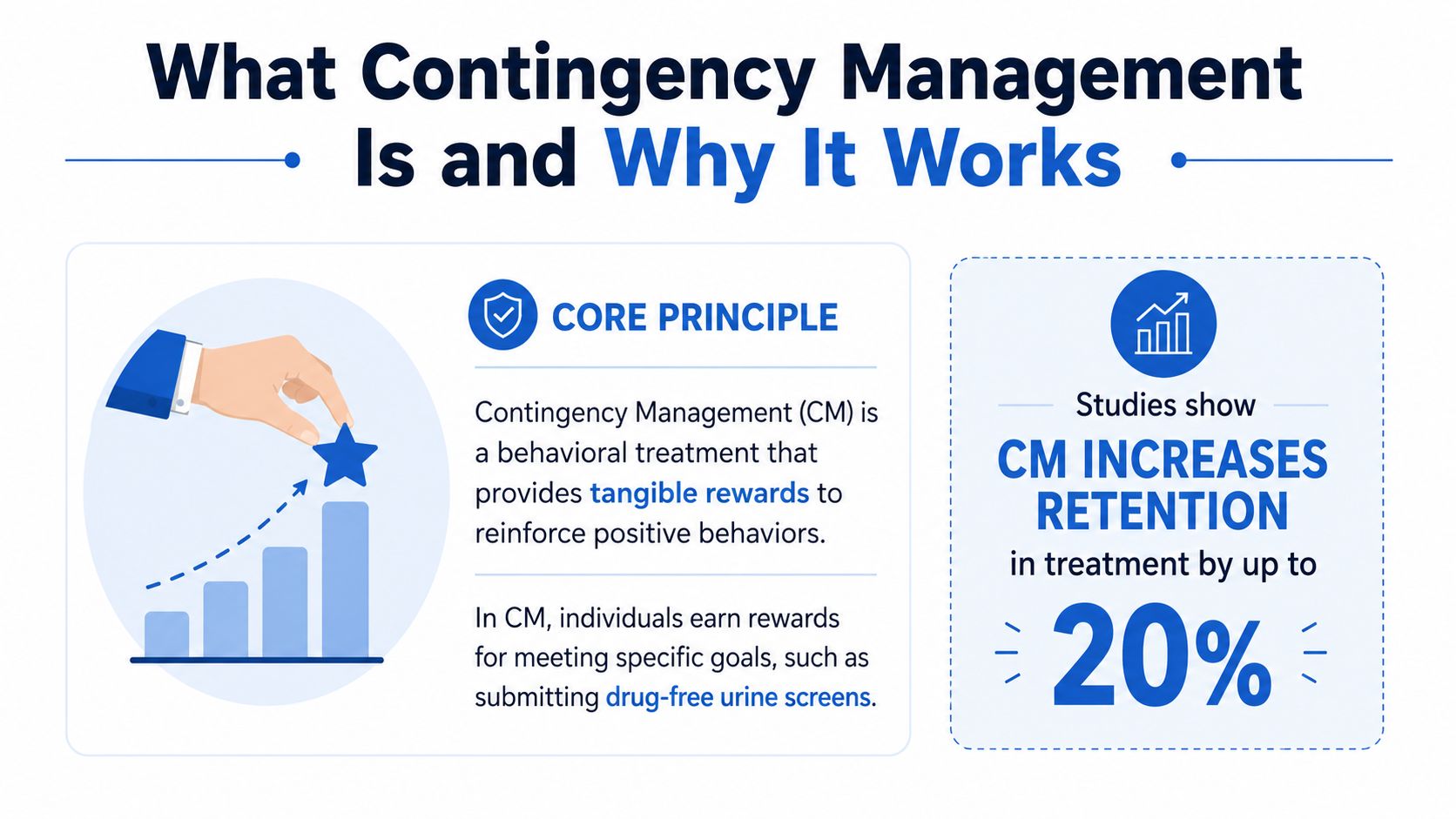
The reward is tied to evidence, not a promise. A sound program reinforces observable actions that support treatment, such as attending appointments or submitting a negative test. The clinician and participant agree in advance on the target behavior, how staff will measure it, and what follows each result.
What participation can look like
A participant might visit a clinic on a regular schedule, complete a urine screen, review the result with staff, and receive a voucher, prize opportunity, or clinic privilege when the result meets the program's criteria. A positive test should prompt a review of support rather than automatic shame or dismissal. The setback provides information and another opportunity to try.
That timing can matter greatly. Addiction may make the long-term benefits of recovery feel distant while the effects of substance use feel immediate. Contingency management adds a healthy, immediate consequence to a behavior that may initially seem unrewarding. The reward does not replace counseling, medication, housing support, or safety planning. It gives recovery behaviors a practical foothold while those supports develop.
The approach has a long clinical history. Its scientific roots trace to B. F. Skinner's work on operant conditioning, and early clinical studies in the 1970s and 1980s found that vouchers, prizes, or privileges tied to drug-free urine samples improved retention and abstinence (history of contingency management). By the 1990s, continued trials had established CM as a recognized evidence-based treatment, particularly for cocaine use disorder. Protocols later developed for cocaine, opioid, alcohol, and stimulant use disorders.
Practical rule: A legitimate program should explain exactly what behavior earns a reward, how staff verify it, how quickly the reward is delivered, and how setbacks are handled.
Why the results matter
Research does not show identical results for every participant. Across studies, however, CM can improve treatment participation and abstinence outcomes compared with other approaches. A review reported abstinence effect sizes ranging from 0.42 to 0.49, with another meta-analysis reporting a mean effect size of d = 0.42 (meta-analytic evidence).
Strong evidence does not guarantee easy access. Clinics may lack funding for incentives, trained staff, frequent testing, or systems for delivering rewards promptly. That implementation gap helps explain why one program may offer carefully structured CM while another uses only general encouragement. Families can ask whether the clinic follows written criteria, verifies behaviors consistently, and has a plan for setbacks. Programs that use structured follow-up may also draw on resources about how to get clients to take action, while keeping reminders respectful rather than pressuring.
The Science Behind Positive Reinforcement in Recovery
Contingency management is built on positive reinforcement, a behavioral principle with roots in operant conditioning. In plain language, a behavior becomes more likely to happen again when something valued follows it. A fitness app that recognizes completed workouts and a coffee shop that rewards repeat purchases use the same basic pattern, although addiction treatment applies it to health and recovery goals.
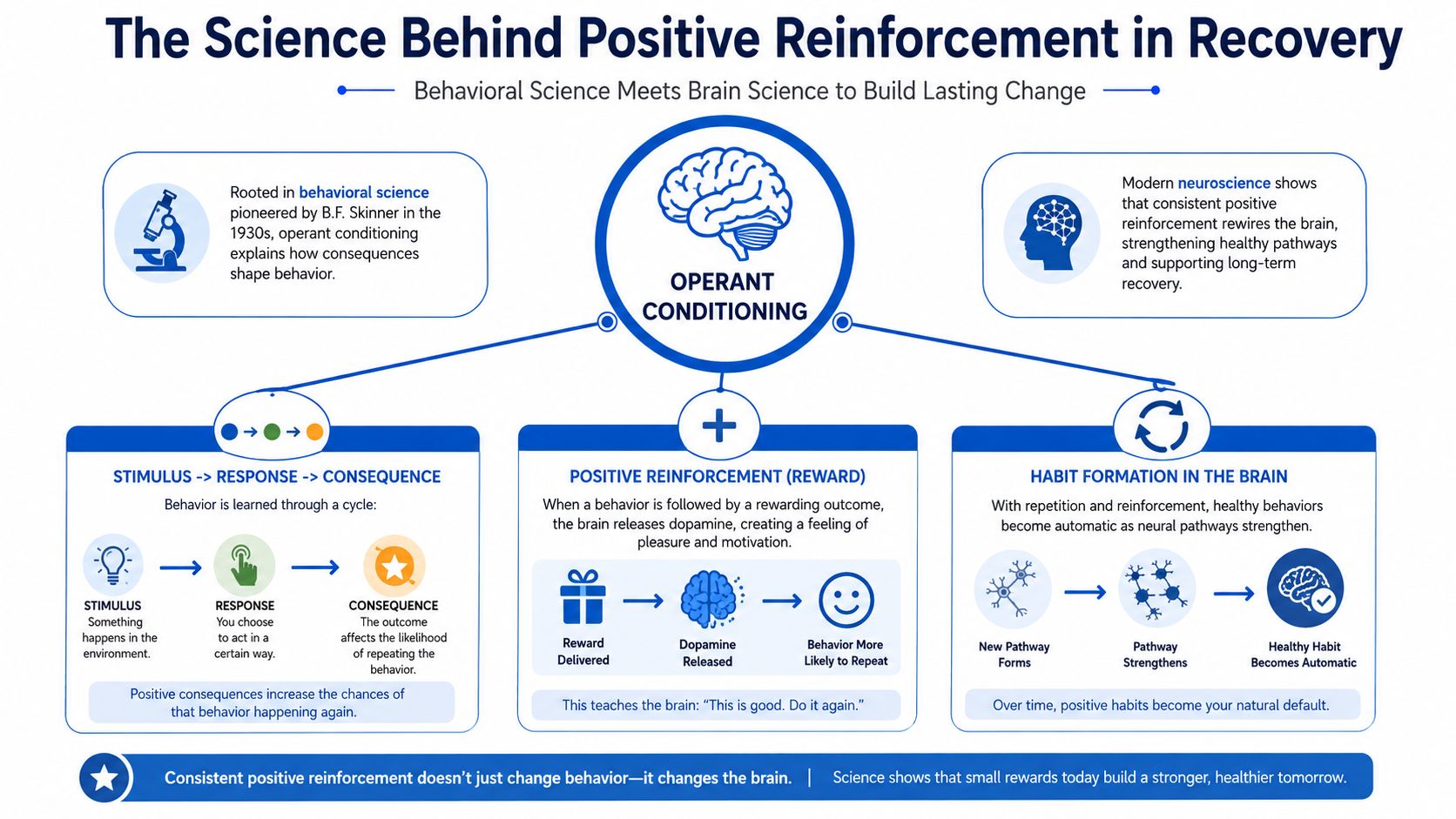
Suppose a participant submits a drug-free test and receives a reward soon afterward. The sequence is clear: a recovery action occurs, staff verify it, and a meaningful consequence follows. With repetition, the participant gets more chances to practice the action, notice its benefits, and build routines that don't depend on substance use.
Why immediate reinforcement helps
Recovery often asks people to work toward outcomes that take time, such as improved health, restored trust, stable employment, or reunification with family. Those goals matter, but they may not compete effectively with the immediate pull of a substance. A reward delivered later may have little influence on a decision being made today.
CM addresses that timing problem. It makes a recovery-oriented choice more concrete in the present, when the person has to decide whether to attend, test, take medication, or follow a treatment plan. The reward is not meant to make the person dependent on prizes forever. It can help create a period of stability in which other sources of reinforcement, including relationships, responsibilities, and personal confidence, have room to return.
The treatment also respects a reality that families sometimes miss. Substance use disorder isn't a failure of character or willpower. Repeated substance use can narrow a person's reward options, making ordinary activities feel less compelling and immediate substance effects feel disproportionately important. Structured reinforcement gives the person a non-drug alternative while clinicians address cravings, stress, trauma, mental health symptoms, and environmental triggers.
For a broader explanation of evidence-based treatment choices, see this guide to effective addiction treatment options and outcomes.
What CM does and doesn't promise
CM doesn't guarantee permanent abstinence, eliminate cravings, or work as a stand-alone answer to every clinical need. It's one behavioral tool, and clinicians may combine it with medication for opioid use disorder, cognitive behavioral therapy, motivational interviewing, medical care, peer support, and recovery planning.
A setback doesn't prove that the approach failed. It may show that the target, reward, testing schedule, transportation plan, or level of clinical support needs adjustment. Good care treats the result as useful information, not as a moral verdict.
Types of Incentives and Program Models
Contingency management can look different from one clinic to another. The reward depends on the treatment setting, target behavior, available funding, testing capacity, and what participants find useful. Before enrollment, a program should explain how rewards are earned and what happens after a missed appointment or positive result. Clear rules help participants judge whether a program is reliable rather than assuming every clinic uses CM in the same way.
Voucher-based programs
A voucher model gives a defined value for a verified recovery behavior. Participants exchange vouchers for approved goods or services instead of receiving unrestricted cash. Some programs increase the value after consecutive successes. Under the program's rules, a setback may reset that sequence.
Predictability is the main strength. Participants know what behavior qualifies and what practical support it can provide. The trade-off is administrative work. Staff must record balances, approve purchases, and apply the same rules to everyone.
Prize-based programs
Prize-based CM gives participants an opportunity to draw for a reward after meeting the target behavior. Prize values may vary, allowing frequent recognition without guaranteeing the same reward each time. The approach can feel engaging, but staff must explain the odds, eligibility requirements, and process plainly. Participants should understand that an opportunity to win is different from a guaranteed prize.
Privilege-based approaches
Some clinics reinforce progress with treatment-related privileges rather than vouchers or prize drawings. Depending on clinical judgment, policy, and applicable regulations, a privilege might include more flexibility in scheduling or another practical benefit connected to participation. It must not compromise safety, bypass medical monitoring, or create unfair access to care.
How incentive level affects design
A reward needs enough practical meaning to compete with the immediate pull of substance use. It also has to fit ethical, legal, and financial requirements. A 2025 meta-analysis reported that effective incentive levels may need to be higher than many programs currently use, recommending about $128 per week for vouchers or $55 per week for prizes over 12 weeks or longer (implementation and incentive evidence).
These figures are not a universal price list. The appropriate design depends on the target behavior, testing schedule, participant needs, funding source, and local rules. Ask whether a clinic follows an established protocol or set its reward level mainly to fit an existing budget. This question can help explain why access and program quality vary, even when clinics describe their services with the same term.
| Model Type | How It Works | Typical Duration | Key Considerations |
|---|---|---|---|
| Voucher-based | A verified behavior earns a defined voucher value | Often structured across a planned treatment period | Predictable, but requires careful purchasing and recordkeeping |
| Prize-based | A qualifying behavior creates an opportunity to receive a prize | Often repeated throughout the active CM period | Engaging, but rules and probabilities must be transparent |
| Privilege-based | Progress earns a treatment-related practical benefit | Set by the clinic's clinical and operational policies | Must protect safety, fairness, and medical oversight |
The important comparison is not just money, prizes, or privileges. Look for consistent application, prompt reinforcement, privacy protections, and clear explanations of missed targets. A well-designed program also connects incentives with the person's broader treatment needs, rather than treating the reward as the whole recovery plan.
How Clinics Implement Contingency Management
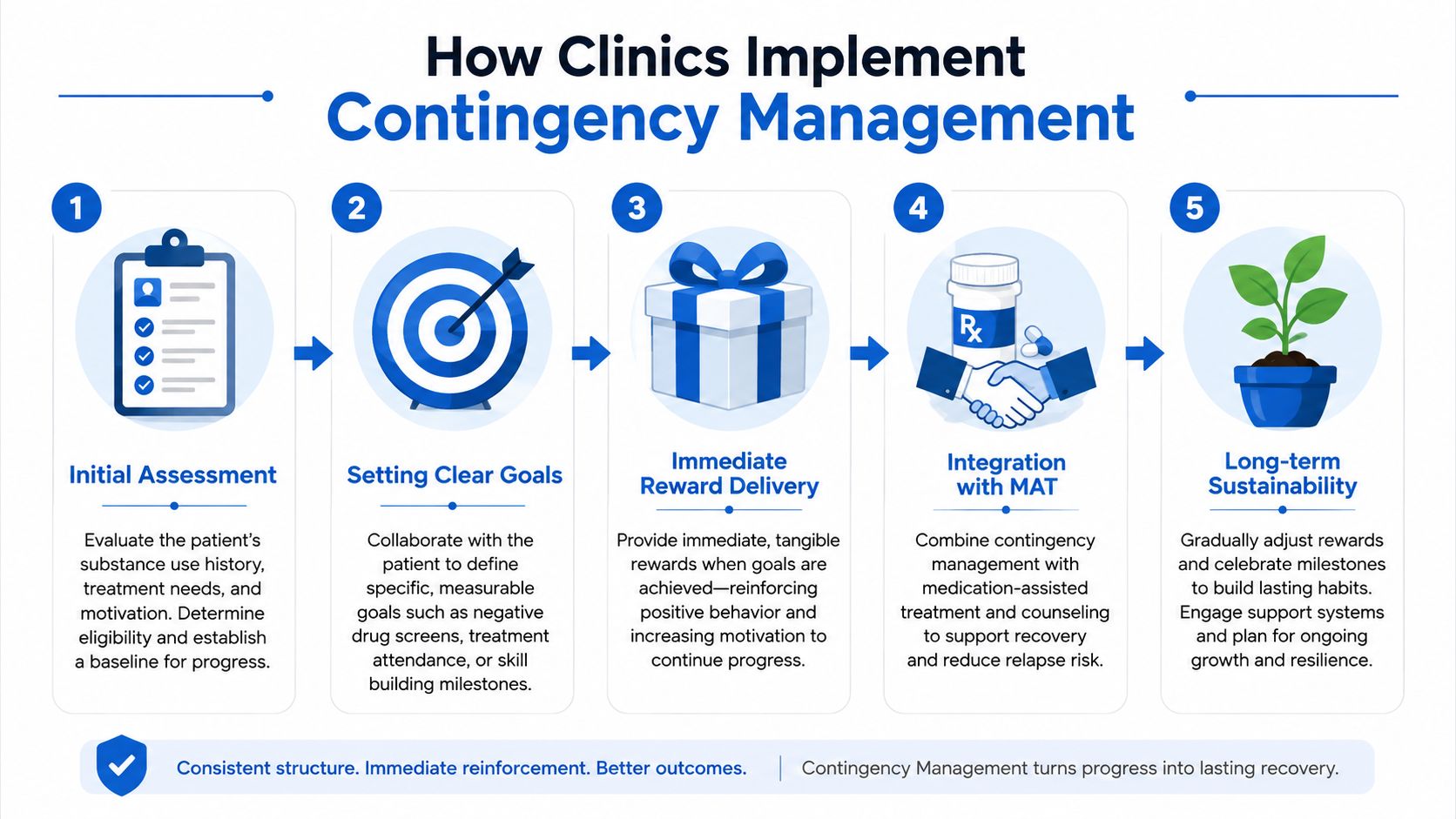
A clinic can offer rewards and still deliver weak CM if the process is unclear. Strong implementation starts before the first incentive: the team needs a written protocol, trained staff, dependable testing, secure records, funding, and a way to review outcomes. These details connect a verified behavior with a prompt, predictable response.
Start with assessment and shared goals
Clinicians identify the target behavior and confirm that participation is safe. Assessment may cover substance use, medical needs, mental health symptoms, medications, transportation, work, childcare, housing, and the person's recovery priorities. This information helps the team set a plan that fits the participant's life rather than applying the same rules to everyone.
The target must be observable and measurable. “Do better” gives no one a clear standard. “Attend the scheduled visit,” “take medication as prescribed,” or “submit a test meeting the agreed criteria” creates a shared reference point for the participant and care team.
Build the workflow into existing care
CM can operate alongside medication treatment, counseling, peer recovery support, and an intensive outpatient program. Medication for opioid use disorder treats opioid dependence through medical care, while CM may reinforce stimulant-related goals or regular participation. Counseling can address coping skills, trauma, relationships, and situations that make recovery harder.
For adults who need structured support without residential placement, an intensive outpatient program for adults may offer a setting where CM is coordinated with scheduled clinical services. The combination should follow the assessment, not a fixed package.
Prepare for operational barriers
Implementation often falls short because a clinic lacks the practical systems to run CM consistently. Staff may have limited training time, insufficient incentive funding, or no reliable method for documenting and tracking progress. If a result is recorded late or a reward is delayed, the connection between the behavior and its consequence becomes less clear.
Barriers can also reflect local conditions, including workload, financial constraints, limited awareness, trust concerns, clinic culture, leadership support, staffing, and available funding. This helps explain the gap between strong evidence and real-world access. Two clinics may use the same name while offering very different levels of structure and follow-through.
Ask providers how the program actually runs
Families can assess a program by asking specific questions:
- Testing process: What behavior is measured, how often, and who reviews the result?
- Reward delivery: How soon after a qualifying behavior does the participant receive the incentive?
- Setbacks: What happens after a positive result, missed visit, or lapse?
- Privacy: Who can see the test result and incentive record?
- Coordination: How does CM connect with medication, counseling, mental health care, and crisis planning?
- Access: Can the clinic accommodate transportation problems, work schedules, disability, or telehealth needs?
Clear answers suggest that the program has been designed for participants, not only for administrators. A clinic should be able to explain its rules, timing, documentation, and coordination in plain language. If “incentive-based care” is only a vague label, ask what the participant will experience week to week.
Addressing Ethical and Legal Considerations
Families may reasonably ask whether rewards are bribery, weaken internal motivation, or make recovery dependent on money. These concerns deserve a clear answer. Contingency management (CM) is ethical when its purpose and rules are transparent.
Bribery usually involves secretive or improper influence. CM is a clinical agreement made in advance. It identifies a recovery behavior, explains how that behavior will be verified, and specifies the incentive. The participant remains free to accept or decline. The clinician's role is to support informed choice, not threaten punishment.
Respect and autonomy come first
A responsible program does not force participation or treat a positive test as proof of poor character. Staff should explain the rules, protect confidentiality, and give participants meaningful choices. They also need to consider whether an incentive could create undue pressure for someone facing poverty, unstable housing, legal supervision, or family safety concerns.
The reward does not purchase dignity. It acknowledges a difficult behavior while the participant rebuilds other sources of stability. CM can therefore resemble other treatments that provide structured support. The ethical question is whether the arrangement helps a person pursue freely chosen health goals without coercion or deception.
Legal access still varies
Funding rules and regulation influence whether clinics can offer CM, especially in publicly funded settings. A clinic may support the approach yet lack an approved way to pay incentives, staff training, compliance guidance, or a billing pathway. These practical limits help explain why access differs between communities with similar patient needs. Strong research does not automatically produce available treatment.
Policy activity may broaden access. A 2026 APA summary described new clinical practice guidelines and policy shifts that could support wider use. Actual availability still depends on how funders, regulators, health systems, and clinics turn policy into daily procedures (APA policy and clinical discussion).
A program's label is not enough. Families should ask whether the clinic has written rules, trained staff, a clear funding process, and safeguards for privacy and choice. Those details show whether CM is a defined treatment or only occasional encouragement.
The fentanyl-era evidence gap
CM appears helpful for people using stimulants and opioids together, but current research does not fully answer how it performs when stimulant use is intertwined with fentanyl exposure. A 2026 systematic review of 26 trials involving 2,356 participants found that CM improved longest continuous abstinence by 1.42 weeks and increased the odds of stimulant-opioid-negative urine samples, with an odds ratio of 2.46.
The review reported no fentanyl exposure data in its included trials. That finding does not establish that CM fails in the fentanyl era. It shows that clinicians and researchers need more directly relevant evidence. Until then, programs should pair CM with overdose prevention, established safety practices, and medications for opioid use disorder when indicated.
Finding Contingency Management Support in Northern California
For someone in Yuba City or a nearby Northern California community, the first task is confirming that a clinic provides formal contingency management, not occasional rewards or general encouragement. Call and ask for the protocol's name, the behaviors it reinforces, the testing process, and how incentives are funded and documented. Clear answers show whether CM is part of the treatment plan or merely an informal practice.

Questions to ask before enrolling
A brief conversation can show whether the program is ready to deliver CM consistently:
- What specific behaviors earn incentives? Ask whether the target is attendance, medication adherence, drug testing, or another measurable action.
- How are results verified? Find out what testing is used, how often visits occur, and who explains the result.
- What happens after a lapse? A compassionate program should explain renewed support, reassessment, and another opportunity to participate instead of relying on shame.
- What rewards are available? Ask whether the model uses vouchers, prizes, privileges, or a combination, and whether the rules are written down.
- How does care address opioids and stimulants together? If fentanyl exposure or opioid use is involved, ask about medication treatment, overdose prevention, and coordination with medical providers.
- Can the schedule work in real life? Transportation, employment, childcare, housing, and phone access may determine whether frequent visits are realistic.
Look for coordinated support
CM works best when it fits with medical and behavioral care. A person may need medically supervised detox, medication-assisted treatment, residential rehabilitation, outpatient counseling, mental health treatment, or aftercare planning. The appropriate setting depends on withdrawal risk, substance use severity, medical conditions, psychiatric symptoms, housing, and support at home.
Families can review broader behavioral health services in California while comparing providers. Ask how the team addresses depression, anxiety, trauma, and other mental health needs. These concerns can affect attendance, cravings, sleep, and relapse risk.
Plan around everyday obstacles
A program may be clinically sound yet difficult to use if the participant cannot reach it. Before starting, discuss transportation, appointment times, telehealth availability, testing requirements, work shifts, caregiving, phone access, and the response to a missed appointment. A written plan can keep a practical problem from becoming an unnecessary treatment discharge.
Loved ones can help with rides, reminders, encouragement, and practical planning without monitoring every action. The participant still needs privacy and ownership of recovery. Ask the care team how family members may participate and what information can be shared with consent.
Addiction Resource Center LLC offers detox, medication-assisted treatment, residential rehabilitation through its partner facility, and an Intensive Outpatient Program in person or through telehealth. Its services address substance use and co-occurring mental health needs. Families can ask whether contingency management, combined with other therapies, fits the person's situation by visiting Addiction Resource Center LLC.
If you are in Yuba City or Northern California and need help evaluating contingency management, detox, MAT, residential care, or IOP, contact the treatment team to discuss available options and next steps.