You may be reading this because something no longer feels manageable. Maybe weekly therapy hasn't been enough. Maybe drinking or drug use has started affecting work, parenting, sleep, or trust at home. Maybe someone you love has agreed to get help, but the idea of leaving for residential rehab feels too disruptive or too frightening. …


You may be reading this because something no longer feels manageable. Maybe weekly therapy hasn't been enough. Maybe drinking or drug use has started affecting work, parenting, sleep, or trust at home. Maybe someone you love has agreed to get help, but the idea of leaving for residential rehab feels too disruptive or too frightening.
That's where an intensive outpatient program for adults often comes in. It gives people real treatment and real structure without requiring them to live at a facility. For many families, that middle ground is what makes getting help feel possible.
The phrase itself can sound clinical. In practice, it usually means this: a person lives at home, comes to treatment several times a week, learns practical recovery skills, gets counseling, and begins rebuilding daily life with support around them.
Table of Contents
- What Is an Intensive Outpatient Program for Adults
- A Look Inside the Structure of an IOP
- Benefits and Outcomes of an Intensive Outpatient Program
- IOP vs Residential Rehab vs PHP A Comparison
- Is an Intensive Outpatient Program Right for You
- Paying for IOP Insurance TRICARE and Other Options
- How to Start Your Recovery Journey Today
What Is an Intensive Outpatient Program for Adults
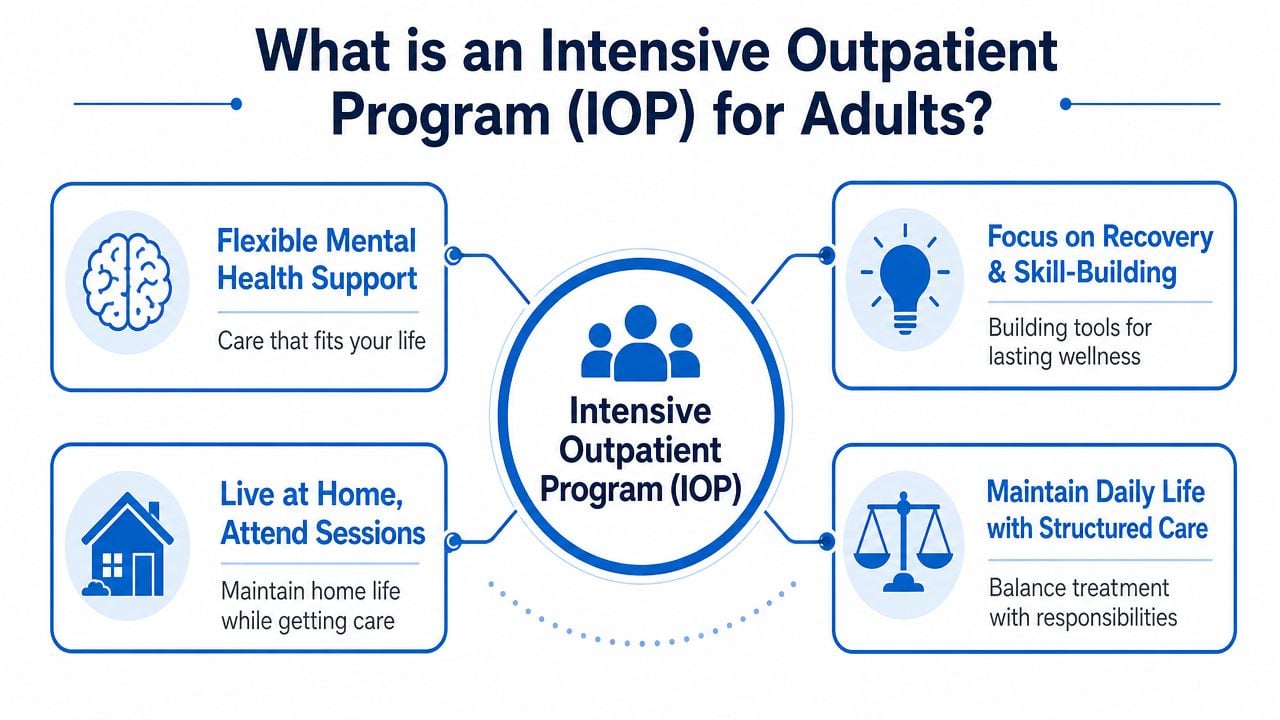
An intensive outpatient program for adults is a form of treatment that offers more support than occasional counseling, but less restriction than inpatient or residential care. You attend scheduled treatment during the week and return home afterward. You keep living your life, but you're not trying to recover alone.
A simple way to think about it is this: IOP is structured support for recovery while you continue to live at home. That structure matters. Recovery usually goes better when people have regular contact, clear expectations, coping tools, and a place to process setbacks before they grow.
Why people choose this level of care
Many adults need meaningful help, but they also need to keep showing up for real life. They may have a job, children, court obligations, school, aging parents, or a lease they can't walk away from. IOP is built for that reality.
It's also a common and established treatment option. As of 2011, there were 6,089 substance abuse IOPs in the United States, representing 44% of all 13,720 addiction treatment facilities nationwide, and they served 141,964 patients, or 12% of the 1.2 million total patients in care. The same national review noted that since 2002, IOPs have consistently ranked as the second most prevalent treatment modality for alcohol and drug use disorders, behind regular outpatient treatment, according to the national overview of intensive outpatient treatment prevalence.
Practical rule: If someone needs more than a weekly appointment but doesn't need round-the-clock supervision, IOP is often the level families ask about first.
What IOP is and what it isn't
People sometimes hear “outpatient” and assume it's light-touch care. That's usually where confusion starts. IOP isn't casual. It has a treatment schedule, clinical goals, and accountability.
It also isn't the same as detox. If someone is at risk for dangerous withdrawal, they may need a medically supervised setting first. And it isn't the same as residential rehab, where a person lives on-site and gets support all day and night.
Here's the simplest distinction:
- IOP helps people practice recovery in real life. They go home after sessions and use new skills in their actual environment.
- Residential care removes people from that environment for a period of time. That can be necessary for some people.
- Weekly therapy offers less structure. For some adults, that's enough. For others, it isn't.
When families ask, “Is this a serious program or just classes?” the answer is that IOP is a serious clinical level of care. It's just designed to fit around life instead of replacing it completely.
A Look Inside the Structure of an IOP
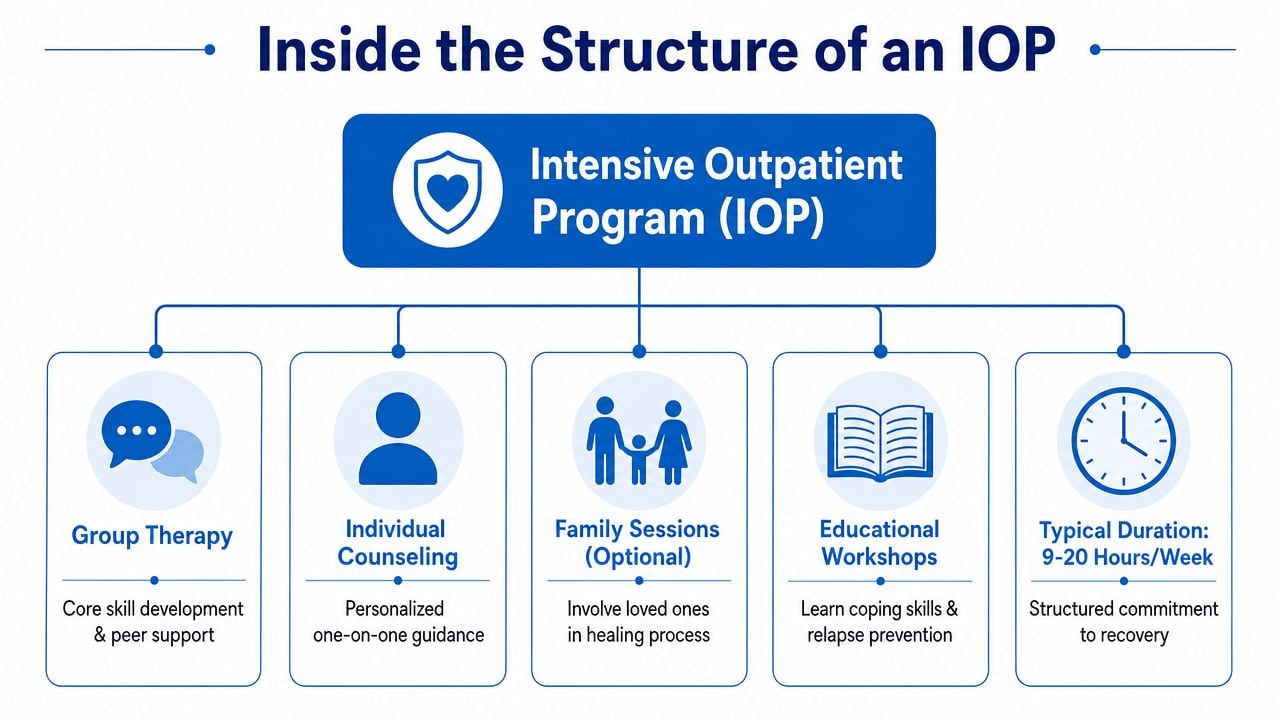
Once people understand that IOP is real treatment, the next question is usually practical: “What does the week look like?” The answer varies by provider, but the rhythm is usually consistent. Adults attend treatment on a set schedule across multiple days, with a mix of group work, individual sessions, education, and recovery planning.
That schedule can feel intimidating at first. In reality, the routine often brings relief. When someone's life has become chaotic, a predictable week can be stabilizing on its own.
What the time commitment usually means
Many programs spread treatment across several days each week rather than packing everything into one long day. That gives people repeated contact and repeated chances to practice what they're learning.
A weekly schedule often includes:
- Group therapy as the core setting. In this setting, adults learn coping skills, discuss triggers, practice communication, and hear from peers who understand the same struggle.
- Individual counseling for personal focus. A counselor helps connect the broader treatment plan to the person's actual history, stressors, and goals.
- Educational sessions that explain recovery in plain language. Topics may include relapse prevention, emotional regulation, boundaries, cravings, and healthy routines.
- Family involvement when appropriate. Some adults benefit from bringing in a spouse, parent, or other support person to repair communication and reduce confusion at home.
Why group therapy matters so much
Families sometimes worry that group is too impersonal. However, participants often discover the opposite. Addiction and mental health symptoms often thrive in secrecy and isolation. Group interrupts that pattern.
A good group isn't a room where people are pressured to tell every detail of their life. It's a guided setting where adults learn how to speak openly, listen well, tolerate discomfort, and receive feedback without shame.
Many people walk into their first group feeling guarded. They often leave realizing they're not the only person whose life got smaller while substance use took over.
Who is usually on the treatment team
Strong IOP care is multidisciplinary. That means one person isn't trying to do everything. Depending on the program, an adult may work with a physician, nurse, licensed counselor, therapist, and recovery support staff.
That matters because recovery has different layers. One person may need help managing withdrawal history or medication questions. Another may need trauma support, relapse prevention planning, and family repair. A team approach makes the care more practical.
If you want to understand how providers turn those needs into something concrete, this guide to practical advice for treatment plans can help you picture how goals are organized, tracked, and adjusted over time.
Benefits and Outcomes of an Intensive Outpatient Program
The strongest argument for IOP isn't convenience alone. It's that the structure can help people make changes while staying connected to the parts of life they're trying to protect.
For some adults, that's the difference between accepting treatment and postponing it.

What people gain from this format
IOP lets adults apply recovery skills in real time. If a session covers cravings, conflict, or stress management on Tuesday, the person can use that skill at home, at work, or with family that same day. Then they come back and talk openly about what worked and what didn't.
That real-world loop is powerful. It turns treatment from an abstract idea into daily practice.
Some of the most meaningful benefits are easier to feel than to measure:
- Continuity with daily life. People can often keep parenting, employment, or school responsibilities.
- Faster feedback. If something goes wrong, they don't wait a full week to address it.
- Local support. They begin building recovery habits in the same community where they'll continue living.
What outcomes suggest
There is a practical benchmark families often want to know. An evidence operational benchmark for IOP success rates is 60% to 70% sustained abstinence at six months post-treatment, with outcomes described as comparable to residential treatment while also allowing people to maintain daily responsibilities, according to this review of evidence-based outpatient treatment benchmarks.
That benchmark matters most when it's tied to what happens inside treatment. Programs tend to be stronger when they use evidence-based approaches such as CBT, DBT, and trauma-informed care rather than relying only on general support or motivation.
Recovery isn't just about stopping a substance. It's about learning what to do with stress, grief, anger, boredom, relationships, and daily pressure once the substance is gone.
A brief overview can also help if you want to hear the format explained another way:
Why adults often stay engaged
Residential rehab can be the right choice for some people. But many adults engage more fully when treatment respects the circumstances of their life. Being able to sleep at home, show up for children, or maintain employment can lower resistance to care.
That doesn't make IOP the easier path. It makes it the more livable path for the right person.
IOP vs Residential Rehab vs PHP A Comparison
The hardest part for many families isn't deciding whether help is needed. It's figuring out which level of help fits the situation. The names sound similar, and the differences can blur together when emotions are high.
This side-by-side view helps simplify the choice.
Treatment Level Comparison
| Feature | Residential Rehab | Partial Hospitalization (PHP) | Intensive Outpatient (IOP) | Standard Outpatient |
|---|---|---|---|---|
| Living arrangement | Lives on-site | Lives at home | Lives at home | Lives at home |
| Daily structure | Highest level of structure | High daytime structure | Moderate structured treatment across the week | Lowest structure |
| Medical supervision | Ongoing on-site support | Frequent clinical oversight during program hours | Regular clinical support, but not overnight | Periodic clinical contact |
| Best fit | Person needs separation from daily environment or close monitoring | Person needs more stabilization than IOP offers, without overnight stay | Person needs strong support while continuing daily life | Person is stable enough for less frequent care |
| Work and family flexibility | Limited during stay | More limited because treatment takes up much of the day | Often more workable for jobs, parenting, and routines | Most flexible |
| Common entry point | After severe escalation, unsafe use, or failed lower levels of care | Step down from inpatient, or step up from outpatient | Step down from higher care, or step up from weekly therapy | Maintenance, follow-up, or early support |
How to read the table
Residential rehab is usually the clearest choice when the home environment is unsafe, substance use is severe, or the person can't stay stable without close supervision. It creates distance from triggers and gives the person a contained place to focus.
PHP sits just below that. It offers a large amount of treatment during the day, but the person still goes home at night. It can work well for adults who need more support than IOP can provide but don't require overnight care.
If you're torn between PHP and IOP, the question usually isn't “Which one is better?” It's “How much structure does this person need to stay safe and engaged right now?”
Where IOP usually fits
IOP is often the middle path. It's appropriate when a person needs consistent treatment, accountability, and skill-building, but can still function outside a facility with support. That includes adults stepping down from detox, residential treatment, or PHP, as well as adults stepping up from standard outpatient therapy because symptoms or substance use have become harder to manage.
Standard outpatient works best when the person is more stable and needs ongoing counseling rather than a concentrated treatment schedule.
The right level of care isn't a value judgment. It's a matching process. Families often feel relief once they understand that needing more structure doesn't mean failure. It just means the person needs a stronger container for a period of time.
Is an Intensive Outpatient Program Right for You
A good candidate for IOP doesn't need to have everything figured out. It is common to start treatment while feeling ambivalent, embarrassed, or exhausted. What matters more is whether this level of care matches the person's actual needs and daily circumstances.
Signs IOP may be a strong fit
IOP often makes sense when someone can benefit from structure without needing overnight supervision. That may look like a person whose substance use is disrupting daily life, but who can still participate reliably in scheduled treatment and return home safely after sessions.
A few common signs point in that direction:
- Home is stable enough for recovery work. It doesn't have to be perfect, but it should be reasonably safe and supportive.
- Symptoms need more than weekly counseling. The person may be slipping between appointments, relapsing, or struggling to use coping tools consistently.
- There's willingness to participate. Motivation can grow over time, but the person has to show up and engage.
- A recent higher level of care needs follow-through. IOP often helps people maintain momentum after detox, residential rehab, or PHP.
When another level may be better
Sometimes the best answer is not IOP, at least not yet. If someone may need medical detox, is at immediate risk, or cannot remain safe outside a supervised setting, a more intensive level of care may be the better starting point.
That can be hard for families to hear. It's still useful information. The right starting point protects the person and gives treatment a fair chance to work.
In-person and telehealth options
Many adults also want to know whether they have to attend in person. The answer depends on the provider and the person's needs. In-person IOP can be especially helpful for people who benefit from leaving the house, having a stronger routine, and reducing isolation. Telehealth IOP can make treatment more reachable for adults dealing with transportation problems, work schedules, parenting demands, or distance from care.
If you're weighing the two, ask a simple question: “In which format is this person most likely to attend consistently and participate fully?” The best program is the one the person can realistically use.
Paying for IOP Insurance TRICARE and Other Options
Cost is often the question people wait the longest to ask. They worry they'll be judged, or they assume treatment will be out of reach. It's better to ask early.
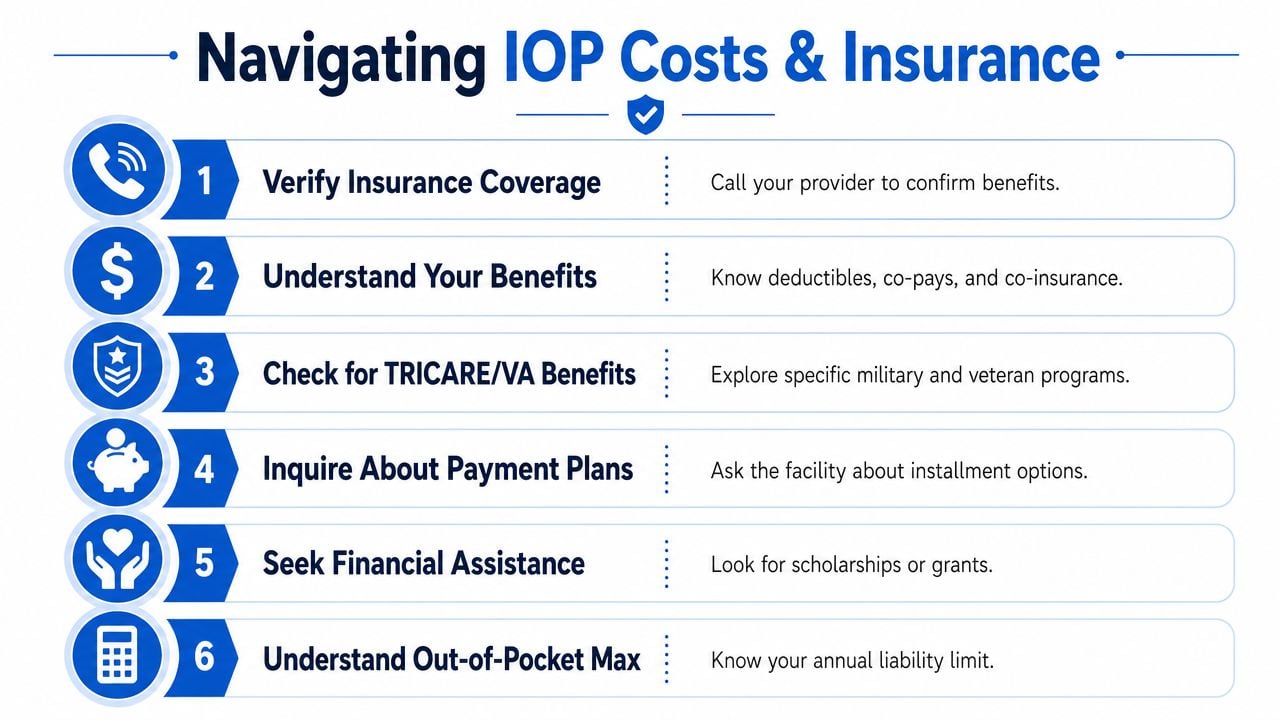
IOP is a clinical service, and many treatment providers work with major insurance plans. Coverage details differ by plan, which is why benefit verification matters so much before someone starts.
What to ask your insurance company
A short phone call can clear up a lot of uncertainty. When you call, keep a pen nearby and ask them to explain terms in plain language if needed.
Start with these questions:
- Is intensive outpatient treatment for substance use covered under my plan?
- Do I need preauthorization before starting care?
- What are my deductible, copay, and coinsurance responsibilities?
- Is there a difference between in-network and out-of-network coverage?
- Does telehealth IOP have the same coverage as in-person care?
Understanding the terms that confuse people most
Insurance language can make families feel lost fast. A few definitions help.
- Deductible means the amount you may need to pay before insurance begins sharing costs.
- Copay usually means a set amount you pay for a service.
- Coinsurance usually means you pay a portion of the allowed cost.
- Out-of-pocket maximum is the most you'd generally pay during a plan period for covered care.
Ask the provider's admissions team to review your benefits with you in plain English. You shouldn't have to decode insurance alone while managing a crisis.
TRICARE and other ways to reduce financial stress
For veterans and military families, TRICARE may be an important option to explore when looking for substance use treatment. If that applies to your household, ask both the insurer and the treatment provider about eligibility, authorization steps, and whether the specific program accepts TRICARE.
If someone has limited coverage or a high financial burden, don't stop at the first obstacle. Ask whether the provider offers payment arrangements, benefit checks, or other guidance. Many families find that the process becomes more manageable once they have a real person walking them through it.
The key point is simple. Don't let uncertainty about cost become the reason treatment gets delayed without even making the call.
How to Start Your Recovery Journey Today
The first step is usually smaller than people expect. You don't need to commit to everything today. You only need to begin the conversation.
For most adults, starting treatment involves reaching out, completing a confidential assessment, and getting a recommendation for the right level of care. That assessment usually covers substance use history, mental health symptoms, physical safety, medications, past treatment, home environment, and schedule needs.
What the first contact often looks like
You call, text, or fill out a form. A staff member asks a few basic questions and helps determine whether IOP seems appropriate or whether another level of care would make more sense first.
After that, the next steps often include:
- A screening or intake appointment. This helps the clinical team understand urgency, history, and practical barriers.
- Insurance and scheduling review. The provider explains available times, benefit verification, and any preadmission requirements.
- A start plan. You learn what to bring, when to arrive, and what the first week will look like.
Questions worth asking any IOP provider
Families feel calmer when they know what to ask. These questions can help:
- What kinds of therapy do you use? Ask whether the program uses approaches such as CBT, DBT, trauma-informed care, or relapse prevention.
- How is progress tracked? You want to know how staff adjust care if someone is struggling.
- What happens if the person needs a higher level of care? Good programs should be able to explain that clearly.
- Are family sessions available? This matters when home dynamics affect recovery.
- Do you offer telehealth, in-person care, or both? Practical access affects follow-through.
One more question matters as much as any clinical one: “When my loved one is scared, ashamed, or resistant, how do you respond?” The answer tells you a lot about the program's culture.
Recovery rarely begins with confidence. It usually begins with discomfort, uncertainty, and one honest conversation. That's enough to get moving.
If you're looking for a compassionate next step in Northern California, Addiction Resource Center LLC offers adult substance use treatment with in-person and telehealth IOP, medically supervised detox with MAT, support for co-occurring mental health needs, and guidance for families who aren't sure where to start. The team is based in Yuba City at 1002 Live Oak Blvd., Suite A, accepts most major insurance plans, welcomes TRICARE beneficiaries, and provides a 24/7 phone and text line at 530-625-7910 for confidential help, scheduling, or tours.