Yes, TRICARE provides extensive coverage for substance use disorder rehabilitation, but navigating the specifics of your plan is the key to accessing that care. This guide will show you exactly how. If you're reading this while worrying about a spouse, your adult child, or yourself, you probably don't need a lecture on insurance. You need …


Yes, TRICARE provides extensive coverage for substance use disorder rehabilitation, but navigating the specifics of your plan is the key to accessing that care. This guide will show you exactly how.
If you're reading this while worrying about a spouse, your adult child, or yourself, you probably don't need a lecture on insurance. You need a straight answer, a clean process, and a realistic sense of what happens next. TRICARE does cover rehab, including detox, residential treatment, partial hospitalization, intensive outpatient care, and medication-assisted treatment when a qualified provider says that care is medically necessary.
That last part matters. Coverage is real, but it isn't automatic. Approval usually depends on your plan, whether the provider is TRICARE-authorized, whether a referral or prior authorization is required, and how the treatment team documents medical necessity. Once you understand those moving parts, the system gets a lot less intimidating.
Table of Contents
- Does TRICARE Cover Rehab The Short Answer Is Yes
- What Rehab Services Does TRICARE Actually Pay For
- How Your TRICARE Plan Affects Your Rehab Coverage
- Getting TRICARE to Approve Your Treatment
- How Much Will Rehab Cost With TRICARE
- How to Find a TRICARE Rehab Center and Start Now
- Frequently Asked Questions About TRICARE and Rehab
Does TRICARE Cover Rehab The Short Answer Is Yes
It usually starts the same way. A spouse, parent, or adult child is trying to help someone in crisis and gets stuck on one question before making the call. Does TRICARE cover rehab?
Yes. TRICARE does cover rehab for substance use disorder treatment, and that includes more than a single program type. Coverage can extend across detox, residential treatment, outpatient care, medication support, and hospital-based services when the treatment is medically necessary and the provider meets TRICARE's rules.
That is the answer families need first. The next question is the one that saves time and money: what level of care does your loved one need, and will TRICARE approve that level with that specific facility?
Practical rule: Stop asking only whether rehab is covered. Ask which level of care is covered under your family member's plan, with a TRICARE-authorized provider, based on the clinical assessment.
TRICARE eligibility is broad. It can apply to active duty service members, retirees, National Guard and Reserve members, and eligible family members. So if you are helping a spouse, son, daughter, or parent on the plan, do not assume rehab is excluded before you verify the details.
The main obstacle is rarely the word "rehab" itself. The obstacle is paperwork, referrals, prior authorization, and provider status. Families who handle those pieces early get into treatment faster and avoid surprise bills.
If your loved one also needs help rebuilding strength during recovery, it can help to find effective arthritis exercises and other low-impact movement options that support physical stability without adding stress.
Here is the takeaway. If someone needs treatment, start the assessment now. Then confirm the provider is TRICARE-friendly, ask what approvals are required, and get the recommendation documented before admission.
What Rehab Services Does TRICARE Actually Pay For
TRICARE pays for several levels of substance use treatment. That matters because the right program depends on what your family member needs today, not on whatever a facility is trying to sell.
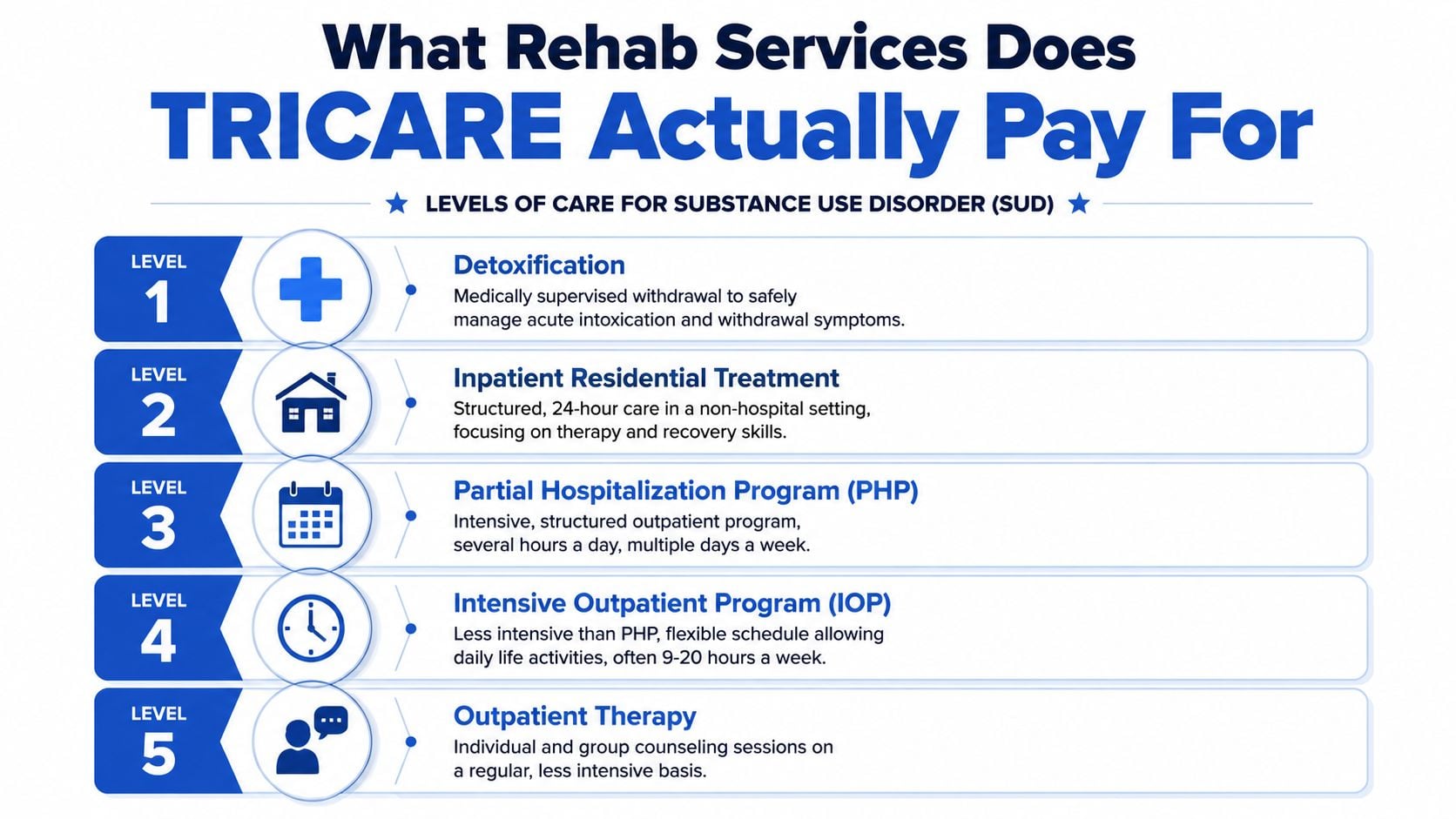
The covered levels of care
TRICARE's rehab benefit is built around levels of care. A person can start with more supervision, then step down as withdrawal risk, cravings, and relapse danger come under control. That staged approach is what families should ask about during the assessment.
Here are the services TRICARE commonly pays for when they are medically necessary and provided through the right kind of program:
Detoxification
Detox is the medical starting point for people withdrawing from alcohol, opioids, benzodiazepines, or other substances. If withdrawal could be dangerous, this is often the safest first stop.Inpatient or residential rehab
This is live-in treatment with 24-hour structure and support. It fits people who need a controlled setting, close monitoring, or distance from a high-risk home environment.Partial Hospitalization Program or PHP
PHP gives patients intensive treatment during the day without an overnight stay. It works well for people who need strong clinical support but do not need round-the-clock residential care.Intensive Outpatient Program or IOP
IOP is a lower level than PHP but still provides frequent therapy, accountability, and relapse-prevention work. It is often used after detox, residential care, or PHP.Outpatient therapy and counseling
This includes individual counseling, group therapy, family sessions, and ongoing recovery support. For some people, this is the starting point. For others, it is the maintenance phase after a higher level of care.Medication-assisted treatment or MAT
TRICARE also covers treatment that uses medication along with counseling and clinical follow-up for substance use disorders, including opioid use disorder.
A simple way to judge whether a recommendation makes sense is to ask whether the level of care matches the risk. Someone with severe withdrawal symptoms or repeated relapse usually needs more structure than weekly counseling. Someone stable at home may not need residential treatment. Recovery works best when the care level fits the clinical picture, then adjusts over time. The same step-by-step logic applies in physical recovery too. Many families who value structured recovery plans also look for ways to find effective arthritis exercises and other guided routines that match the person's current ability.
What TRICARE does not pay for
TRICARE does not pay for every service a rehab center advertises. Programs still need to offer recognized treatment, document medical need, and follow TRICARE rules.
In practical terms, be careful with facilities pushing vague wellness packages, luxury add-ons, or treatment methods they cannot explain in plain English. TRICARE is looking for evidence-based care. Families should do the same.
If a program sounds vague about what it provides, treat that as a warning sign. Ask for the exact level of care, the clinical assessment process, and the authorization steps before you agree to admission.
How Your TRICARE Plan Affects Your Rehab Coverage
A lot of families get stuck here. They hear “TRICARE covers rehab,” then assume the process will look the same for everyone. It will not. Your specific plan changes how fast you can get in, who you can use, and how much financial risk you take on if you choose the wrong facility.
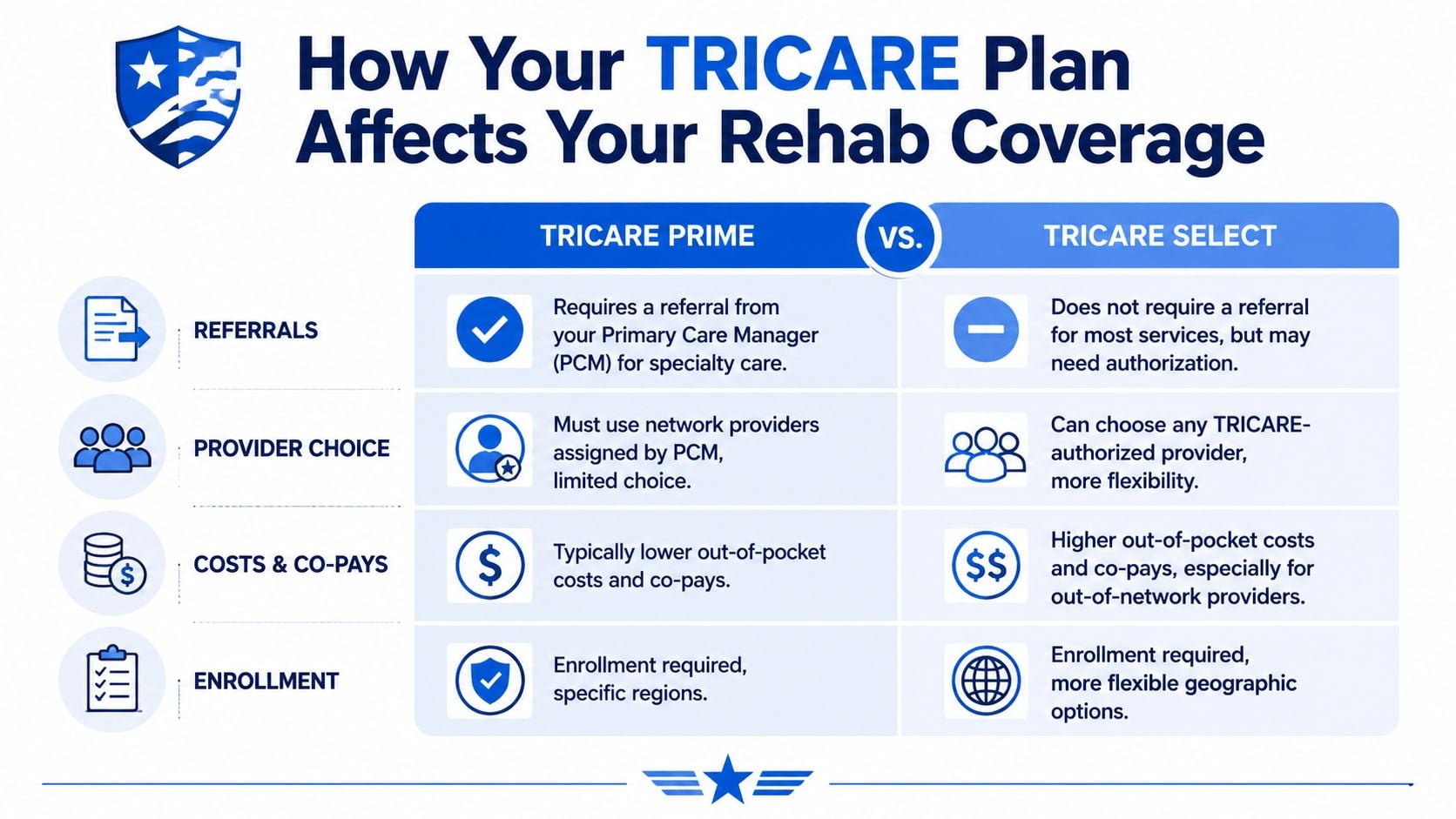
Prime and Select do not work the same way
If your family member has TRICARE Prime, expect tighter rules. Prime usually routes specialty care through a Primary Care Manager and puts more weight on network providers. That can slow the front end of the process, but it also tends to keep costs more predictable if you follow the referral and authorization rules.
If your family member has TRICARE Select, you usually have more freedom to choose a provider. That freedom can get expensive fast. Out-of-network care often means higher cost-sharing and more room for billing surprises.
Here is the practical difference:
| Plan issue | TRICARE Prime | TRICARE Select |
|---|---|---|
| Referral pathway | Usually more structured, often through PCM | Usually more direct provider choice |
| Network limits | Stronger focus on network care | More flexibility, but verify authorization status |
| Out-of-pocket risk | Usually lower if you follow plan rules | Usually higher if you go out of network |
The mistake that costs families the most
Families often focus on the facility's website, amenities, or how quickly admissions answers the phone. That is not the first question to solve.
Start with these two:
- Is the rehab center TRICARE-authorized?
- Is it in network for your specific plan?
If you skip those checks, you can end up with a covered service at the wrong facility and still face bigger bills than expected. That is the kind of problem you prevent before admission, not after.
My recommendation
If you have Prime, call your PCM and ask for the referral path before you commit to a program. If you have Select, ask the facility to verify both authorization status and network status in writing. In either case, have the admissions team explain the approval steps clearly. If they get vague, move on.
This is also the point where families benefit from mastering prior authorization, because the right paperwork and the right level-of-care request can save days of delay.
Choose the provider that fits your plan rules first. The nicest brochure does not protect you from a bad billing outcome.
Getting TRICARE to Approve Your Treatment
Your family can do everything right clinically and still get delayed if the approval process is sloppy. The fastest way to admission is simple. Get the diagnosis documented, match the patient to the right level of care, and make sure the provider submits the correct TRICARE paperwork the first time.
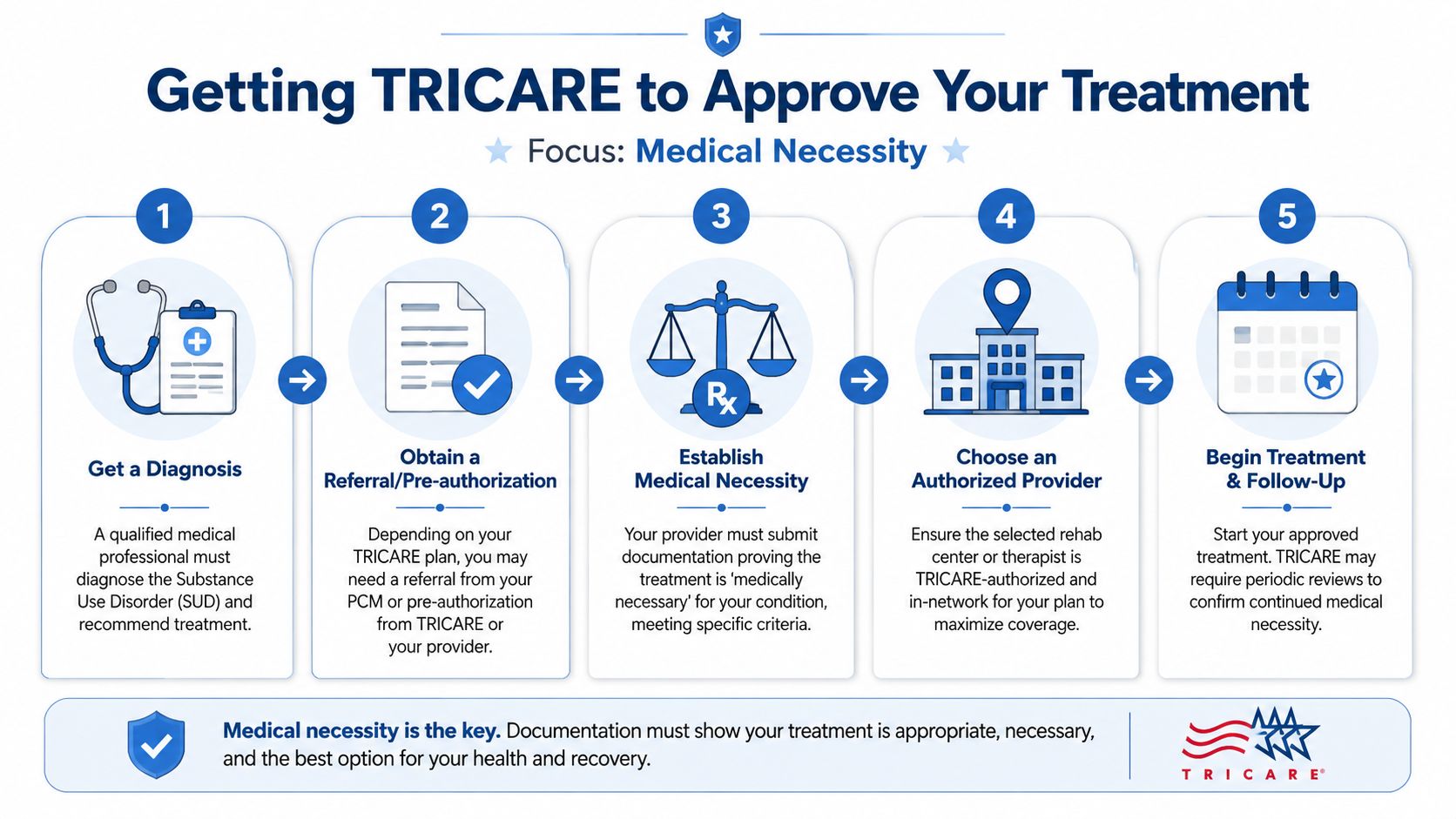
Medical necessity decides the outcome
TRICARE approves rehab based on medical necessity. That means the records have to show two things clearly. The patient has a covered substance use or mental health condition, and the requested level of care is appropriate for that condition.
Families get tripped up here because they focus on the facility they want before anyone has documented what level of treatment is clinically justified. Start with the clinical case. The program choice comes after that.
Approval usually depends on:
- A formal diagnosis from a licensed clinician
- A specific level-of-care recommendation such as detox, residential, PHP, or IOP
- Clinical notes that explain why that level of care is needed
- A provider who knows TRICARE rules and can submit the request correctly
- Any required referral or authorization tied to the patient's plan
TRICARE also excludes some services and may require pre-authorization for certain types of treatment, as noted earlier in the article. If a facility gets vague about what is covered, ask them to state exactly which service they are requesting approval for.
The approval process I recommend
Use this sequence. It prevents a lot of avoidable delays.
Get a full assessment
The patient needs an evaluation from a qualified clinician. No diagnosis means no solid case for treatment. No level-of-care recommendation means the insurer has nothing concrete to approve.
Have the provider verify the exact treatment request
“Rehab” is too vague. Ask what they are requesting. Detox, inpatient residential, PHP, and IOP can follow different approval paths.
Confirm who is submitting the authorization
Do not assume the admissions team is handling it unless they say so plainly. Ask who is sending the clinical records, when they are sending them, and what else they need from you.
Check for referral requirements
Some families need authorization and a referral. Those are not the same thing. If your plan requires both, missing either one can stall admission.
Follow up until you get a real answer
Ask whether the request is pending, approved, denied, or incomplete. “We're working on it” is not a status update.
Prepare for continued reviews
Approval at admission does not always approve the entire stay. TRICARE may ask for updated records to show the patient still meets criteria.
If you want a cleaner view of how insurers handle these requests, this guide to mastering prior authorization explains the process in plain English.
Where approvals usually go wrong
The problem is often paperwork, not medical need.
A provider may submit incomplete notes. The diagnosis may be documented, but the records may not explain why outpatient care is not enough. The facility may request the wrong level of care. A required referral may never get entered. Those are fixable problems, but only if someone catches them early.
That is why I tell families to ask one direct question before admission: What exactly is still needed for TRICARE to approve this stay?
Delays usually happen because the request was incomplete, mismatched to the level of care, or missing a referral. Push for specifics right away.
TRICARE follows federal parity rules, but parity does not eliminate utilization review. The plan still checks whether the treatment request is supported by the clinical record. Your job is to make sure the provider builds a strong case and keeps the file current.
How Much Will Rehab Cost With TRICARE
A family usually asks about cost after they hear the word “approved.” That is smart. Approval does not tell you the final bill.
With TRICARE, your out-of-pocket cost usually comes down to four things. Your plan, the level of care, whether the facility is in network, and whether the referral or authorization requirements were handled correctly. Those details change the numbers fast, so do not rely on what another family paid under a different plan.
What you may have to pay
Here are the terms that matter before admission:
| Term | What it means in plain English |
|---|---|
| Deductible | The amount you may pay first before TRICARE starts sharing the cost |
| Copayment | A set dollar amount for a covered service under some plans |
| Cost-share | The percentage of the bill you pay after TRICARE pays its portion |
| Out-of-network cost | The higher amount you may owe if the provider is not contracted the way your plan prefers |
The biggest cost mistake families make is choosing a facility first and checking network status later. Reverse that. Confirm the provider is TRICARE-authorized and in network for your exact plan before you agree to anything.
Parity rules still matter here, as noted earlier. Rehab is treated as medical care, not an optional add-on. That does not mean every bill is small. It means TRICARE cannot single out addiction treatment for harsher financial rules than comparable medical treatment.
What usually raises the bill
Inpatient and residential care generally cost more than outpatient care because you are paying for a higher level of supervision and treatment. Out-of-network care can raise your share even more. Missing a referral or prior authorization can also leave you fighting a bill that should have been sorted out before admission.
This is why I recommend getting a cost estimate in writing whenever possible.
Ask the facility's admissions or billing team these questions, word for word:
- Are you in network for my exact TRICARE plan?
- What is my deductible, copay, or cost-share for this level of care?
- Do I need a referral or prior authorization before admission?
- Can you verify my benefits and give me an estimate of what I may owe?
- Are any doctors, labs, or outside services billed separately?
That last question matters more than families expect. A facility can be in network while a physician group, lab, or ambulance provider is not.
The safest way to avoid a surprise bill
Use one checklist before admission. Confirm network status. Confirm the level of care. Confirm whether approval is already in place. Confirm your expected patient responsibility. Then ask for the estimate by email so you have something concrete to reference if the billing changes later.
If you only make one call today, make it a benefits verification call. It can save you weeks of stress and a much bigger bill.
How to Find a TRICARE Rehab Center and Start Now
Once you know the answer to “Does TRICARE cover rehab,” the next challenge is speed. Families lose time by calling random facilities, repeating the same insurance story, and finding out too late that the program isn't a good fit.
How to search without wasting time
Start with the official TRICARE provider search tools and look specifically for TRICARE-authorized behavioral health or substance use treatment providers. Then call the facility directly and ask sharper questions than “Do you take TRICARE?”
Ask these instead:
- Are you TRICARE-authorized for my level of care?
- Are you in network for my exact plan?
- Do you handle benefit verification and prior authorization?
- What documentation do you need from us today?
- Can you admit quickly if approval is required?
That short list will save you hours.
You should also confirm whether the program can provide the actual level of care the patient needs. Some centers say they “treat addiction” but only offer counseling. Others can coordinate detox, medication-assisted treatment, and step-down care. Those are not the same thing.
A practical option for Northern California families
For families in Yuba City and the surrounding Northern California area, there is one practical option worth calling early: Addiction Resource Center LLC.

Addiction Resource Center LLC welcomes TRICARE beneficiaries and offers a continuum of care that matches what military families usually need in their everyday lives: medically supervised detox with medication-assisted treatment, access to residential rehabilitation through its partner facility Ona Treatment Center in Browns Valley, and an Intensive Outpatient Program available in person and by telehealth. The team includes a medical doctor, registered nurse, CADC counselors, an LMFT, and recovery mentors, which matters because addiction treatment usually goes better when both medical and emotional needs are addressed together.
If you're local and need a direct next step, call or text 530-625-7910 or visit the office at 1002 Live Oak Blvd., Suite A, Yuba City, CA. Don't wait to have every insurance detail perfectly organized before making the call. A strong admissions team can usually help you sort out eligibility, next steps, and what documentation is needed.
The fastest path to treatment is often one call to a provider that already knows TRICARE, not ten calls to centers that “might” accept it.
Frequently Asked Questions About TRICARE and Rehab
A few questions come up constantly, especially when families are trying to act fast.
| Question | Answer |
|---|---|
| Does TRICARE cover rehab for family members too? | Yes. Eligible family members are included in TRICARE coverage. Eligibility depends on beneficiary status and plan rules. |
| Does TRICARE cover detox and residential treatment? | Yes, when a qualified provider determines those services are medically necessary. |
| Will I need prior authorization? | Often, yes for certain services. It depends on the plan and level of care. Inpatient and residential services commonly involve authorization steps. |
| Can I use an out-of-network rehab center? | Sometimes, depending on the plan. But your costs may be higher than with in-network care. |
| What if TRICARE denies the request? | Don't stop there. Ask why it was denied, get the denial reason in writing, and have the provider review whether more documentation, a referral, or a different level-of-care request is needed. |
| Does TRICARE cover care overseas? | Yes, emergency rehab services can be covered overseas for eligible beneficiaries, which helps maintain continuity of care for military families stationed abroad. |
| Are there treatments TRICARE won't cover? | Yes. Unproven treatments and aversion therapy are excluded. |
| What should I do first today? | Get a clinical assessment, confirm the patient's exact TRICARE plan, and contact a TRICARE-savvy provider that can verify benefits and handle authorization steps. |
If you're overwhelmed, narrow your focus to one decision. Get the assessment started. That single move usually enables everything else.
If you need help sorting out TRICARE rehab coverage and finding a realistic next step, Addiction Resource Center LLC can help. The team works with TRICARE beneficiaries, offers compassionate substance use treatment in Yuba City, and can guide you through detox, IOP, MAT, and referral options for residential care. Call or text 530-625-7910 or visit 1002 Live Oak Blvd., Suite A, Yuba City, CA to get clear answers and start treatment without more delay.