You've probably heard it already. Stay after the meeting. Get phone numbers. Get a sponsor. For a lot of people, that advice lands like pressure instead of help. You may still be figuring out where to sit, what to say, or whether you even belong in Narcotics Anonymous. Then someone tells you to ask a …

You've probably heard it already. Stay after the meeting. Get phone numbers. Get a sponsor.
For a lot of people, that advice lands like pressure instead of help. You may still be figuring out where to sit, what to say, or whether you even belong in Narcotics Anonymous. Then someone tells you to ask a stranger to guide your recovery. That can feel awkward, rushed, and intensely personal all at once.
Still, there's a reason experienced members keep repeating it. A sponsor in NA isn't there to control you, rescue you, or judge your past. The right sponsor helps you stay connected when your head starts lying to you, when shame shows up, or when you're tempted to disappear after a hard day. Sponsorship works best when it's practical, honest, and grounded in the program rather than personality.
This guide is for the person trying to find a sponsor, the member wondering whether it's time to switch sponsors, and the recovering addict thinking about becoming one. It focuses on the part many articles skip: how to practically do this in real life, what to say, what boundaries matter, and what usually helps.
Table of Contents
- Why Sponsorship Is a Cornerstone of NA Recovery
- Defining the Role of an NA Sponsor
- How to Find the Right Sponsor for You
- Conversation Scripts for Asking and Accepting
- Navigating Sponsorship Challenges and Boundaries
- Local Support and Next Steps with Addiction Resource Center
Why Sponsorship Is a Cornerstone of NA Recovery
The phrase sponsor Narcotics Anonymous often gets reduced to a slogan. In practice, it means having someone who has already walked through the same confusion, resistance, cravings, and emotional swings that can hit hard in early recovery. That kind of guidance matters because recovery isn't just about attending a meeting. It's about learning how to live differently between meetings.

The strongest argument for sponsorship isn't sentiment. It's outcomes. According to a 2018 survey of 28,495 Narcotics Anonymous members, members who use sponsorship as part of their 12-step involvement report an average of 11.4 years of continuous abstinence, and 85% report five or more years of stable recovery. The same survey found that broader NA involvement, including sponsorship, was linked with better long-term outcomes than occasional meeting attendance alone, as summarized in this NA World Services survey overview.
That doesn't mean a sponsor is magic. It means recovery gets stronger when someone knows your patterns, hears your excuses early, and can point you back to the basics before a bad week turns into a relapse.
Why this matters in real life
A sponsor helps translate the program from words on the wall into daily action. Meetings can give hope. A sponsor helps with follow-through.
People often need support in several layers. Peer guidance, structure, treatment, and community can work together. That's one reason many people benefit from learning how peer support works in recovery instead of treating sponsorship like a stand-alone fix.
Practical rule: If you're serious about staying clean, don't wait until you're in crisis to build a recovery relationship.
What sponsorship does that meetings alone may not do
- Creates accountability: A sponsor notices when you stop calling, stop showing up, or start isolating.
- Helps you work the Steps: Reading is useful. Working the Steps with another recovering addict is different.
- Offers perspective: When your thinking gets distorted, a sponsor can tell you plainly what they hear.
- Keeps recovery personal: General sharing helps. Specific guidance often helps more.
A good sponsor won't live your life for you. They'll help you stop running it on old instincts.
Defining the Role of an NA Sponsor
People get into trouble with sponsorship when expectations are fuzzy. Some newcomers expect a sponsor to function like a therapist, parent, parole officer, best friend, and emergency service all in one. Some sponsors overreach and start acting like they're in charge of another person's life. Both setups usually go badly.
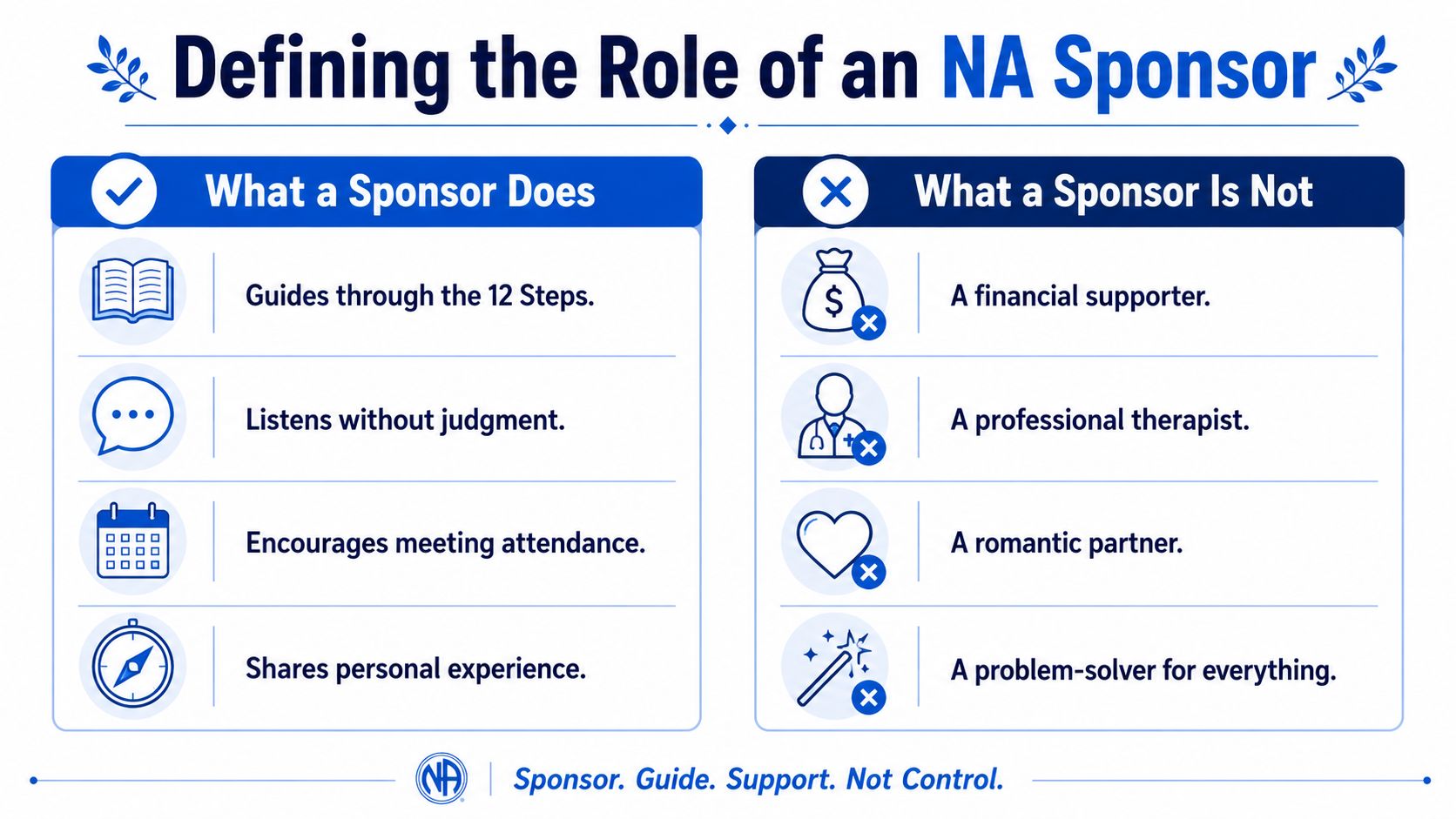
A sponsor is best understood as an experienced peer guide inside NA. They share what they've done, how they've worked the Steps, how they stayed clean through hard situations, and how they use the fellowship. Research on 12-step affiliation found that participants who secured a sponsor had a 75% success rate in remaining clean from drugs and sober from alcohol, discussed in this study on 12-step affiliation and abstinence. That doesn't mean any sponsor will do. It means the relationship is worth taking seriously.
What a sponsor actually does
A healthy sponsor relationship usually includes several basic functions:
- Step guidance: They help you move through the 12 Steps instead of circling them in your head.
- Experience sharing: They tell you what happened in their own recovery, not what a textbook says should happen.
- Program connection: They encourage meetings, literature, service, and contact with other members.
- Honest feedback: They may say what you don't want to hear, especially when self-deception shows up.
This short video gives a plain-language overview of sponsorship in practice.
The sponsee also has a job. Sponsorship isn't passive. If you want help, you need to be reachable, honest, willing to take suggestions, and willing to tell the truth before things spiral.
What a sponsor should not become
A sponsor is not your banker, attorney, doctor, or romantic partner. They are not there to make your decisions for you. They are not your only support system. And they shouldn't be the person you call to avoid every uncomfortable feeling that normal recovery brings.
A sponsor shares direction from lived recovery. They don't replace treatment, mental health care, or personal responsibility.
Here is a clear perspective:
| Role | Appropriate in sponsorship | Not appropriate in sponsorship |
|---|---|---|
| Recovery guidance | Yes | |
| Step work support | Yes | |
| Emotional support | Yes, within boundaries | |
| Medical advice | No | |
| Lending money | No | |
| Romantic involvement | No | |
| Total life control | No |
When people understand those limits early, the relationship tends to stay useful. When they don't, resentment builds fast.
How to Find the Right Sponsor for You
Finding a sponsor isn't about choosing the most charismatic person in the room. It's about choosing someone whose recovery has weight behind it. You're looking for stability, honesty, and consistency. Not performance.
A lot of newcomers make one of two mistakes. They either ask the first person who seems nice, or they overthink it so long that they never ask anyone. A better approach is to observe people for a few meetings, pay attention to how they carry themselves, and then make a decision without waiting for certainty.
What to watch for in meetings
Listen for members who speak plainly about recovery instead of trying to sound impressive. Look for someone who seems grounded, not dramatic. If they talk about their own sponsor, their step work, and their responsibilities in NA, that's usually a healthy sign.
NA guidance emphasizes looking for someone with more clean time than the newcomer, someone trustworthy and compassionate, and ideally making that connection early in meeting attendance, as noted in NA sponsorship guidance.
Green flags often look like this:
- They practice what they talk about: Their words match their behavior over time.
- They're active in the program: They show up, participate, and stay connected.
- They have humility: They don't present themselves as the answer to everything.
- They're available enough: Not endlessly available, but reachable and reliable.
- They have the kind of recovery you respect: Not because they're perfect, but because they're steady.
If you're still trying to get into the rhythm of fellowship, it helps to first lock in a regular meeting routine. A practical starting point is checking a local NA meetings schedule guide so you can see the same people consistently.
A simple way to narrow your choices
Don't ask, “Who's the best sponsor in NA?” Ask, “Who seems capable of helping me stay honest and work the Steps?”
Use this quick filter:
- Do I respect their recovery?
- Do they seem emotionally steady?
- Are they active in NA now, not just proud of old clean time?
- Can I imagine telling them the truth when I'm struggling?
If someone intimidates you so much that you know you'll hide from them, they may not be the right sponsor for you.
You also don't need to treat the first ask like a lifetime contract. Many members start with a temporary sponsor. That lowers the pressure and gets you moving.
Conversation Scripts for Asking and Accepting
Individuals don't avoid sponsorship because they reject the idea. They avoid the conversation. They don't know how to ask, what to call it, or how to handle a no.
The cleanest approach is direct and simple. You don't need a speech. You need clarity.
If you're asking someone to sponsor you
Try one of these after a meeting:
“I'm new, and I've been listening to how you share. I'm looking for a sponsor. Would you be open to talking about that?”
Or keep it even lighter:
“I'm trying to stop doing this alone. Would you be willing to be a temporary sponsor while I get started?”
If you already know you need structure, say that plainly:
- Be specific: “I need someone who can help me start the Steps and stay accountable.”
- Be honest: “I'm nervous asking, but I'd rather ask than keep drifting.”
- Be flexible: “If you can't, I'd appreciate a suggestion.”
A no doesn't mean rejection. Sometimes the person doesn't have time, already sponsors several people, or knows they're not a good fit for your needs.
If you're being asked to sponsor someone
Accepting should also be clear. Don't say yes from guilt. Say yes if you have the capacity and the willingness to show up.
Here are healthy responses:
- Accepting: “Yes, I'm open to that. Let's talk about expectations and how we'd stay in contact.”
- Temporary sponsorship: “I can sponsor you temporarily and help you get started.”
- Declining with care: “I can't take on another sponsee right now, but I'd be glad to help you find someone.”
One important trade-off deserves honesty. A study of injection drug users found that being a sponsor was strongly associated with better 1-year sustained abstinence for the sponsor, but having a sponsor did not statistically improve short-term abstinence for the sponsee in that specific high-risk group, according to this longitudinal study on sponsorship and abstinence. The lesson isn't that sponsorship doesn't matter. It's that sponsorship alone isn't enough. The relationship works best when the sponsee also shows willingness, action, and program engagement.
That's why clarity at the start matters. Good intentions don't replace commitment.
Navigating Sponsorship Challenges and Boundaries
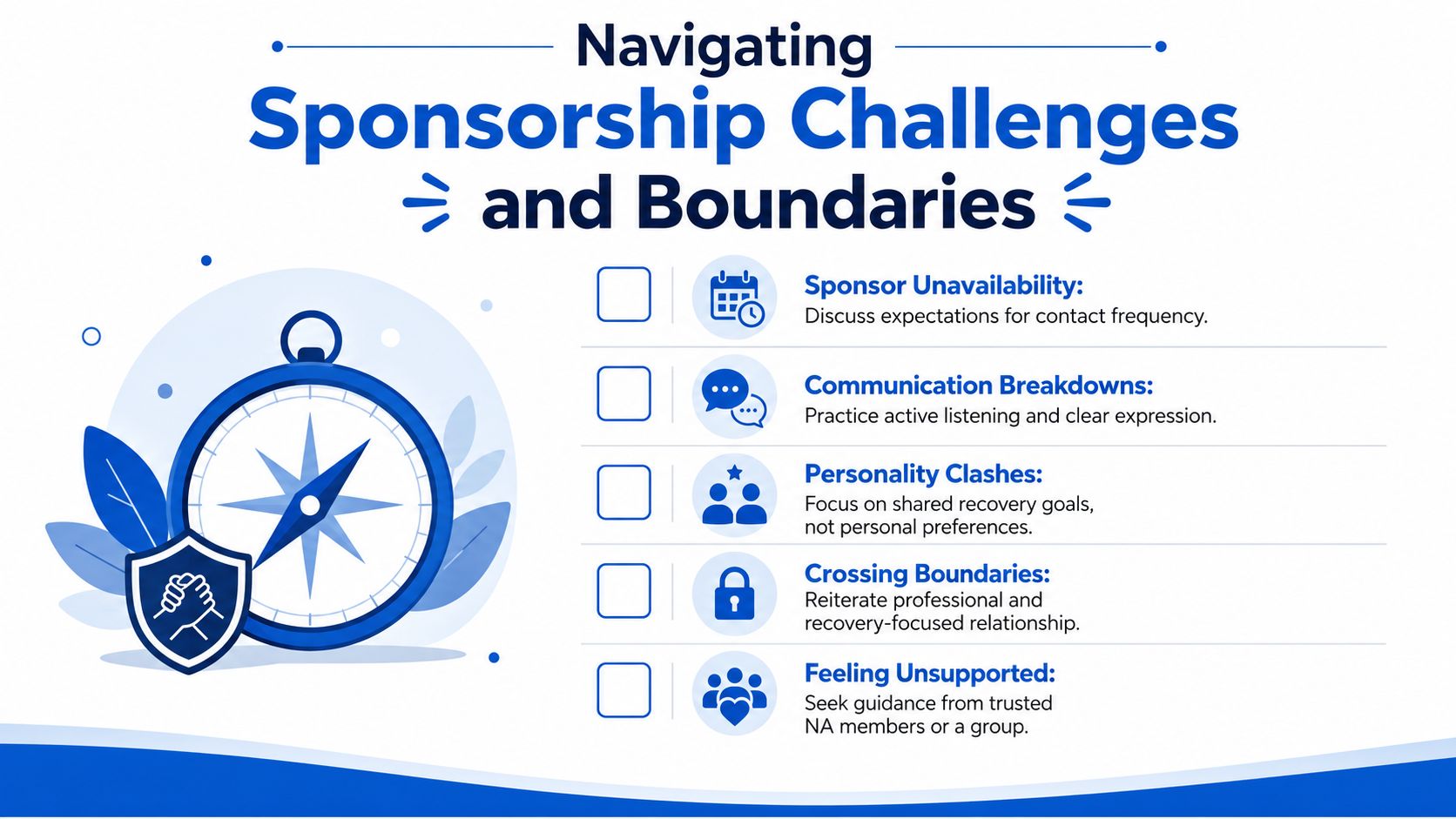
Some sponsorship relationships click quickly. Others stall out. Some become distant, controlling, vague, or emotionally messy. That isn't rare. It's part of working with human beings.
One of the biggest myths in recovery is that if a sponsor relationship feels wrong, you should just tolerate it. That mindset can keep people stuck. Few resources give practical guidance on sponsor mismatch or switching, even though trial and error is common and relationship quality affects outcomes, as discussed in this review of sponsorship challenges.
When the fit is off
Not every problem means you need to leave. Some issues can be solved with one honest conversation.
Common trouble spots include:
- Inconsistent contact: You never know when they'll return a call.
- Confusing advice: They drift from NA guidance into opinions about every part of your life.
- No movement in the Steps: You talk a lot but never work.
- Emotional distance: You can't get honest because the connection feels cold or dismissive.
- Boundary problems: The relationship starts feeling dependent, blurred, or inappropriate.
A useful test is this: after talking to your sponsor, do you feel more connected to recovery, or more confused and shut down?
How to end a sponsorship respectfully
You don't need a dramatic breakup. You need honesty and respect.
Try a script like this:
“I'm grateful for your help. I think I need a different sponsorship fit for where I am right now, so I'm going to ask someone else.”
That's enough. You can be kind without overexplaining. You don't need to build a legal case.
If you're unsure whether to switch, take these steps first:
- Name the issue clearly. Is it availability, trust, pace, or boundaries?
- Have one direct conversation. Give the relationship a fair chance to improve.
- Ask trusted members for perspective. Don't build a resentment committee. Get grounded feedback.
- Make the change cleanly. Don't ghost unless safety is an issue.
- Find the next sponsor quickly. Don't use the transition as an excuse to drift away.
Recovery suffers when people stay in a bad sponsorship fit out of fear, pride, or loyalty to appearances.
For sponsors, boundaries matter just as much. Don't become someone's only support, don't encourage dependence, and don't act outside your role. Strong sponsorship is warm, direct, and boundaried.
Local Support and Next Steps with Addiction Resource Center
A sponsor can help you stay connected to NA, tell the truth, and work the Steps. Treatment can give you the clinical structure, medical support, and daily stability that make it easier to use that guidance. Those two supports don't compete. They often strengthen each other.
That matters for people leaving detox, stepping down from residential care, or trying to hold recovery together while managing work, family, cravings, depression, or anxiety. In a multisite randomized clinical trial of stimulant users, people who had a sponsor at the end of treatment showed a 33% greater likelihood of no illicit drug use at the 1-month follow-up than peers without sponsors, according to this summary of sponsor outcomes after treatment. The practical takeaway is simple. Clinical care can help people get stable enough to use peer support well.
For many people in Northern California, the strongest plan includes meetings, sponsorship, and a broader sober support network in recovery. If you need more than meeting-based support, look for a setting that can address withdrawal, relapse risk, co-occurring mental health needs, and aftercare planning without losing the human side of recovery.
Addiction Resource Center in Yuba City offers that kind of continuum. Services include medically supervised detox with MAT, residential rehabilitation through its partner Ona Treatment Center in Browns Valley, and an Intensive Outpatient Program available in person and via telehealth. The center serves adults 18+ at 1002 Live Oak Blvd., Suite A, Yuba City, CA, and can be reached at 530-625-7910 for guidance on treatment, admissions, or support for loved ones.
If you're trying to get clean, stay clean, or help someone take the first step, Addiction Resource Center LLC offers compassionate substance use treatment in Yuba City with detox, MAT, residential rehab through its partner facility, and IOP options in person or by telehealth. Call or text 530-625-7910 any time to talk through options, verify insurance, or get help figuring out the next right move.