You may be reading this in a quiet moment after a hard conversation, or in the middle of one. Maybe you've agreed to get help, but the idea of recovery still feels lonely. You might trust a doctor, respect a counselor, and still wonder whether anyone really understands what it feels like to wake up …

You may be reading this in a quiet moment after a hard conversation, or in the middle of one. Maybe you've agreed to get help, but the idea of recovery still feels lonely. You might trust a doctor, respect a counselor, and still wonder whether anyone really understands what it feels like to wake up with cravings, fear, shame, or exhaustion and try again anyway.
That feeling is common. So is the belief that treatment has to be a choice between professional care and human understanding. It doesn't.
Peer support in recovery helps close that gap. It brings lived experience into the healing process, so recovery isn't only guided by clinical expertise, but also by someone who has walked through similar struggles and learned how to stay moving forward. For many people, that's the moment recovery starts to feel less abstract and more possible.
Table of Contents
- The Journey of Recovery Does Not Have to Be Solitary
- What Exactly Is Peer Support
- The Proven Benefits of Shared Experience
- Understanding the Different Roles in Peer Support
- How Peer Support Enhances Clinical Treatment at Every Stage
- Practical Steps to Find and Connect With Peer Support
- Frequently Asked Questions About Peer Support
The Journey of Recovery Does Not Have to Be Solitary
A lot of people begin recovery while feeling cut off from everyone around them. Family may care profoundly but not know what to say. Friends may want to help but still be tied to old habits. Even in treatment, a person can sit in a room full of others and think, "No one gets what this is like for me."
That isolation can make the first steps feel heavier than they already are. A person might complete an intake call, show up for an appointment, or agree to detox, then immediately wonder if they've made a mistake. It's not always because they don't want help. Often, it's because recovery can feel unfamiliar, and unfamiliar things feel risky when your life already feels unsteady.
Peer support often changes the emotional temperature of the whole process. Instead of hearing only professional advice, you hear from someone who can say, in plain language, "I've been there. I know what early recovery can feel like. You're not weak, and you're not broken."
Recovery often becomes believable when you meet someone who has lived through the same chaos and isn't speaking from theory.
That kind of connection matters beyond addiction treatment too. Many readers find value in the Kindness Community Foundation insights, which explore why human connection keeps becoming more valuable in a world that can feel impersonal and fragmented.
What this kind of support feels like
Peer support usually doesn't start with a big breakthrough. It often starts with small moments:
- A ride to a meeting: Someone helps you show up when part of you wants to disappear.
- A text after a hard day: You get a reminder that one craving or one bad mood doesn't erase your progress.
- A calm voice during treatment: Someone explains what early recovery can feel like in real life, not just in clinical terms.
For people who have spent a long time feeling misunderstood, those moments can be powerful. They don't replace medical care or counseling. They make it easier to stay connected to both.
What Exactly Is Peer Support
Think of peer support like a trail guide. A clinician may know the map, the risks, and the treatment methods. A peer supporter also knows the terrain because they've walked it themselves. They know where people tend to panic, where motivation drops, and where hope starts coming back.
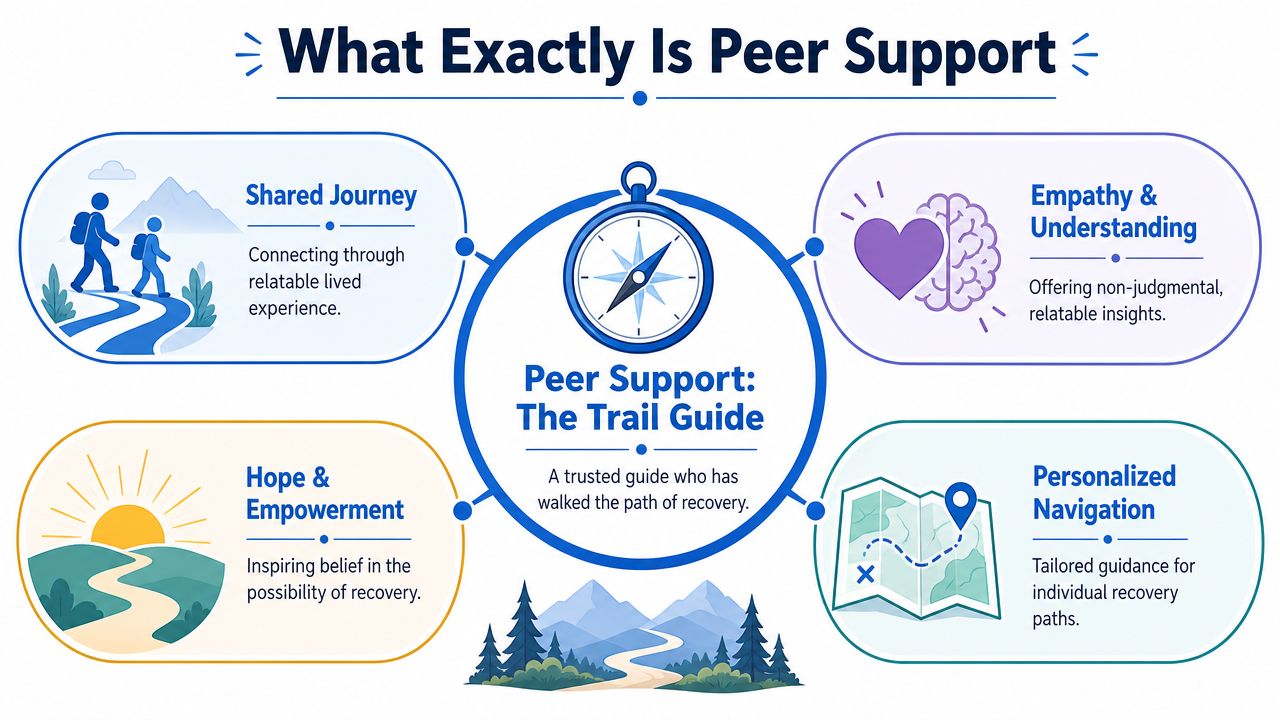
In recovery settings, peer support is usually non-clinical support from someone with lived experience of addiction and recovery. That person may be a certified peer specialist, a recovery coach, a mentor, or another trained peer worker. Their role isn't to diagnose, prescribe, or provide formal therapy. Their role is to connect, encourage, and help translate recovery into daily life.
The heart of peer support
Three ideas help make sense of it.
| Principle | What it means in practice |
|---|---|
| Mutuality | The relationship isn't built on superiority. The peer isn't talking down to you. |
| Empathy | Support comes from shared understanding, not guesswork. |
| Empowerment | The goal is to help you build your own recovery, not become dependent on one person. |
Often, people arrive in treatment feeling judged, managed, or misunderstood. Peer support can soften that fear. When someone says, "I remember what that felt like," it often lands differently than "I understand" from someone who hasn't lived it.
What peer support is and isn't
People sometimes confuse peer support with friendship, sponsorship, or therapy. There can be overlap, but they aren't the same.
- It's not therapy. A therapist helps you process patterns, trauma, mental health symptoms, and treatment goals using clinical training.
- It's not a lecture. A peer supporter doesn't need to impress you with perfect language.
- It's not casual advice. Good peer support has structure, boundaries, and a focus on recovery.
Practical rule: If clinical care helps stabilize and treat the condition, peer support helps a person stay engaged, understood, and connected while that treatment does its work.
A simple example helps. A counselor might teach relapse prevention planning. A peer supporter might help you think through what that plan looks like at 8 p.m. on a Friday when your stress spikes, your phone lights up with old contacts, and you suddenly want to leave your apartment. Both forms of help matter. They just do different jobs.
The Proven Benefits of Shared Experience
A person can leave detox with a solid discharge plan, agree that treatment makes sense, and still feel completely alone by nightfall. That gap matters. It is often the space where people miss appointments, stop medication, or decide they are beyond help. Peer support helps close that gap by adding steady human connection to clinical care.
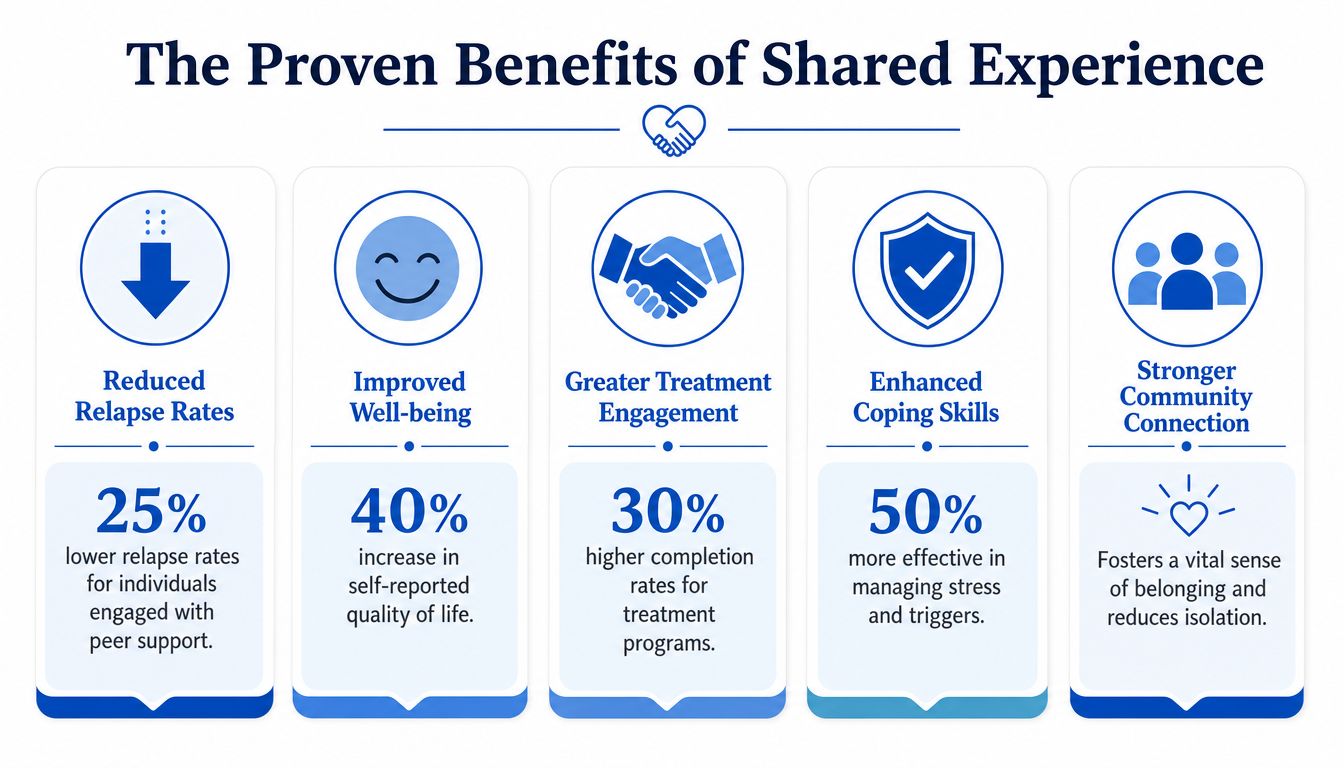
Research has linked peer involvement in recovery services with lower relapse risk, stronger treatment retention, and better patient satisfaction. A 2025 review in Frontiers in Public Health reports that peer support in substance use care is associated with a 25 to 35 percent reduction in relapse rates, 20 percent higher treatment retention, and 15 percent greater satisfaction with treatment providers. The same review also describes improved long-term recovery outcomes when peer services are part of care.
Those numbers make sense in real life. Recovery often breaks down at the handoff points. Someone finishes detox but feels shaky at home. Someone starts IOP but feels out of place in group. Someone begins MAT and worries that others will judge them for using medication. A peer supporter can meet a person in those moments and say, in effect, "You're still in recovery, and you do not have to figure out tonight by yourself."
That kind of support works like a bridge. Clinical care treats withdrawal, cravings, mental health symptoms, and safety concerns. Peer support helps people stay connected long enough to benefit from that care.
Here is a short video that many readers find useful for understanding the human side of support in recovery.
Why shared experience changes outcomes
People do not usually leave treatment because they learned nothing. They leave because recovery feels confusing, lonely, or too hard to carry into ordinary life.
Shared experience helps in several practical ways:
- It lowers shame. People often speak more openly with someone who has also lived through cravings, relapse, or fear of starting over.
- It builds trust in treatment. Care can feel less like something being done to you and more like something you are participating in.
- It makes skills usable. A clinician may help create a relapse prevention plan. A peer can help a person use that plan after a rough shift, during a family conflict, or on a weekend when old routines pull hard.
- It supports continuity across levels of care. Peer support can stay helpful before treatment, during treatment, and after discharge, which is one reason it pairs so well with detox, IOP, outpatient therapy, and MAT.
That last point is easy to miss. Recovery is not a single event. It is closer to learning how to walk on uneven ground. Clinical treatment provides the map, the tools, and the medical support. Peer support walks beside the person while they practice using them in daily life.
Seeing recovery in another person builds hope
Hope becomes more believable when it has a face. A peer supporter does not need to be perfect. They only need to show that progress is possible, setbacks can be survived, and treatment can become part of a real life rather than a temporary program.
If you are interested in the broader idea of how community shapes growth, Coachful has a thoughtful piece on how groups can gain client transformation through support, reflection, and shared progress.
Sometimes that is the benefit people feel first. They stop seeing treatment and peer support as an either-or choice. They begin to see a full recovery team. One part handles medical and clinical needs. One part brings lived proof, encouragement, and day-to-day reality. Together, they give recovery more structure, more staying power, and more room to last.
Understanding the Different Roles in Peer Support
Not every peer role is the same. That can be confusing at first, especially when people use terms like sponsor, mentor, coach, and specialist as if they all mean one thing. They don't.
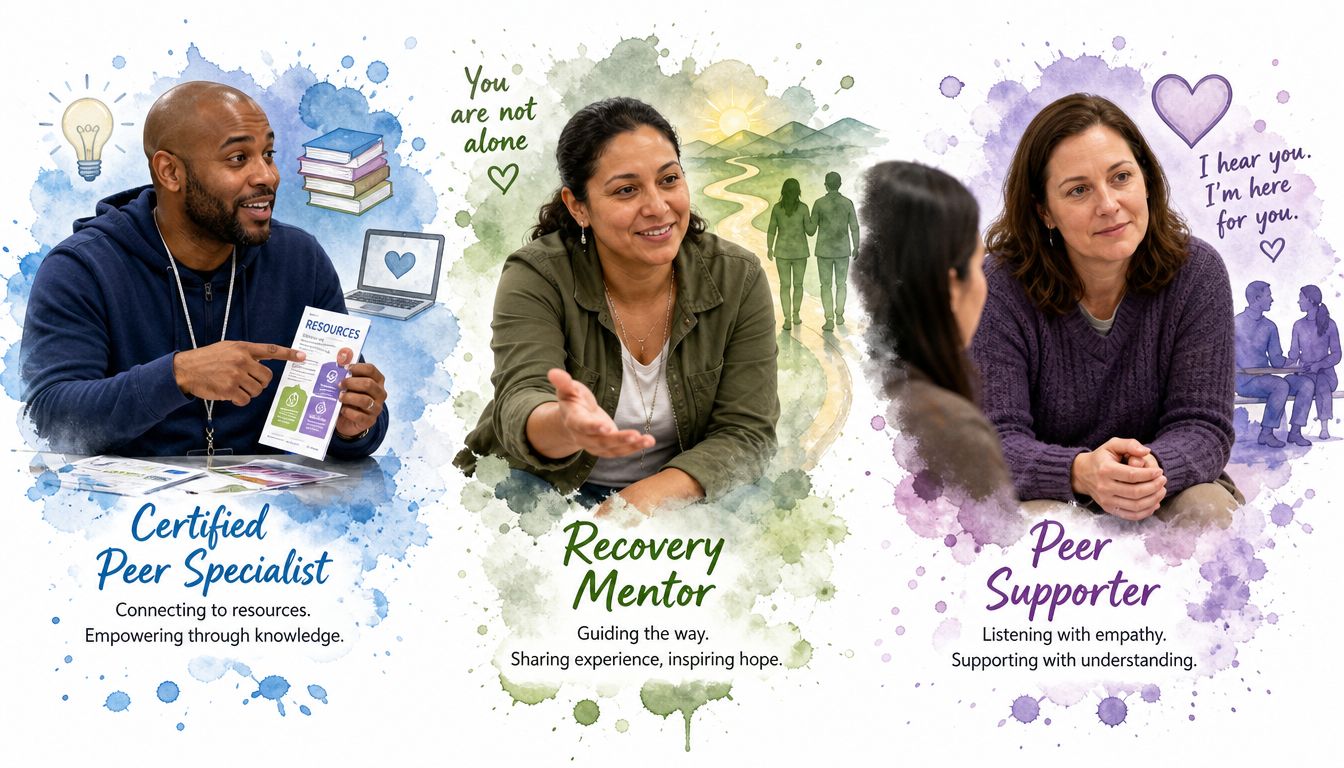
A helpful way to sort them is by asking three questions. Where does this person work. What training do they have. What kind of support are they offering day to day.
Certified peer specialist
A Certified Peer Specialist usually has lived experience of recovery plus formal training and certification. They may work inside treatment programs, health systems, recovery organizations, or community settings. Their role is structured, and their responsibilities often include engagement, encouragement, resource connection, and recovery planning support.
This isn't a fringe role. As of 2018, 38 states had implemented policies to reimburse for peer support services for substance use disorders, and a 2019 national survey found that over 61 percent of treatment facilities utilized peer support services, according to Hazelden Betty Ford's summary of peer recovery support research.
That adoption matters because it shows peer support has moved well beyond informal goodwill. In many settings, it is now a recognized part of care delivery.
Recovery mentor or recovery coach
A recovery mentor or recovery coach may or may not hold the same certification depending on the program or state. The role often focuses on practical support, accountability, motivation, and helping a person stay connected to recovery goals in the middle of daily life.
This person might help someone think through transportation, routines, social pressures, sober activities, job stress, or what to do after a difficult weekend. The tone is usually collaborative and down to earth.
Sponsor in a 12 step program
A sponsor is specific to a 12 step setting such as Alcoholics Anonymous or Narcotics Anonymous. Sponsors share their own experience and guide someone through that program's steps and traditions. That's different from a peer specialist working in a treatment environment.
A sponsor can be highly valuable, but the relationship has a narrower context. It's anchored in one recovery model.
A quick comparison
| Role | Main setting | Main function |
|---|---|---|
| Certified Peer Specialist | Treatment or community program | Structured peer recovery support |
| Recovery Mentor or Coach | Community, recovery program, or informal setting | Practical guidance and encouragement |
| Sponsor | 12 step fellowship | Step-based support within that fellowship |
The best fit depends on what kind of help you need. Some people benefit from more than one of these relationships at different points in recovery.
How Peer Support Enhances Clinical Treatment at Every Stage
The most helpful way to think about peer support is not as a substitute for treatment, but as a force that makes treatment easier to enter, easier to stick with, and easier to carry into real life.
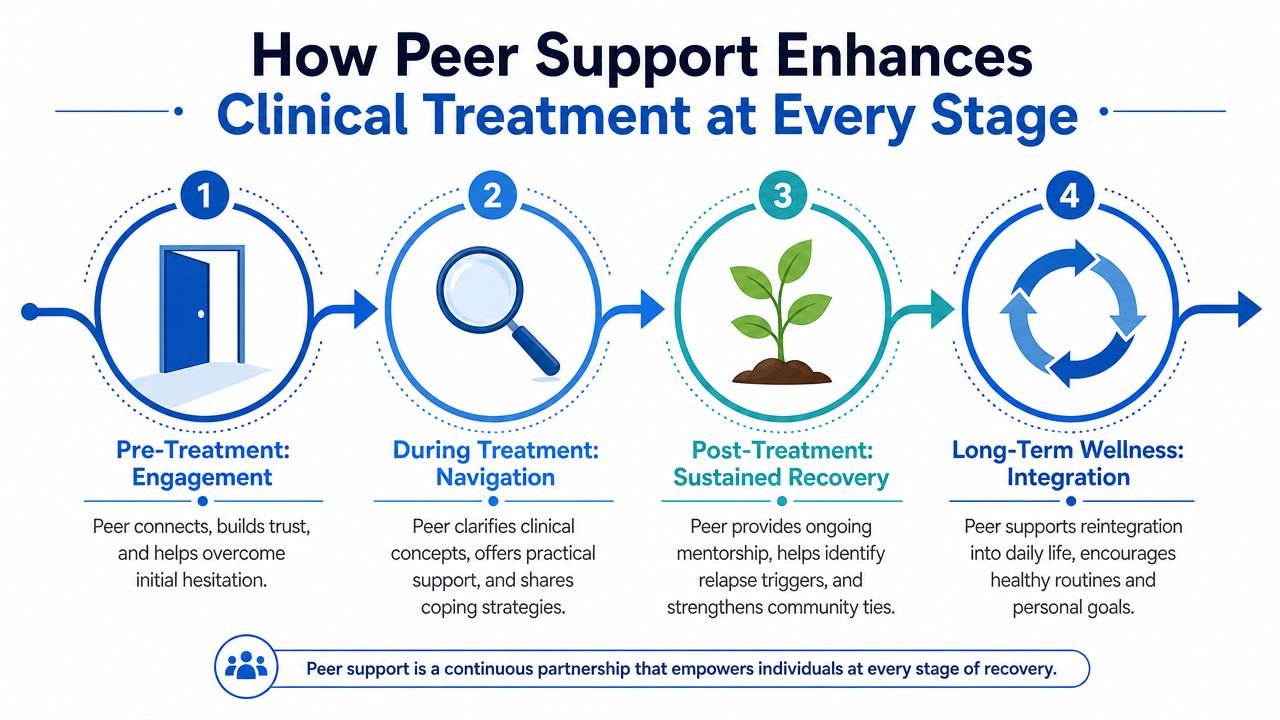
That matters across the full continuum of care. Detox, medication-assisted treatment, intensive outpatient care, and aftercare all have different demands. A peer supporter doesn't do the same job in each stage. The value is in how they adapt.
During detox and early stabilization
The first stage is often dominated by fear. People worry about withdrawal, shame, physical discomfort, and losing control. A clinician handles medical safety. A peer supporter helps with a different question. "Can a person get through this and build a life afterward?"
That example can be powerful in early treatment. When someone in recovery says, "I remember being terrified too," it can lower resistance in a way that medical reassurance alone sometimes can't.
During medication assisted treatment
Medication-assisted treatment can save lives, but some people still arrive with stigma, doubt, or mixed feelings. They may worry that taking medication means they are not really in recovery, or they may fear being judged by others.
This is one place where peer support can help bridge understanding and follow-through. Significant evidence demonstrates that peer recovery support services increase treatment engagement by 30 to 45 percent and reduce acute care hospitalizations by 20 to 30 percent. Medicaid members receiving peer support were also 25 percent more likely to initiate buprenorphine treatment, according to the Center for Health Care Strategies overview of peer recovery support services.
A peer can help normalize the emotional side of MAT. They can talk through what commitment looks like, how to handle outside opinions, and how medication fits into a larger recovery plan that includes counseling, routines, and support.
Good care doesn't force people to choose between medical treatment and human connection. It brings both together.
During IOP and skill building
In an Intensive Outpatient Program, people often learn tools that make sense in session but feel harder to use at home. Boundaries sound clear until your phone rings. Trigger planning sounds simple until you're tired, angry, and alone.
Peer support helps bridge that gap. A peer can take a concept like urge surfing, accountability, or relapse prevention and make it concrete. What does that look like before work. What do you say to an old friend who wants to meet at a bar. How do you get through the gap between evening cravings and bedtime.
During aftercare and re-entry
After structured treatment, many people don't need less support. They need a different kind of support. Daily life returns. Bills, family tension, routines, boredom, and freedom all come back at once.
Peer support can be especially useful here because it keeps recovery connected to community. It can help a person rebuild social habits, notice warning signs early, and stay tied to a recovery identity that doesn't disappear the moment formal treatment hours end.
What integration looks like in practice
A combined approach often works because each part handles something different:
- Clinical care addresses safety and treatment needs: withdrawal management, counseling, mental health support, medication, and treatment planning.
- Peer support addresses lived recovery challenges: discouragement, isolation, practical obstacles, and the day-to-day meaning of change.
- Together they support continuity: the person doesn't have to switch between "medical help" and "real life." Care speaks to both.
That combination is one of the strongest arguments for peer support in recovery. It isn't either-or. For many people, it's the partnership that gives treatment staying power.
Practical Steps to Find and Connect With Peer Support
Knowing peer support matters is one thing. Taking the first step can still feel awkward. Many people worry they'll say the wrong thing, pick the wrong group, or walk into a room where everyone else seems more confident and more settled.
You don't need to solve all of that before you begin. You only need a starting point.
Where to look first
Some options are straightforward and local. Others are useful if you prefer privacy or want to start online.
- Ask a treatment provider directly. If you're entering detox, outpatient care, counseling, or MAT, ask whether peer support is built into the program or available by referral.
- Check recovery community centers. These often offer groups, mentorship, events, and introductions to people with lived experience.
- Explore mutual aid groups. AA, NA, SMART Recovery, and other communities can provide support, structure, and regular contact.
- Look for online options. Virtual groups can be easier if transportation, work schedules, parenting, or anxiety make in-person support harder.
How to know if a support setting feels healthy
Not every group or peer relationship will fit. That's normal. Look for signs that the environment is grounded and respectful.
- Clear boundaries: The person doesn't try to control your decisions or become the center of your life.
- Respect for treatment: They don't tell you to ignore medical advice or stop therapy.
- Consistency: They follow through, show up, and communicate in a stable way.
- Humility: They share experience without acting like their path is the only valid one.
If a peer supporter makes you feel more ashamed, more pressured, or more cut off from professional care, that isn't a good fit.
If you're nervous to reach out
Many people need a script. That's okay. You can keep it simple.
Try one of these:
- "I'm new to recovery and looking for support."
- "I'm interested in meeting others who understand this process."
- "I'm not sure what I need yet, but I know I shouldn't do this alone."
If you're helping a loved one evaluate organizations or volunteer-led programs, practical safeguards matter too. Resources like this guide to choosing a nonprofit background check company can help families think through screening and trust in community-based settings.
Give yourself room to find the right fit
The first group may not click. The first conversation may feel stiff. That doesn't mean peer support isn't for you.
It usually means you're doing something new while vulnerable. Stay with the process long enough to meet people who feel steady, respectful, and real. That is often where support begins to feel less like an obligation and more like a lifeline.
Frequently Asked Questions About Peer Support
Is peer support a replacement for therapy
Peer support works best as part of a larger recovery plan, not as a substitute for clinical care. A therapist helps with diagnosis, treatment planning, and mental health concerns. A peer supporter brings lived experience, day-to-day encouragement, and practical insight that can make treatment feel less lonely.
A simple way to picture it is this. Clinical care provides the map. Peer support helps you stay on the road when the week gets hard.
That matters at every stage of care. Someone may need medical detox first, then outpatient treatment, medication for opioid or alcohol use disorder, and ongoing peer connection to keep recovery anchored in daily life.
What is the difference between a peer supporter and a friend
A friend may care a great deal, but peer support has a clearer purpose. A peer supporter understands recovery from the inside and keeps the focus on your goals, your safety, and your progress.
They also bring boundaries. The relationship is meant to support healing, not create dependence or turn into a social obligation. That structure can be comforting when life already feels unsteady.
How is confidentiality handled
Privacy depends on the setting, so it is wise to ask before you share personal details. In a treatment program or agency, peer workers often follow formal privacy rules and documentation standards. In community groups, privacy may rely more on group agreements and shared respect.
If you are unsure, ask a direct question such as, "What stays private here?" or "Are there any limits to confidentiality I should know about?" Clear answers help people feel safer.
What kinds of help do peer supporters actually provide
Peer support often helps in four practical ways. Emotional support means being with someone who understands shame, cravings, setbacks, and small wins without needing a long explanation. Informational support means sharing recovery resources, meeting options, or questions to bring to a counselor or doctor. Practical support can include help with routines, transportation planning, housing leads, or preparing for work again. Community support helps people reconnect with healthy relationships and recovery spaces where they feel less alone.
In real life, that can look simple. A peer supporter might text before a first IOP session, sit with someone after discharge from detox, encourage them to stay consistent with MAT appointments, or help them plan for a high-risk weekend. Small supports like these can make clinical treatment easier to continue.
How can family members encourage peer support without pushing too hard
Start with curiosity. A calm question often works better than advice.
You might say, "Would it feel easier to talk with someone who has been through recovery too?" You can also offer practical help, such as finding a group, arranging a ride, or sitting nearby during a virtual meeting. Then give the person room to decide.
That balance matters. Recovery usually grows better when support feels steady and respectful, not forced.
If you or someone you love is looking for care that combines clinical treatment with compassionate recovery guidance, Addiction Resource Center LLC offers detox, MAT, residential rehabilitation through its partner facility, in-person and telehealth IOP, and individualized support in Yuba City. You can reach out for private guidance, ask questions about treatment options, or take the first step without pressure.