You've probably already had the hardest moment. Someone in your family said, out loud or indirectly, “I need help.” Or maybe nobody said it cleanly, but the signs are obvious. Pills are disappearing. Drinking is no longer occasional. Work, sleep, money, and trust are getting hit. You're ready to act, then TRICARE enters the picture …


You've probably already had the hardest moment. Someone in your family said, out loud or indirectly, “I need help.” Or maybe nobody said it cleanly, but the signs are obvious. Pills are disappearing. Drinking is no longer occasional. Work, sleep, money, and trust are getting hit. You're ready to act, then TRICARE enters the picture and everything suddenly feels slow, technical, and confusing.
That confusion stops a lot of military families from moving. It shouldn't.
TRICARE drug rehab benefits are real, and they can open the door to detox, outpatient care, medication-assisted treatment, and inpatient treatment. The problem isn't usually whether help exists. The problem is knowing exactly what to do first, what to ask for, who has to document it, and how to avoid getting stuck in insurance limbo.
This guide is for that moment. It's built for the spouse making calls between school pickup and work. For the veteran who doesn't want to explain their story five times. For the parent trying to help an adult child on the family plan. You need a path, not a pile of policy language.
Table of Contents
- The First Step Navigating TRICARE for Addiction Help
- Understanding Your TRICARE SUD Benefits
- What Drug Rehab Services Does TRICARE Cover
- How to Access Your TRICARE Rehab Benefits Step by Step
- Navigating Potential Hurdles and Appeals
- Your Next Step Finding Help at Addiction Resource Center
- Frequently Asked Questions About TRICARE and Rehab
The First Step Navigating TRICARE for Addiction Help
A lot of families freeze at the same place. They know treatment is needed, but they don't know whether to call TRICARE, a doctor, a rehab center, or the crisis line first. They worry about saying the wrong thing, choosing the wrong provider, or triggering a bill they can't manage.
My advice is simple. Stop trying to solve the whole case in one afternoon. Your first job is to get the person assessed by a TRICARE-authorized provider or a treatment center that can help coordinate that process. Until there's a diagnosis and a recommendation for level of care, most of the insurance questions stay fuzzy.
Here's the practical way to understand it:
- If there's immediate danger: Get emergency help first. Insurance questions come second.
- If there's no immediate danger but the situation is escalating: Push for a clinical assessment now, not next week.
- If the person is resisting treatment: You can still start by verifying benefits and asking what documentation TRICARE will require.
Don't wait for things to get worse just because the paperwork feels intimidating.
Military families are used to pushing through. That mindset helps in a crisis, but it can backfire with addiction. Substance use disorders tend to get more expensive, more disruptive, and more dangerous when families delay action while they “figure out insurance.”
The good news is that TRICARE drug rehab access isn't a mystery once you break it into pieces. You need a diagnosis. You need medical necessity documented. You need a TRICARE-approved path for the level of care being recommended. Then you move.
Understanding Your TRICARE SUD Benefits
Why this benefit matters
TRICARE didn't treat substance use disorder care as some side benefit. In 2017, TRICARE significantly expanded its mental health benefits to include full coverage for substance use disorder treatment, integrating SUD treatment into its standard benefits structure and supporting coverage parity with physical health conditions under federal law. The same source notes that more than 21,000 people have used insurance to attend treatment at facilities covered under TRICARE. You can review that expansion in TRICARE substance use coverage details from AdCare.
That matters because many families still assume rehab is partly covered, rarely covered, or only covered in extreme cases. That's outdated thinking. TRICARE drug rehab benefits are broad enough to support care at different stages of recovery, from acute stabilization to ongoing outpatient support.
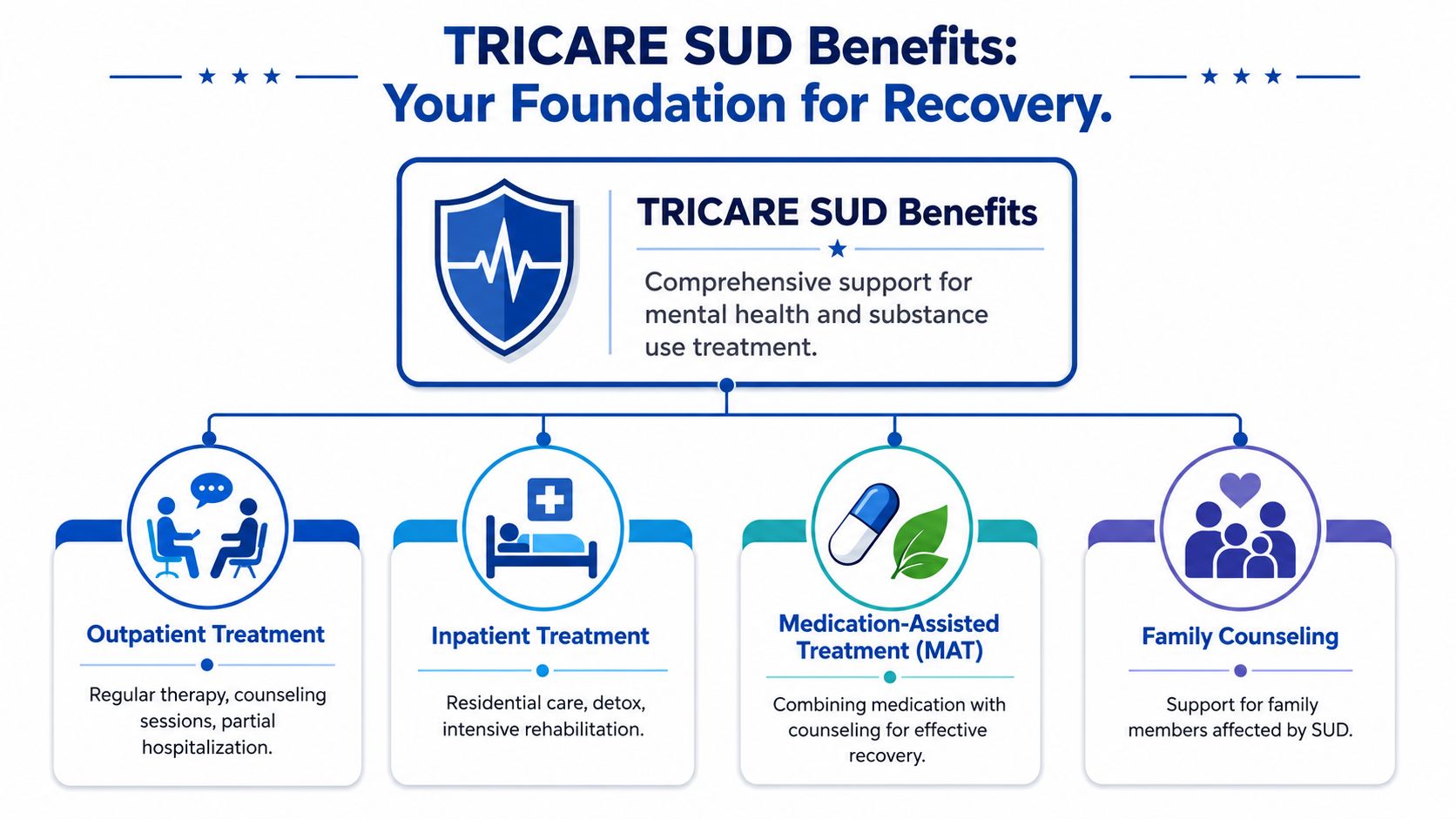
The key issue isn't whether treatment exists under the benefit. The key issue is whether the treatment being requested is documented as medically or psychologically necessary and arranged through the right channels.
What the continuum of care means for you
Recovery rarely follows one straight line. Someone may need detox first, then residential care, then step down to intensive outpatient treatment. Another person may never need inpatient rehab at all and can start safely in outpatient care with therapy and medication support.
That's why the phrase continuum of care matters. TRICARE supports treatment as a process, not a one-time event.
A few practical truths help here:
- Detox isn't the whole treatment plan. It's the front end for people who need withdrawal management.
- Residential rehab isn't always the default. It's the right fit when the person needs structure, monitoring, or separation from a destabilizing environment.
- Outpatient care isn't “less serious.” For many people, it's the most realistic way to stay engaged over time.
Practical rule: Don't choose the level of care based on pride, convenience, or stigma. Choose it based on clinical need and safety.
Your specific TRICARE plan still affects logistics. Referral rules, network requirements, preauthorization, and cost-sharing can differ by plan. That's why families get into trouble when they assume “covered” means “automatic.” It doesn't. Covered means the benefit exists. You still have to use it correctly.
What Drug Rehab Services Does TRICARE Cover
The main levels of care
TRICARE covers a full range of addiction treatment services when the person has an official diagnosis from an in-network medical professional and treatment is confirmed as medically or psychologically necessary. According to American Addiction Centers' overview of TRICARE rehab coverage, that includes every level of outpatient addiction treatment, including standard outpatient rehab, Partial Hospitalization Programs (PHP), and Intensive Outpatient Programs (IOP). The same source also states that TRICARE covers Medication-Assisted Treatment (MAT) for opioid addiction, including methadone and buprenorphine.
That's the big picture. Here's how those services usually work in real life.
Medical detox is for people who may face significant withdrawal symptoms from alcohol or drugs and need close medical supervision. If someone is at risk during withdrawal, don't try to “white knuckle” it at home because it feels simpler.
Residential or inpatient rehab makes sense when the home environment is unstable, relapse risk is high, or the person needs intensive daily structure. This level can also help when repeated outpatient attempts haven't held.
PHP is often the middle ground. It gives a high level of treatment intensity during the day while the patient lives at home or in a supportive setting.
IOP works well for step-down care or for people who need strong treatment involvement but can still function safely outside a facility.
Standard outpatient rehab is the least intensive. It's often appropriate for ongoing therapy, relapse prevention, and long-term recovery maintenance.
TRICARE covered levels of care comparison
| Level of Care | Description | Best For |
|---|---|---|
| Detox | Medically supervised withdrawal management with clinical support | People with withdrawal risk or recent heavy substance use |
| Residential or Inpatient Rehab | Live-in treatment with structured daily programming | People needing round-the-clock support or a stable environment away from triggers |
| PHP | Day treatment with intensive services while living off-site | People needing strong clinical support without overnight stay |
| IOP | Several treatment sessions each week with more flexibility than PHP | People stepping down from higher care or needing a structured outpatient option |
| Standard Outpatient | Therapy, counseling, and recovery support at a lower intensity | People with stable housing, lower acute risk, or ongoing maintenance needs |
| MAT | Medication combined with counseling for opioid use disorder | People who benefit from craving reduction and relapse prevention support |
A mistake I see often is families asking, “What does TRICARE cover?” when the better question is, “What level of care does the clinician recommend, and is the facility approved by TRICARE?”
That second question gets results.
If you're unsure where your loved one fits, focus on three factors:
- Withdrawal risk: If stopping use could be medically risky, start with detox assessment.
- Daily stability: If the person can't reliably stay safe, show up sober, or avoid triggers, residential care may be the better fit.
- Recovery history: If they've already relapsed after lower levels of care, don't repeat the same weak plan.
How to Access Your TRICARE Rehab Benefits Step by Step
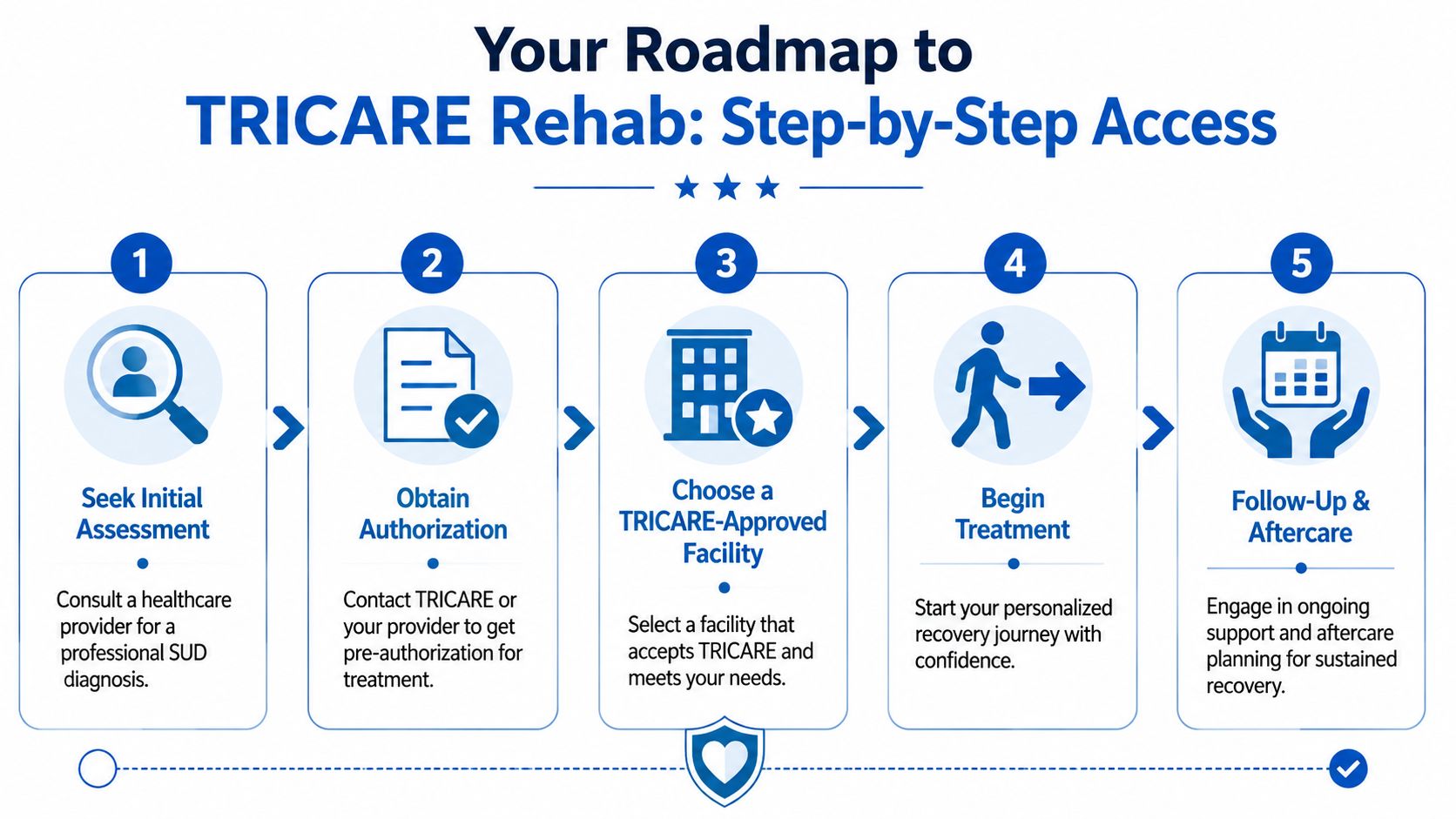
Start with the diagnosis, not the facility
Families often waste time by starting to compare programs before they've handled the clinical and insurance basics. For TRICARE drug rehab, the sequence matters.
- Get a clinical assessment. The person needs an official diagnosis and a recommendation for treatment from an in-network professional.
- Confirm the level of care being recommended. Ask plainly whether the recommendation is detox, residential care, PHP, IOP, MAT, outpatient therapy, or a combination.
- Verify the facility's TRICARE status. Don't assume a center “takes TRICARE” in the way you need. Confirm that it's approved and ask how billing is handled.
- Ask whether preauthorization is required. Some services, especially more intensive levels of care, often involve additional approval steps.
- Get the paperwork trail started immediately. Clinical notes, diagnosis, referral details, and authorization records should be organized from day one.
A short explainer can help if you're trying to understand the flow before making calls:
The families who move fastest aren't the ones who know insurance language. They're the ones who ask direct questions and write every answer down.
Ask every provider the same three things: Are you TRICARE-approved, what level of care do you recommend, and what must be authorized before admission?
Use a practical checklist before admission
Before anyone packs a bag or commits to a start date, get these details nailed down:
- Diagnosis on file: If there's no formal diagnosis, fix that first.
- Medical necessity documented: This needs to be clear in the record, not implied in a phone call.
- Referral or authorization status: Ask whether it's pending, approved, or still missing information.
- Network status confirmed: In-network care is usually the cleaner path.
- Cost expectations discussed: Copays, deductibles, and any out-of-pocket responsibilities depend on the specific plan and facility.
Don't leave costs vague. Ask the admissions or billing team to explain what they know, what they don't know yet, and what may still depend on authorization. You don't need a perfect estimate before admission, but you do need clarity about the process.
Also, don't let embarrassment slow you down. A spouse can often do a lot of the legwork if the patient is overwhelmed. A parent can ask smart questions. A close family member can keep records, track calls, and push follow-up. Bureaucracy gets easier when one organized person owns the file.
Navigating Potential Hurdles and Appeals
Why denials happen
A denial doesn't automatically mean the treatment is inappropriate. It usually means the request, documentation, provider status, or authorization path didn't line up the way TRICARE required.

Common problems include:
- Medical necessity wasn't documented clearly enough: The chart may describe use, but not the clinical reasons for that exact level of care.
- The provider or facility wasn't the right network fit: That can complicate approval or reimbursement.
- Preauthorization wasn't completed properly: This is a frequent administrative failure.
- The requested level of care didn't match the documentation: For example, the family may want residential rehab, but the clinical record only supports outpatient treatment.
If active-duty legal concerns are mixed into the situation, especially when alleged drug use may have disciplinary consequences, families should separate the treatment issue from the military justice issue and get informed legal help. A solid starting point is legal representation for Article 112a, which explains the legal side of military drug cases.
How to respond without losing momentum
Don't treat a denial as final on day one. Treat it as a problem to be documented and challenged.
Here's the response plan I recommend:
- Request the exact denial reason in writing. Verbal summaries aren't enough.
- Ask the provider to review the clinical record. Many denials are appealable if the documentation is tightened.
- Collect every supporting record. Assessment notes, diagnosis, treatment recommendation, medication history, and prior treatment attempts can matter.
- Track every call. Keep names, dates, times, and reference numbers.
- Submit the appeal quickly and cleanly. Messy appeals fail for preventable reasons.
Bottom line: A weak first submission can still become a strong appeal if the clinical story is documented clearly.
Stay focused on the immediate objective, which is getting the person into the safest appropriate level of care. Pride slows appeals down. Precision speeds them up.
Your Next Step Finding Help at Addiction Resource Center
What to do today
If you're in Yuba City or elsewhere in Northern California, a useful next move is to talk with a local program that understands both addiction treatment and the TRICARE verification process. You need someone who can help translate assessment, benefits, and placement into one coordinated process.
Start with a direct call or text. Ask for a confidential assessment. Ask whether they can help verify benefits. Ask what level of care may fit your situation and what documents they'll need from you. Keep the conversation practical.

What local support can look like
Addiction Resource Center LLC in Yuba City works with adults who need substance use treatment and co-occurring mental health support, including people using TRICARE. Their services align with the kinds of care military families often need most: medically supervised detox with medication-assisted treatment, residential rehabilitation through a partner facility, and an Intensive Outpatient Program available in person and through telehealth.
What I like about this kind of setup is the practicality. Families don't need a glossy pitch. They need care that is organized, private, and grounded. A multidisciplinary team matters because addiction rarely shows up alone. People may need medical oversight, counseling, family guidance, structure, relapse prevention, and aftercare planning, not just a bed for a few days.
If that sounds like your situation, make the next step concrete:
- Call or text: 530-625-7910
- Visit: 1002 Live Oak Blvd., Suite A, Yuba City, CA
You don't have to commit to everything in one conversation. You can start by asking whether your TRICARE plan can be verified, what level of care may be appropriate, and how quickly an assessment can happen. Action beats worry every time.
Frequently Asked Questions About TRICARE and Rehab
Can my family member use treatment under my TRICARE plan
Possibly, if they're an eligible beneficiary under your TRICARE coverage. Eligibility depends on beneficiary status and plan details, so verify that first before discussing admission.
Does TRICARE cover rehab outside my home area
It can, as long as the facility is approved under the benefit structure that applies to your plan and the treatment is authorized as needed. Don't assume geography is the main issue. Network status and authorization usually matter more.
Are telehealth and online IOP options covered
They may be available depending on the provider, the plan, and how the service is billed. If telehealth matters for work, childcare, or transportation, ask specifically whether the provider offers IOP or follow-up services in that format.
Will TRICARE cover medication for opioid addiction
Yes, MAT is part of covered addiction treatment for opioid use disorder when clinically appropriate. The earlier coverage summary in this guide addresses that benefit.
Is SUD treatment private
Privacy rules still apply, but military families are right to ask careful questions. Before treatment starts, ask the provider how records, billing, and communication are handled so there are no surprises.
What if my loved one refuses residential treatment
Then focus on the next clinically appropriate option, not on winning an argument. A good assessment can identify whether outpatient care, IOP, PHP, MAT, or detox is the right entry point. Some treatment is better than no treatment.
If you're ready to stop guessing and start moving, contact Addiction Resource Center LLC. They welcome TRICARE beneficiaries and can help you sort out assessment, benefits verification, detox, MAT, IOP, residential options through their partner program, and next steps for your family. Call or text 530-625-7910 or visit 1002 Live Oak Blvd., Suite A, Yuba City, CA for a confidential conversation.