Emotional sobriety means tolerating anger, fear, grief, and disappointment without substances, other people, or ideal circumstances supplying inner security, and it is not a promise of constant happiness. People started naming that skill after more than 20 years of personal sobriety, once staying away from alcohol was no longer the hardest part. The advice you …

Emotional sobriety means tolerating anger, fear, grief, and disappointment without substances, other people, or ideal circumstances supplying inner security, and it is not a promise of constant happiness. People started naming that skill after more than 20 years of personal sobriety, once staying away from alcohol was no longer the hardest part.
The advice you hear most often still misses the point. "Just don't drink, and try to stay serene." Serenity gets sold as a mood you should hold all day. Then a comment at dinner, a stack of bills, or a silent evening hits, and the body treats it like an emergency. Abstinence did its job. The feeling still wants a manager.
What helps is a way of responding, not a mood score. You notice the feeling, you pause, and you choose an action that keeps recovery intact. Inner security does not get borrowed from prestige, control, approval, or a perfect set of circumstances.
Table of Contents
- What Emotional Sobriety Means in Daily Life
- Where the Emotional Sobriety Definition Began
- How Emotional Sobriety Differs from Abstinence
- Signs You Are Building Emotional Sobriety
- Why Emotional Sobriety Is Not Constant Happiness
- How to Practice Emotional Sobriety in Recovery
- Start Care That Supports Emotional Sobriety
What Emotional Sobriety Means in Daily Life
Emotional sobriety shows up in what you do when a feeling gets intense. After someone stops drinking or using drugs, a sharp comment, an overdue bill, or a quiet evening can still stir distress. The skill is staying steady in your actions, even when your mood is not steady.
A useful emotional sobriety definition describes a practice, not a perfect state. You notice anger, grief, fear, frustration, shame, or joy without needing a substance, another person, or ideal circumstances to make you feel safe. Calm may come later. Your next choice is what matters now.
Borrowed safety versus a pause
Approval, control, and status can become emotional props. A compliment may lift your mood, a changed plan may spoil the day, and someone else's tension may set the tone at home. When your sense of safety depends on those things, inner security has little room to grow.
Consider a familiar moment: you are sober at home when a text feels insulting. Your chest tightens. You could drink, start a fight, or rush to fix the situation. Instead, name the anger and wait before replying. The feeling can stay; it does not have to choose your behavior.
Practical rule: Sobriety here is a way of responding, not a mood score.
For families, the same distinction matters. A loved one may have stopped using while evenings remain tense. Clear limits can help separate caring for someone from taking responsibility for their feelings. This guide to healthy boundaries in recovery offers ways to make that difference clearer.
Faith leaders may also mistake constant availability for care. When every crisis takes priority, exhaustion can build while personal distress goes unaddressed. Mental wellness guidance for church leaders can help leaders distinguish supporting others from avoiding their own needs.
Emotional sobriety does not require a peaceful Tuesday. It means feeling what is there, choosing a response, and staying aligned with a recovery plan that continues after abstinence.
Where the Emotional Sobriety Definition Began
The phrase did not start in a clinic manual. It grew inside Alcoholics Anonymous after physical abstinence was already a shared practice, and it still gives treatment a plain way to talk about relapse.
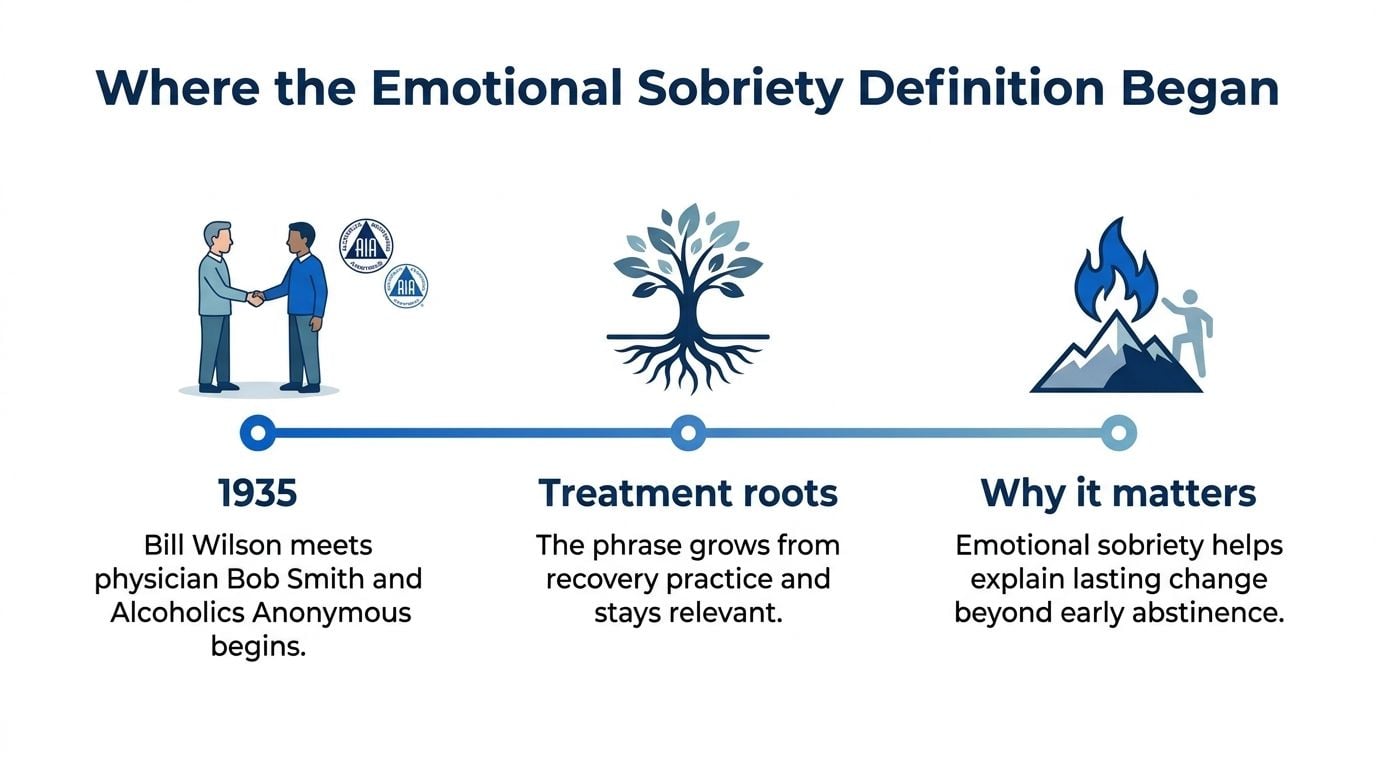
AA began in 1935, when Bill Wilson met physician Bob Smith in Akron, Ohio. The first edition of Alcoholics Anonymous appeared in April 1939. Those early years built a fellowship around stopping drinking and helping the next person do the same, as the Canadian Centre for Addictions account of emotional sobriety lays out.
A later frontier, not a new slogan
Wilson came back to the idea after more than 20 years of personal sobriety. He discussed it in a 1956 letter. Readers met it in the January 1958 issue of AA Grapevine, in the essay commonly known as "The Next Frontier: Emotional Sobriety."
He was naming what comes after the drink is down. A person learns to tolerate difficult emotions, grow some emotional maturity, and stop borrowing security from substances, other people, prestige, control, approval, or ideal conditions. That is recovery language. It is not a formal diagnosis, and it is not a score you pass in a chart.
Why treatment still uses it
Picture someone who has been abstinent long enough that friends call the problem solved. Then grief hits, or a work slight, or a stretch of flat joy, and the old exit looks reasonable again. The 1958 essay gives staff and families a shared sentence for that moment. Recovery means learning to feel anger, grief, fear, frustration, and joy without impulsive escape, emotional shutdown, or substance use.
The timeline matters because the idea arrived late on purpose. First came a meeting in Akron and a book. Years later came a letter about the feelings that abstinence does not erase. Treatment still borrows that sequence when it treats relapse prevention as more than a promise to stay away from the drug.
How Emotional Sobriety Differs from Abstinence
Early abstinence answers a calendar question. Did the person drink or use today? Emotional sobriety answers a distress question. What did they do with the feeling once the substance was off the table?
The two can travel together, and they often don't. A clean stretch can sit next to a nervous system that still treats discomfort as an emergency.
What the words actually split
Emotion regulation is the technical neighbor. You name an internal state, accept it without automatic avoidance, tolerate the rise in arousal, and pick a response that matches recovery goals. The endpoint is abstinence plus adaptive decisions while feelings change. It is not the removal of negative affect.
Treating the goal as "feeling good" sets a standard nobody can keep. Treating it as behavioral stability under emotional stress points at skills you can practice: urge monitoring, delay of action, cognitive reappraisal, distress tolerance, and asking for help.
A systematic review of emotion regulation in substance use disorders found that people with substance use disorders show substantially greater emotion-regulation difficulty than people without SUDs, with a large overall effect. Those deficits may improve during abstinence, yet they can remain at higher levels after 3–6 months. Stopping use helps. It does not, by itself, restore the full capacity to steer distress.
Side by side
Abstinence and emotional sobriety side by side
| Question | Early abstinence | Emotional sobriety |
|---|---|---|
| Main change | The substance stops | The response to distress changes |
| What you can see | Days without alcohol or drugs, a body starting to settle | Trigger recognition, craving that gets named, fewer impulsive acts |
| Coping | Often "don't pick up" plus white-knuckle waiting | A chosen strategy, then a return toward baseline after stress |
| Risk if you stop here | The emergency feeling is still in charge | Feelings still hurt, but they don't automatically write the next action |
A month without drinking can coexist with a mind that still files every hard feeling under one label: fix this now.
Aftercare cannot assume regulation returns because detox ended or a residential stay went well. Assessment has to watch both the emotion and the behavior that follows it. If craving still spikes at conflict, and the only plan is "try harder," the abstinence is real and the regulation work is unfinished.
Signs You Are Building Emotional Sobriety
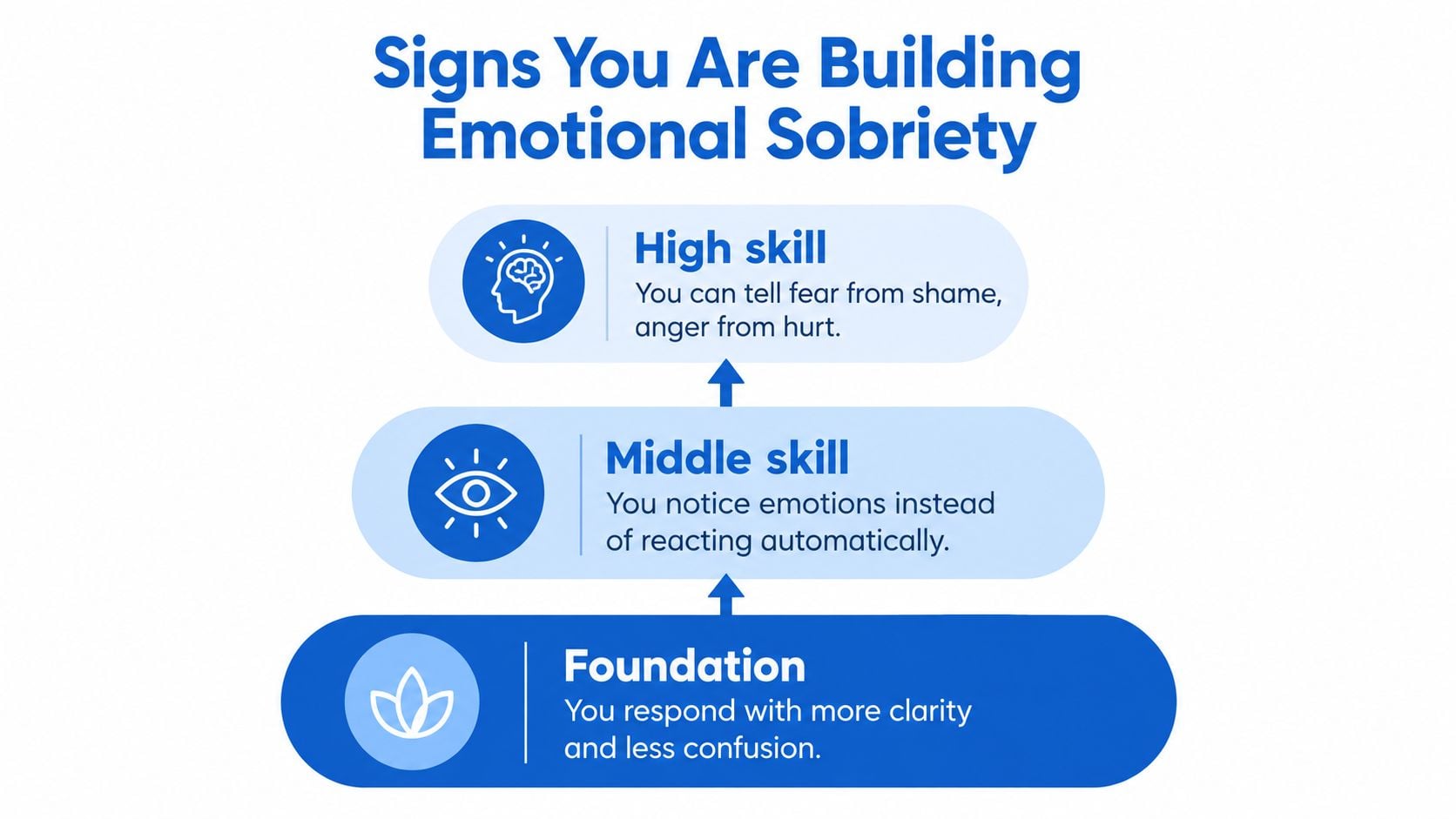
Signs show up in the next choice, not in a mood diary that says "felt fine." The useful marker is whether you can tell one hard feeling from another before you act.
Naming the feeling more precisely
Emotion differentiation means recognizing experiences as distinct, instead of treating every unpleasant state as one blob. Fear is not shame. Anger is not sadness. Anxiety is not a vague "everything is bad."
In a 2022 study of people recovering from alcohol use disorder, researchers measured that skill and then followed drinking. Average negative emotion differentiation was inversely associated with the percentage of drinking days during the following 3-month follow-up, at p = 0.042. People who identified negative emotions with greater precision tended to report fewer drinking days over those three months, according to the study of emotion differentiation in early alcohol recovery.
That finding does not prove differentiation alone prevents relapse. It also does not turn emotional sobriety into a standardized clinical diagnosis. It supports one piece of a larger goal: awareness, tolerance, regulation, and behavior that lines up with long-term abstinence.
What the next action looks like
You will not grade this like a test. Watch both the feeling and the move that follows.
- A pause before the text or the drink: The urge is present, and the send button or the pour waits.
- A number on the intensity: "This anger is a 7" is more usable than "I'm losing it."
- Craving that rises and falls: You stay long enough to see it change instead of treating the peak as permanent.
- Help chosen on purpose: A call, a meeting, or a counselor gets used before the impulse picks for you.
- A return toward baseline: After the stress, sleep, food, and ordinary tasks come back into reach.
Clearer naming is one supported piece, not the whole recovery. Someone can label shame perfectly and still need a plan for what they do at 9 p.m. Someone else may fumble the words and still delay the action, call a sponsor, and get through the night. Look at both. The feeling tells you what is happening. The next action tells you whether the skill is being built.
Why Emotional Sobriety Is Not Constant Happiness
Still feeling angry, anxious, grief-stricken, or depressed does not mean you are failing recovery. It means you are a person with a nervous system.
The mix-up is old. People hear "serenity" and think they must feel positive, or they chase the hope of being happy, joyous, and free every day. Emotional sobriety is not mood improvement, and it is not emotional suppression. The goal is to recognize the emotion, pause, and choose a response that fits recovery. Severe feelings can sit right beside that skill.

When positivity becomes a hiding place
If serenity is misread as mandatory cheer, people hide symptoms. They skip mental health care because a low week feels like a character flaw. They feel shame after an ordinary reaction, a snapped answer, a cry in the car, a flat Sunday. As noted earlier, regulation difficulty can linger well after abstinence begins, even when stopping use helps. A clean stretch does not cancel grief.
Counselors who teach learning to tolerate unpleasant feelings make a related point families can use. A negative emotion is information. It is not a verdict that recovery has collapsed, and it is not something you have to delete before you are allowed to be around other people.
A sequence for adults and families
Use this when the feeling is strong and nobody is sure what "handling it" means.
- Notice the feeling. Name anger, fear, sadness, or shame without grading it as good or bad.
- Name the trigger. A comment, a memory, a bill, a silence.
- Assess immediate safety. Are you at risk of using, driving unsafely, or hurting yourself or someone else?
- Use a coping or support plan. Breathing, a walk, a call, a meeting, a boundary.
- Get clinical help when functioning drops. Work, sleep, eating, or relationships falling apart is a reason to call, not a reason to double down on willpower.
Persistent depression, trauma symptoms, mania, suicidal thoughts, or overwhelming cravings need professional assessment, not a stricter attitude.
That line comes from the same clinical picture summarized in the review of emotion-regulation difficulty and substance use. Emotional sobriety is a measurable skill. It is not a personality trait, a spiritual grade, or proof that you feel good.
How to Practice Emotional Sobriety in Recovery
Emotional sobriety does not mean staying calm or feeling happy all the time. It means keeping your behavior steady enough to protect recovery while distress is present. Practice focuses on a learned loop: a substance briefly dulls an uncomfortable feeling, and that relief can make the substance seem like the answer the next time a similar feeling appears. This pattern is called negative reinforcement.
Emotional dysregulation can keep that loop going. Difficulty noticing feelings, accepting them, pausing before acting, or choosing helpful coping strategies can increase vulnerability to addictive behavior and relapse. A discussion of emotion regulation and relapse describes the connection and notes that interventions that build regulation skills are associated with better treatment outcomes and lower relapse risk. Willpower alone may not be enough when substance use has repeatedly brought short-term relief.
Two scenes, one sequence
Scene one, the argument. Voices rise in the kitchen. Your jaw tightens and your hands feel hot. Name the feeling as anger, rather than treating it as a command to leave or drink. Rate its intensity. You might notice that using promises a quick release from the tension and a reason to end the conversation. Try paced breathing or urge surfing, contact a support person, then reassess before deciding what to do.
Scene two, the shame spiral. You make a mistake at work, and your mind says you are finished. Your shoulders fold inward; your stomach drops. Name shame and rate its intensity. Notice that using might mute the painful story for a while. Choose a response that works against the urge, contact support, then decide on your next action. The feeling changes; the skill sequence stays much the same.
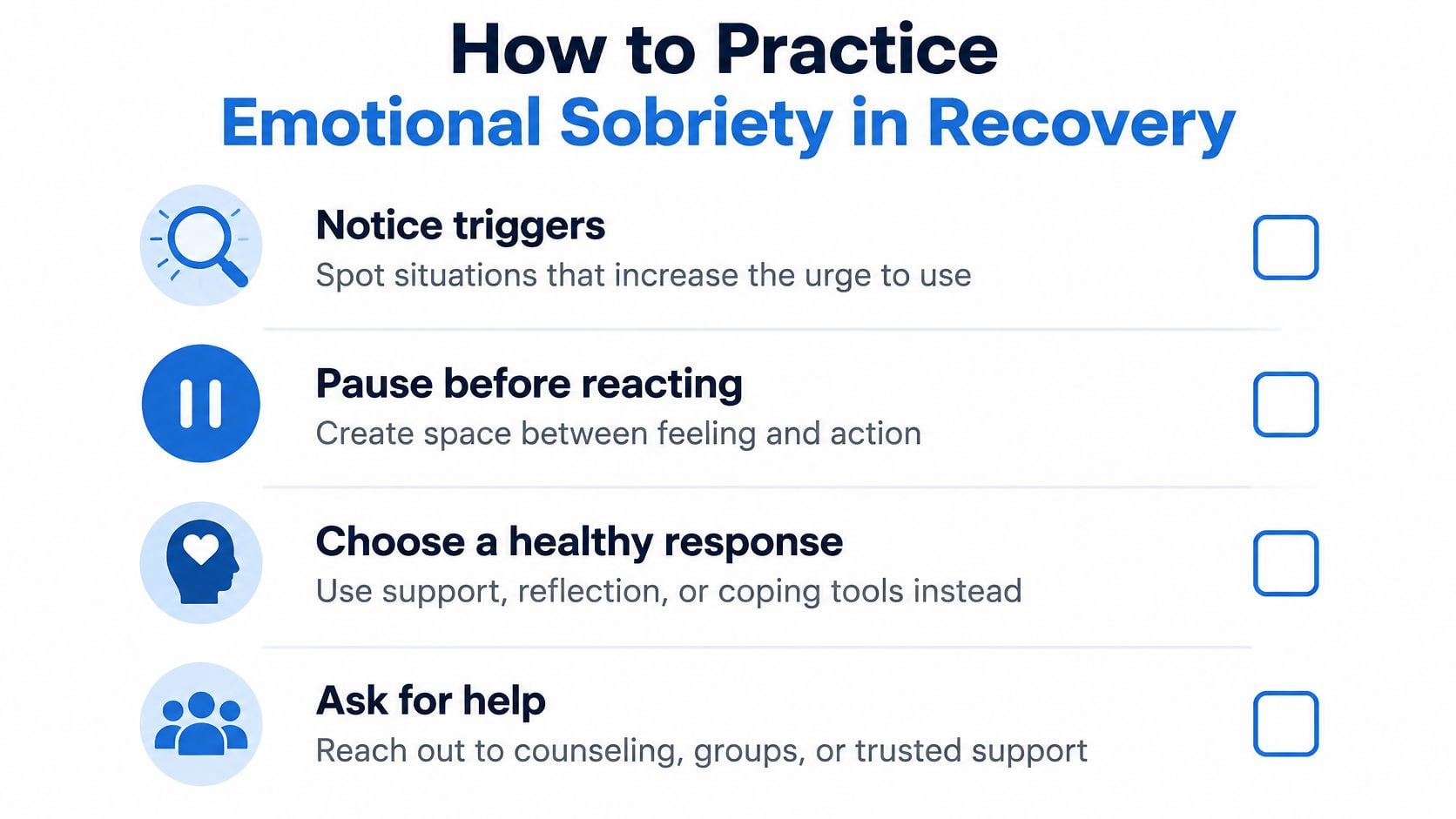
Use this order: Label the emotion and body cues. Rate intensity. Name the short-term benefit of using. Apply a competing response. Contact support. Reassess before acting. That gives you specific actions to try when distress narrows your choices. The overview of emotional regulation techniques for lasting change offers more ideas for choosing a competing response.
A short video can help you picture the pause before trying the sequence during a real disagreement.
Alone versus inside a plan
You can practice the sequence on your own when feelings are manageable. Conflict, shame, and stress can make it harder to pause, and regulation may still be difficult after detox. A structured recovery plan can help you keep practicing after early residential care, with support suited to your needs.
For adults 18 and older, Addiction Resource Center in Yuba City is one option. Care includes medically supervised detox with medication-assisted treatment, residential care through partner Ona Treatment Center in Browns Valley, and intensive outpatient care in person or by telehealth. The team includes a doctor, nurse, CADC counselors, an LMFT, and recovery mentors. Trigger work, coping skills, relapse prevention, and aftercare can support practice beyond a single difficult moment. It is one structured setting among others, not a replacement for using the daily sequence.
Start Care That Supports Emotional Sobriety
Emotional sobriety does not require a calm mood before you seek help. It means learning to choose a recovery-supporting action while distress is still present. A call to a treatment team can be one such action, especially when feelings after detox or during outpatient care are hard to manage. Asking for structure is not a sign of failure.
Who should make the call
Adults in Yuba City and Northern California can call to ask what kind of care may fit. Families can ask how to offer support without trying to manage every mood. Veterans and military families using TRICARE, along with people who have major private insurance, can ask what coverage questions to resolve before admission. The goal is a clear next contact, not a perfect explanation of what you feel.
You can call or text 530-625-7910 any time. You can also visit Addiction Resource Center to request a conversation, ask about a tour, or get guidance as a family member making the first move. Be ready to name the kind of care you are considering: detox with medication-assisted treatment, residential care through Ona Treatment Center, or intensive outpatient care in person or by telehealth.
The office is at 1002 Live Oak Blvd., Suite A, Yuba City, CA. Staff can explain the options even if you are unsure how to describe your feelings.
Safety before scheduling
If you have suicidal thoughts or cannot stay safe, seek emergency help first. Scheduling a tour can wait.
A family member who wants to offer comfort can share a short, caring message without suggesting that faith replaces clinical support. Scroll With God's verse-sharing guide offers ideas for sharing scripture with someone who needs encouragement. Support from another person in recovery can also help you remain connected while difficult feelings are present. Learn more about peer support in recovery.
Addiction Resource Center LLC offers medically supervised detox with medication-assisted treatment, residential care through Ona Treatment Center, and intensive outpatient treatment in person or by telehealth for adults. Its care includes coping skills, relapse prevention, and aftercare, alongside support for stopping substance use. To ask about care, contact the center or visit its website.
Choose one practical action today: make a call, send a text, or ask a family member to reach out with you. You do not have to feel serene first.