You notice someone you love no longer seems like themselves. Their eyes look different, sleep has become unpredictable, and familiar friends have disappeared from their routine. Stress, depression, a medical condition, or drug use could explain these changes. Start with careful observation, not an accusation. The signs of someone using drugs usually form a pattern …

You notice someone you love no longer seems like themselves. Their eyes look different, sleep has become unpredictable, and familiar friends have disappeared from their routine. Stress, depression, a medical condition, or drug use could explain these changes. Start with careful observation, not an accusation.
The signs of someone using drugs usually form a pattern across three areas: physical changes, behavior, and the person's environment. A substance use disorder means continued drug use despite harm to health, work or school, or relationships. It also includes cognitive, behavioral, and physiological symptoms, as described by the CDC's overview of substance use disorders. NIDA's guidance for families highlights warning signs such as new friend groups, reduced interest in favorite activities, changed eating or sleeping habits, missed classes, lower grades, and more conflict.
Use the eight signs below to document patterns and decide when professional treatment guidance is needed. No single sign proves drug use, and several may have medical or mental-health explanations. Approach the person privately, describe specific changes, and encourage an assessment rather than demanding an admission.
If they are difficult to wake, breathing unusually slowly, having a seizure, severely confused, or in immediate danger, call emergency services immediately. Do not wait for a conversation.
Table of Contents
- 1. Dilated or Constricted Pupils
- 2. Sudden Changes in Sleep Patterns and Energy Levels
- 3. Neglect of Personal Hygiene and Appearance
- 4. Mood Swings and Emotional Instability
- 5. Sudden Changes in Social Circles and Relationships
- 6. Financial Instability and Unexplained Money Problems
- 7. Paraphernalia and Environmental Evidence of Drug Use
- 8. Cognitive Changes and Physical Health Deterioration
- 8-Point Comparison: Signs of Drug Use
- Taking Action and Finding Help
1. Dilated or Constricted Pupils
Pupil changes can be noticeable during an interaction, but they're not a standalone diagnosis. Some substances can cause unusually large pupils, while others can produce very small pupils. Prescription medications, medical conditions, fatigue, lighting, and eye disorders can also affect the way pupils look.

Look for a repeated change from the person's usual appearance. Pupils that seem unusually large in ordinary indoor light, unusually small, or slow to respond to changes in light deserve attention, especially when they occur alongside drowsiness, agitation, slurred speech, secrecy, or impaired coordination. One pupil being different from the other can also signal an urgent medical or neurological problem, so don't assume drug use is the explanation.
How to observe without escalating conflict
Don't shine a bright light directly into someone's eyes or conduct your own “test.” Instead, notice the eyes in ordinary, comparable conditions. Record the date, approximate time, lighting, and other changes you observed. A pattern is more useful than a single glance.
Practical rule: Treat pupil changes as a prompt for a broader assessment, not as evidence that lets you accuse someone.
Emergency clinicians may examine pupils as part of a wider evaluation, but families should avoid trying to identify a substance from eye appearance alone. If you're also noticing alcohol-related eye changes, this guide to alcohol and dilated pupils provides additional context.
Speak privately when the person appears calm and sober. Say what you observed, such as, “I've noticed your eyes and energy seem different lately, and I'm concerned about your safety.” Ask whether a health professional can help evaluate what's happening.
2. Sudden Changes in Sleep Patterns and Energy Levels
A person who once kept a steady routine may begin staying awake all night, sleeping during the day, or shifting between intense activity and exhaustion. They might start projects impulsively, miss morning commitments, or sleep through conversations and meals. Watch the practical effects: disrupted school or work, unsafe driving, missed childcare, and neglected household duties.
Sleep changes have many possible causes, including grief, anxiety, depression, shift work, chronic pain, sleep disorders, and prescribed medications. Concern increases when the disruption appears with secrecy, new social contacts, volatile moods, unexplained money problems, or a broader decline in daily functioning. One sleepless night proves little. A persistent pattern deserves attention.
Track the pattern, not the worst night
Keep a private record for several weeks. Note bedtime, wake time, missed obligations, unusual energy, extreme tiredness, and related physical or behavioral changes. Use the record to prepare for a conversation or clinical appointment, not to monitor or interrogate the person.
- Compare with baseline: Measure the change against the person's established routine.
- Record functional effects: Write down missed classes, late arrivals, unfinished work, or unsafe decisions.
- Check other explanations: Encourage a medical or mental-health assessment before concluding that drugs are involved.
- Share precise observations: Give a clinician dates and concrete examples, not a label such as “addict.”
Changes in eating or sleeping, lower grades, missed classes, and reduced interest in activities can accompany problematic drug use. Assess the person's daily life as a whole rather than treating one symptom as proof.
Seek urgent medical help if the person has remained awake for an extended period, seems severely confused, behaves dangerously, or is difficult to wake. Do not let a dispute about suspected drug use delay care for an immediate health risk. A calm conversation is safer when the person is rested and sober. Describe what you observed, ask about health concerns, and recommend professional assessment.
3. Neglect of Personal Hygiene and Appearance
A gradual decline in grooming can signal that a person is struggling to maintain daily routines. Someone who usually showers, changes clothes, cares for their teeth, or keeps appointments may begin neglecting those activities. Clothing may remain unwashed, hair may go uncombed, and personal spaces may become disorganized.
Appearance alone doesn't establish drug use. Depression, trauma, disability, financial hardship, grief, and other medical conditions can also reduce motivation or make self-care difficult. The more useful question is whether the change is persistent and connected to other disruptions, such as missed work, isolation, sleep changes, appetite changes, or unexplained health problems.

Look for health needs, not shame
Skin sores, infected wounds, severe dental problems, or marks associated with injection drug use require medical attention. Don't touch wounds, used needles, or bodily fluids without appropriate protection, and don't attempt to treat a suspected infection at home. A clinician can assess the person's physical health while also asking confidential questions about substance use.
Compare the current pattern with reliable knowledge of the person's previous routine, not an idealized memory. Write down when the change began, whether it's getting worse, and whether the person reports pain, poor appetite, low mood, or difficulty completing basic tasks. That timeline can help a primary-care clinician or addiction professional distinguish depression, illness, and substance-related problems.
If substance use appears connected to stimulant-related changes, stimulant addiction treatment information can help families understand what professional support may involve. The next step should be a calm conversation and a health evaluation, not criticism about clothing or cleanliness.
Use specific language. “You haven't been caring for yourself and I'm worried you may be unwell” opens more space for honesty than “You look like a drug user.” Respect privacy, but don't ignore serious wounds, unsafe living conditions, or a sudden inability to meet basic needs.
4. Mood Swings and Emotional Instability
A person who is normally steady may suddenly become irritable, suspicious, agitated, emotionally numb, or withdrawn. They might argue over minor issues, react intensely to ordinary questions, or shift from apparent excitement to despair within a short period. Record the pattern, but do not treat one difficult day as proof of drug use.
These changes can accompany drug use, depression, anxiety, trauma, bipolar disorder, sleep deprivation, medication effects, or an acute medical problem. Understanding hormone imbalance symptoms can also help identify medical issues that overlap with mood changes. A clinical assessment matters because substance use and mental-health symptoms may occur together. The Cleveland Clinic's overview of substance use disorder describes behavioral signs including lost interest, secrecy, impaired school or work performance, irritability, and social withdrawal.
Identify the pattern and protect safety
Write down what happens before, during, and after each episode. Record concrete details, such as threatening language, missed responsibilities, or abrupt withdrawal from family. Note possible links to suspected substance use, lack of sleep, medication changes, or a clear stressor. This record gives a healthcare or addiction professional useful context without turning an observation into a diagnosis.
- Choose a calm moment: Talk when the person is not intoxicated, enraged, or exhausted.
- Use observations: Say, “You've seemed frightened and angry several evenings,” rather than “You're unstable.”
- Ask direct safety questions: Ask whether they are thinking about harming themselves or someone else.
- Leave unsafe situations: End the conversation if the person becomes threatening.
- Seek urgent help: Contact emergency services for imminent violence, suicidal behavior, severe confusion, or a medical emergency.
Safety comes before disclosure. The person does not need to admit drug use before you respond to immediate danger.
Do not promise secrecy if a child, vulnerable adult, or anyone else faces harm. For continuing concerns, arrange an evaluation with a healthcare or addiction professional who can assess substance use and co-occurring mental-health needs. Treatment should address the whole picture, rather than forcing the family to choose one explanation before care begins.
5. Sudden Changes in Social Circles and Relationships
A sudden shift in relationships deserves attention when it changes the person's daily functioning. They may stop calling relatives, abandon hobbies, skip sports or community groups, or spend most of their time with unfamiliar people. Unusual secrecy around a phone, refusal to introduce new friends, and defensive answers about their whereabouts add context.
Social change alone does not indicate drug use. New jobs, relationships, classes, and interests can reshape someone's routine. Concern rises when withdrawal from healthy supports appears alongside secrecy, repeated conflict, missed responsibilities, and reduced interest in former activities. Focus on the pattern and its effects, not on stereotypes or a single unfamiliar friend.
Keep communication open
Do not demand a full list of friends or search for evidence during an argument. Choose a calm moment and ask specific, observable questions:
- “You haven't attended practice lately. What changed?”
- “I've noticed you're spending time with people we don't know, and I'm concerned because you seem isolated.”
Listen for whether the person still has supportive relationships. A new social group may be harmless, while complete isolation from longstanding supports, unexplained absences, and anger over ordinary questions call for follow-up. Track changes in attendance, contact with family, and responsibilities so you can describe a pattern clearly to a healthcare or addiction professional.
A conversation may not lead to an admission. State your concern, set boundaries, and offer practical help, such as arranging transportation, scheduling an appointment, or calling a treatment provider together. Do not cover up dangerous behavior or serious consequences.
If the person is an employee or coworker, respect their privacy. Document workplace conduct that affects safety or performance, then follow organizational reporting and support procedures. Families should consult addiction professionals before arranging a formal intervention, especially if the person has become threatening or unpredictable. Safety takes priority over confronting suspected drug use.
6. Financial Instability and Unexplained Money Problems
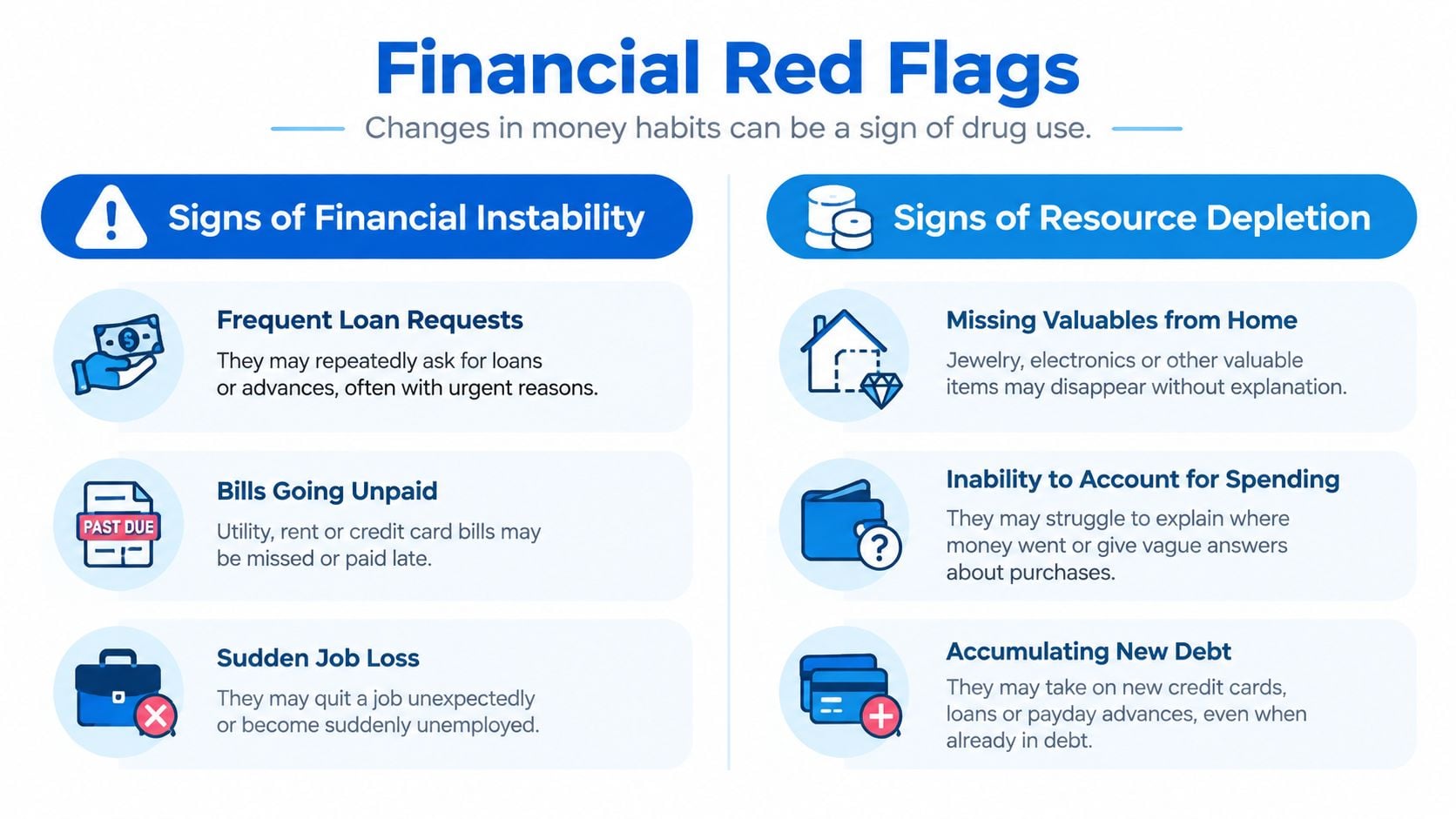
Money problems often make a pattern visible because they leave concrete records. A previously reliable person may stop paying bills, request repeated loans, sell possessions, lose work, or give inconsistent explanations for missing funds. You may find that jewelry, electronics, collectibles, or other valuables have disappeared.
Financial stress can happen for many reasons, including unemployment, illness, divorce, debt, or housing problems. It becomes more concerning when money changes coincide with secrecy, new acquaintances, sleep disruption, missed obligations, or continued behavior despite obvious harm.
Protect finances without abandoning the person
If you share accounts, loans, housing, or bills, review what you're legally entitled to review. Save copies of statements, note missed payments, inventory valuable belongings, and separate essential expenses from discretionary cash. Don't give unrestricted money when you suspect it may fund drug use. Offer practical support instead, such as paying a necessary bill directly, arranging transportation, or helping schedule an assessment.
- Set a clear boundary: Explain what financial help you will and won't provide.
- Protect access: Change passwords and secure medications, cash, and important documents.
- Avoid accusations: Discuss the missing money and its effect on the household.
- Get professional guidance: Ask a financial adviser, attorney, or addiction professional about safe boundaries.
- Respond to danger: Report theft, threats, or coercion through appropriate services.
The guide on helping a family member with addiction can support a more structured conversation about limits and treatment. Financial boundaries aren't punishment. They reduce immediate harm while preserving a route to care.
You can also review spending habits and look for ways to improve your monthly cash flow, but budgeting won't resolve a substance use disorder by itself. If the person keeps using despite debt, damaged relationships, or lost housing, professional assessment is the appropriate next step.
7. Paraphernalia and Environmental Evidence of Drug Use
Finding drug-related objects in a bedroom, vehicle, bag, or shared space is more direct than noticing a change in mood or appearance. Possible items include pipes, rolling papers, glass tubes, syringes, burned spoons, rubber tubing, small bags, or other equipment associated with preparing or consuming substances. Some objects have legitimate uses, so context matters.
Don't handle unknown powders, residue, or used syringes. Keep children and pets away, avoid sweeping or touching contaminated items, and contact local poison control, public-health services, or a safe disposal program for instructions. If there's an immediate exposure, breathing problem, loss of consciousness, or severe reaction, call emergency services.
Respond to evidence with care
Photographing an item may help you describe what you found to a clinician, treatment provider, landlord, or safety professional, but don't use images to shame the person or post them publicly. Don't search private spaces in a way that creates a confrontation or puts you at risk. If a child or vulnerable person could access the item, secure the area and get immediate safety guidance.
Don't turn discovery into a courtroom. State what you found, explain the safety concern, and ask for professional help.
Say, “I found an item I'm worried could be connected to drug use. I'm concerned about your safety and want us to speak with a professional.” Avoid claiming you know which substance was used unless a qualified professional confirms it. Paraphernalia can suggest active use, but it doesn't tell you the person's diagnosis, medical condition, or treatment needs.
For a broader visual explanation, you can review the embedded educational video below.
If drug equipment is found at work, follow workplace safety and reporting policies rather than confronting a colleague alone. Treatment professionals can help families decide how to discuss the discovery and what level of care may be appropriate.
8. Cognitive Changes and Physical Health Deterioration
Drug-related problems can affect attention, memory, judgment, speech, coordination, and the ability to follow a conversation. A person may repeatedly ask the same question, miss deadlines, make decisions that seem out of character, or struggle with tasks they previously handled easily. These changes matter most when they persist and interfere with school, employment, relationships, or safety.
Physical deterioration may appear at the same time. Unexplained weight change, poor nutrition, repeated injuries, infections, worsening dental health, breathing problems, or untreated medical conditions all require evaluation. Don't assume a visible health problem identifies a particular drug. Many illnesses and medications can produce overlapping symptoms.

Document functional decline and arrange assessment
Write down specific examples. “Missed three work deadlines and became lost on a familiar route” gives a clinician useful information. “He's acting strange” doesn't. Include changes in sleep, appetite, mood, coordination, injuries, medical visits, and prescribed medications.
A structured screen can help identify unhealthy drug use even when outward signs are subtle. In a review of adult screening tools, instruments for unhealthy use of any drug showed sensitivity ranging from 0.71 to 0.94 and specificity ranging from 0.87 to 0.97, while tools for abuse, dependence, or a use disorder showed sensitivity from 0.85 to 1.00 and specificity from 0.67 to 0.93. The clinical review of these screening instruments also supports the practical point that a positive screen needs confirmatory assessment.
A single question can also miss a problem. One review found that NIDA Quick Screen single-item questions had specificity of 0.99 but sensitivity of 0.10 to 0.27, while the 5Ps had sensitivity of 0.80 to 0.88 and specificity of 0.35 to 0.37. The review of these screening tradeoffs shows why casual observation and one “sign” shouldn't replace professional assessment.
Encourage a primary-care visit or addiction evaluation. If the person has chest pain, severe breathing difficulty, a seizure, extreme confusion, a dangerous temperature, or cannot be awakened, call emergency services immediately.
8-Point Comparison: Signs of Drug Use
| Indicator | 🔄 Implementation Complexity | ⚡ Resource Requirements | ⭐ Expected Outcomes / Reliability | 📊 Ideal Use Cases | 💡 Key Advantages / Tips |
|---|---|---|---|---|---|
| Dilated or Constricted Pupils | Low, visual check but lighting-sensitive | Minimal, ambient light or flashlight | High, specific patterns (stimulants vs opioids) | ER triage, sobriety checks, intake assessments | Hard to fake; observe in consistent lighting and document over time |
| Sudden Changes in Sleep Patterns and Energy Levels | Moderate, requires prolonged observation | Low, sleep logs or wearables help | Moderate, early and common but nonspecific | Family monitoring, schools, employers | Track 2–4 weeks; correlate with other signs before concluding |
| Neglect of Personal Hygiene and Appearance | Low, visible during interaction | Minimal, in-person observation, photos for baseline | Moderate, clear change but can have other causes | Intake evaluations, family observations | Compare to prior photos; check for injection sites or skin issues |
| Mood Swings and Emotional Instability | Moderate–High, subjective, needs documentation | Low–Medium, journals; professional assessment for diagnosis | Moderate, salient to close contacts but overlaps with mental illness | Family interventions, clinical mental-health assessment | Log timing relative to use; consider co-occurring disorders |
| Sudden Changes in Social Circles and Relationships | Low, observable but interpretive | Minimal, conversation, social media review | Low–Moderate, common sign but often non-specific | Early detection by family; planning interventions | Note timing vs life events; approach conversations non-accusatorily |
| Financial Instability and Unexplained Money Problems | Moderate, requires access to records and corroboration | Medium, financial statements, inventories, documentation | High, concrete, documentable evidence though multifactorial | Evidence for interventions, treatment planning, legal/financial counsel | Inventory valuables, document missing items, review shared accounts |
| Paraphernalia and Environmental Evidence of Drug Use | Low–High, locating items may require access | Minimal–Medium, PPE for safe handling, photo documentation | Very High, direct, specific evidence if present | Home searches (with consent), harm-reduction services, law enforcement | Photograph evidence, avoid handling needles, contact safe-disposal services |
| Cognitive Changes and Physical Health Deterioration | High, needs medical and neurocognitive assessment | High, medical tests, neuropsychological evaluation | High, medical confirmation possible; indicates severity | Clinical settings, medical detox, long-term treatment planning | Compare to baseline, obtain comprehensive medical workup and screenings |
Taking Action and Finding Help
These signs do not authorize a diagnosis, a search of someone's belongings, or a forced confession. They do justify action when physical health, behavior, relationships, finances, and daily functioning change together. Continued use despite harm deserves more attention than one unusual symptom or isolated experiment. Use the earlier guidance on substance use disorder and warning signs to prepare for a calm, informed conversation.
Start with immediate safety. Call emergency services if the person may have overdosed, cannot stay awake, has abnormal breathing, is severely confused, has a seizure, or presents an immediate danger to themselves or someone else. Do not drive with someone who appears impaired. Stay with a person in medical distress while help is coming, unless doing so puts you at risk.
For a non-emergency discussion, choose a private time when the person appears sober and you feel safe. Describe what you observed, then state your concern. “I've noticed missed work, major sleep changes, and money problems. I'm worried and want to help you speak with a professional” invites discussion more effectively than an accusation.
Offer one practical next step. Help make a call, arrange transportation, attend an appointment if invited, or collect insurance information. Set firm boundaries around violence, impaired driving, children's safety, theft, and shared finances. Do not provide unrestricted cash, conceal dangerous conduct, or promise support you cannot provide.
Addiction Resource Center LLC is a Yuba City provider for adults seeking care for substance use disorders and co-occurring mental-health needs. Its services include medically supervised detox with medication-assisted treatment, residential rehabilitation through partner facility Ona Treatment Center in Browns Valley, California, and an Intensive Outpatient Program offered in person or through telehealth. The team includes a medical doctor, registered nurse, licensed counselors, licensed marriage and family therapist, and recovery mentors. Services include wellness monitoring, individualized plans, relapse-prevention education, accountability, and aftercare planning. The center accepts most major insurance plans and welcomes TRICARE beneficiaries. It is located at 1002 Live Oak Blvd., Suite A, Yuba City, and offers a 24/7 phone and text line at 530-625-7910.
Families need support too. A clinician can assess whether symptoms relate to substance use, depression, anxiety, sleep disorders, trauma, medication effects, or another health condition. If military legal concerns are involved, consult a qualified professional familiar with the UCMJ Article 112a defense guide. Keep medical care and immediate safety first.
Do not wait for every sign. A respectful conversation and professional assessment can identify whether the person needs outpatient support, intensive treatment, medically supervised detox, residential rehabilitation, or coordinated mental-health care.
Addiction Resource Center LLC offers medically supervised detox, medication-assisted treatment, residential rehabilitation through its partner facility, and in-person or telehealth Intensive Outpatient care for adults facing substance use and co-occurring mental-health concerns. Visit Addiction Resource Center LLC or call 530-625-7910 to discuss the signs you are seeing and pursue professional support.