Yes, Vicodin is addictive because it contains hydrocodone, an opioid that can trigger reward, tolerance, and physical dependence. Nearly 10 million Americans used prescription opioids without a prescription or not as prescribed in 2012 to 2013, which is why the key question isn't just whether Vicodin can be addictive, it's how much risk is sitting …

Yes, Vicodin is addictive because it contains hydrocodone, an opioid that can trigger reward, tolerance, and physical dependence. Nearly 10 million Americans used prescription opioids without a prescription or not as prescribed in 2012 to 2013, which is why the key question isn't just whether Vicodin can be addictive, it's how much risk is sitting in front of you right now.
People often ask that question as if Vicodin is either safe or unsafe, but that's too blunt to be useful. A short prescription after surgery is not the same thing as weeks of taking extra doses, and a person with a family history of addiction doesn't carry the same risk as someone with no prior exposure. A calmer, more useful way to think about it is this, Vicodin sits on a risk spectrum, and each point on that spectrum calls for a different next step. For a broader public-health view of how opioid dependence has changed over time, trends in opioid dependence from IPA is a helpful companion read.
Table of Contents
- The Direct Answer and Why It Matters
- How Hydrocodone Hooks the Brain
- Who Is Most at Risk of Vicodin Addiction
- Early Warning Signs That Use Has Become a Problem
- What Vicodin Withdrawal Actually Looks Like
- Treatment Options and Levels of Care
- Practical Next Steps for You or a Loved One
The Direct Answer and Why It Matters
Yes, Vicodin can be addictive. It contains hydrocodone, which the DEA describes as a mu-opioid receptor agonist that can produce pain relief, euphoria, respiratory depression, decreased gastrointestinal motility, and physical dependence. That combination is why the same medication that helps with pain can also become hard to stop, especially when the dose goes up or the use goes on longer than planned. The DEA's hydrocodone review lays out that mechanism plainly.
The useful question is how risky this use is
A binary answer can be misleading. Someone taking a brief, prescribed course after a procedure is in a very different place from someone taking extra pills, using Vicodin to sleep, or stretching a prescription across months. The risk changes with dose, duration, how often the medication is taken, and the person's own vulnerability.
That's why the best way to answer “is Vicodin addictive” is to place the use on a spectrum. On one end is short, directed use with close follow-up. In the middle is use that starts to drift, maybe an early refill, maybe a dose increase, maybe a little more reliance than the prescription intended. On the other end is compulsive use, withdrawal, and a life that begins to organize around the next pill.
Practical rule: if the medication is no longer being used exactly as prescribed, the risk has already moved.
Historical and population data back up why this matters. NIH reported that nearly 10 million Americans, or 4.1% of adults, used prescription opioids such as Vicodin without a prescription or not as prescribed in 2012 to 2013, up from 1.8% in 2001 to 2002. The same analysis found prescription opioid use disorder rose to 0.9% of U.S. adults, about 2.1 million people, in 2012 to 2013, compared with 0.4% in 2001 to 2002. That doesn't mean every prescription is dangerous, but it does show why opioid exposure deserves respect, not casual assumptions.
A second data point helps put today in context. In 2024, the DEA reported 3.4 million people aged 12 or older, 1.2% of the population, misused hydrocodone products in the past year, down from 7.2 million, 2.7%, in 2015. Misuse has fallen from its peak, but the numbers are still large enough that families, prescribers, and patients need a clear way to judge risk early.
How Hydrocodone Hooks the Brain
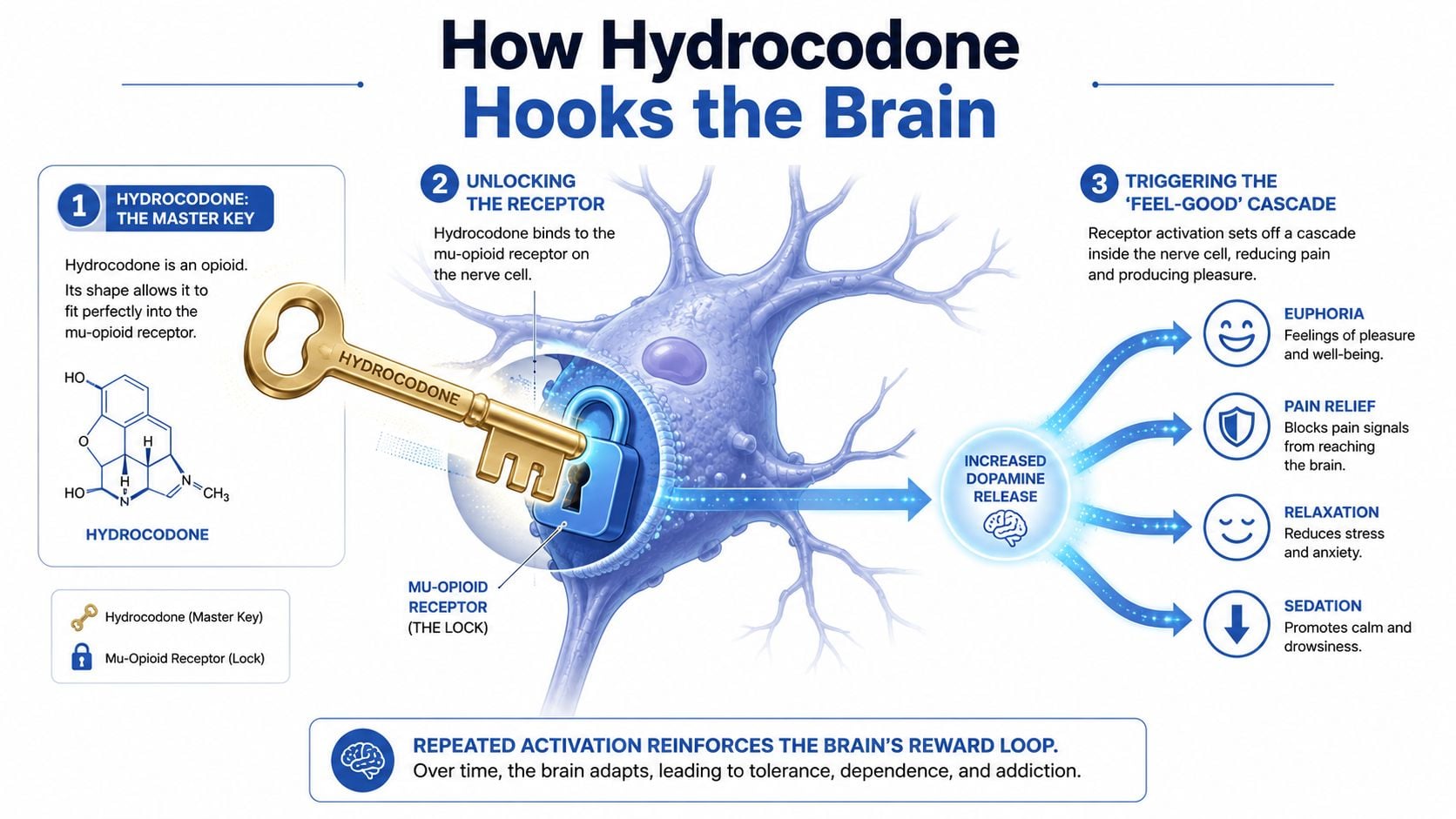
Vicodin's addictive potential comes from hydrocodone, not from the fact that it is a pain pill in the abstract. Hydrocodone works as a mu-opioid receptor agonist in the central nervous system, which means it fits into opioid receptors on nerve cells and changes how pain is perceived. That helps explain why the drug can feel useful at first, and why it can become reinforcing if the brain starts linking it with relief.
A lock-and-key that changes behavior
A simple way to picture it is this, the mu-opioid receptor is like a lock, and hydrocodone is a key that opens it. Once the lock turns, pain signaling quiets down. But the same action also affects the brain's reward circuitry, which is why some people feel relief, calm, or even euphoria.
Repeated exposure strengthens that learning. Sources describing Vicodin abuse note that dopamine signaling in the brain's reward circuitry reinforces use, so the brain starts associating the drug with comfort and relief. Over time, the body adapts, and higher, more frequent doses may be needed to get the same effect. That pattern is where a prescription starts to slide toward danger.
Tolerance, dependence, and addiction are not the same thing
People often use those words interchangeably, but they mean different things.
- Tolerance means the same dose stops working as well.
- Physical dependence means the body has adapted enough that stopping triggers withdrawal.
- Addiction means use has become compulsive, hard to control, and tied to harm.
Clinician's shortcut: tolerance can show up before addiction, and dependence can happen even when someone never meant to misuse the medicine.
That distinction matters because a person can be taking Vicodin for legitimate pain and still develop dependence. If the body has adjusted to ongoing opioid exposure, stopping suddenly can cause withdrawal. That's one reason medically supervised tapering or detox may be needed for people who've been taking it regularly.
The practical red flag is escalation. If one pill no longer feels like enough, if the next dose arrives sooner and sooner, or if the medicine starts being used for stress, sleep, or mood rather than pain, the reward system is doing more than pain control. It's teaching the brain to want the drug back.
Who Is Most at Risk of Vicodin Addiction
Risk isn't evenly distributed. A short post-procedure prescription can be low risk for one person and much riskier for another, depending on their history and their environment. That's why the same bottle can sit at very different places on the spectrum.
The person matters as much as the prescription
Prior substance use raises concern, especially if there's already a pattern of using medication to change mood or energy. Family history also matters because addiction vulnerability tends to travel with biology and learned behavior. Easy access through multiple prescribers, or keeping leftover pills around, can turn a brief script into repeated exposure.
Co-use changes the picture fast. Alcohol and sedatives can make opioid effects more dangerous, and people who are already depressed, anxious, or impulsive may be more likely to use Vicodin for emotional relief instead of pain control. That's where a legitimate prescription can start to behave like a coping tool.
Reading the risk spectrum in real life
A person who takes Vicodin only for a few days after a dental procedure and then stops sits near the low-risk end, assuming they're using it exactly as directed. A person who keeps taking it after pain has improved, or takes an extra pill because the first one “doesn't hit anymore,” has already moved up the spectrum. Someone who hides pills, asks different clinicians for refills, or mixes Vicodin with alcohol has moved into a much higher-risk zone.
The safest question is not, "Did a doctor prescribe this?" The safer question is, "How is it being used now?" If the answer includes higher doses, longer use, or use for sleep or mood, that deserves attention even if the original prescription was appropriate.
If you're trying to judge whether a loved one is at risk, look at patterns, not promises. People rarely become dependent all at once.
A patient with any history of opioid exposure, a strong family history of addiction, or a tendency to self-medicate should talk with the prescriber early if Vicodin is still needed. That conversation should cover how long the medication is expected to last, whether a non-opioid option can take over, and what signs should prompt a stop or a follow-up visit. For patients who are already worried, that's the moment to ask for a medication review rather than waiting for things to get worse.
Early Warning Signs That Use Has Become a Problem
A husband I might see in clinic doesn't usually start out saying, “I think I'm addicted.” He says he's taking the pills because his back still hurts, then his wife notices he's checking the clock, then the bottle runs out early, then he's suddenly irritable when asked about it. The problem usually shows up as a pattern, not a single dramatic event.
What people notice first
Behavioral changes are often the clearest signal. Taking extra pills, asking for early refills, or seeing multiple prescribers can all mean the medication is starting to run the person's schedule. Some people begin using Vicodin to sleep, to calm down, or to blunt emotional pain, which is a warning that the drug has become a coping tool.
Physical signs can be quieter but still matter. Drowsiness, constipation, and needing more medication to get the same effect are common clues that the body has adjusted to the opioid. If family members start seeing secrecy, hiding bottles, or mood changes when the medication is mentioned, that's worth taking seriously.
- Taking more than prescribed: the bottle empties too early, or doses are spaced closer together than directed.
- Using it for non-pain reasons: sleep, stress, anxiety, or mood become part of the pattern.
- Keeping it hidden: pills are stashed, counted, or denied when someone asks.
The words people use around this phase often sound reassuring. “I've got it under control.” “It's just for this week.” “I'm only taking it because I need to function.” Those phrases can be true in some cases, but they can also cover a growing problem.
Simple self-test: if two or more warning signs are present, don't wait for a crisis. Schedule a confidential conversation with a clinician.
If you want a plain-language distinction between misuse and abuse, this explainer on abuse vs misuse is a useful reference. The point isn't to label someone for the sake of it. The point is to catch the drift before the drift becomes dependence.
What Vicodin Withdrawal Actually Looks Like
Withdrawal is one of the clearest signs that the body has adapted to Vicodin. It can feel frightening if nobody has explained it ahead of time, which is why many people keep using longer than they intended. The symptoms are real, but they're also understandable once you know the pattern.
The timeline helps remove some of the fear
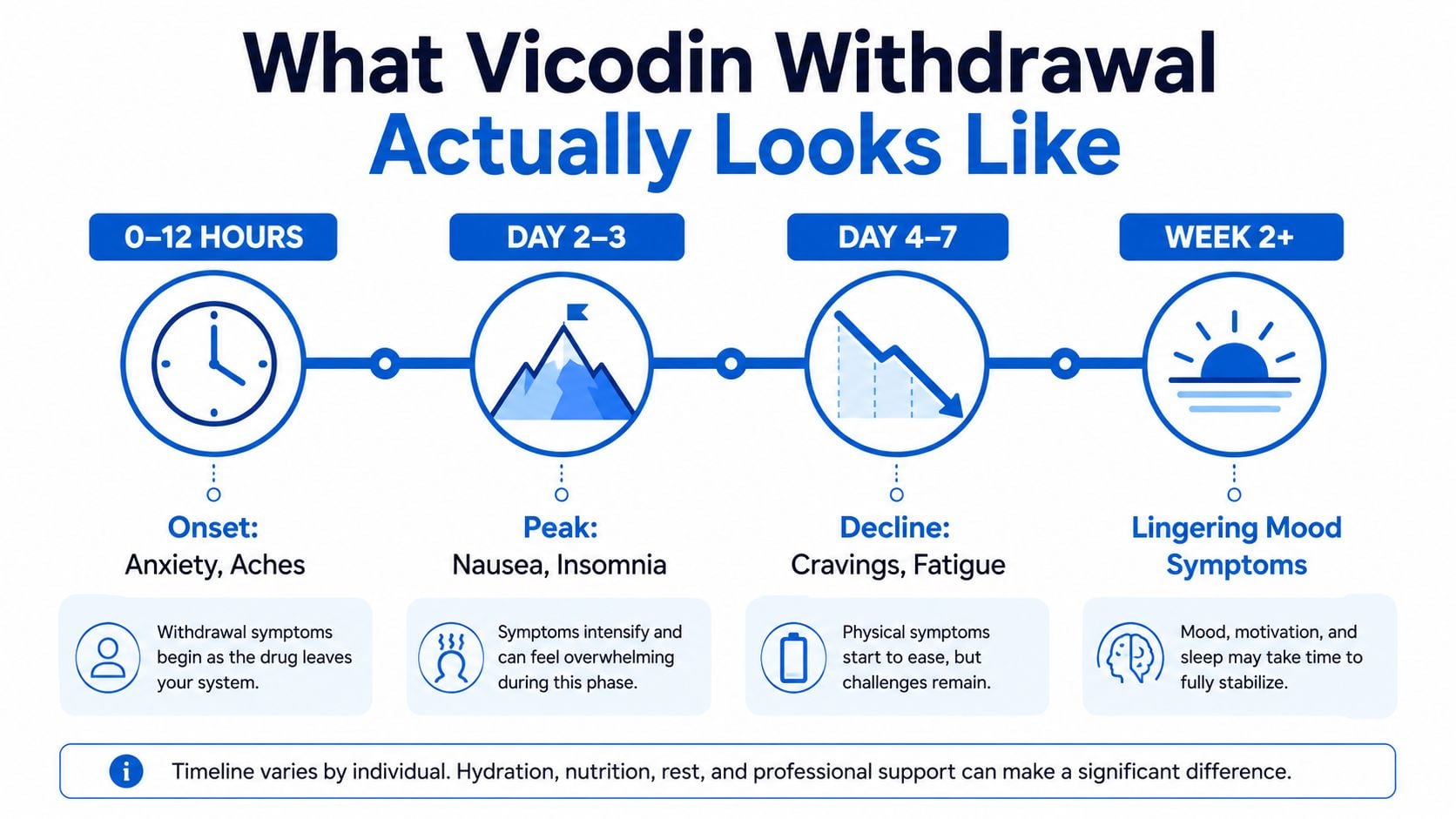
For short-acting opioids like hydrocodone, withdrawal often begins within 6 to 12 hours after the last dose, peaks around days 2 to 3, and then gradually improves over one to two weeks. That doesn't mean every person follows the exact same clock, but it does mean symptoms usually arrive in stages rather than all at once.
The early phase often feels like anxiety, restlessness, and body aches. The middle phase can bring nausea, insomnia, sweating, and stronger cravings. The later phase is usually less intense physically, but fatigue and mood symptoms can linger and make the person want to go back to the drug.
The symptoms below are common:
- Anxiety and restlessness
- Muscle aches and body pain
- Nausea, vomiting, or diarrhea
- Sweating and chills
- Insomnia and sleep disruption
- Cravings and low energy
Why stopping suddenly can backfire
Withdrawal from hydrocodone is usually not fatal by itself, but that does not make it harmless. The discomfort can be strong enough to drive relapse, and relapse after a break can be more dangerous because tolerance has changed. That's one reason people are often advised not to just white-knuckle it alone.
Stopping cold turkey is rarely the smartest plan if the medication has been used regularly.
A safer approach is medically supervised tapering or detox, especially when the person has been taking Vicodin for a while or has already tried to stop and couldn't manage the symptoms. A short educational video can help people see the sequence in a more concrete way, and this embedded resource is a useful visual alongside the timeline above.
For readers trying to understand how long detox can last in practice, the overview on how long is detox can help set expectations. Withdrawal is temporary, but trying to manage it alone can turn temporary symptoms into a repeated cycle.
Treatment Options and Levels of Care
Treatment works best when it matches the person's actual level of risk. Someone with a short-term prescription and no warning signs may only need a medication review and a clear stop plan. Someone with cravings, withdrawal, or repeated early refills may need structured treatment that combines medical support with therapy.
Matching care to the problem
Medication-assisted treatment, or MAT, uses medicines such as buprenorphine or methadone to help reduce withdrawal and cravings while the person stabilizes. That approach is often useful when opioid use has become hard to control, especially if stopping has failed before. Naltrexone can also play a role for some people after detox, depending on the clinical situation and the treatment plan, and this overview of naltrexone for addiction explains the concept in plain language.
Medically supervised detox fits the period when the body needs help getting through withdrawal safely and with less distress. Residential rehab makes sense when structure is needed around the clock, or when home is not a safe place to stabilize. Intensive outpatient programs, or IOP, work for people who need regular treatment but can still live at home and manage daily obligations.
Addiction Resource Center LLC in Yuba City offers a full continuum that includes medically supervised detox with MAT, residential rehabilitation through its partner facility, Ona Treatment Center in Browns Valley, and IOP available in person and via telehealth. For Northern California families, that means there's a realistic path from first assessment to ongoing care without having to guess which service comes next.
Levels of care for Vicodin use disorder
| Level of Care | Best Fit For | What It Includes |
|---|---|---|
| Medically supervised detox with MAT | Withdrawal, recent heavy use, or trouble stopping | Medical monitoring, symptom relief, medication support |
| Residential rehab | Severe use, unstable home environment, repeated relapse | Structured living, therapy, relapse prevention, 24-hour support |
| Intensive outpatient program | Moderate symptoms, need for ongoing support, ability to live at home | Scheduled therapy sessions, education, accountability |
| Standard outpatient counseling | Early concerns, low-to-moderate risk, strong home support | Individual or group counseling, follow-up, planning |
The right level of care depends on what's happening now, not on what the original prescription was for. A person can start with a legitimate prescription and still end up needing structured support if the pattern changes. The good news is that treatment can be stepped up or stepped down as symptoms change, which makes recovery more flexible than people often assume.
Practical Next Steps for You or a Loved One
If Vicodin is still being taken exactly as prescribed and only for a short period, start with the prescriber. Ask how long use should continue, what side effects to watch for, and what the plan is for stopping. That simple conversation can keep a temporary prescription from turning into a longer problem.
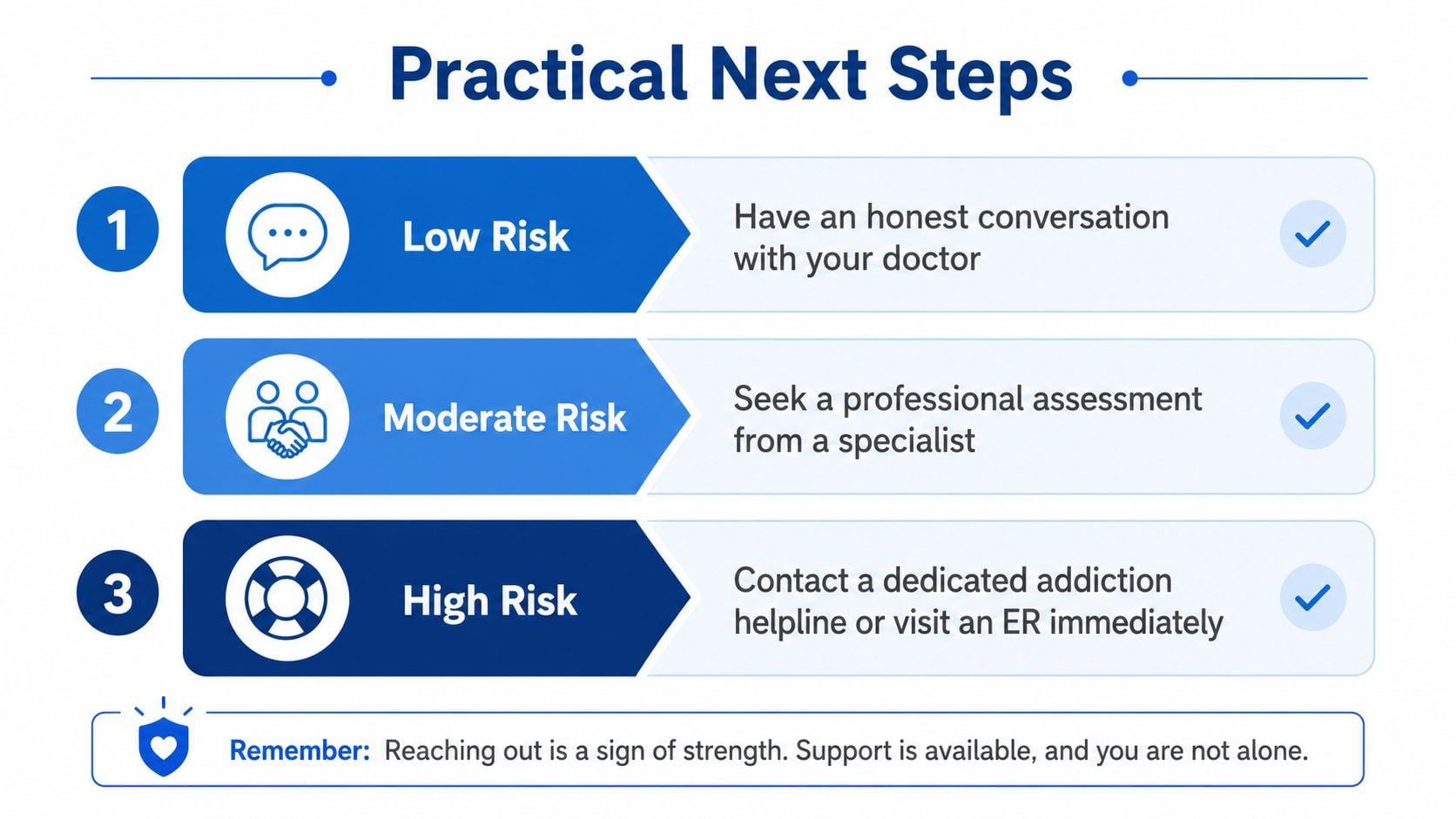
Choose the next step by risk level
If warning signs are showing up, make a confidential call for a professional assessment. If withdrawal has started, or use is already out of control, seek same-day medical help. People in that higher-risk zone shouldn't be told to just “wait and see.”
- Low risk: talk to the prescribing clinician and confirm the stop plan.
- Moderate risk: get a substance-use assessment before the pattern deepens.
- High risk: contact a treatment line or go to urgent care or the ER if safety is uncertain.
Families sometimes hesitate because they don't know whether a crisis is “bad enough.” A better standard is simpler, if the person is hiding use, running out early, or can't comfortably stop, it's time to ask for help. Support for the family matters too, especially when fear, guilt, or exhaustion are already in the room, and the Family Caregiving Kit suicide prevention resources can be helpful for relatives who need practical guidance while they sort out next steps.
For people in or near Yuba City, Addiction Resource Center LLC can be reached at 530-625-7910 for 24/7 phone or text support, and the address is 1002 Live Oak Blvd., Suite A, Yuba City, CA. If the situation feels urgent tonight, use that line now instead of waiting for business hours.
Addiction Resource Center LLC offers medically supervised detox, MAT, residential rehab, and IOP for adults facing Vicodin or other opioid problems, along with family guidance and aftercare planning. If you're trying to figure out whether use is still in the low-risk range or has started to slide, visit Addiction Resource Center LLC to get help with the next practical step.