Medically supervised detox usually lasts a matter of days, often about 3 to 10 days. That timeline describes the acute medical phase, when the immediate goal is to help the body withdraw as safely as possible and keep complications under control. For some substances, that window is shorter. For others, especially long-acting drugs, it can …

Medically supervised detox usually lasts a matter of days, often about 3 to 10 days. That timeline describes the acute medical phase, when the immediate goal is to help the body withdraw as safely as possible and keep complications under control. For some substances, that window is shorter. For others, especially long-acting drugs, it can stretch longer.
When a family is scared, though, "how long is detox?" usually means something more personal. It means: When will the shaking ease up? When will sleep come back? When will it feel safe to go to work, drive a car, cook dinner, or leave someone alone without worrying that the worst is still ahead?
Those are reasonable questions.
The confusion starts because two different timelines often get blended together. Detox is the medical process of getting through withdrawal safely. Withdrawal is the set of symptoms a person feels while that happens. A person can be medically stable before they feel steady, rested, or emotionally like themselves again.
That distinction matters. Acute detox is the emergency phase, like getting a plane through turbulence and back on level flight. After that, the ride may be calmer, but the body and brain can still feel unsettled for a while. People often improve enough to leave the highest-risk period within days, yet still struggle with cravings, anxiety, fatigue, low mood, or poor sleep during the next stretch of early recovery.
Programs in the addiction treatment field often note this gap between being medically cleared and being ready for everyday life. Arista Recovery makes that point clearly in its discussion of detox timelines and functional recovery (Arista Recovery on the gap between detox and functional recovery).
So the answer is two-part. Detox may last days. Feeling more normal can take longer, and the timeline depends on the substance, the person's health, how long they have been using, and whether they have medical and emotional support in place.
Table of Contents
- The Real Answer to How Long Detox Takes
- Typical Detox Timelines by Substance
- The Stages of Withdrawal A Day by Day Guide
- Key Factors That Influence Your Detox Journey
- When Medically Supervised Detox Is Essential
- Your Path Forward After Detox with Addiction Resource Center
- Frequently Asked Questions About Detox
The Real Answer to How Long Detox Takes
A family often asks this question in the hardest moment. Someone has stopped drinking or using, everyone is exhausted, and the first need is simple. How long until they are safe, and how long until they seem like themselves again?
Those are two different timelines.
Detox usually refers to the short medical period when the body clears the substance and the treatment team watches for withdrawal problems. Feeling steady again is broader than that. It includes sleep settling down, appetite returning, anxiety easing, and the brain adjusting after repeated substance use. A person can finish detox and still feel shaky, emotional, or worn out for a while.
That gap is why a single number can be misleading. The body may stabilize first. The nervous system often takes longer.
A helpful way to picture it is to separate medical safety from early recovery function. Medical safety means the person is past the phase where seizures, severe dehydration, dangerous blood pressure changes, or other acute complications are the main concern. Early recovery function means they can think more clearly, rest more normally, and handle daily life with less distress. Those milestones do not always arrive on the same day.
Here is why. Repeated alcohol or drug use pushes the brain and nervous system to adapt. Over time, the body starts treating the substance almost like part of its operating routine. Once the substance is removed, the system has to recalibrate. That process can look like sweating, shaking, poor sleep, panic, low mood, irritability, and strong cravings. In plain terms, the body may be out of immediate danger before the brain has fully quieted down.
This is often the part families find confusing. Someone may be told they are ready to leave detox, yet still seem unlike themselves. That does not automatically mean something is wrong or that treatment failed. It often means the first phase is over and the stabilization phase is still underway.
For that reason, detox is best understood in three parts:
- Acute withdrawal: the period focused on immediate medical monitoring and symptom control
- Early stabilization: the days or weeks when sleep, mood, appetite, focus, and cravings begin to level out
- Ongoing treatment: counseling, medication when appropriate, structure, and support that help recovery hold long enough for the brain and body to heal
If you are asking, "When will they feel normal again?" you are asking an important question. It just reaches beyond detox alone.
Typical Detox Timelines by Substance
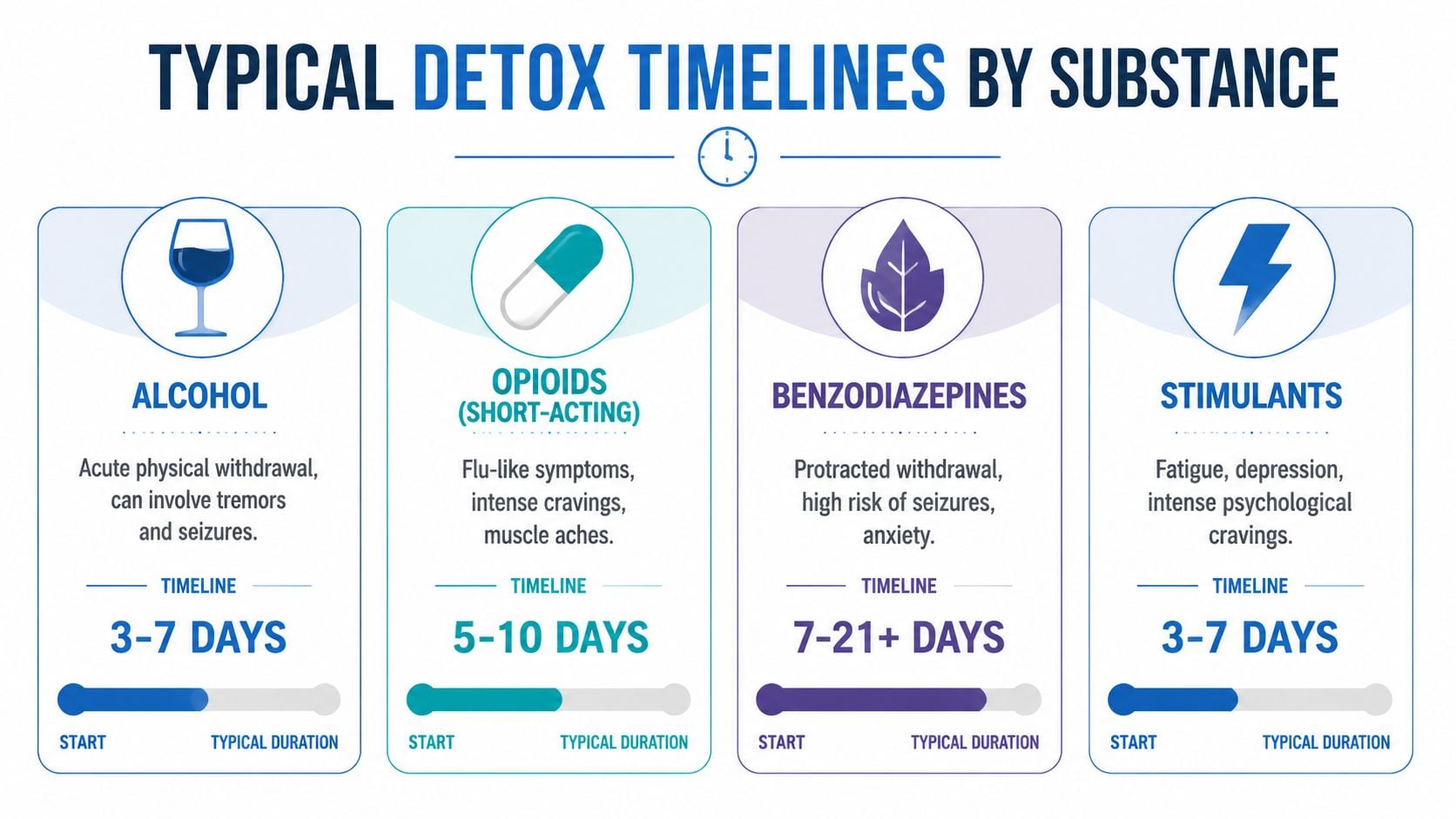
A detox timeline works less like a kitchen timer and more like a weather forecast. You can often estimate when symptoms begin, when they usually peak, and when the most intense stretch starts to ease. What you cannot do is pick one number and expect every person to feel "back to normal" by then.
That is why substance-specific timelines help. They show the likely course of the acute medical phase, while also warning families where the longer stabilization period often begins.
A quick comparison
| Substance | Withdrawal Begins | Peak Symptoms | Acute Phase Duration |
|---|---|---|---|
| Alcohol | Often within 6 to 12 hours after the last drink | Around 24 to 72 hours | Often about 5 to 7 days |
| Opioids, short-acting | Often within 8 to 24 hours | Commonly around 24 to 72 hours | Commonly 4 to 10 days |
| Opioids, long-acting | Often within 1 to 3 days | Can build more gradually over several days | Often 10 to 14 days, sometimes longer |
| Benzodiazepines | Can begin within 1 to 4 days for many longer-acting medications, sometimes sooner with shorter-acting ones | Often peaks in the first 1 to 2 weeks, but the course can vary widely | Acute symptoms may last days to several weeks. Sleep problems, anxiety, and sensitivity can persist longer |
| Stimulants | Often begins within hours to 1 day as a crash | The crash is often strongest in the first several days | Acute fatigue, sleep changes, and mood symptoms often last several days to 1 to 2 weeks. Cravings, low mood, and motivation problems can continue for weeks or months |
| Nicotine | Can begin within hours | Cravings and irritability often rise in the first few days | Physical symptoms often ease over days to a few weeks, though urges and routines can persist longer |
What these timelines mean in real life
Alcohol often changes quickly, which is one reason families get caught off guard. A clinical overview notes that symptoms can start within 6 to 12 hours, usually worsen during 24 to 72 hours, and often improve over about 5 to 7 days (Healthline on alcohol withdrawal timing). The bigger concern is that a person can seem stable early on and still develop serious complications later in that first window.
A second alcohol source helps put the average experience into perspective. A survey summary from The Recovery Village reports that many people described alcohol withdrawal as lasting several days, with the heaviest symptoms commonly falling inside the first week (Recovery Village alcohol detox survey findings). That does not mean the person feels well by day five. It means the sharpest medical phase often settles before sleep, mood, and energy fully recover.
Short-acting opioids such as heroin or immediate-release prescription opioids often bring on withdrawal faster. The person may have body aches, sweating, stomach upset, chills, restlessness, and strong cravings. It can look severe because it is miserable, even though the medical risk profile differs from alcohol or benzodiazepine withdrawal.
Long-acting opioids such as methadone usually move more slowly. Families sometimes mistake that slower start for a milder detox. In practice, it often means the process stretches out and patience matters more.
Benzodiazepines deserve extra caution because the timeline can be wide and the risk can be serious. Some people develop symptoms in the first day or two. Others worsen later, especially with longer-acting medications. Acute withdrawal may last days to several weeks, and anxiety, insomnia, panic, poor concentration, and sensory sensitivity can continue well beyond the first detox stay. This is one of the clearest examples of why "How long is detox?" and "When will they feel normal again?" are not the same question.
Stimulants such as cocaine and methamphetamine often begin with a crash instead of the classic image of shaking and vomiting. A person may sleep for long periods, feel empty or depressed, become irritable, or struggle with intense cravings. The first several days are often the hardest physically and emotionally, but low motivation, sleep disruption, and depression can last much longer than families expect.
Nicotine usually has a shorter physical withdrawal window, but the behavioral pull is strong. The body may settle before the person's daily routines do. That gap matters because many people confuse ongoing urges with detox "failing," when it often reflects habit, stress cues, and brain reward pathways still settling down.
A timeline gives you a map. The person's symptoms, mental state, and safety risk tell you how the trip is actually going.
The Stages of Withdrawal A Day by Day Guide
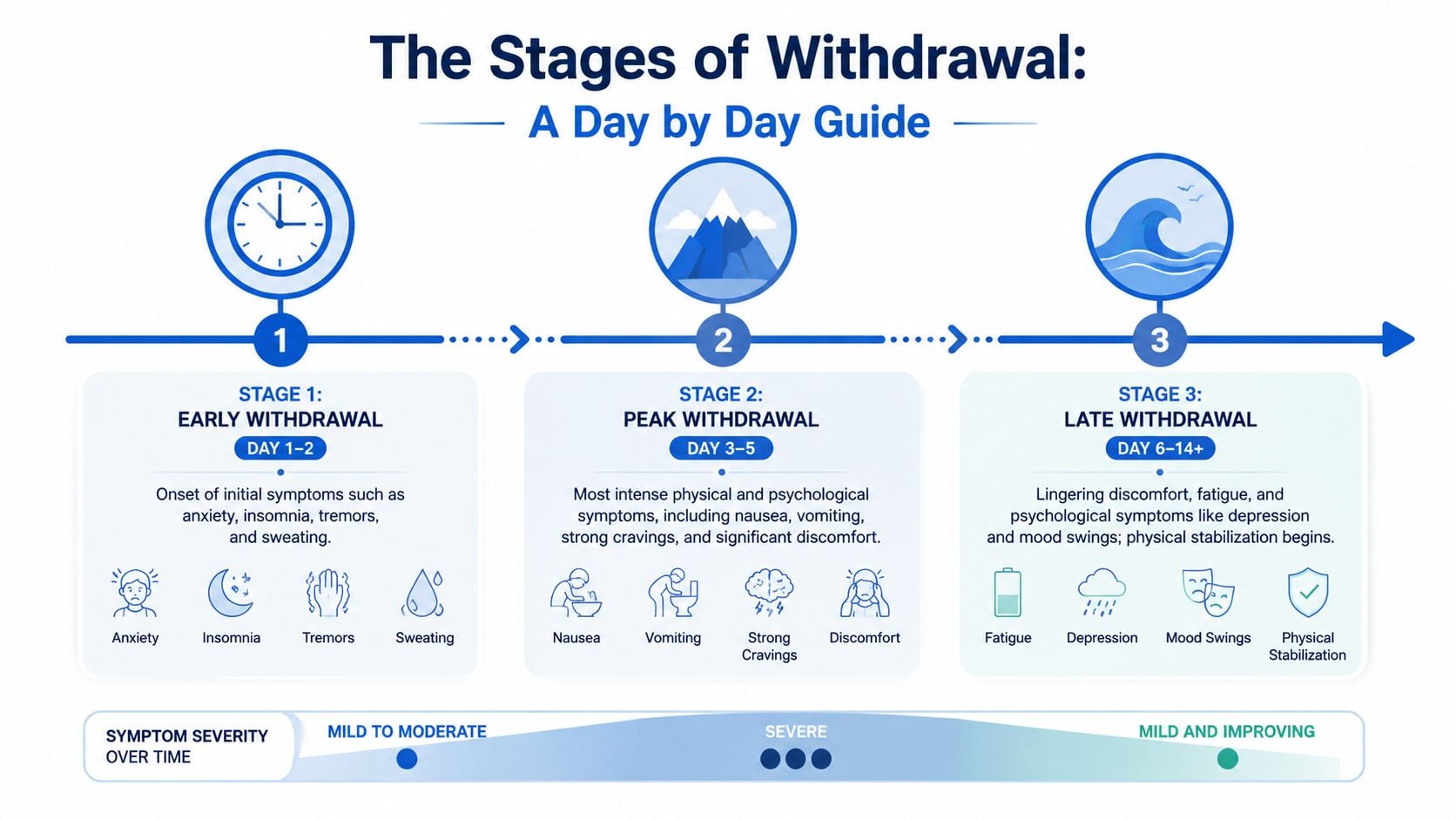
Withdrawal often feels less like a straight line and more like weather. Symptoms gather, intensify, and then slowly break apart. For many families, it helps to think in stages instead of asking whether the person should be "done" yet.
Early withdrawal
This is the body's first protest.
The person may become anxious, sweaty, restless, shaky, or unable to sleep. They may say they feel like crawling out of their skin. Appetite often drops. Small frustrations can feel huge. If alcohol is involved, a clinical overview notes that symptoms can begin within 6 to 12 hours, which is one reason families are often surprised by how quickly things change (Healthline on alcohol withdrawal timing).
For loved ones, this early stage can be confusing because the person may still be talking, walking around, or insisting they're fine. That doesn't mean the process is mild. It may just be beginning.
Peak withdrawal
This is usually the hardest stretch.
Symptoms often intensify during the highest-risk window. For alcohol withdrawal, that same clinical overview describes worsening around 24 to 72 hours, which is also the period clinicians watch most closely for seizure risk. During this phase, people may have nausea, vomiting, tremors, agitation, racing thoughts, and very strong cravings.
A simple way to picture it is this: early withdrawal is the storm front moving in. Peak withdrawal is when the wind and rain hit hardest.
During peak withdrawal, people often need reassurance repeated many times. A calm voice, short explanations, and medical support matter more than long conversations.
Late withdrawal and the unsettled phase
As the acute storm passes, many physical symptoms start to ease. The person may look better before they feel better.
For alcohol, the same overview notes that most minor symptoms resolve in about 4 to 5 days, though higher-severity cases can extend to two weeks or more. This often leads to mixed signals for many families. The crisis may be improving, but sleep can still be poor, concentration may be weak, and mood may be flat or irritable.
Some people also go through a longer period of emotional and psychological instability often called post-acute withdrawal. The exact experience varies, but common problems include:
- Sleep disruption that lingers after the physical symptoms improve
- Cravings that show up suddenly, especially with stress or boredom
- Low mood or anxiety that makes daily tasks feel heavier than usual
- Mental fog that makes work, driving, or planning feel harder
This is why "medically cleared" and "back to normal" aren't the same thing. One describes safety. The other describes recovery.
Key Factors That Influence Your Detox Journey
Two people can stop using on the same day and still have very different first weeks. Families often find that confusing. If the drug is the same, why is one person up and talking by day three while the other still feels shaky, exhausted, or emotionally raw?

The short answer is that detox is not just about what substance a person used. It is also about how much the body has adapted to that substance, and how much strain the person is carrying into withdrawal. A helpful comparison is a sprained ankle. Two people can have the same injury on paper, but healing looks different if one person is well-rested and healthy while the other is run down and already dealing with pain.
The history of use shapes the first phase
What often changes the detox experience is the person's pattern of use over time.
A few questions matter more than families usually realize:
- How long use has been going on. A body that has adjusted over months or years usually needs more time to regain balance.
- How heavily the person has been using. Larger or more frequent amounts often lead to a harder landing once use stops.
- Whether use has been steady or stop-and-start. Repeated cycles of quitting and returning can make withdrawal less predictable.
- Whether more than one substance is involved. Mixed substance use can blur the picture and make symptoms harder to interpret.
This helps explain why a simple answer like "detox takes about a week" can be misleading. The medical detox window may be short, but the person's own history often determines how rough that window feels and how long it takes to feel steady again.
Physical health changes how recovery feels
Withdrawal happens in a real body, not in a chart.
Someone who is dehydrated, undernourished, sleep-deprived, or dealing with chronic pain may feel weaker and recover more slowly. Someone with liver problems, heart disease, or other medical issues may need closer observation because the body has less reserve during stress.
Small factors add up. Poor sleep can worsen anxiety. Dehydration can intensify headaches, dizziness, and fatigue. Not eating regularly can make a person feel more shaky, nauseated, or emotionally overwhelmed.
Mental health affects the timeline after medical detox
This is the part many families miss. A person can be medically safer while still feeling far from normal.
Anxiety can make every physical symptom feel louder. Depression can flatten motivation and make improvement hard to notice. Trauma, panic, and severe stress can keep the nervous system on high alert even after the most dangerous withdrawal symptoms begin to settle.
That is why the first question should not only be, "How many days will detox take?" The better question is, "What will recovery look like after the body is out of immediate danger?" Acute detox and emotional stabilization are related, but they are not the same stage.
Treatment support can change the experience
Medication support can make withdrawal more tolerable and more stable. It does not erase the need for recovery work. It can reduce suffering, lower risk, and help a person stay engaged long enough to reach the next step in care.
Supportive care matters too. Fluids, nutrition, rest, reassurance, symptom monitoring, and a calm environment can make a hard week more manageable. In many cases, what helps a person complete detox is not toughness. It is good support and the right level of care.
Progress is not measured by how much pain a person can endure. It is measured by safety, stabilization, and what happens after the acute withdrawal phase ends.
When Medically Supervised Detox Is Essential
Some forms of detox should never be treated like a home project.
Alcohol and benzodiazepine withdrawal can become life-threatening. The danger isn't just discomfort. The danger is that serious complications can emerge after the person thinks they're "getting through it."
Situations that should never be handled casually
Medical supervision is especially important when any of the following are true:
- Alcohol is involved, especially with heavy or long-term use
- Benzodiazepines are involved, including situations where the person wants to stop suddenly
- There has been a previous severe withdrawal, including seizures, hallucinations, or extreme confusion
- More than one substance is involved, which can make symptoms harder to predict
- There are co-occurring medical or mental health issues, such as heart problems, severe anxiety, depression, or unstable mood
People sometimes hear "detox is only a few days" and decide they should just power through at home. That's risky reasoning. A short timeline doesn't mean a safe timeline.
Red flags that need immediate help
If a person in withdrawal develops any of these problems, urgent medical attention is needed:
- Seizures
- Hallucinations
- Severe confusion or disorientation
- Uncontrolled vomiting or inability to keep fluids down
- Signs of delirium tremens, such as extreme agitation, shaking, confusion, or rapid changes in awareness
- Chest pain, trouble breathing, or collapse
These symptoms aren't signs that the person is weak. They're signs that the nervous system and body may be under dangerous stress.
A helpful way to think about supervised detox is this: it isn't punishment, and it isn't overreacting. It's a safety net. Medical teams monitor symptoms, watch for complications, support hydration and comfort, and adjust care if things worsen.
If you're unsure whether home detox is safe, assume uncertainty itself is a reason to get professional guidance.
For families, that often brings relief. You don't have to judge how serious the symptoms are by feel alone. You can let trained staff make that call.
Your Path Forward After Detox with Addiction Resource Center
A family often feels a wave of relief when the worst withdrawal symptoms begin to settle. Then a new question shows up almost immediately. "Now what?"
That question matters because feeling safer is not the same as feeling normal again. Detox helps the body clear the substance and get through the acute medical phase. The next stretch is about helping the brain, mood, sleep, routines, and relationships steady out. Recovery works more like healing after a storm than flipping a switch.
What happens after the first few days
The first days of detox are usually about safety, symptom control, hydration, rest, and monitoring. After that, the focus shifts. Cravings may still come and go. Sleep can still be off. Anxiety, low mood, irritability, and poor concentration can linger even after the medical danger has eased.
That is why many people need a step-by-step plan instead of a single stop. A good program matches care to what the person needs right now, then adjusts as the person gets stronger.
Addiction Resource Center LLC in Yuba City provides treatment for adults with substance use disorders and co-occurring mental health needs across several levels of care. Services include medically supervised detox with medication-assisted treatment, residential rehabilitation through Ona Treatment Center in Browns Valley, and an Intensive Outpatient Program offered in person and through telehealth.
The team includes a medical doctor, a registered nurse, licensed counselors, an LMFT, and recovery mentors. Each role covers a different part of early recovery. One person may need medication support and monitoring. Another may need help rebuilding daily structure, handling family conflict, or treating anxiety and depression alongside addiction.
A simple way to understand this is to picture detox as the emergency repair and follow-up care as the rebuilding phase. The power may be back on, but the house still needs work before life feels steady again.
Ways to get help without guessing
Families often stall out here. Not because they do not care, but because the practical questions pile up fast. Can insurance help? Will treatment fit around work or parenting? What level of care makes sense? What if the person needs more than detox?
Addiction Resource Center tries to make those first decisions clearer. The program accepts many major insurance plans, welcomes Tricare beneficiaries, serves adults 18 and older, and offers options for detox, residential rehab, MAT, and outpatient care.
If you want to see what that support can look like, this video is a useful starting point.
For local families in Yuba City and Northern California, the next step can be simple. Ask questions. Check insurance. Request a tour. Learn more through the Addiction Resource Center LLC website.
Frequently Asked Questions About Detox
Is detox confidential
Yes. Treatment programs are designed to protect patient privacy. If you're worried about neighbors, employers, or extended family finding out, ask the program directly how confidentiality is handled, who can receive updates, and what consent forms are needed before staff speak with loved ones.
Can someone keep working while going through detox
Usually, acute detox itself isn't something people should plan to work through. Even when symptoms aren't dangerous, they can be exhausting and unpredictable. Some people later step into outpatient care that fits around work or family duties more easily.
What should someone bring to a detox stay
Bring practical basics. Comfortable clothes, identification, insurance information, a list of current medications, and approved hygiene items are common starting points. It's smart to ask the facility for a packing list before arrival because some items may be limited for safety reasons.
What if the person isn't sure they need detox
That uncertainty is common. Many people compare themselves to someone "worse" and talk themselves out of help. A professional assessment can sort out whether the person needs medically supervised detox, another level of care, or a different treatment plan altogether.
If you or someone you love needs help starting safely, Addiction Resource Center LLC offers compassionate substance use treatment in Yuba City, including medically supervised detox with MAT, residential rehab through Ona Treatment Center, and in-person or telehealth IOP. You can call or text 530-625-7910 any time, or visit them at 1002 Live Oak Blvd., Suite A, Yuba City, CA to ask questions, verify insurance, schedule a tour, or get guidance for the next step.