If mental illness can run in families, why do some relatives develop symptoms while others never do, even in the same household? That question sits at the center of a lot of fear, and it also points to the actual science, which is more useful than the old idea that a diagnosis is just passed …

If mental illness can run in families, why do some relatives develop symptoms while others never do, even in the same household? That question sits at the center of a lot of fear, and it also points to the actual science, which is more useful than the old idea that a diagnosis is just passed down like eye color.
The best answer starts with three separate forces, not one. Genes can raise susceptibility, environment can protect or strain the brain, and the two can interact in ways that change what happens over time. That's why a family history matters, but it doesn't equal fate.
Table of Contents
- Why Families Ask Whether Mental Illness Is Inherited
- What Heritability Actually Means
- Heritability Across Specific Mental Illnesses
- How Genes and Environment Interact
- Family History, Substance Use, and Co-Occurring Disorders
- Signs Worth Watching in Yourself or a Loved One
- When to Seek Assessment and What to Ask
- Common Myths and Your Next Steps
Why Families Ask Whether Mental Illness Is Inherited
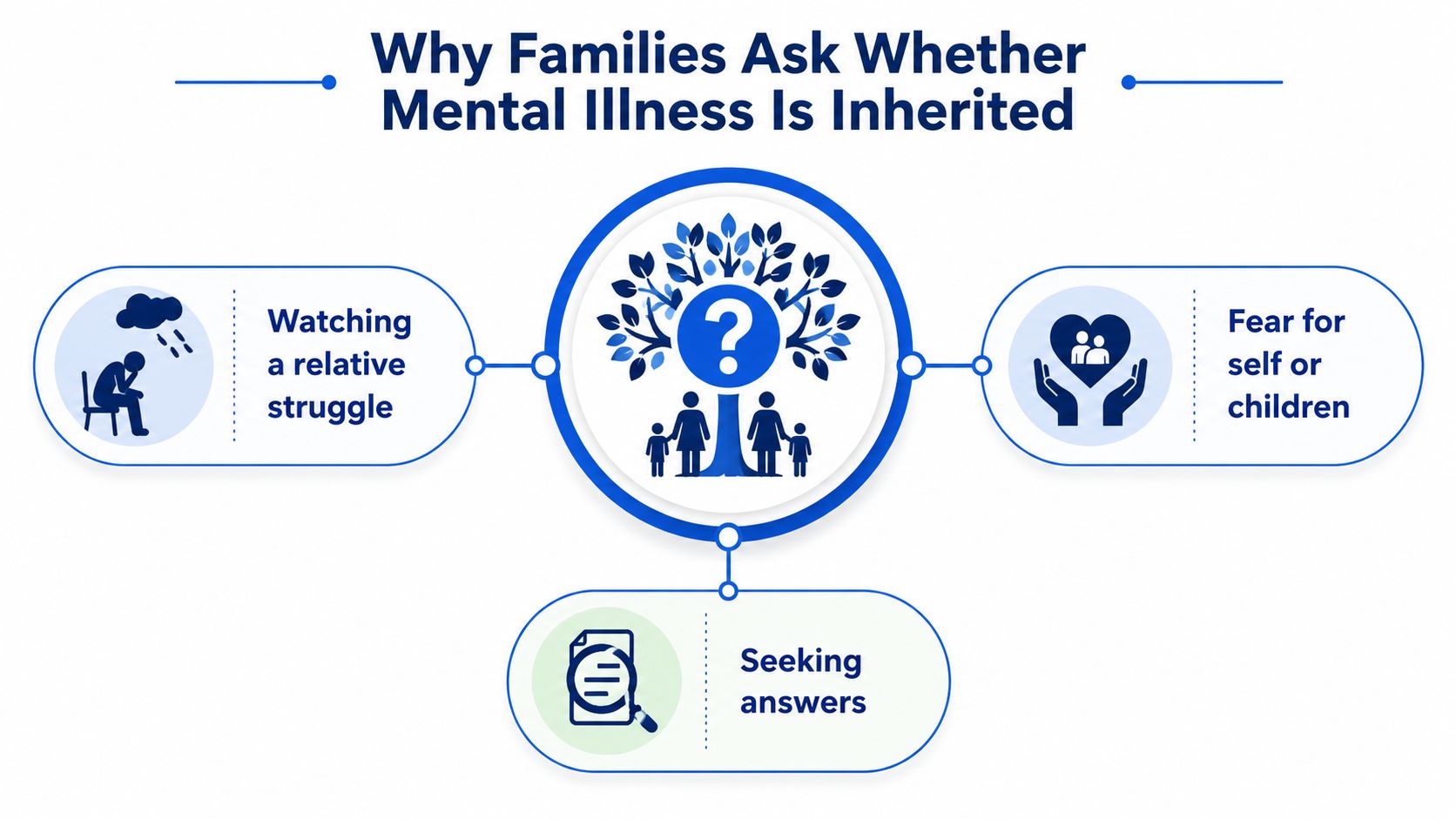
A parent, sibling, or child gets sick, and suddenly the whole family starts asking the same private question. Will this happen to me too? That worry is especially sharp when the illness is severe, unpredictable, or tied to behavior that felt frightening from the outside. Families also ask because they want a language for what they've lived through, not just a label.
Why the word inherited creates confusion
In everyday speech, inherited can mean three different things at once. People may mean a single gene, a family pattern shaped by shared life, or a risk that goes up because of biology without becoming certain. That's a big source of confusion, because mental illness doesn't behave like a simple trait with one cause.
The science supports a more careful view. Research syntheses show that major psychiatric disorders have substantial heritability, and a 2023 review reported SNP-heritability estimates from 5% to 25% across ten major psychiatric disorders, while offspring of affected parents had a strongly increased lifetime risk of mental disorder and the same disorder diagnosed in the parent (PMC review). That doesn't mean a child is destined to be ill. It means family history changes the odds.
What families are really trying to decide
Individuals aren't asking an abstract genetics question. They're trying to decide whether to watch more closely, whether to get help sooner, and whether their children need anything different. If you've ever wondered the same thing, the most accurate starting point is this, family history is information for planning.
That's also why addiction and mental health questions often overlap in the same family. A family with one person in treatment for alcohol or drug use may also be dealing with mood symptoms, trauma, or paranoia in another relative. For a plain-language introduction to how inherited risk can show up across generations in addiction, see this addiction in the family guide.
Practical rule: family history should lower the threshold for attention, not raise panic.
What Heritability Actually Means
Heritability sounds like a verdict, but it is really a population statistic. It tells you how much of the difference between people in a large group can be linked to genetic variation, not how much of one person's illness came from genes. That distinction matters because readers often hear “70% heritable” and assume it means the condition is 70% genetic in every individual, which is not what the term means.
Recipe, not destiny
A direct analogy helps. Heritability works like a recipe's influence across many kitchens, not a description of one meal on one night. The recipe gives structure, but the chef, the ingredients, and the oven all change the result. In psychiatry, that is why the same condition can look much more genetic in one setting and less genetic in another.
The American Academy of Pediatrics explains that mental disorders usually reflect multifactorial inheritance, with genes and environment both contributing, and that there is no genetic test that can determine with certainty who will or won't develop a disorder (AAP). That is the point families need to hold onto. Genetics can raise risk, but it does not hand out certainties.
Why twin and adoption studies matter
Heritability estimates come largely from twin, adoption, and population studies. Researchers compare how often a disorder appears in people who share more genes, or more environment, or both. If identical twins resemble each other more often than fraternal twins, that suggests a genetic contribution. If adopted children resemble biological relatives more than adoptive relatives for a particular trait, that also points toward inherited risk.
The number still depends on the setting. A trait can be highly heritable in one environment and less heritable in another if the environment is especially harsh or especially protective. That is why these estimates help clinicians think about risk, but they cannot predict a personal future.
For readers who want a deeper inheritance primer, the genetic inheritance guide gives a useful general overview of how genetic patterns differ across conditions.
Plain-language takeaway: heritability is about groups, not prophecies.
Heritability Across Specific Mental Illnesses
A family history can mean different things depending on the disorder. Some conditions show a stronger inherited pattern, while others reflect a wider mix of genes, stress, life experience, and medical factors. That difference matters because a history of schizophrenia does not carry the same practical meaning as a history of mild anxiety, even though both deserve attention.
Comparing disorders on the same yardstick
| Disorder | Approximate Heritability | What the Range Means |
|---|---|---|
| Schizophrenia | 70% to 80% | Family history can signal a strong inherited vulnerability, but it still does not determine outcome. |
| Bipolar disorder | 70% to 80% | Genetic loading is substantial, so clinicians take family history seriously when mood swings begin. |
| Major depressive disorder | 40% to 50% | Genes matter, but life stress and other exposures play a large role. |
| Generalized anxiety disorder | below 40% | Inherited risk is real, but environment and learned patterns often weigh heavily. |
Twin studies consistently estimate schizophrenia and bipolar disorder heritability at roughly 70% to 80%, and a Frontiers review describes these illnesses as fitting a gene–environment model (Frontiers in Psychiatry). For major depression, Stanford Medicine summarizes heritability at about 40% to 50%, which is high enough to matter but far from deterministic (Stanford Medicine summary). A broader psychiatry review also places bipolar disorder, schizophrenia, and cocaine use disorder at 70% or higher, while major depressive disorder and generalized anxiety disorder are below 40% (AAP article).
How to read those differences
A higher number does not mean the disorder is “more real” or more severe. It means that, across a population, genetic differences explain more of the variation in who develops it. For a family member, the practical meaning is narrower. If schizophrenia or bipolar disorder runs in the family, early symptoms deserve fast evaluation, especially if sleep changes, unusual beliefs, or marked mood shifts appear.
For major depression and anxiety, family history still matters, but it is usually one part of a wider picture that includes stress load, trauma, sleep, and medical illness. That makes prevention more actionable, because those other pieces can often be changed. A person who knows their family pattern can use that information to watch for early changes, talk with a clinician sooner, and ask whether mood, anxiety, or substance use symptoms should be assessed together.
If you are comparing inheritance patterns across health conditions, a genetic testing services overview can help you understand what testing can and cannot do in a clinical setting.
How Genes and Environment Interact
Genes are not the whole story because most mental illness develops through interaction, not isolation. A person can inherit a stronger vulnerability and never become ill if the environment stays steady, support is strong, and stress stays manageable. Another person with lower inherited risk can still become sick after repeated trauma or prolonged instability.
The switch and the pressure
The cleanest analogy is a light switch. Genes may make the switch easier to flip, but life often supplies the pressure that turns it on. That pressure can come from childhood trauma, prenatal stress, substance exposure, chronic sleep loss, or major life disruption. None of those factors acts in a vacuum.
Clinical point: inherited risk is real, but life events still shape whether symptoms appear.
What epigenetics means in plain language
Epigenetics refers to changes in how strongly genes are expressed. It doesn't change the DNA sequence itself. Instead, stress and experience can affect whether certain genes are turned up or turned down, which helps explain why two people with similar genetic susceptibility can follow very different paths.
That's why families shouldn't hear inherited risk as a fixed sentence. Protective routines matter. Stable sleep, early support, trauma-informed care, and reduced substance exposure can all change the course of risk before a crisis develops. In practice, this means the right question is not only “Did this run in my family?” but also “What can we change around the person now?”
Family History, Substance Use, and Co-Occurring Disorders
When mental illness and substance use show up together, family history becomes even more important. Genetic vulnerability to mood or psychotic disorders can overlap with vulnerability to addiction, and shared environments can reinforce both. That overlap is one reason people often need a dual diagnosis lens, meaning care for mental health and substance use at the same time.
Why the overlap matters clinically
A person who is already vulnerable to depression, bipolar symptoms, or psychosis may use alcohol or drugs to quiet distress, sleep, or self-medicate. That can seem helpful at first, but it often blurs the picture and makes symptoms harder to assess. Substance use can also intensify mood instability, paranoia, and impulsivity, which means the family history isn't just background information, it changes the treatment plan.
The right care model is usually integrated, not fragmented. A coordinated team can evaluate both symptom sets together, rather than treating one problem as if the other isn't there. That matters when someone is deciding between detox, residential care, outpatient support, or medication-assisted treatment, because the safest level of care depends on the full picture, not just the substance being used.
For a clear explanation of how dual diagnosis care works, this co-occurring conditions resource is a useful companion.
What families should listen for
- Escalating use with mood change: alcohol or drug use rising alongside irritability, insomnia, or withdrawal from others.
- Symptom masking: a person seems calmer after using, but becomes more depressed, agitated, or suspicious when it wears off.
- Treatment mismatch: separate providers are treating separate problems, and nobody is tracking the full pattern.
Signs Worth Watching in Yourself or a Loved One
The earliest clues are often small, and families usually notice them before a formal diagnosis does. The point isn't to self-diagnose, it's to recognize when a conversation with a clinician is overdue. A lower threshold makes sense when there's a strong family history.
In young adults
Watch for sleep changes, a sudden drop in motivation, social withdrawal, or new substance use that seems to be doing the job of sleep or anxiety relief. A person who used to keep a routine may stop showing up to work, classes, or family plans. If that shift appears after stress, breakup, grief, or moving away from home, it still deserves attention, especially when there's inherited risk in the background.
In middle-aged adults
Look for mood changes that don't fit the usual pattern, rising anxiety, drinking that has become more frequent or more hidden, or opioid use that starts after injury and doesn't fade. Some adults don't look “sick,” they just become less steady, more reactive, or harder to read. That can be the first sign of a developing condition, not a personality change.
One rule families can use
Don't wait for a crisis if the pattern is new, persistent, and disrupting daily life.
A short written list helps. Note what changed, when it started, whether sleep changed first, and whether substance use came before or after the mood shift. That simple record often makes the first appointment more useful, because the clinician gets a timeline instead of a vague worry.
When to Seek Assessment and What to Ask
A family history alone can justify a baseline mental health assessment, especially if the person is entering a stressful life stage, starting to use substances, or already showing sleep or mood changes. If symptoms are new, escalating, or affecting safety, the right move is to seek evaluation sooner rather than later. The first contact doesn't have to be dramatic, it just has to happen.
What a good first evaluation covers
A thoughtful psychiatric assessment usually includes personal history, family history, substance use review, and screening tools for mood, anxiety, and psychosis risk. A clinician should also ask about sleep, trauma, medications, and any prior episodes that may have been brushed aside. If substance use is part of the picture, that should be discussed openly, not treated as a side issue.
Questions worth bringing to the appointment
- How will you weigh family history in your assessment?
- How do you screen for co-occurring substance use and mental illness together?
- What level of care makes sense if symptoms are mild, moderate, or unsafe?
If the need is broader than weekly therapy, the usual continuum includes outpatient psychiatry, intensive outpatient programming, residential rehabilitation, and medically supervised detox when withdrawal or instability is present. A confidential call to a treatment center can help a family understand which level fits the current problem. For veterans and military families comparing benefits, this TRICARE mental health benefits guide can be a useful starting point.
Common Myths and Your Next Steps
The most damaging myth is that mental illness is inherited through a single broken gene. It usually isn't. The second myth is that it skips generations, as if risk were following a hidden rule. It doesn't, not in any predictable way. The third myth is that a genetic test can tell you who will or won't become ill. The American Academy of Pediatrics says no genetic test can do that with certainty (AAP).
Replace myths with action
- Write down the family history: include diagnoses, substance use, hospitalizations, and suicide attempts if known.
- Lower stress where you can: protect sleep, reduce substance exposure, and take new symptoms seriously.
- Ask for a baseline assessment: especially if there's schizophrenia, bipolar disorder, severe depression, or addiction in the family.
- Keep one clinical contact in mind: a therapist, psychiatrist, or treatment center you can call quickly if symptoms change.
Family history is not a sentence. It's a signal that the earlier, calmer, and more coordinated response is usually the safer one. If you're ready to talk with a team that understands co-occurring mental health and substance use concerns, Addiction Resource Center LLC can help you sort out next steps, whether you need an assessment, detox guidance, or support for a loved one right now.