You're sitting at the kitchen table with a list of names from the TRICARE directory, a half-finished coffee, and a question that sounds simple but rarely feels simple in real life. “What does TRICARE cover for mental health, and what do I need to do before we book anything?” For many military families, that question …


You're sitting at the kitchen table with a list of names from the TRICARE directory, a half-finished coffee, and a question that sounds simple but rarely feels simple in real life. “What does TRICARE cover for mental health, and what do I need to do before we book anything?”
For many military families, that question shows up after weeks of stress. A spouse in Northern California wants counseling for anxiety. A parent is trying to find help for a young adult child. A service member needs support but keeps hearing different answers about referrals, network rules, telehealth, and whether a higher level of care will be approved. The insurance card makes it look straightforward. The paperwork often doesn't.
Mental health coverage under TRICARE can be generous, but it also has gatekeeping steps that people don't see until a claim is denied or an intake is delayed. That's especially true when treatment moves beyond standard weekly therapy into telehealth, intensive outpatient care, or substance use treatment. Even the billing side can get confusing, which is why a practical explainer like telehealth billing for mental health can help families understand why the same virtual visit may be covered smoothly in one situation and stalled in another.
This guide is built for people who need clear answers, not policy jargon. It walks through who qualifies, what services are covered, when authorization is required, what costs to expect, how to verify providers, and where hidden administrative barriers tend to show up.
Table of Contents
- Understanding Tricare Mental Health Benefits
- Tricare Plans and Eligibility
- Covered Mental Health and Substance Use Services
- Authorization and Referral Requirements
- Cost Sharing and Copay Details
- Finding and Verifying Tricare Providers
- Using Benefits for Addiction Care
- Appeals Exceptions and Local Next Steps
Understanding Tricare Mental Health Benefits
TRICARE mental health benefits are easiest to understand if you think of them as two layers. The first layer is coverage. Will the plan pay for therapy, psychiatry, medication management, addiction treatment, or telehealth? The second layer is access rules. Does the person need a referral, prior authorization, a network provider, or added documentation before care starts?
That second layer is where people get tripped up.
A military spouse in Northern California may find a therapist who looks like a great fit, only to learn the clinician is out of network. A retiree may assume a virtual intensive outpatient program works like regular telehealth therapy, then discover it needs advance approval. An Active Duty family might hear “telehealth is covered now” and not realize that coverage and permission are not the same thing.
What TRICARE does cover
TRICARE covers a broad range of mental health conditions and services. The program covers care for anxiety, depression, PTSD, OCD, schizophrenia, and bipolar disorder, along with treatment for co-occurring substance use issues, according to the Health.mil access report on military and dependent mental health care.
That means the benefit itself isn't limited to “serious” diagnoses or hospital-level crises. In many cases, someone can start with office-based outpatient care, then step up to more intensive treatment if symptoms worsen or daily functioning starts to slip.
Why telehealth changed the picture
One of the biggest practical improvements for beneficiaries was TRICARE's permanent telehealth expansion. TRICARE permanently expanded coverage for telehealth and telemental health services on July 1, 2022, making remote psychiatric and therapy visits a permanent option for beneficiaries under this overview of the TRICARE telehealth expansion.
For families in rural or spread-out regions, that matters. Driving long distances for every therapy visit can turn “covered care” into care that's hard to use.
Practical rule: Don't ask only “Is therapy covered?” Ask “What kind of therapy, with which provider type, under which access rules?”
A simple way to think about the system
Use this checklist before scheduling anything:
- Identify the service level: Weekly therapy, psychiatry, IOP, PHP, inpatient, or addiction treatment.
- Confirm the person's status: Active Duty, family member, retiree, or another beneficiary category.
- Check network participation: A good clinical match won't help much if billing rules don't line up.
- Ask about approvals early: Especially for anything more intensive than standard outpatient visits.
When people understand those four pieces, TRICARE mental health benefits stop feeling random. They start feeling navigable.
Tricare Plans and Eligibility
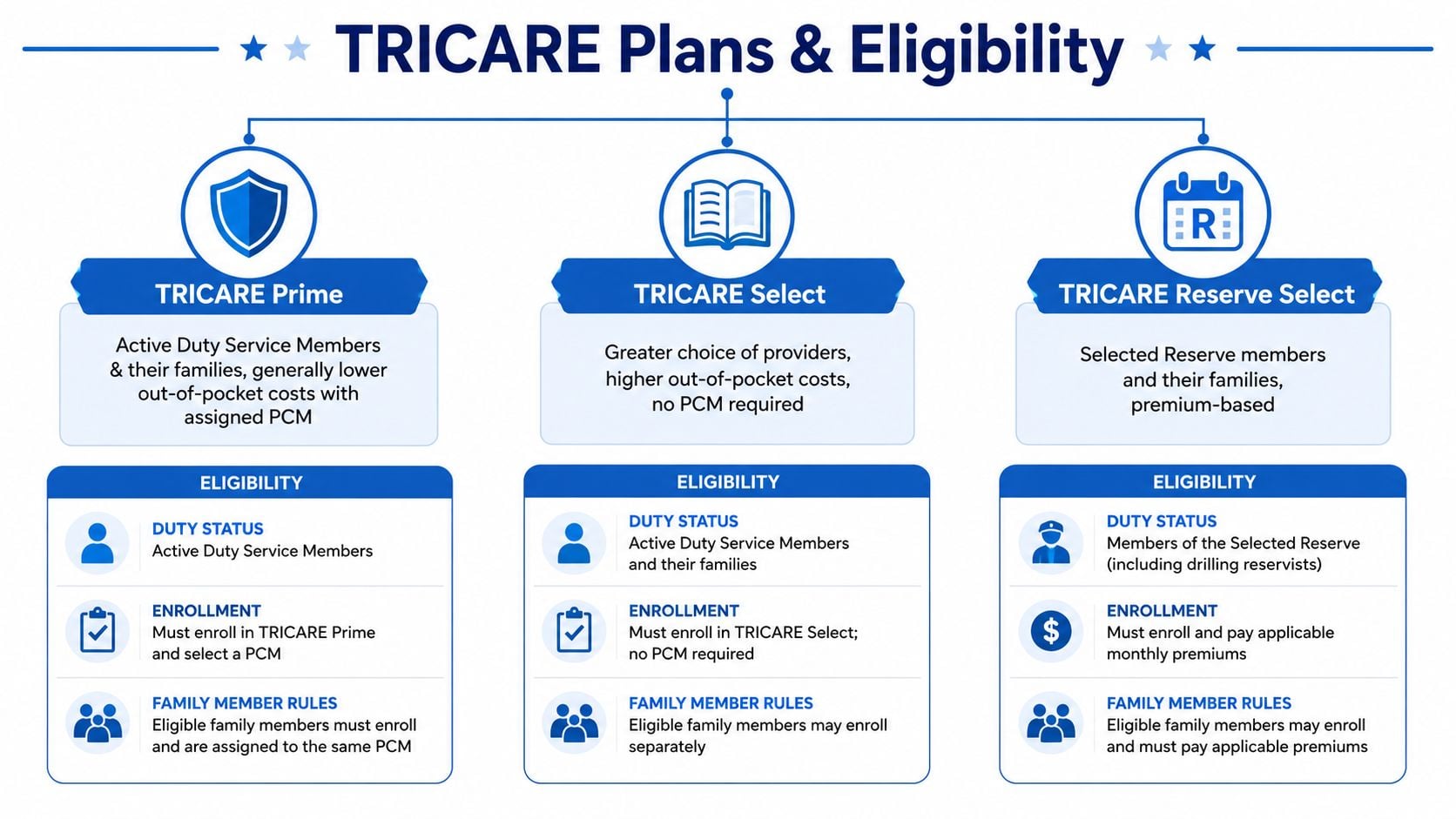
TRICARE plans can feel like different entry gates into the same health system. The benefits overlap in important ways, but the path into care changes depending on the plan and the person's military status. If you think of them like gym memberships, TRICARE Prime is the structured membership with a home base and more direction, while TRICARE Select is the more flexible membership where you choose more of your own route. TRICARE Reserve Select is a separate option tied to Selected Reserve status.
How the plan type changes the experience
Prime tends to be more managed. People often work through an assigned primary care manager, and the system is designed to coordinate care through that structure. Select usually offers more provider choice, but that flexibility can come with different out-of-pocket responsibilities and more pressure on the family to confirm network details before treatment starts.
Reserve Select works differently because eligibility is tied to reserve status rather than the same framework many Active Duty families use. That distinction matters when someone assumes their friend's TRICARE process must be the same as theirs. It often isn't.
Eligibility isn't just about the sponsor
Mental health access often depends on who is seeking care, not just which household has military affiliation. Active Duty Service Members, spouses, children, retirees, and reserve families don't move through the same administrative lane. A family can all carry TRICARE and still have different rules applied to individual members.
That's why “We have TRICARE” is only the first sentence in the conversation.
Here's a plain-language comparison:
| Plan | General experience | Common mental health access question |
|---|---|---|
| TRICARE Prime | More structured care coordination | “Do I need a referral before I start?” |
| TRICARE Select | More provider choice | “Is this clinician in network, and what will I pay?” |
| TRICARE Reserve Select | Reserve-based enrollment path | “Am I using the right contractor and directory?” |
What to gather before you call anyone
Before reaching out to a therapist, psychiatrist, or treatment program, pull together:
- Insurance details: Front and back of the TRICARE card, plus the sponsor's information if needed.
- Beneficiary status information: Whether the patient is Active Duty, a dependent, retiree, or reserve family member.
- Basic treatment goal: Anxiety counseling, psychiatric medication management, addiction treatment, or higher-intensity care.
- Regional contractor information: So you know whether you're verifying through Humana Military or TriWest.
Most delays happen before the first appointment, not during treatment. Families lose time when they call providers before confirming the plan pathway.
The most useful habit is simple. Verify eligibility first, then match it to the service level you need. That prevents a lot of wasted effort.
Covered Mental Health and Substance Use Services
TRICARE mental health benefits cover far more than weekly counseling. The covered spectrum includes office-based therapy, psychiatric medication management, telehealth, medication-assisted treatment for substance use disorder, higher-intensity outpatient programs, and residential or inpatient care when medically necessary.
That range matters because people rarely stay in one treatment lane forever. Someone with depression may start with outpatient therapy and psychiatry. Another person may need addiction treatment with multiple levels of care over time. Coverage is broad, but the right fit depends on symptom severity, safety needs, and what setting the treating clinicians recommend.
Standard outpatient care
Outpatient care is frequently the first level considered. It includes individual psychotherapy, family therapy, group therapy, and medication management. TRICARE's outpatient session limits are also defined by duration. Individual sessions are covered up to 60 minutes, with crisis sessions extending to 120 minutes, and family or group sessions are covered up to 90 minutes, with crisis sessions extending to 180 minutes, according to the Health.mil report on access to military and dependent mental health care.
That's useful because many families don't realize session length matters in billing. A provider may clinically recommend longer crisis work, but the billing has to match what TRICARE recognizes.
Telehealth and remote care
Remote care is now a permanent part of the benefit. TRICARE permanently expanded coverage for telehealth and telemental health services on July 1, 2022, making remote psychiatric and therapy visits a permanent option for beneficiaries and eliminating geographic barriers, as described in this TRICARE telehealth summary.
For military families, that can mean psychiatric follow-up from home, therapy without a commute, and more practical continuity when travel, relocation, or childcare make in-person care hard.
Higher levels of care
Some needs go beyond standard weekly sessions.
TRICARE covers Intensive Outpatient Programs (IOP), Partial Hospitalization Programs (PHP), and residential treatment for substance use disorder when medical necessity and authorization requirements are met. It also covers medication-assisted treatment (MAT) for substance use disorder as part of inpatient and outpatient benefits, according to the same Health.mil access report.
A simple way to picture the levels:
- Outpatient therapy: Best for people who can function safely with periodic support.
- IOP: A stronger structure for people who need multiple hours of care each week while still living at home.
- PHP or residential care: For people whose symptoms, relapse risk, or instability require more concentrated supervision.
Some readers exploring trauma care may also appreciate Gonzalez & Waddington's veteran therapy guide, which offers broader context on treatment conversations military veterans often have when standard care hasn't felt sufficient.
If your main question is whether rehab itself falls under the benefit, this explanation of whether TRICARE covers rehab gives a focused look at that topic.
Covered doesn't always mean automatic. For higher levels of care, the insurer usually wants proof that the setting matches the patient's clinical needs.
One important provider detail
TRICARE-authorized clinical social workers can provide covered services within their licensed scope without physician referral or supervision, based on the Health.mil coverage report. That can widen the provider pool for families who are waiting too long for psychiatry or psychology appointments.
Authorization and Referral Requirements
This is the part that causes the most avoidable denials.
People hear that mental health is covered and assume they can schedule any level of care the same way they'd book a regular therapy visit. TRICARE doesn't work that way. The required paperwork depends on both the person and the setting.
The shortest version of the rule
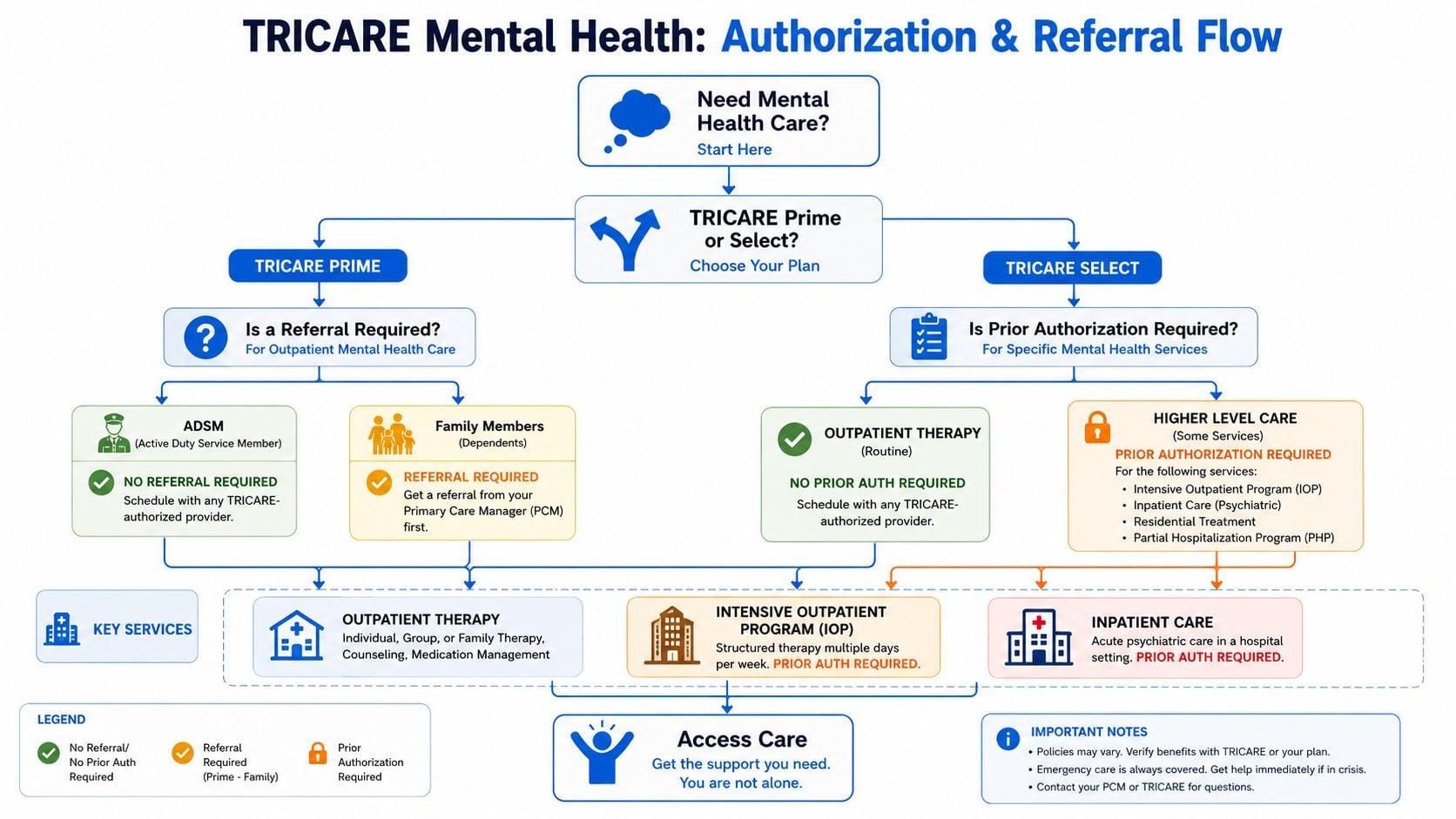
TRICARE requires prior authorization for all IOP and PHP services for every beneficiary, and Active Duty Service Members must secure a referral from their PCM before any mental health care, according to the TriWest behavioral health coverage and requirements document.
That sentence alone clears up a lot of confusion.
Standard outpatient psychotherapy and medication management are generally simpler for non-Active Duty beneficiaries using network providers. Higher-intensity care is not. If the service is IOP or PHP, prior authorization is mandatory. If the patient is Active Duty, the referral issue is broader and stricter.
Where families make the wrong assumption
Telehealth creates a common trap. A family thinks, “It's online, so maybe it works like ordinary virtual counseling.” But a virtual IOP still falls into the same higher-intensity category as in-person IOP. It triggers the same authorization requirement.
Another point of confusion involves substance use treatment delivered through a rehabilitation facility. Non-Active Duty Prime beneficiaries may not need a referral for routine office-based outpatient mental health visits with network providers under the 2026 guidance noted in the BetterHelp summary of TRICARE's expanded mental health access, but SUD therapy through a SUD rehabilitation facility follows a more restricted path. That difference surprises people because both services feel like “therapy,” even though TRICARE classifies them differently.
A practical decision path
Use this sequence before the first appointment:
- Name the level of care clearly. Don't say “counseling” if the provider is recommending IOP or PHP.
- Confirm the patient category. Active Duty rules aren't the same as family member or retiree rules.
- Ask whether the provider is in network. This affects both access and billing.
- Ask one direct question: “Does this service require prior authorization under my plan?”
- Get approval before intake when required. Don't assume the provider will always obtain it without your involvement.
- Keep written confirmation. Save portal messages, reference numbers, and intake emails.
“Medically necessary” treatment can still be denied if the authorization step was skipped.
The Active Duty bottleneck
Active Duty Service Members face a narrower lane. Public FAQs often blur the difference between Active Duty rules and family member rules. The result is delay. Someone reaches out for virtual mental health support expecting to start quickly, then finds out a PCM referral and contractor approval need to happen first. That doesn't mean care is impossible. It means the administrative sequence matters more.
The safest mindset is this. Schedule clinically, but verify administratively. In TRICARE mental health benefits, those are two separate jobs.
Cost Sharing and Copay Details
Cost questions usually surface after a family has already found a provider they like. That's frustrating because money stress can shape treatment decisions just as much as clinical recommendations. TRICARE mental health benefits can reduce that burden, but the out-of-pocket picture depends on the plan, the patient category, and whether the provider is in network.
The most specific published figure in the verified data applies to standard outpatient visits under TRICARE Select. For TRICARE Select, outpatient copays for network providers range from approximately $30 to $55 per visit for retirees and families, while Active Duty Service Members generally have no copay or a fixed minimal fee, according to the Health.mil report on access to military and dependent mental health care.
What that means in everyday terms
If you're a retiree or family member using TRICARE Select and seeing a network provider for outpatient therapy, you should expect a per-visit cost within that published range. If you're comparing two therapists, ask both offices the same direct questions:
- Are you in network with my specific TRICARE plan?
- Will this visit be billed as standard outpatient therapy or something more intensive?
- Do you collect the copay at the visit, or bill later?
The same insurance card can produce very different bills depending on the provider's network status and how the service is coded.
Why higher levels of care feel harder to budget
For services like residential treatment, PHP, or IOP, families often want a neat price estimate before admission. In practice, those costs are harder to predict in advance because authorization, medical necessity findings, and service setting all affect what's approved and what portion may be patient responsibility.
That doesn't mean you shouldn't ask. It means you should ask for an eligibility and benefits verification rather than a casual estimate.
Here's a useful way to compare the planning mindset:
| Service type | What to budget for first |
|---|---|
| Standard outpatient therapy | Copay, visit frequency, and provider network status |
| Psychiatry or medication management | Per-visit copay and follow-up cadence |
| IOP, PHP, or residential care | Authorization status, covered setting, and patient responsibility after approval |
Questions that protect your wallet
A short phone call can prevent a much bigger billing problem later. Ask:
- Network status: “Are you currently contracted with TRICARE in my region?”
- Service intensity: “Is this office-based outpatient, or something that needs prior approval?”
- Patient responsibility: “What amount do you expect me to pay up front?”
- Claims handling: “Will your office file TRICARE claims directly?”
The hidden cost isn't always money
Sometimes the biggest cost is delay. A family spends weeks assuming a provider is covered, only to restart the search because the office doesn't accept the plan they expected. Or they begin intake for a higher level of care before authorization is on file.
That's why it helps to think of cost sharing in two categories. There's the bill itself, and there's the cost of administrative missteps. TRICARE mental health benefits can be manageable, but only when the front-end verification is done carefully.
Finding and Verifying Tricare Providers
Finding a clinician is one task. Verifying that the clinician can bill your TRICARE plan correctly is a separate task. Many people stop after the directory search, then get blindsided when the office says, “We're familiar with TRICARE,” which isn't the same thing as “We're in network for your plan and service.”
Start with the directory, but don't stop there
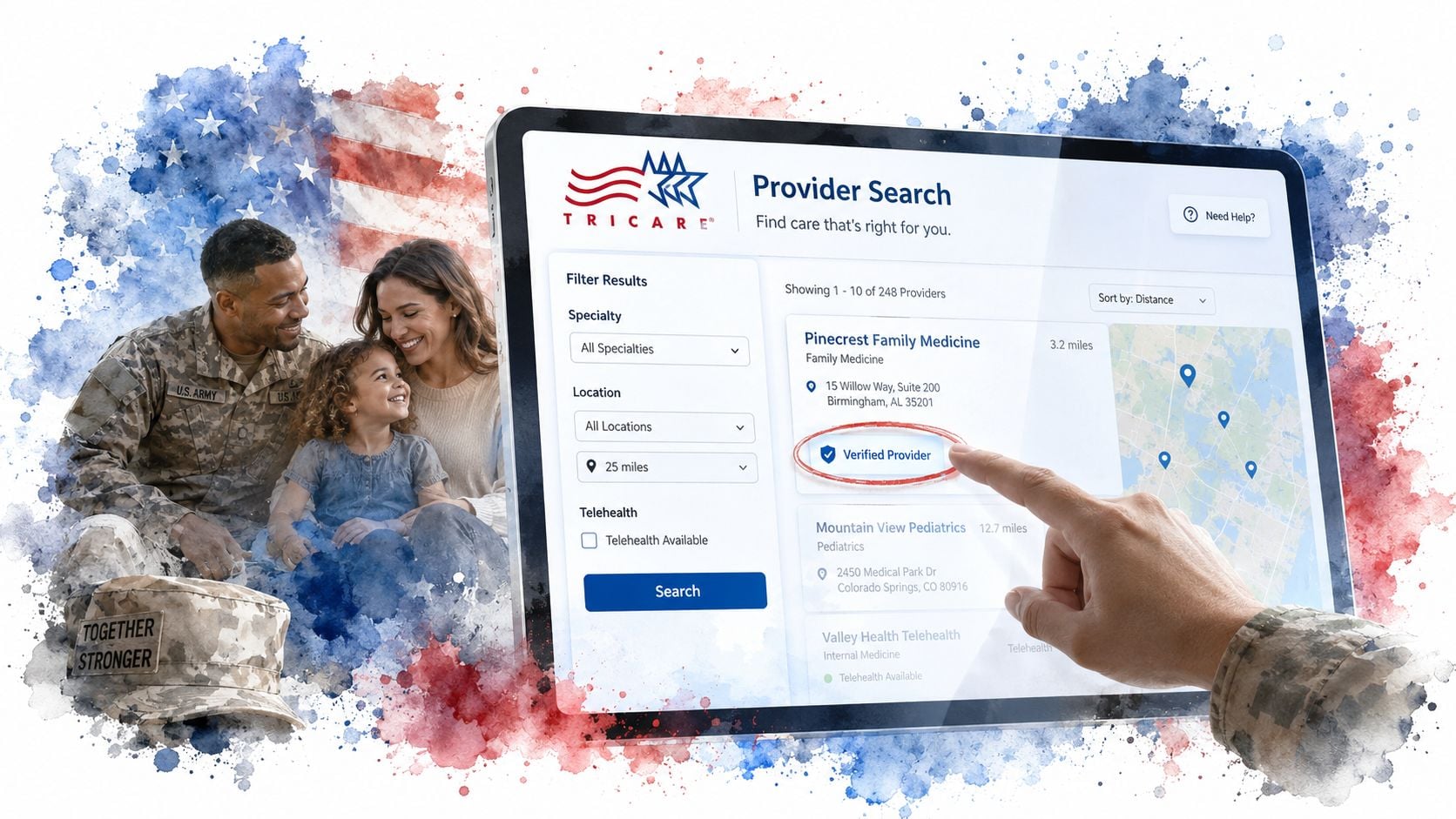
Use the TRICARE provider directory through your regional contractor and filter for the service you need. Search terms matter. “Behavioral health” may pull a wider list than “substance use disorder,” and “telehealth” may narrow the list too much if a provider offers virtual care but hasn't labeled it consistently.
Once you have a short list, verify four things with the office:
- Current network status: Contracts change, and directories can lag.
- License type: Therapist, psychologist, psychiatrist, clinical social worker, or addiction specialist.
- Service level offered: Standard outpatient, medication management, IOP, or addiction treatment.
- Telehealth availability: Especially if distance or transportation is an issue.
If you want a walkthrough of the insurance side of this process, this guide on how to verify insurance coverage is a practical companion.
Watch for these red flags
A provider may be clinically excellent and still be the wrong administrative fit.
- “We can give you a superbill.” That often means the office may not be billing TRICARE as an in-network provider.
- “We treat everything.” Broad claims without specific program descriptions can hide the fact that they don't offer the level of care you need.
- Unclear answers about authorization: A good intake team should know whether their services typically require prior approval.
- No distinction between therapy and rehab services: That can signal billing confusion.
Check the billing path, not just the therapist bio. A warm consultation call doesn't guarantee smooth claims processing.
Use the office conversation as a screening tool
When you call, ask the same questions every time. That keeps emotion from taking over the process.
A strong office usually answers clearly. They know whether they're in network. They know what level of care they provide. They know whether they've worked with your TRICARE contractor before. If they sound vague, treat that as useful information.
For families trying to understand the provider side of healthcare staffing more broadly, resources like physician jobs can also offer context on how medical practices recruit and structure clinical coverage, which helps explain why some specialties are easier to find than others in certain regions.
A visual walkthrough can also help if online portals feel clunky the first time you use them.
The simplest verification script
Try this wording when you call:
“I have TRICARE. I need to verify that you're in network for my plan, that you provide this exact level of behavioral health care, and whether any referral or authorization is required before intake.”
That one sentence gets to the point fast.
Using Benefits for Addiction Care
Addiction treatment under TRICARE can be life-changing, but it's also where administrative detail matters most. Detox, medication-assisted treatment, outpatient therapy, IOP, partial hospitalization, and residential services may all be relevant at different stages of recovery. Families often think of these as one continuous rehab benefit. TRICARE treats them as distinct service categories with separate rules.
Start with the level of care, not the label
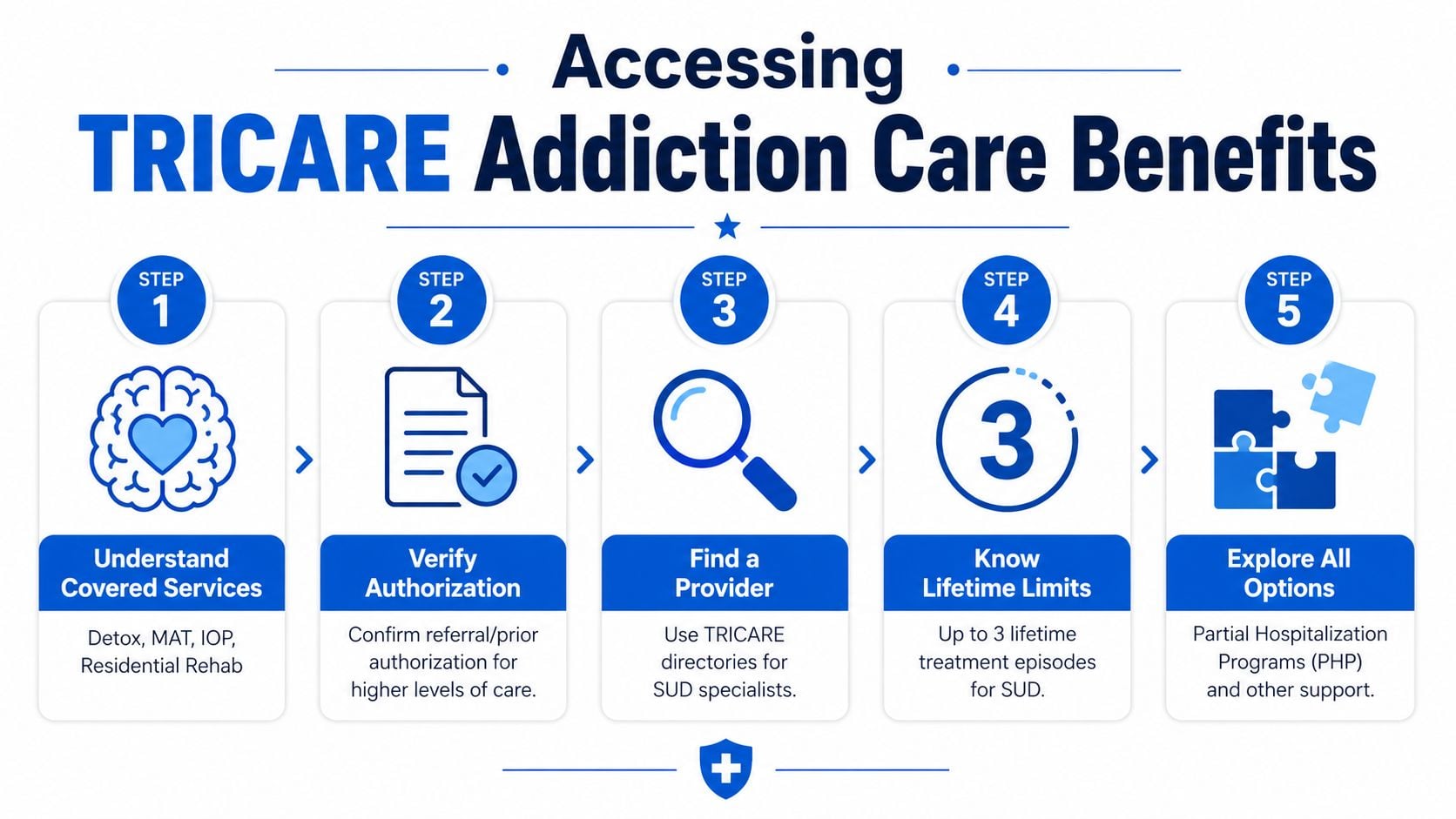
A person might say they need “rehab,” but that could mean several different things. TRICARE covers medication-assisted treatment, outpatient services, partial hospitalization, intensive outpatient, and residential treatment for substance use disorder when the clinical and authorization rules are satisfied, based on the Health.mil mental health care access report.
The key is matching the patient's needs to the treatment intensity. Someone who is medically unstable may need detox or a more supervised setting. Someone stepping down from residential care may fit IOP. Someone focused on relapse prevention may do well with outpatient therapy and MAT.
The limit many families don't see coming
TRICARE imposes a strict lifetime cap of exactly three substance use disorder rehabilitation treatments, with a maximum of one episode per benefit period and a limit of 21 days of rehabilitation per episode in a TRICARE-authorized SUD rehabilitation facility, according to the TRICARE mental health fact sheet hosted by Parity Registry.
That cap has real consequences. Detoxification and therapy delivered by authorized SUD rehabilitation facilities can count toward that limit. Partial hospitalization in that setting can count too. Families sometimes assume that only full residential stays use up the benefit. That assumption can lead to benefit exhaustion sooner than expected.
If you're researching this area in more depth, this page on TRICARE drug rehab gives a focused overview of addiction treatment access.
A workable step-by-step approach
Use this order when pursuing addiction care:
- Get a clinical assessment. The right level of care has to be documented first.
- Ask whether the program is a SUD rehabilitation facility. That classification affects how the benefit is counted.
- Confirm authorization needs before admission. This is especially important for IOP and PHP.
- Ask what days and services count toward the rehab episode. Don't assume.
- Plan discharge and aftercare early. Long-term support may need to shift to services outside the capped rehab structure.
Holistic services need the right setting
Ancillary therapies such as art, music, or occupational approaches are only covered when delivered within the proper facility setting, such as an IOP or residential treatment center, according to the TRICARE mental health and SUD briefing. They aren't covered as standalone general outpatient services.
That detail matters for co-occurring disorders. A patient may benefit from a broader therapeutic mix, but coverage depends on where and how those services are delivered.
The treatment plan and the billing category have to tell the same story. If they don't, claims tend to break down.
Appeals Exceptions and Local Next Steps
A denial isn't always the end of the road. In TRICARE mental health benefits, denials often reflect an administrative mismatch rather than a complete lack of coverage. The insurer may be saying, “We don't have enough proof,” “This wasn't authorized in advance,” or “The requested service doesn't match the documentation we received.” Those are frustrating problems, but they're often appealable problems.
Families lose ground when they treat denials like final judgments instead of challenges to be answered with better records.
When appeals make sense
An appeal is worth considering when the care is covered in principle but denied because of process, documentation, or classification. Common examples include a higher level of care denied for insufficient medical necessity records, a whole-person therapy denied because it was billed outside the setting where TRICARE recognizes it, or a substance use episode denied because the file doesn't clearly explain why an exception is justified.
The strongest appeals are specific. They don't say, “The patient needs help.” They say, “The patient meets this level of care because of these documented symptoms, these failed lower levels of care, and these co-occurring conditions.”
The overlooked issue with holistic therapies
Many guides miss a small but powerful coverage rule. Ancillary therapies are more likely to be covered when they're documented within an IOP or residential setting and tied to co-occurring disorders, as noted in the TRICARE briefing on mental health and substance use disorder services.
That means the problem often isn't the therapy itself. It's the paperwork around medical necessity.
If a patient has both substance use disorder and another mental health condition, the clinical record needs to say so clearly. If expressive or occupational supports are part of stabilization, the record should connect them to functional impairment and treatment goals inside the covered setting. Vague notes produce weak appeals.
What to gather before filing
If you're challenging a denial, collect the practical documents first:
- The denial notice: Read the reason line carefully. The exact wording matters.
- Clinical assessment and diagnosis: Include co-occurring conditions when relevant.
- Treatment recommendation: The provider should explain why this level of care is appropriate.
- Prior treatment history: Especially failed or insufficient lower levels of care.
- Authorization records: If approval was requested, keep dates, reference numbers, and messages.
- Progress notes or discharge summaries: These help show medical necessity over time.
How to strengthen the exception request
For treatment that pushes against standard limits, the appeal should answer three questions plainly:
- Why isn't a lower level of care enough?
- What safety or relapse risks support the requested setting or duration?
- How does the record show that the requested services are part of a covered treatment structure, not optional extras?
That third point is especially important for families seeking integrated care. If a program includes trauma work, recovery skills, behavioral health therapy, and ancillary supports, the documentation has to show how those services fit together clinically. Insurance reviewers don't infer that on their own.
A strong appeal reads like a case summary, not a complaint letter.
Local next steps that help before and after a denial
Northern California families often need more than a benefits answer. They need someone to help them organize the process. That may mean asking a provider's intake team to verify network status before assessment, requesting written confirmation of authorization requirements, or having the treating clinician revise documentation so the diagnosis, level of care, and billed services align.
It also helps to ask practical questions that standard guides leave out:
- Will this facility bill under a SUD rehabilitation structure or standard outpatient structure?
- Do ancillary therapies appear in the treatment plan as part of a covered setting?
- Has the program handled TRICARE appeals or exceptions before?
- Who tracks authorization dates during the stay?
These questions can feel overly detailed when you're already overwhelmed. They aren't. They are how families protect continuity of care.
For people in Yuba City and the surrounding region, local support can make this process far less intimidating. A treatment center that understands TRICARE verification, co-occurring documentation, and the difference between routine outpatient care and higher-intensity addiction services can often spot problems before they become denials.
If you need help taking the next step, Addiction Resource Center LLC in Yuba City offers support for adults seeking detox, MAT, residential rehab through its partner facility, and intensive outpatient care in person or via telehealth. The team welcomes TRICARE beneficiaries, can help verify benefits, and can walk you through practical next steps such as scheduling a tour, discussing treatment options, or talking through what documentation may be needed before admission. You can reach them at 1002 Live Oak Blvd., Suite A, Yuba City, CA, or contact their 24/7 phone and text line at 530-625-7910.