You left treatment with a plan and meant every word of it. Then a relative arrived unexpectedly, an argument started, and the thought of using returned before you'd even put your keys down. You remember being told to reach out, but you can't decide who to call or what to say. A relapse prevention workbook …

You left treatment with a plan and meant every word of it. Then a relative arrived unexpectedly, an argument started, and the thought of using returned before you'd even put your keys down. You remember being told to reach out, but you can't decide who to call or what to say.
A relapse prevention workbook should help with that exact moment. Not by asking you to complete pages while you're overwhelmed, but by keeping a response you've already practiced within reach.
Table of Contents
- Why a Workbook Matters Between Appointments
- Build the Right Workbook Structure
- Map Triggers and Build Coping Responses
- Connect the Workbook With Professional Care
- Use Brief Check-Ins Between Sessions
- Troubleshoot Workbook Problems Responsibly
- Put Your Workbook Into a Weekly Routine
Why a Workbook Matters Between Appointments
Consider a hypothetical evening after discharge. You're anxious about returning to work, someone at home wants answers you don't have, and your counselor isn't immediately available. Nothing about the situation resembles the calm room where you discussed coping skills.
Remembering advice and applying it under pressure are different tasks. A useful workbook connects a recognizable warning sign with an action, a support person, and a backup when the original plan isn't possible.
Write for the moment you'll need it
The cognitive-behavioral relapse-prevention model developed by G. Alan Marlatt and Judith Gordon in 1985 treats relapse as a process: high-risk situations can lead to craving, reduced confidence, ineffective coping, and an initial lapse that may escalate into continued use. That process-oriented understanding underpins the Marlatt and Gordon relapse-prevention framework.
The practical implication is important. You don't have to wait until substance use occurs to take the situation seriously. Your workbook can identify an earlier decision point, such as withdrawing from support after an argument.
In the hypothetical evening above, a usable entry might say:
- Warning sign: I stop answering messages and start thinking about where I could get substances.
- Immediate response: Move away from the argument and contact my agreed support person.
- Backup: If that person doesn't answer, use the next contact on my plan rather than waiting alone.
Practical rule: Write what you can actually do when distressed, not what sounds impressive when you feel settled.
A workbook is a support tool, not a standalone treatment or a promise against relapse. It can hold questions for therapy, observations for an Intensive Outpatient Program (IOP), medication concerns for a prescriber, and updates for telehealth or aftercare appointments.
When risk escalates, completing another worksheet isn't the priority. Contacting an appropriate professional is. The pages should make that transition easier, not become another task you must finish before asking for help.
Build the Right Workbook Structure
Start with a small, connected set of pages. A thick workbook isn't necessarily a usable one, especially if the information you need is buried beneath exercises you haven't finished.
Put your personal recovery profile near the beginning. Include what you want recovery to make possible, what has interrupted recovery before, and any practical needs that affect participation in care. Keep the profile specific: being available for your children or returning to work safely is more actionable than wanting life to improve.
The structure below moves from personal priorities toward recognizing risk.
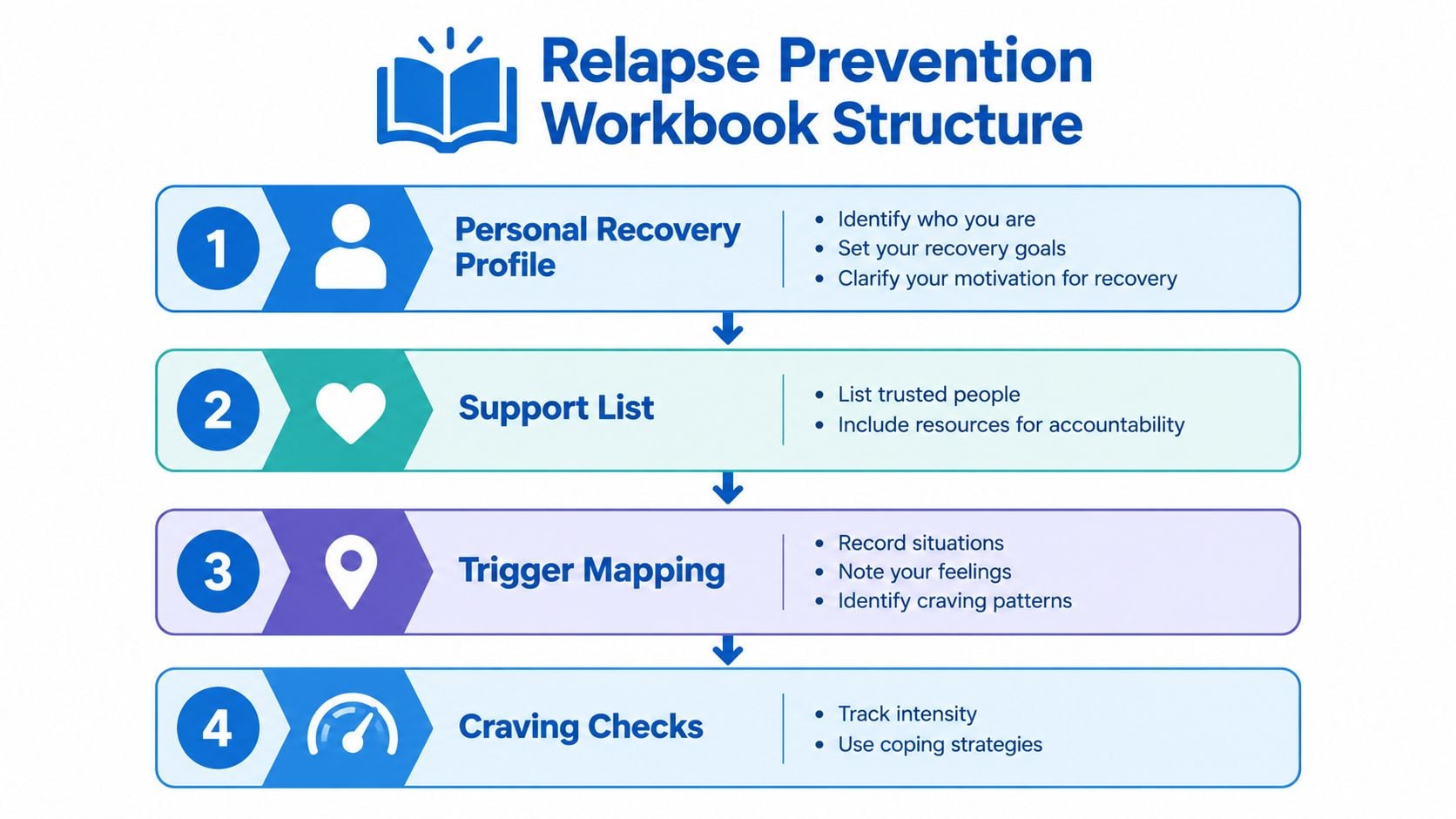
Give every page a decision to support
Your support list should distinguish between people who offer encouragement, professionals who assess treatment needs, and emergency resources. Ask contacts what they're comfortable doing and when they're available. Don't assume a loved one can provide clinical guidance or answer at any hour.
Core Relapse Prevention Workbook Components
| Workbook Component | Best Used | Decision It Supports |
|---|---|---|
| Personal recovery profile | Initial setup and care transitions | Which goals and needs should guide the plan? |
| Support list | Before risk increases | Who can help, and with what? |
| Trigger map | Preparation and later review | Which situations need a specific response? |
| Craving check | During a risk episode | What action fits my current experience? |
| Coping response card | When attention is limited | What should I do next? |
| Coordination page | Discharge and appointment planning | Who owns each follow-up task? |
| Lapse-response sheet | After substance use | How do I reconnect with appropriate care? |
| Optional work or family page | When responsibilities interfere | What adjustment should I request? |
The pages should refer to each other. A trigger-map entry about family conflict should point to the relevant response card and support contact. A missed appointment should lead to the coordination page, not disappear into a general journal entry.
Keep access simple
Use a printable binder, a notebook with labeled tabs, or a phone-friendly document. Choose based on what you can access privately and reliably, not which format looks most complete.
Keep the immediate-response page separate from longer reflection exercises. You may want room to explore a difficult relationship later, but during an urge you need readable instructions.
Leave optional sections out until they solve a real problem. A workbook should reflect your circumstances rather than require you to manufacture answers to every generic prompt.
Map Triggers and Build Coping Responses
A trigger map works best when it captures an actual situation rather than a broad category such as stress. Consider a hypothetical person who feels anxious before a family gathering where alcohol may be present.
Use a situation map to separate what's happening around you from what's happening inside you.
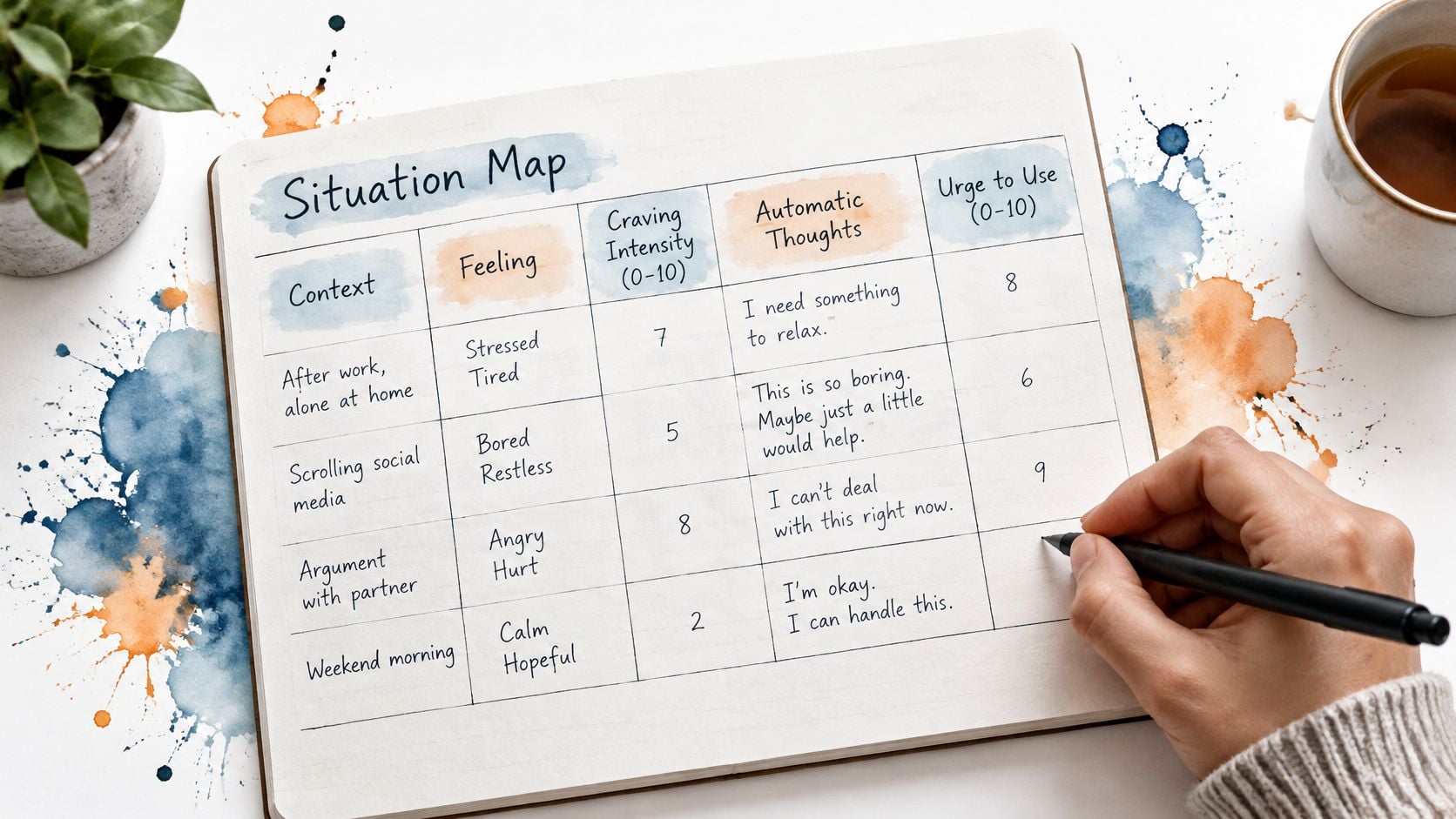
Describe the sequence without judging it
For this example, the entry could include:
- Context: A family gathering after work, with no independent ride home.
- Internal risks: Anxiety, resentment, and the thought that drinking would make conversation easier.
- External risks: Alcohol nearby, questions about treatment, and pressure to stay.
- Craving intensity: Strong enough that paying attention to conversation feels difficult.
- Urge: Accept a drink to avoid explaining the situation.
An emotion is an internal risk; an available substance or pressuring conversation is an external one. Recording both helps you avoid treating an environmental problem as something you must solve through emotional control alone.
For more prompts, use this guide to handling triggers in addiction recovery alongside your own history. Don't copy someone else's triggers just because they appear on a worksheet.
Convert intentions into actions
“Manage stress” doesn't identify a behavior. For this hypothetical gathering, a more usable plan might be to arrange independent transportation, tell the host you may leave early, and ask a trusted person to be available for a check-in.
Then write an if-then response: If someone repeatedly offers alcohol, I'll end the conversation and contact my support person from a private location. If I can't leave safely, I'll ask the agreed person to help arrange transportation.
Build a coping menu with different kinds of help. A grounding exercise may be an immediate option; changing attendance plans may address the setting; discussing family boundaries in therapy may address a recurring problem. These actions serve different purposes and aren't interchangeable.
Use the following video as an additional discussion prompt, then compare any suggestions with your individualized care plan.
A review of 26 relapse-prevention studies involving 9,504 participants associated the approach with reduced substance use, r = .14, and improved psychosocial functioning, r = .48, across individual and group formats and inpatient and outpatient settings. Those findings concern treatment approaches, not proof that a particular worksheet prevents relapse.
Finish each coping plan with a stop point. For example, if the urge intensifies despite the agreed actions, or you begin making arrangements to obtain substances, follow your escalation instructions rather than repeating an ineffective exercise. Review that threshold with your clinician.
Connect the Workbook With Professional Care
A workbook can be complete on paper while the treatment arrangements remain uncertain. An appointment without transportation, a medication question without a prescriber contact, or a telehealth session without privacy still needs attention.
Treat the coordination page as a shared work document. Record the task, the person responsible, how you'll confirm completion, and what happens if the arrangement falls through.
The shared-review process should connect your observations with the people qualified to act on them.
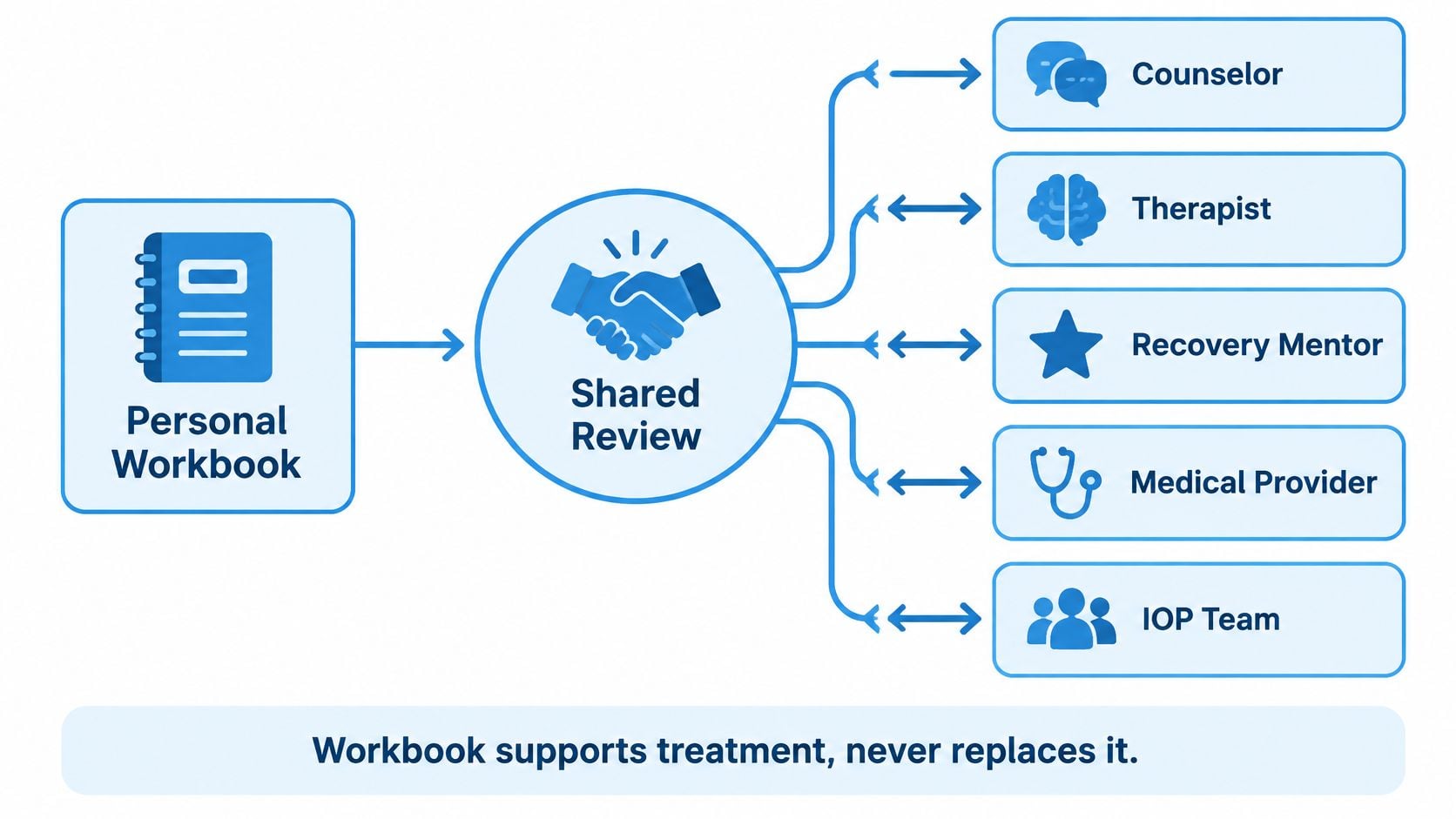
Bring questions to the right professional
Use separate prompts rather than a single crowded appointment list:
- Therapy: Which thoughts, emotions, or relationship patterns do I want help examining?
- Medication-assisted treatment (MAT): What prescribed instructions, refill concerns, side effects, or missed-dose questions need the medical provider's attention?
- IOP: Which attendance barriers or recent risk episodes should the team review?
- Telehealth: Where will I join privately, and what is the backup if the connection fails?
- Aftercare: Has the receiving provider confirmed the appointment, and do I know whom to contact?
Record medication instructions as provided. Don't use a workbook to make independent dose changes or substitute a mentor's advice for medical guidance.
Before leaving residential care, draft your first-week schedule with actual appointment arrangements, work obligations, caregiving coverage, and travel plans. If you need a handoff to an outpatient or mental-health provider, write down who will make it and how you'll know it happened.
Use remote support deliberately
A 2025 review of 34 randomized trials involving 6,461 participants found that remote interventions alongside in-person treatment were associated with 39% lower odds of relapse and fewer substance-use days. Evidence was less conclusive when remote care replaced face-to-face treatment, and risk of bias was substantial.
That distinction matters when choosing convenience over contact. A digital workbook can support a telehealth conversation, but an entry isn't the same as a clinician reviewing it.
Bring selected pages to relapse-prevention counseling and ask for a concrete revision. Perhaps a coping strategy needs rehearsal, an attendance expectation needs clarification, or a medical concern needs referral.
A shared plan needs an owner for each next action. “Someone will follow up” is an unfinished arrangement.
Before the appointment ends, record what you'll do, what the provider will do, and how you'll reconnect if the problem remains unresolved.
Use Brief Check-Ins Between Sessions
A check-in should be short enough to use during an ordinary workday. Save detailed reflection for a private setting where you can think without rushing.
Create a phone-friendly entry with fields for context, craving, risk level, chosen action, and outcome. Use plain-language risk categories that you and your clinician have defined together, such as manageable, increasing, and urgent. These labels are organizational tools, not a validated clinical assessment.
Match the entry to the moment
A hypothetical entry might look like this:
Context: Leaving work after an argument.
Craving: Strong and distracting.
Risk: Increasing under my agreed plan.
Action: Contact my support person before deciding where to go.
Outcome: Still unsettled; request a clinical check-in.
Later, the printable review can capture what the short entry left out: what was said at work, which automatic thought appeared, whether the support person answered, and what made the next step difficult. You don't need to type that history while standing in a parking lot.
Look for repeated circumstances rather than trying to interpret every mood change. Your clinician can help decide whether a pattern requires a treatment adjustment. This guide to warning signs of relapse can help you prepare observations to discuss.
Build reminders around responsibilities
Use reminders selectively so they remain useful:
- Appointments: Include travel or login preparation, not just the start time.
- Medication: Follow prescribed instructions and flag questions for the medical team.
- Support: Schedule agreed contacts and recovery activities.
- Barriers: Note shift changes, childcare gaps, transportation trouble, or lost privacy.
Patient-perspective research published in 2025 identified individualized outpatient arrangements before discharge, continuity with a familiar psychiatric professional, flexible return-to-work arrangements, and digital self-monitoring with clinical feedback as priorities. The useful connection is between recording an observation and getting a relevant response.
Protect sensitive entries on shared devices. Consider notification previews, account access, and who can open the document. Agree on what you'll share with professionals or loved ones rather than assuming everyone needs the full journal.
Also confirm whether anyone monitors submitted entries and when. A saved note, app prompt, or unread message isn't urgent human help.
Troubleshoot Workbook Problems Responsibly
An unfinished workbook isn't evidence that you don't care about recovery. It may contain prompts that are too abstract, too demanding, or disconnected from the problem you're facing.
Treat nonuse as something to investigate. Ask whether the page was accessible, whether the instructions made sense, and whether completing it would have helped you choose an action.
Repair the page that isn't working
| Workbook Problem | Practical Correction |
|---|---|
| Trigger pages stay blank | Describe a recent difficult moment before trying to name a pattern. |
| Coping entries say “stay positive” | Replace the phrase with an observable action and a named contact. |
| The plan requires privacy you don't have | Identify a realistic location or communication method with your team. |
| Forms feel overwhelming | Keep the immediate decision fields and move reflection elsewhere. |
| Completed pages never get reviewed | Bring a selected entry and a specific question to your next session. |
| Family involvement feels like surveillance | Agree on supportive actions, boundaries, and what information is shared. |
Don't require a loved one to inspect every entry. A communication agreement might authorize them to ask whether you want company, help with transportation, or assistance contacting care. That's different from searching your phone or demanding proof that you completed a worksheet.
Prepare a response after substance use
If a lapse occurs, use the response page to reconnect, not to conduct a harsh self-interrogation. Record what happened in neutral language once you're safe enough to do so, including what the treating professional needs to know about substance use and current symptoms.
Contact the agreed treatment professional promptly. Ask whether you need medical assessment, a change in treatment intensity, or help restarting interrupted care. Don't wait to produce a polished explanation.
After a lapse: The immediate task is safety and reconnection, not proving that you deserve another appointment.
Keep emergency instructions separate from reflection prompts. If you suspect an overdose, experience a medical emergency, cannot stay safe, or face immediate danger, seek emergency assistance rather than completing the workbook or waiting for a routine reply.
For rising urges without immediate danger, follow the clinician-agreed escalation plan. If coping actions aren't helping, contacts aren't reachable, or you're unsure whether symptoms require assessment, seek professional guidance.
Once immediate needs are addressed, review the sequence with your team. Revise the point where the plan became impractical or insufficient. A lapse should prompt reassessment, not an instruction to abandon recovery.
Put Your Workbook Into a Weekly Routine
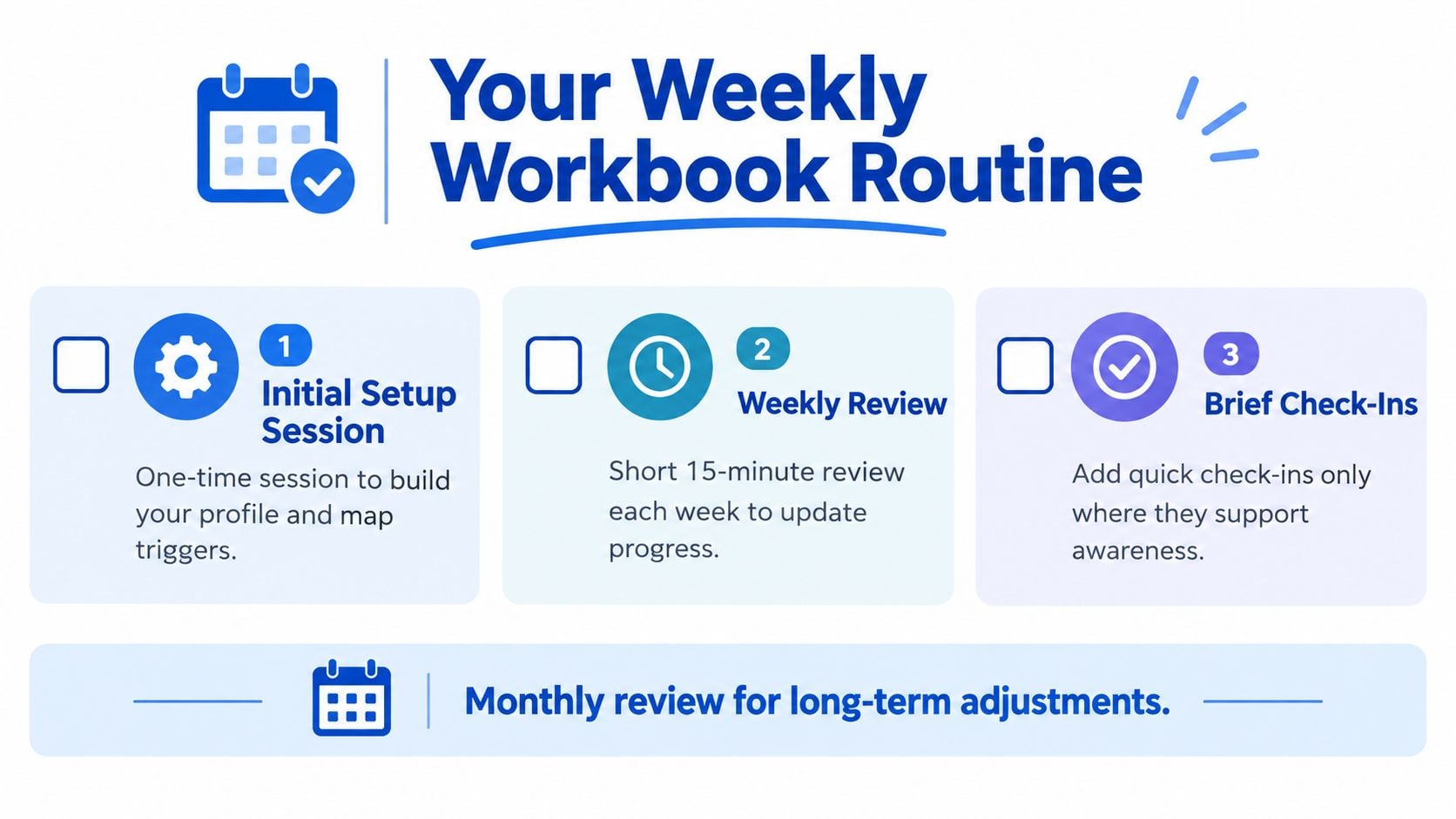
Choose a routine you can maintain during a busy week, not just during a quiet stretch. Begin with an initial setup session, then reserve a short weekly review for the entries that changed a decision or revealed an unresolved problem.
Add brief check-ins where they serve a purpose, such as a difficult commute or a recurring family interaction. At a monthly review or care transition, revisit contacts, goals, and arrangements that may no longer fit.
Use this visual guide as a planning aid, adjusting the review length to your needs.
Review decisions rather than page counts
During the weekly review, select a useful entry, an action that didn't work, and a question that needs someone else's expertise. You don't need to reread everything or grade yourself on completion.
Bring a focused checklist to clinical appointments:
- Patterns and responses: What repeated, and which actions were feasible?
- Medication questions: What needs the prescriber's review?
- Attendance: Did missed care reflect avoidance, scheduling trouble, or another barrier?
- Work and family: Which responsibilities need a negotiated adjustment?
- Access: Are transportation and private telehealth arrangements still reliable?
- Escalation: Do you know whom to contact when routine support isn't enough?
A multidisciplinary care setting can help distribute these questions appropriately. A medical provider can address medication concerns, a therapist can work on distress and relationship patterns, and counselors or recovery mentors can help you rehearse practical responses.
Keep the next version realistic
Retain actions you could use. Rewrite those that depended on unavailable people, money, transportation, or privacy. If the workbook keeps identifying a problem you can't solve independently, bring that limitation directly to the team rather than adding more self-management tasks.
Consistent use doesn't mean perfect entries. It means returning to the plan, making honest observations, and reconnecting when your needs exceed what the page can support.
Addiction Resource Center LLC offers individualized treatment planning, in-person and telehealth IOP, relapse-prevention education, and customized aftercare planning to help connect workbook exercises with ongoing care. Visit Addiction Resource Center LLC to discuss treatment options and how a practical relapse prevention workbook could fit your recovery plan.