You're reading, texting, or looking at road signs after a few drinks, and something feels off. The letters seem to split. A face looks doubled for a moment. Closing one eye makes it better, which is what often makes people pause and wonder if this is “just being drunk” or something more serious. That worry …

You're reading, texting, or looking at road signs after a few drinks, and something feels off. The letters seem to split. A face looks doubled for a moment. Closing one eye makes it better, which is what often makes people pause and wonder if this is “just being drunk” or something more serious.
That worry makes sense.
People often assume alcohol-related vision trouble is mostly about blur, dryness, or trouble focusing. But alcohol and double vision usually point to a different problem. The issue often isn't that the eyes can't see the image. It's that the brain can't keep both eyes lined up well enough to combine two images into one.
That distinction matters. A short-lived episode during intoxication can happen because alcohol disrupts eye coordination. But double vision can also show up in heavier long-term alcohol use, during complicated recovery periods, or alongside nutritional deficiency, especially when confusion, clumsiness, or abnormal eye movements appear too.
Many people search this topic in the middle of the night, after a party, or because a loved one suddenly looks unsteady and says they're “seeing two.” In those moments, the most useful thing isn't a vague reassurance. It's a simple way to think clearly: when is this likely a temporary intoxication effect, and when is it a reason to get urgent care?
Table of Contents
- Introduction to Alcohol and Double Vision
- How Binocular Vision Normally Keeps Images Single
- Why Alcohol Can Trigger Double Vision During Intoxication
- Double Vision Beyond Acute Drinking and Nutritional Deficiency Links
- Warning Signs That Mean You Need Emergency Care Now
- How Clinicians Evaluate and Treat Alcohol Related Double Vision
- Prevention Recovery and Support Options for Lasting Clarity
Introduction to Alcohol and Double Vision
A common real-life version of this starts.
Someone has been drinking, feels buzzed but still functional, then tries to read a menu in dim light. The words won't stay single. Or they get into a car, look at headlights, and realize one set of lights seems to split into two. That's frightening, even if it lasts only minutes.
Double vision after drinking deserves attention because it changes what your brain is doing with visual information. It can make walking downstairs unsafe, turn nighttime driving into a hazard, and make a person underestimate how impaired they really are.
Why this symptom gets misunderstood
A lot of people use the word “blurry” for any visual problem after alcohol. But blur and double vision aren't the same.
Blur means one image loses sharpness. Double vision means the visual system is producing two copies of the same object. That usually means the eyes aren't pointing at the exact same place at the same time.
Practical rule: If closing either eye makes the symptom go away, that strongly suggests a binocular alignment problem rather than simple eye-surface blur.
That's why this topic belongs partly in eye care and partly in neurology. Your eyes are collecting the image, but your brain, brainstem, and cerebellar control systems are responsible for keeping them coordinated.
The patterns people often miss
Alcohol-related double vision doesn't all come from the same pathway. It can show up in different settings:
- Acute intoxication: A temporary coordination problem while alcohol is actively affecting the brain.
- Repeated heavy use: A pattern of recurring episodes or persistent symptoms that shouldn't be brushed off.
- Withdrawal or recovery complications: Visual symptoms can occur in medically complicated alcohol withdrawal states and need careful assessment.
- Nutritional deficiency: Long-term heavy alcohol use can contribute to thiamine deficiency, which can affect eye movements and mental status.
If you only remember one idea, remember this. Double vision after drinking isn't just “tired eyes.” It can be temporary, but it can also be a clue that the brain systems for fusion and eye alignment are under strain.
How Binocular Vision Normally Keeps Images Single
Your brain creates single vision by doing something surprisingly delicate all day long.
Each eye captures its own image. Those images are similar, but not identical. The brain has to line them up and merge them into one useful picture. When that system works well, you don't notice it. You just see one world.
Two cameras, one target
Think of your eyes like two cameras mounted side by side. If both cameras point at the same object, software can merge the two images smoothly. If one camera drifts even a little, the software struggles. You may get overlap, ghosting, or two separate pictures.
That's close to how binocular vision works in people.
The eyes must stay precisely aligned so that both foveae are aimed at the same target. The brain then fuses those two images into one and uses the tiny difference between them to create depth perception, also called stereopsis.
The hidden jobs your visual system handles
Several control systems help keep images single:
- Fusion reflex: This is the brain's automatic effort to keep the two eyes working as a team.
- Vergence: These are the inward and outward eye movements that keep both eyes on the same near or far target.
- Cerebellar control: The cerebellum helps fine-tune the precision of those eye movements.
- Ocular motor timing: Quick shifts between targets and smooth tracking both need tight coordination.
Single vision depends less on “strong eyesight” than on accurate teamwork between the eyes and the brain.
That's why someone can have clear vision in each eye separately and still see double with both eyes open.
Why some tasks expose the problem sooner
Small alignment errors become obvious fastest during tasks that demand precision. Reading is a classic example. So is watching moving traffic at night, following subtitles, or trying to keep your place on a phone screen.
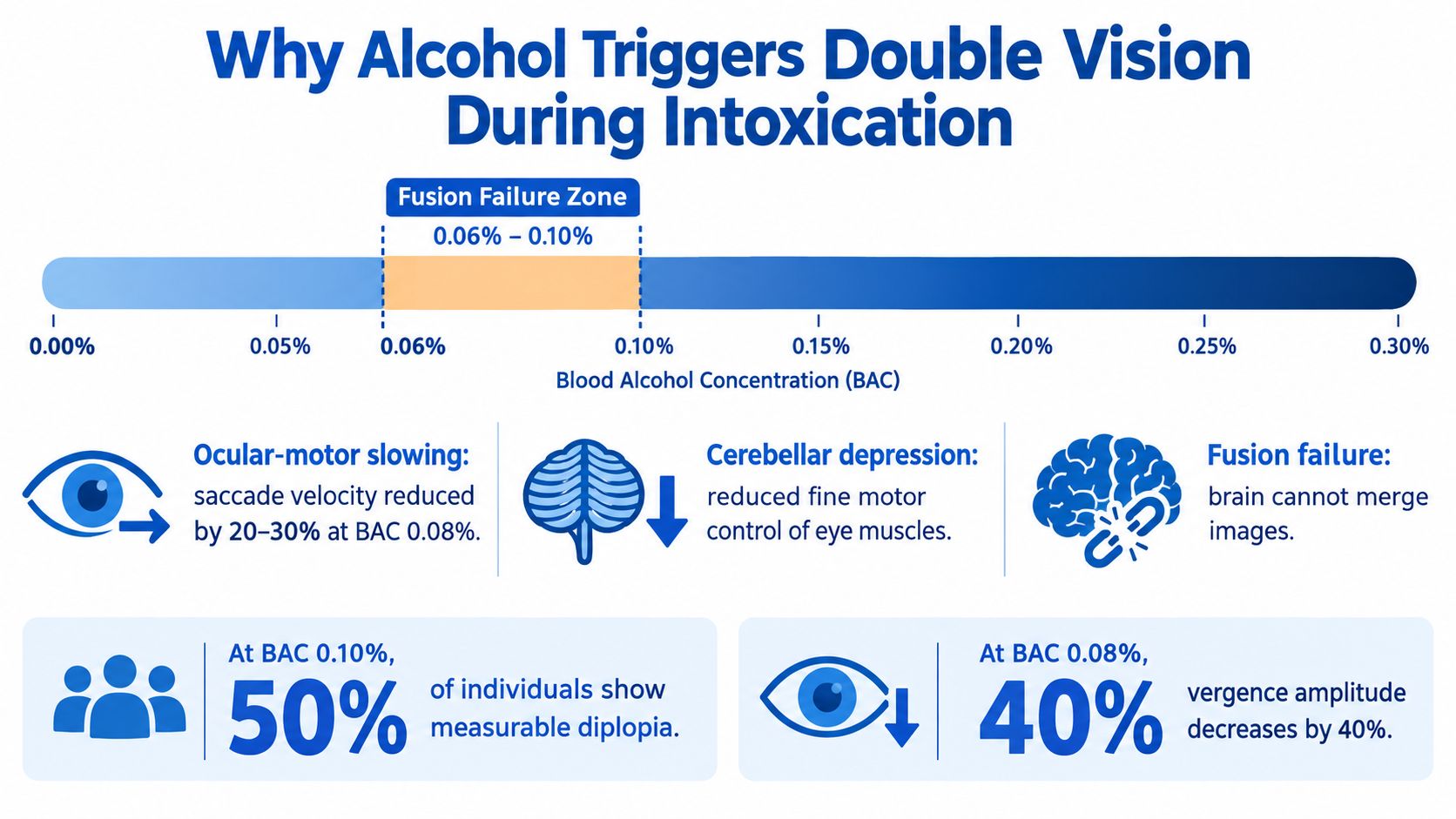
A detailed clinical review explains that acute alcohol exposure can impair binocular vision by depressing cerebellar control of eye coordination, disrupting the fusion reflex and vergence mechanisms needed to keep both foveae aligned on one target. When fusion reserves are exceeded, binocular single vision breaks down and diplopia appears, especially during tasks that require fine vergence adjustments such as reading, nighttime driving, or tracking moving objects (clinical review of binocular vision and alcohol effects).
Later in the same visual process, tracking can also fall apart in ways people feel as unstable sight. This short explainer helps show the eye-brain side of that problem in motion.
Why Alcohol Can Trigger Double Vision During Intoxication
Alcohol can trigger double vision because it interferes with the control system that keeps both eyes aligned. The key point is that this is usually a fusion failure, not just a focusing problem.
What starts to change as intoxication rises
Alcohol-related visual changes are recognized acute effects of intoxication. One review found that noticeable visual changes commonly begin around 0.08% BAC, which is also the legal driving limit in many countries. Another clinical review found statistically significant reductions in distance visual acuity and stereoacuity after drinking, including a near-constant shift in horizontal phoria of 2.9 ± 3.2 prism diopters in one study of 30 participants (review of blurred vision and intoxication effects).
That phoria shift matters because phoria is the tendency of the eyes to drift when the brain's fusion system relaxes. If alcohol nudges the eyes farther out of alignment, the brain has to work harder to keep the image single.
For some people, that extra demand is enough to tip them into seeing double.
Why the image splits instead of just going soft
Objective testing shows that higher alcohol exposure slows and destabilizes ocular-motor performance. A clinical research summary reports that alcohol can reduce saccade velocity, increase saccade onset latency, and lower smooth-pursuit gain, creating more saccadic pursuit and retinal slip. That same review notes that diplopia can appear around 0.08% BAC and blurred vision around 0.10% BAC in some drinkers, although susceptibility varies by person (ocular-motor findings in alcohol exposure).
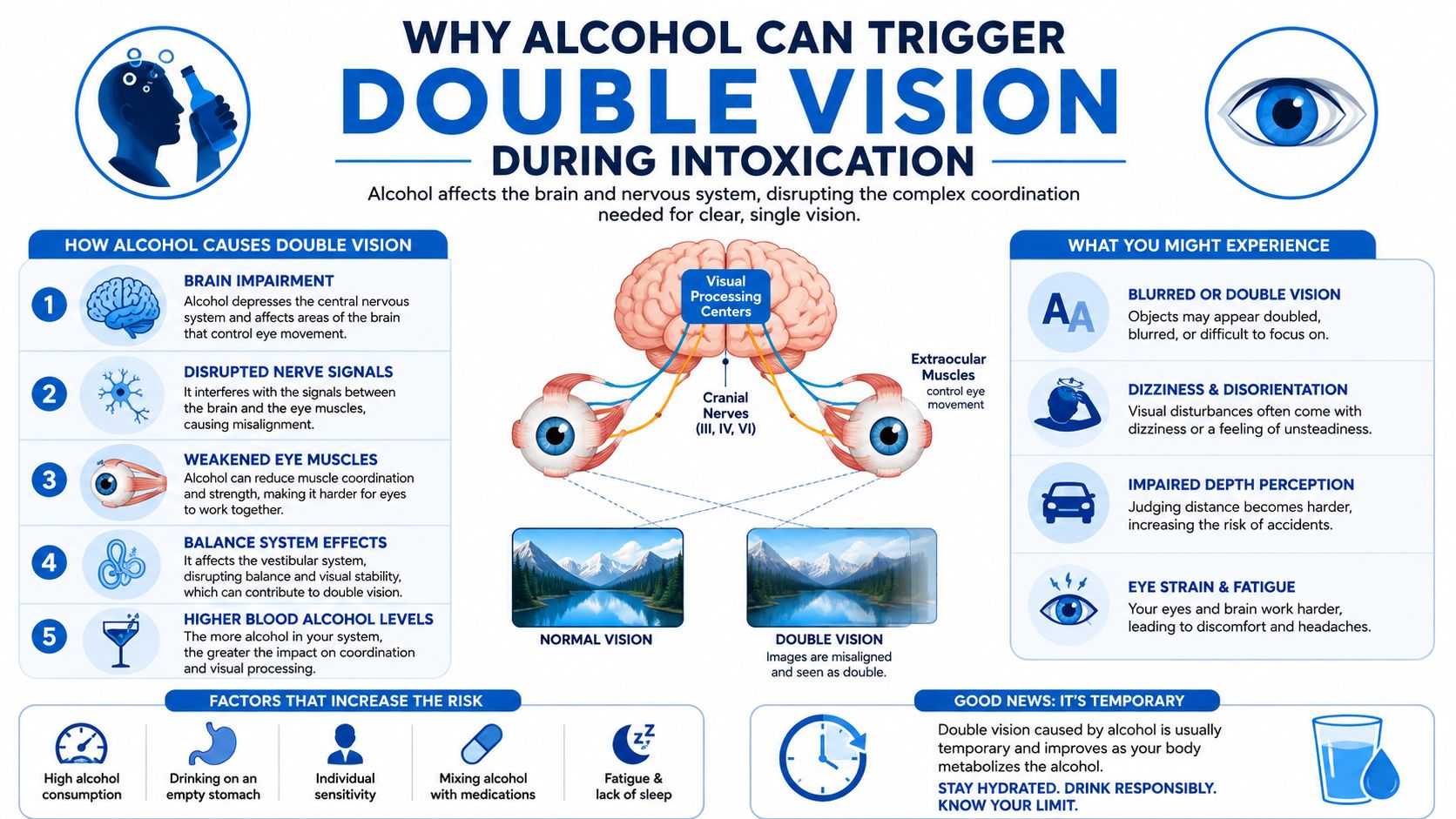
That helps explain a common experience. A person may say, “I can see it, but it won't stay still,” or “The words split when I try to read.” The eyes are still receiving images. The tracking and alignment system is failing to hold them together.
Why one person gets it sooner than another
Not everyone develops symptoms at the same moment or in the same way. One person may mainly feel blur. Another notices doubled headlights first. Another gets unstable tracking.
Pupil changes can overlap with these visual symptoms, which is why some people also look into related signs such as alcohol and dilated pupils. But when true doubling happens, the main problem is still binocular coordination.
A practical way to think about it:
- Reading exposes it early because near work needs constant fine alignment.
- Night driving exposes it early because low light and oncoming lights make small errors more obvious.
- Moving scenes expose it early because smooth tracking is harder when ocular-motor control slows.
If the doubling disappears as sobriety returns, that supports an intoxication-related cause. If it lingers, recurs often, or arrives with other neurologic symptoms, it stops being routine.
Double Vision Beyond Acute Drinking and Nutritional Deficiency Links
A single episode during intoxication is one pattern. Persistent, repeated, or more medically complicated double vision is another.
Many quick guides fall short. They explain the short-term effect but skip what chronic heavy use, withdrawal-related complications, or thiamine deficiency can do to eye movements and brain function.
What long-term patterns can point to
Historical and experimental evidence shows this isn't a new observation. A 1992 Australian road-safety publication reported significant changes in heterophoria, negative fusion range, and peak saccadic velocity at moderate blood alcohol levels. Later work also cites classic ophthalmic studies from 1940, 1950, 1955, 1969, and 1977, showing that alcohol-induced diplopia has been documented for decades as a sign of impaired eye coordination (historical and experimental review of alcohol and binocular vision).
That long history matters because it reminds us that double vision in a drinker is not a trendy internet symptom. Clinicians have recognized it for a very long time.
Acute vs Persistent Alcohol Related Double Vision Patterns
| Pattern | Typical Timing | Key Associated Signs | What It Suggests |
|---|---|---|---|
| Acute intoxication | During or shortly after drinking | Unsteady gait, slowed reactions, worse with reading or low light, improves as alcohol wears off | Temporary fusion failure from alcohol's effect on eye-brain coordination |
| Recurrent episodes with heavy use | Happens across multiple drinking episodes or with smaller amounts over time | Repeated visual complaints, worsening balance, lingering coordination problems | Alcohol may be exposing an underlying eye alignment weakness or broader neurologic strain |
| Persistent double vision after sobriety | Continues after expected intoxication should have resolved | Ongoing diplopia, gait trouble, abnormal eye movements, new neurologic symptoms | Needs urgent evaluation for ocular motor or neurologic causes |
| Nutritional deficiency related pattern | Often in long-term heavy drinkers | Confusion, clumsiness, abnormal eye movements, mental status change | Possible thiamine deficiency or Wernicke-spectrum illness |
| Withdrawal-related complicated picture | During medically significant alcohol withdrawal or recovery | Agitation, severe confusion, visual disturbance, autonomic instability | Medical assessment is needed rather than home monitoring |
Persistent or repeatedly triggered double vision deserves a different level of concern than a brief, clearly intoxication-linked episode.
The nutritional deficiency pathway many people miss
A second neglected issue is the link between long-term heavy alcohol use and nutritional injury. Clinical and recent sources note that Wernicke syndrome can present with double vision, abnormal eye movements, clumsiness, and confusion in heavy drinkers, and that vision changes in this setting may reflect thiamine deficiency or other alcohol-related neurologic injury rather than simple intoxication (discussion of alcohol-related vision changes and Wernicke warning signs).
That's one reason families often look for supportive ways to improve overall eye health while medical evaluation is underway. For general wellness support, some people also browse eye care products, but supplements should never replace urgent assessment when double vision is persistent or paired with confusion or imbalance.
Warning Signs That Mean You Need Emergency Care Now
The most important decision isn't “what caused this in theory.” It's whether the pattern looks unsafe right now.
Double vision after alcohol can be temporary. But there's a line where it stops being something to sleep off and becomes something to treat as urgent.
Use this emergency filter
Stronger clinical guidance emphasizes the gap many consumer articles miss. Persistent double vision, severe headache, weakness, speech changes, eye pain, or confusion can point to neurologic or ocular emergencies rather than simple intoxication, especially when symptoms continue after sobriety should have returned (clinical warning signs for urgent evaluation).
Seek emergency care now if any of these are happening:
- The double vision persists: If you're no longer clearly intoxicated and the symptom is still there, that's a red flag.
- There's a severe headache: A major new headache with double vision needs prompt evaluation.
- Weakness or numbness appears: Trouble moving an arm, leg, or one side of the face raises concern for a neurologic event.
- Speech changes show up: Slurred speech can happen with intoxication, but new difficulty forming words or understanding language needs urgent attention.
- Confusion is getting worse: Disorientation, memory gaps, or unusual sleepiness can signal something more serious.
- There's eye pain or a sudden change in vision quality: Painful or one-sided symptoms need prompt assessment.
What to do in the moment
If you're deciding whether to go in, keep the steps simple:
- Stop drinking immediately.
- Don't drive. Ask a sober person to stay with you and arrange transportation.
- Notice the pattern. Is it constant or intermittent? Better with one eye closed? Linked with headache, weakness, or confusion?
- Get urgent help if the symptom persists or clusters with neurologic signs.
If withdrawal may be part of the picture, medically supervised care matters because visual symptoms can occur in more serious withdrawal states. This overview of alcohol withdrawal treatment in hospital can help families understand why home observation isn't always enough.
When you arrive for care, tell the team when the double vision started, how much alcohol was involved if known, whether it improves with one eye closed, and whether there are balance, headache, or mental status changes.
How Clinicians Evaluate and Treat Alcohol Related Double Vision
When someone comes in with double vision after drinking, clinicians usually try to answer two questions quickly. Is this a short-lived intoxication effect, or is it a sign of neurologic, ocular-motor, or nutritional injury that needs more treatment?
The workup often feels more detailed than patients expect, because eye alignment problems are really brain-eye coordination problems.
What the evaluation usually includes
A typical assessment starts with history.
Clinicians ask when the symptom began, whether it's horizontal or vertical, whether it disappears when either eye is closed, and whether there are associated problems such as imbalance, headache, confusion, vomiting, or weakness. They also ask about drinking pattern, recent nutrition, previous episodes, and any history of withdrawal.
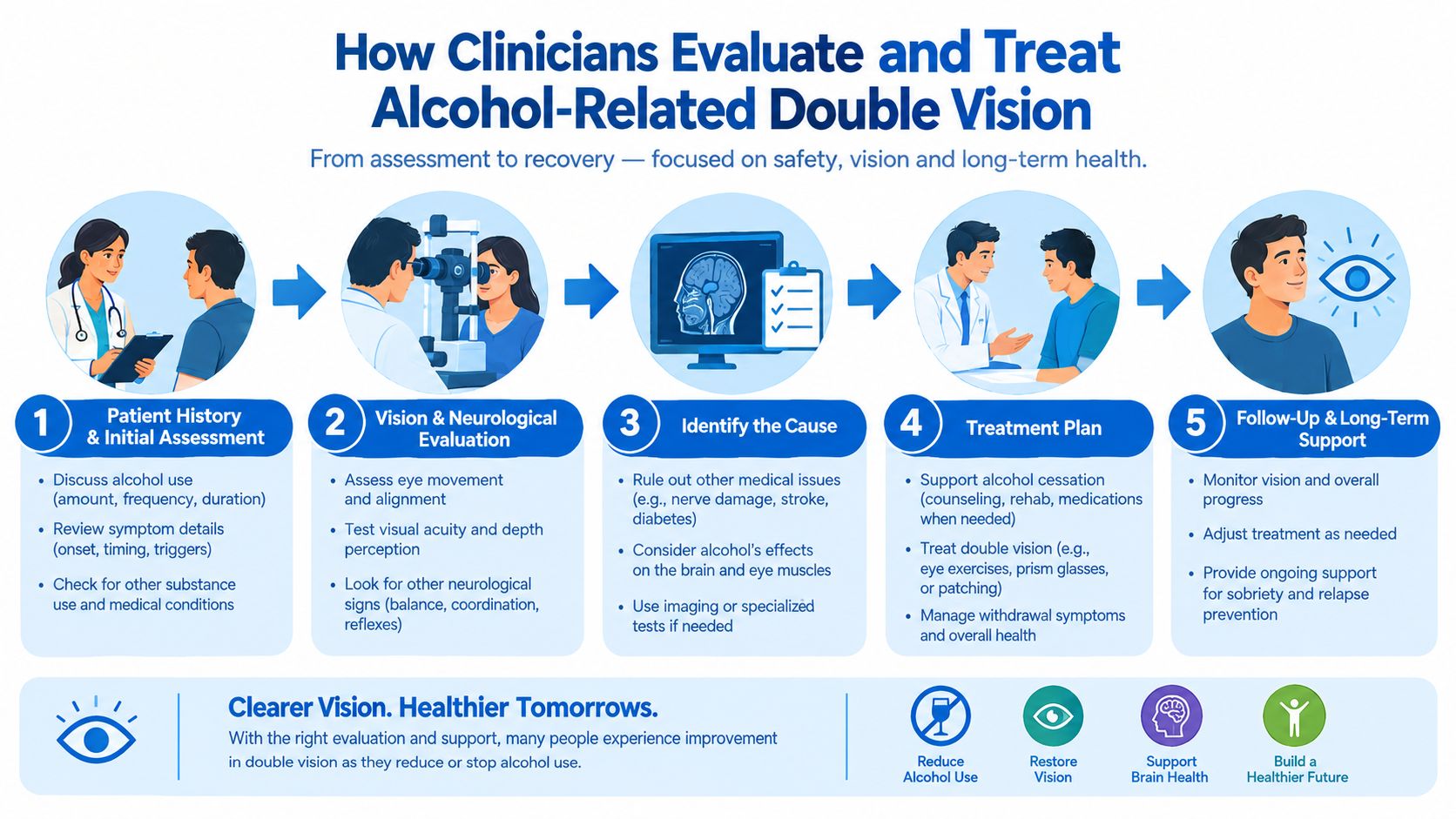
Then comes the focused exam. This may include:
- Eye alignment testing: Cover testing can reveal whether one eye drifts when fusion is interrupted.
- Saccades and pursuit: The clinician watches how quickly and smoothly the eyes move from target to target or follow a moving object.
- Convergence and near work: Reading-like tasks can expose subtle vergence failure.
- Neurologic exam: Coordination, gait, cranial nerves, and mental status all matter here.
How treatment depends on the pattern
If the picture fits uncomplicated intoxication and symptoms are fading, treatment may be supportive observation in a safe setting with clear instructions not to drive or remain alone if symptoms are significant.
If the story suggests thiamine deficiency, Wernicke-spectrum illness, or persistent neurologic dysfunction, treatment becomes more urgent and more medical. The aim isn't only to relieve double vision. It's to protect the brain.
New double vision after drinking that lasts beyond expected intoxication should be treated as a neurologic warning sign until a clinician says otherwise.
Some people also need referral to an emergency department, neurologist, ophthalmologist, or neuro-ophthalmologist. Imaging or additional testing may be considered when the exam doesn't fit a simple intoxication pattern.
For people whose visual symptoms are part of a larger alcohol use disorder, ongoing treatment may matter as much as the immediate exam. In Northern California, one option is Addiction Resource Center LLC, which provides medically supervised detox, outpatient treatment, and support for co-occurring substance use and mental health needs. The goal in that setting is not eye care alone. It's stabilizing alcohol use so repeated neurologic stress doesn't keep happening.
Prevention Recovery and Support Options for Lasting Clarity
The safest way to prevent alcohol-related double vision is to reduce or stop the alcohol exposure that triggers it. That can be a hard sentence to read, especially if drinking has become part of how you cope, sleep, socialize, or get through stress. But from a brain-and-vision standpoint, it's the cleanest truth.
Practical ways to lower risk
If double vision has happened after drinking, treat that as useful information. Your system has already shown that alcohol can disrupt eye coordination enough to make daily tasks unsafe.
Helpful next steps often include:
- Stop driving after any visual change: If words split, headlights double, or tracking feels off, you're not safe to drive.
- Pay attention to repetition: One brief episode may be intoxication. Repeated episodes deserve medical review.
- Don't ignore nutrition: People with heavy long-term alcohol use may need assessment for deficiencies, especially if balance, confusion, or abnormal eye movements are involved.
- Get help before withdrawal starts at home: If stopping alcohol leads to severe shakiness, agitation, confusion, or visual symptoms, medical guidance is safer than trying to push through alone.
Recovery protects more than sobriety
When alcohol use is frequent or hard to control, preventing the next episode of double vision usually means treating the drinking pattern, not just the symptom.
That may include detox, counseling, medication support, outpatient care, family involvement, and aftercare planning. Some patients do well with structured outpatient treatment. Others need monitored detox first. For people exploring medication support, this guide to MAT treatment for alcohol can help clarify one part of the treatment picture.
The goal isn't only to stop seeing double. It's to protect the brain systems that keep vision, balance, judgment, and safety working together.
If you're a family member, trust what you're seeing. A loved one who keeps describing double vision, stumbling, acting confused, or struggling to track objects may need medical care, not an argument about whether they're “just drunk.”
The hopeful part is simple. Temporary alcohol-related double vision can resolve. Persistent or recurrent symptoms can be evaluated. And if alcohol is driving the cycle, treatment can reduce the chances that the problem keeps coming back.
If alcohol use is tied to episodes of double vision, confusion, unsafe driving, or withdrawal risk, Addiction Resource Center LLC offers medically supervised detox, outpatient care, and support for adults and families dealing with alcohol use disorders. Their team can help you sort out whether you need urgent medical evaluation, structured treatment, or a safer plan for stopping alcohol. Visit Addiction Resource Center LLC to learn more or reach out for guidance.