The search usually starts in a hard moment. A person wakes up sick, scared, and exhausted from chasing relief. Or a parent is sitting in the car outside work, searching treatment options on a phone and wondering which choice is real help and which one is just another short stop. What most need in that …

The search usually starts in a hard moment. A person wakes up sick, scared, and exhausted from chasing relief. Or a parent is sitting in the car outside work, searching treatment options on a phone and wondering which choice is real help and which one is just another short stop.
What most need in that moment isn't a lecture. They need a map.
Heroin addiction recovery is rarely one dramatic turning point. It's more like bringing a storm-hit system back online. First, you get safe. Then you stabilize. Then you rebuild daily life in a way that can hold under stress. That process can include medically supervised detox, medication-assisted treatment, residential rehab, outpatient care, and aftercare that keeps the gains from slipping away.
Table of Contents
- Introduction to Heroin Addiction Recovery and What Healing Looks Like
- Understanding Heroin Addiction and How Recovery Works
- Treatment Options That Support Lasting Recovery
- What to Expect During Each Phase of Recovery
- Relapse Prevention and Aftercare Planning That Keeps Progress Going
- How Families and Loved Ones Can Help Without Hurting Recovery
- Navigating Insurance and Accessing Local Help in Yuba City
Introduction to Heroin Addiction Recovery and What Healing Looks Like
A lot of people picture recovery as one event. Finish detox. Go to rehab. Come home cured. Real healing usually doesn't work that way.

A more honest picture is this: someone stops using long enough to get medically safe, then starts sleeping again, eating again, thinking more clearly, and reacting less urgently to cravings. Later, they practice saying no to old routines, repairing trust, keeping appointments, and learning how to get through a bad day without using. Recovery becomes visible in daily life long before everything feels easy.
What healing often looks like in real life
Healing can begin.
A person who used to spend the whole day trying to avoid withdrawal begins to make it to breakfast. Then to counseling. Then to a full week without leaving treatment. A family that has lived in chaos begins to have ordinary conversations again. Small routines start doing heavy lifting.
That view matches what treatment research has shown. A major one-year Australian study of heroin dependence found much better heroin abstinence outcomes for people who received treatment than for those who did not. At 12 months, 65% of people in maintenance therapy, 52% in detoxification, and 63% in residential rehabilitation were heroin-abstinent, compared with 25% in the non-treatment group, with broader improvements in drug use, criminality, psychopathology, and injection-related health problems as well, according to the Australian Treatment Outcome Study follow-up on heroin dependence treatment.
The path is a continuum, not a single stop
People often get overwhelmed because they think they need to understand every treatment detail before making one call. You don't.
Recovery usually starts with the next safe step, not with a perfect long-term plan.
What helps is knowing the general path. Care often moves from assessment and withdrawal support into medication-assisted treatment, residential structure when needed, outpatient therapy, and aftercare. Each phase has a different job.
You'll see what heroin addiction recovery means in the brain and body, how to compare treatment options, what each phase feels like, how relapse prevention works, how families can help, and how to take practical steps toward local care.
Understanding Heroin Addiction and How Recovery Works
Heroin changes the way the brain and body respond to stress, reward, and discomfort. That's why people can sincerely want to stop and still feel pulled back toward use.
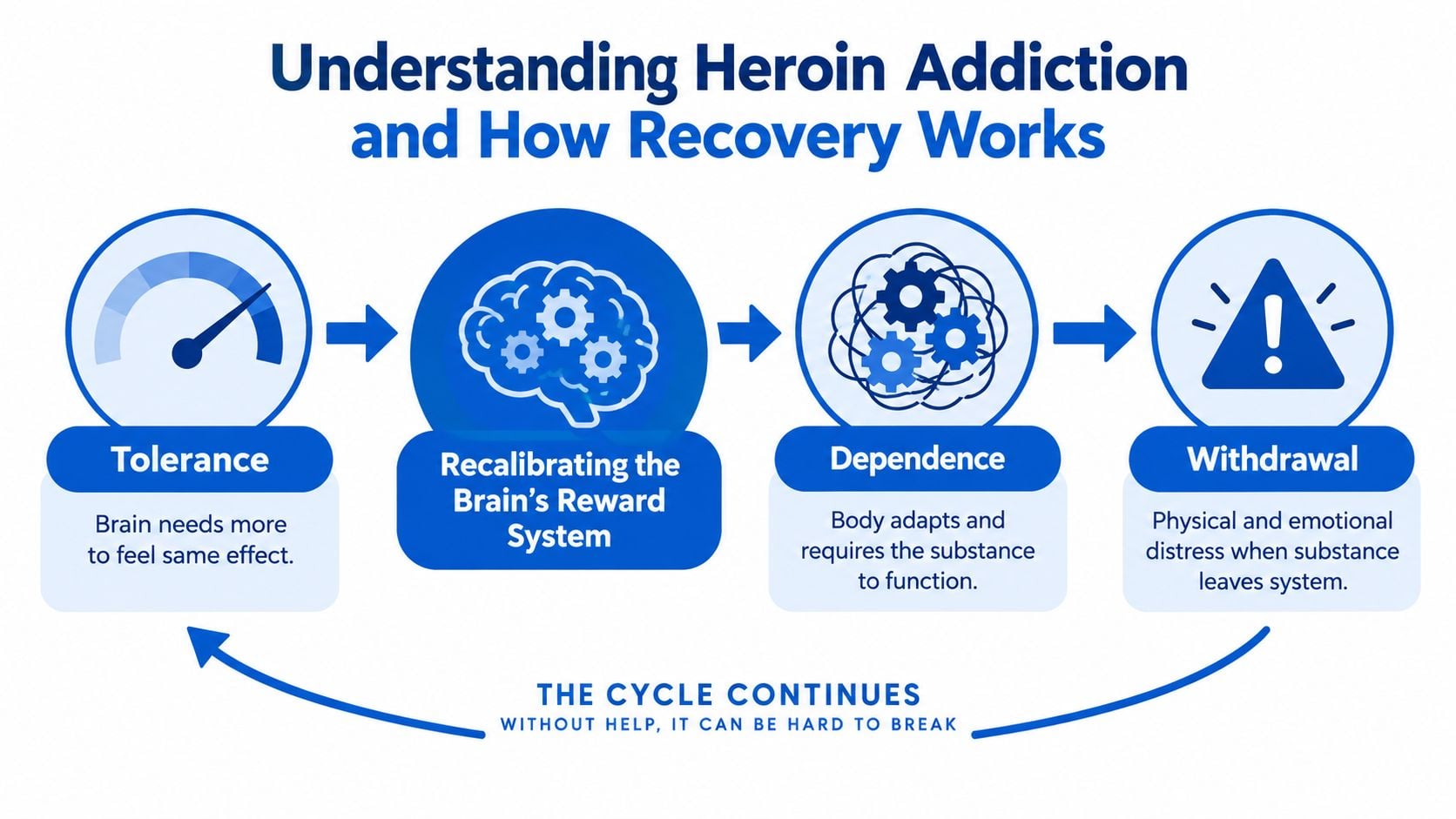
A thermostat that has been forced out of calibration. At first, the drug creates a strong effect. Over time, the system adjusts. The person may need more just to feel normal, not even high. When heroin leaves the system, the body reacts hard because the settings have shifted.
Why willpower alone often isn't enough
Readers often get confused. They ask, “If my loved one really wants recovery, why can't they just stop?”
Because stopping isn't only a decision problem. It's also a dependence and withdrawal problem. When the body has adapted to repeated opioid exposure, withdrawal can take over attention, judgment, and behavior. The person may feel sick, agitated, sleepless, and desperate for relief. In that state, “just say no” is like telling someone with a severe asthma attack to calm down and breathe better.
That's why treatment works best when it helps the brain and body settle down while the person builds new routines. Medication, structure, monitoring, counseling, and repetition all support that reset.
Recovery means broader stabilization
Heroin addiction recovery isn't just about whether someone used on one specific day. It includes safety, mood, sleep, thinking, reliability, relationships, and whether the person can function without constantly organizing life around avoiding withdrawal.
Long-term studies have also shown why this process needs patience. An 11-year follow-up from the Australian Treatment Outcome Study found that 10.2% of participants had died, 46.6% were still in treatment, and about one in four continued using heroin at year 11. In a separate 20-year cohort analysis of 401 people with severe heroin use, 18% of the original cohort had died, 14% had severe heroin use disorder, and 83% reported other current substance use, according to the long-term heroin recovery follow-up findings summarized in this evidence review.
Those numbers don't mean recovery is hopeless. They mean recovery is often long-term health stabilization, not a quick cure.
The goal isn't to prove toughness. The goal is to reduce danger, increase stability, and keep moving toward a life that can hold.
If you want a plain-language overview of medication support, this guide to MAT and addiction medicine is a helpful companion when you're sorting through treatment choices.
Treatment Options That Support Lasting Recovery
Different treatment options do different jobs. Problems start when people expect one level of care to do the work of another.
Detox helps a person get through withdrawal safely. Medication-assisted treatment helps steady the nervous system and reduce the push back toward heroin use. Residential care creates distance from triggers and adds structure. Intensive outpatient care helps people practice recovery in real life while keeping clinical support in place.
Why detox is a beginning, not the finish line
Many families hope detox will solve the whole problem. It usually doesn't.
Independent clinical guidance warns that withdrawal management by itself is ineffective for opioid use disorder and is associated with near-universal relapse, especially after abrupt tapers of less than one week. The same guidance also notes that buprenorphine should be started only when objective withdrawal is present, with an initial 4 to 6 mg dose in one guideline, to lower the risk of precipitated withdrawal, as described in the CRISM guidance on withdrawal management and buprenorphine initiation.
That's a key practical point. Detox can make someone drug-free for a moment. It doesn't automatically make them stable.
How medication-assisted treatment supports retention
For opioid addiction, retention in care matters. A person who stays engaged in treatment has more protection against the repeated cycle of withdrawal, craving, and return to use.
A Cochrane review found that buprenorphine at any studied dose retained patients better than placebo, and high-dose buprenorphine, defined there as 16 mg/day or more, reduced illicit opioid use. The review also found that methadone generally outperformed flexible-dose or low-dose buprenorphine for retention, with a pooled retention advantage in trials of RR 0.83, 95% CI 0.72 to 0.95, and that there was no meaningful difference only when both medications were used at sufficiently high fixed doses, according to the Cochrane review of buprenorphine maintenance versus placebo or methadone.
In plain language, underdosing or stopping medication too early can make recovery harder. Matching the right medication and dose to the person matters.
Choosing the right level of care for heroin recovery
| Treatment Option | Primary Purpose | Intensity and Setting | Best Fit When |
|---|---|---|---|
| Medically supervised detox | Manage withdrawal safely and prepare for next treatment step | Short-term, medically monitored setting | The person is physically dependent, has a high risk of severe withdrawal, or needs immediate stabilization |
| Medication-assisted treatment with buprenorphine or methadone | Reduce cravings, stabilize opioid receptors, improve retention | Ongoing medical care with counseling and follow-up | Cravings, relapse risk, and repeated returns to heroin use are central problems |
| Residential rehabilitation | Create structure, distance from triggers, and daily therapeutic routine | Live-in treatment with full-day programming and monitoring | Home is unstable, triggers are everywhere, or the person needs a contained recovery environment |
| Intensive Outpatient Program | Build skills while living at home and maintaining work or family roles when possible | Scheduled therapy and support, in person or telehealth | The person is medically stable enough not to need residential care but still needs strong support |
One local example of this continuum is Addiction Resource Center LLC, which offers medically supervised detox with MAT, residential rehab through Ona Treatment Center, and outpatient support including an addiction intensive outpatient program in person and through telehealth.
What to Expect During Each Phase of Recovery
The early days feel less mysterious when you know what usually happens next. They do better when they can stop guessing and start preparing.
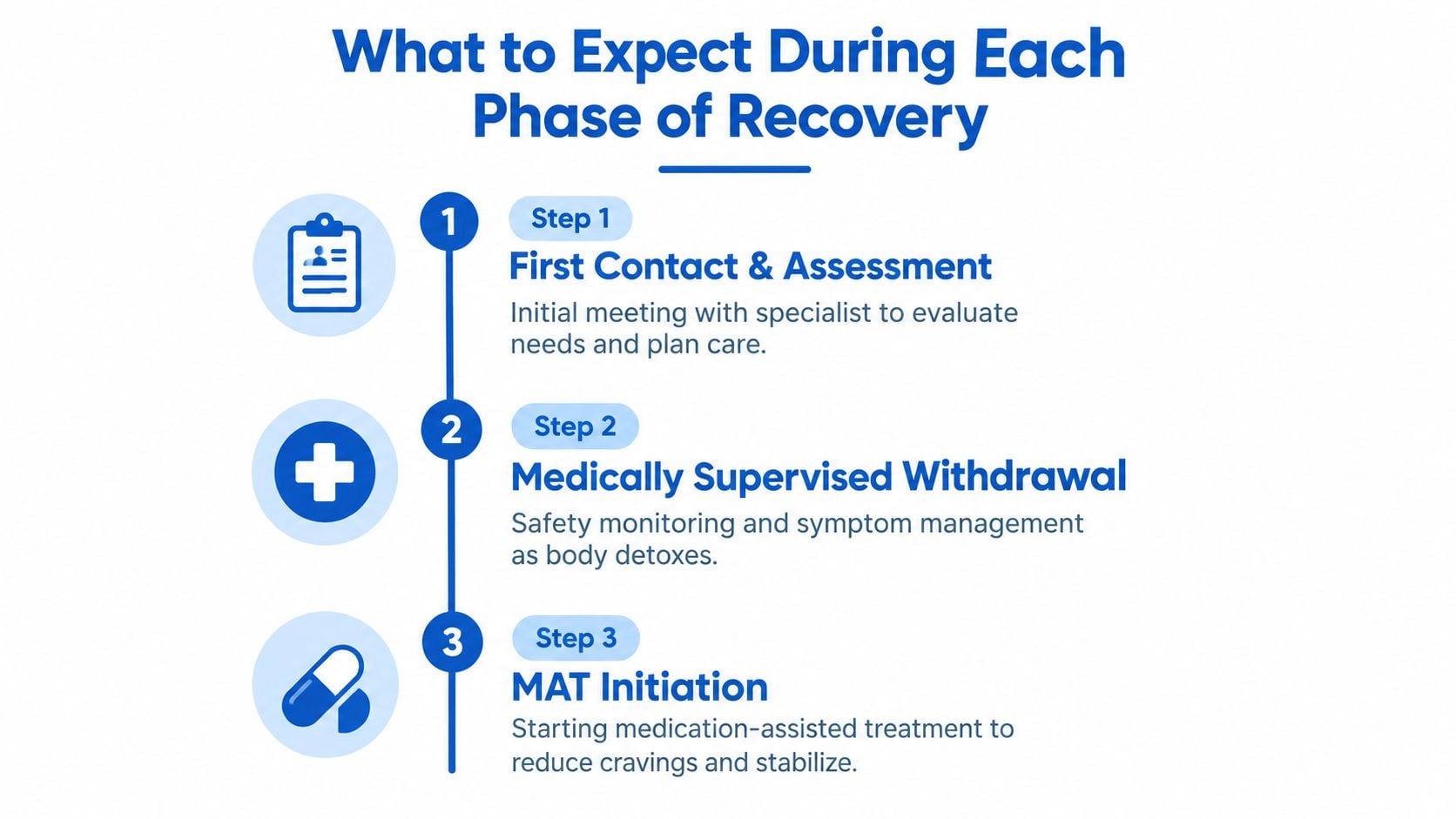
First contact and assessment
The first conversation is usually simple. Someone asks what's been happening, what substances are involved, what the current risks are, whether there are mental health concerns, and what kind of support system exists. The point isn't to judge. It's to decide what level of care is safest and most realistic.
You may also talk through practical concerns. Can the person leave work? Is home safe enough for outpatient care? Have there been recent overdoses, blackouts, or failed attempts to stop? Those details shape the plan.
Withdrawal support and medication start
During withdrawal, staff watch for discomfort, complications, and when medication can be started safely. This phase can be physically draining and emotionally rough. People often feel restless, discouraged, and unsure whether they can tolerate it.
The timing of medication matters. Starting too early can make things worse in some cases, which is why clinicians look for clear signs that objective withdrawal has begun before buprenorphine is introduced.
Reassurance: Feeling miserable in early withdrawal doesn't mean treatment is failing. It usually means the body is going through a hard but expected transition.
Useful preparation steps include:
- Bring the basics: Comfortable clothes, a list of medications, ID, insurance information, and contact numbers can reduce last-minute stress.
- Expect mixed emotions: Relief, anger, shame, and fear often show up together.
- Let staff know your history: Prior withdrawal experiences, mental health symptoms, and recent substance use help the team respond more safely.
Residential care, outpatient work, and step-down
If residential treatment is recommended, daily life becomes more structured. Wake times, meals, counseling, group therapy, medication checks, and recovery education create rhythm. That routine helps when decision-making has been chaotic for a long time.
Later, many people step down to outpatient care. That's when the focus shifts. Instead of being protected from triggers all day, the person starts practicing coping skills while living in the world again. Work stress, family conflict, boredom, and transportation problems become part of treatment rather than reasons treatment failed.
A strong step-down plan usually includes these pieces:
- Follow-up appointments that are scheduled before discharge, not left vague.
- Medication continuity so there's no gap in MAT if MAT is part of the plan.
- Skill practice around sleep, routines, communication, cravings, and high-risk situations.
Relapse Prevention and Aftercare Planning That Keeps Progress Going
Relapse prevention isn't one trick. It's a system. The system works better when people stop treating relapse like a random event and start looking at the chain that leads up to it.
For some people, the chain starts with loneliness. For others, it starts with pain, conflict, boredom, payday, or seeing a certain person's name on the phone. The earlier that chain gets noticed, the easier it is to interrupt.
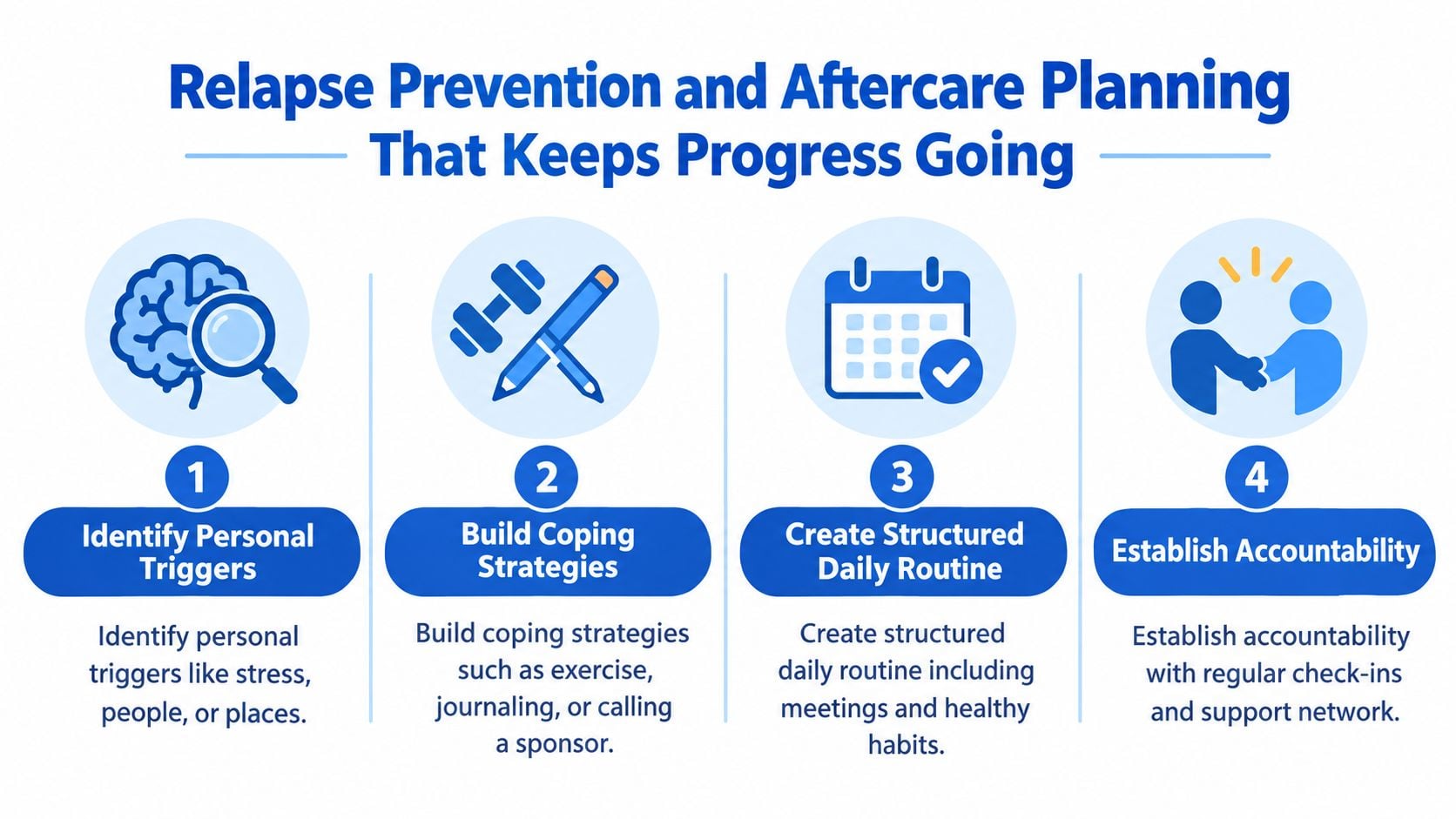
Build a plan around your own triggers
Generic advice doesn't hold up well under pressure. Personal plans do.
Some people relapse after contact with old using partners. Some after insomnia stacks up for several nights. Some when they start feeling “fine” and decide they don't need meetings, medication, therapy, or accountability anymore.
A practical prevention plan should cover:
- Known triggers: People, neighborhoods, arguments, cash in hand, physical pain, or unstructured time.
- Fast coping tools: Calling a mentor, leaving a risky place, attending a meeting, journaling, walking, or asking someone to stay with you.
- Protection for bad days: A written list of who to contact, where to go, and what to do before using becomes an option again.
Recovery often weakens gradually before it breaks suddenly. Missed appointments, skipped medication, isolation, and secrecy are warning signs worth taking seriously.
Keep support connected after discharge
Long-term heroin recovery often involves multiple transitions. That's normal. The risk comes when those transitions happen without support.
A major gap in care is simple access and continuity. Reporting cited in 2026 states that only about 16% of people needing substance use treatment received it in the past year, and only 15.7% of people with past-year opioid use disorder received medications for opioid use disorder, as discussed in this National Recovery Month 2026 article on treatment access and recovery. That helps explain why people need more than encouragement. They need a way to stay attached to care.
A strong aftercare checklist
Aftercare works best when it's concrete.
- Appointments on the calendar: Counseling, medication follow-up, primary care, and mental health visits should be set before discharge.
- A stable daily frame: Wake time, meals, transportation, work, meetings, exercise, and sleep routines reduce drift.
- People who will notice change: Family, peers, sponsors, mentors, or counselors who know the warning signs can respond early.
- Basic life support: Housing, work planning, legal obligations, and childcare problems should be addressed directly because instability can reopen risk.
- A written relapse prevention plan: If you need help building one, this guide on what a relapse prevention plan is gives a simple starting structure.
How Families and Loved Ones Can Help Without Hurting Recovery
Families often swing between two painful extremes. They either try to control everything, or they get so burned out that they back away completely. Neither one usually helps for long.
The middle path is support with boundaries. That means taking addiction seriously as a health condition while still refusing to participate in chaos.
What helps more than people expect
Start with how you talk. Short, calm, direct language works better than speeches. “I care about you, and I'll help you get assessed today” usually lands better than “You're ruining your life and everyone else's.”
Helpful support often looks like this:
- Offer action, not arguments: Drive them to an assessment, help gather documents, or sit with them during a treatment call.
- Set clear limits: You can refuse to give cash, allow drug use in the home, or cover up legal or work consequences.
- Join family education if available: Families do better when they understand cravings, withdrawal, manipulation, and relapse risk as patterns instead of personal attacks.
What tends to make recovery harder
Some well-meant responses can accidentally keep the cycle going.
- Rescuing from every consequence: Paying repeated debts, making excuses to employers, or hiding drug use from others can remove pressure to accept care.
- Monitoring like a detective: Constant phone checks, interrogations, and surprise confrontations often increase secrecy, not honesty.
- Making treatment a one-time test: If a loved one slips, it doesn't mean all progress was fake. It may mean the plan needs more support, more structure, or a different level of care.
You can be compassionate without being permissive. Both matter.
If conversations keep exploding, or the person refuses help while risk is rising, ask a professional team for guidance on the safest next step. Families need support too. Exhausted relatives make better decisions when they have their own counseling, peer support, and rest.
Navigating Insurance and Accessing Local Help in Yuba City
Insurance questions stop a lot of people before treatment even starts. That's understandable. When someone is in crisis, nobody wants to sort through vague benefit language and surprise costs.
A simpler approach is to call and verify the essentials. Ask whether your plan covers medically supervised detox, medication-assisted treatment, residential rehab, and intensive outpatient care, including telehealth if needed. If you're a veteran or military family member, ask specifically about Tricare eligibility and authorization steps.
What to ask on the first call
Keep a short list in front of you.
- Coverage questions: Ask which levels of care are in network and what preauthorization may be required.
- Timing questions: Ask how soon an assessment can happen and whether same-day guidance is available.
- Continuity questions: Ask how the program handles discharge planning, MAT follow-up, and transitions between levels of care.
If you're comparing local and regional services, the Wald Behavioral Health areas page can help you understand coverage geography and care options across surrounding communities.
For local help in Yuba City, Addiction Resource Center is located at 1002 Live Oak Blvd Suite A, Yuba City, CA. They also have a 24/7 phone and text line at 530-625-7910. A first call typically focuses on privacy, immediate safety, substance use history, insurance verification, and which next step fits best. You can also ask about scheduling a tour if seeing the setting first would make the decision easier.
The biggest practical mistake is waiting for the perfect moment. A private, straightforward call can turn confusion into a plan.
Addiction Resource Center LLC provides medically supervised detox with MAT, residential rehab through its partner facility, intensive outpatient care, and aftercare planning for adults who need real structure for heroin addiction recovery. If you or someone you love needs a calm, confidential next step in Yuba City or Northern California, visit Addiction Resource Center LLC and start the conversation today.