You may be sitting with a notebook, a discharge packet, or a phone full of advice people keep sending you. “Make a plan.” “Set goals.” “Get your life together.” In early recovery, that can sound simple and feel impossible. The usual personal improvement plan content doesn't fit this stage of life. It often borrows from …

You may be sitting with a notebook, a discharge packet, or a phone full of advice people keep sending you. “Make a plan.” “Set goals.” “Get your life together.” In early recovery, that can sound simple and feel impossible.
The usual personal improvement plan content doesn't fit this stage of life. It often borrows from workplace performance plans or generic self-help checklists, then acts like discipline alone will carry you. That misses what many people in recovery already know in their bones. A healing brain gets tired fast, focus comes and goes, emotions spike, and too many decisions can knock a whole day off track.
That gap matters. One review of this problem notes that most personal improvement plan advice blurs corporate PIPs and real self-development for recovery, and that 68% of individuals in early recovery fail self-improvement plans because they ignore neurocognitive fatigue tied to substance use (StaffCircle). If your past plans fell apart, that doesn't automatically mean you were lazy, unserious, or “not ready.” It may mean the plan was built for the wrong person in the wrong season.
A better model starts smaller, gets more support, and respects what recovery asks of you. Good outside frameworks can still help. If you want a broader self-development perspective, Life Purpose App's guide to growth offers useful reflection prompts. In recovery, though, the standard needs to be different. The plan has to work on hard days, not just motivated ones.
If you're trying to build a life that lasts, not just stack sober days, it helps to think in terms of routines, values, triggers, treatment support, and accountability. That's how long-term change gets traction. For a practical mindset on steady sobriety, this sober for life resource is a strong companion.
Table of Contents
- Introduction Beyond the Corporate PIP
- Laying Your Foundation with Core Values
- Setting Recovery-Focused SMART Goals
- Building a Structured Routine for Sobriety
- Mapping Your Triggers and Coping Strategies
- Assembling Your Accountability and Support Team
- Your Plan as a Living Document for Growth
Introduction Beyond the Corporate PIP
A corporate performance plan is built to correct output. A recovery-centered personal improvement plan is built to protect a life.
That difference sounds obvious, but many people don't feel it until they try to use the wrong template. Corporate-style plans assume stable attention, predictable energy, and a person who can push harder when stress rises. Early recovery rarely works that way. People need fewer moving parts, more support, and clear ways to respond when cravings, shame, conflict, or exhaustion show up.
Generic plans often fail because they ask for polished executive function from people whose nervous systems are still stabilizing.
A useful recovery plan is compassionate without becoming vague. It still asks for honesty, effort, and follow-through. But it doesn't pretend that “try harder” is a strategy. It accounts for treatment appointments, sleep disruption, legal stress, family repair, medication schedules, transportation problems, and the mental fog that can hit even when someone wants change.
Individuals also don't usually need a giant reinvention project in the first month. They require a plan that answers a few grounded questions:
- What matters most right now
- What do I need to do this week
- What situations put me at risk
- Who will know if I'm slipping
- What support do I need before things get bad
That's the shift. Recovery doesn't improve because a plan looks impressive on paper. It improves because the plan is usable on a tired Tuesday, after an argument, during a craving, or when motivation drops out. If it only works when you feel strong, it's not a strong plan.
Laying Your Foundation with Core Values
Many people start with goals because goals feel productive. In recovery, values often matter more at first. Goals tell you what to do. Values tell you why it matters when doing it feels hard.

Why values come before goals
If someone says, “I want to get healthier,” that can mean a lot of different things. It might mean sleeping through the night, eating breakfast, taking prescribed medication correctly, walking after dinner, or showing up to therapy instead of isolating. Values help narrow that down.
In our work with recovery planning, the most durable changes usually connect to a value the person believes in now, not one they think they're supposed to perform. Common values in recovery include honesty, stability, family, peace, health, dignity, faith, service, reliability, and connection.
When a person says, “I want to stay sober because I value being dependable for my kids,” that lands differently than “I should probably stop messing up.” One creates direction. The other creates shame.
Practical rule: If a goal doesn't connect to a value, it usually won't survive stress.
A simple values exercise
Don't overcomplicate this. You don't need a perfect identity statement. You need a short list that feels true.
Start by writing down answers to these prompts:
- What have I nearly lost that I don't want to lose again?
- What kind of person do I want people to experience when they're around me?
- What feels better now that I'm not using, even a little?
- What have I been avoiding because addiction pulled me away from it?
- What do I want my daily life to stand for?
Then circle the words that repeat themselves. Maybe you keep coming back to honesty, calm, health, and family. Maybe it's self-respect, work, and spiritual growth. There's no prize for picking the most admirable list. The right values are the ones you're willing to protect.
A few examples:
- Honesty if hiding, minimizing, or double lives have done damage.
- Stability if chaos has run the schedule for too long.
- Connection if isolation has been a relapse pathway.
- Health if your body has taken a hit and needs steady care.
- Responsibility if repairing trust matters more than quick comfort.
Write a mission statement you can use
Turn those values into one or two plain sentences. Keep it short enough to remember when you're upset.
Examples:
- I'm building a sober life based on honesty, stability, and showing up for my family.
- I protect my recovery by choosing health, structure, and connection over chaos.
- I want a life that feels calm, responsible, and real.
This statement isn't for social media. It's for decision-making. Use it when you're asked somewhere you shouldn't go, when you're tempted to hide a mistake, or when you're deciding whether to skip a support appointment because you feel “fine.”
Here's a good test. Read your statement and ask, “Would this help me make a better choice on a bad day?” If yes, keep it. If it sounds polished but empty, rewrite it in simpler language.
A personal improvement plan works better when the plan sounds like your life, not a workbook. Values give the rest of the plan a spine.
Setting Recovery-Focused SMART Goals
SMART goals are useful, but only if they're adapted for recovery. The standard framework can become another pressure machine if every goal is too big, too fast, or too disconnected from treatment and daily capacity.
Early in this process, visual frameworks can help keep things clear.
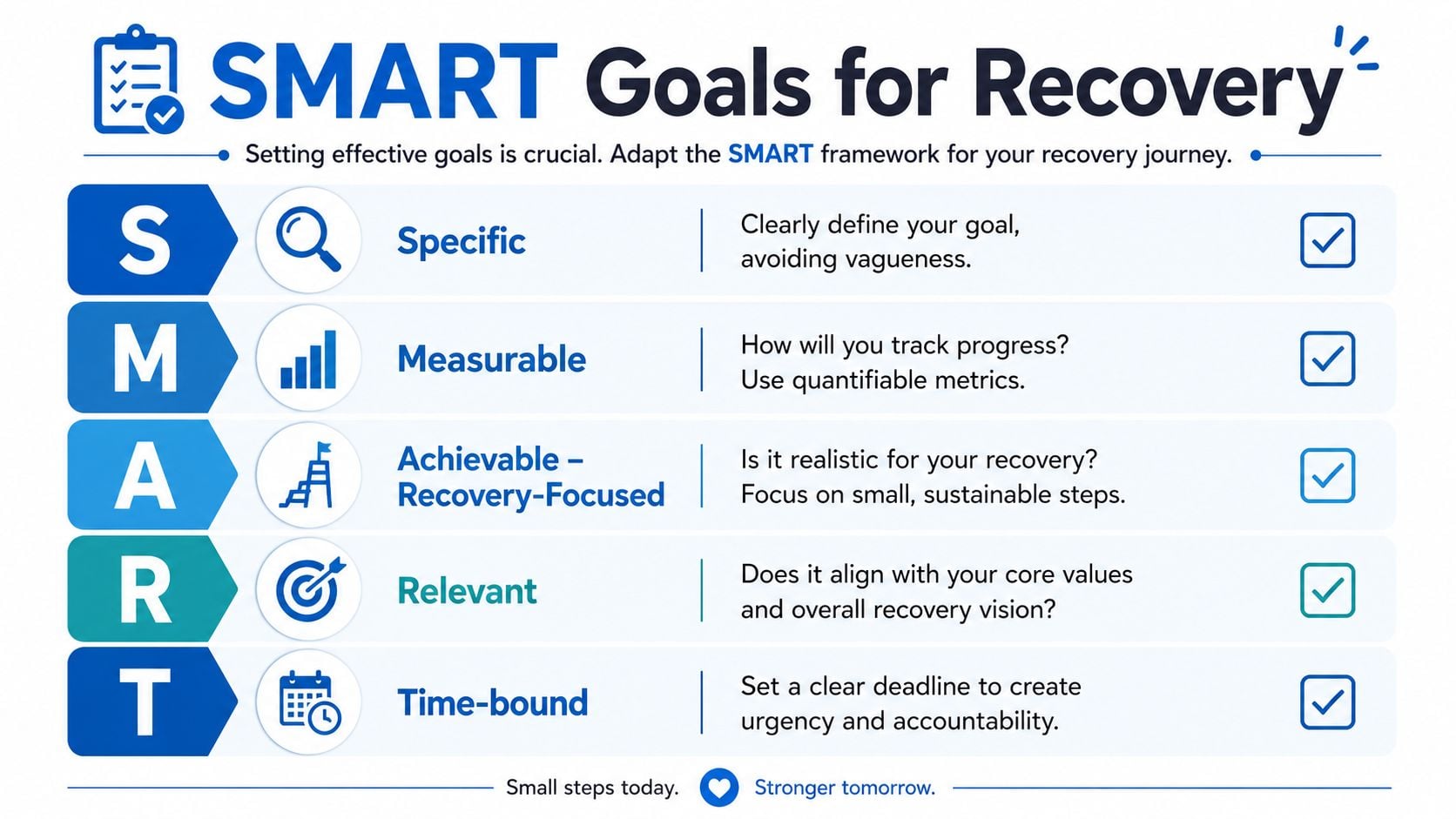
A key reason SMART goals stay relevant is that structured, collaborative plans outperform vague directives. Industry benchmarks show that plans using SMART goals, root-cause analysis, and collaborative involvement achieve 25% to 35% higher success rates than top-down mandates (Culture Amp). That matters even more in recovery, where forced plans often trigger resistance, shame, or quiet disengagement.
What SMART looks like in recovery
A recovery-centered version of SMART looks like this:
- Specific means the goal is concrete. “Attend three support meetings this week” is specific. “Work on myself” isn't.
- Measurable means you can tell whether you did it.
- Achievable means it fits your actual bandwidth, transportation, childcare, job schedule, and mental energy.
- Relevant means it lines up with the values you chose earlier.
- Time-bound means it has a clear review point.
The “A” matters more than people think. Ambition gets praised. In recovery, overloading yourself can backfire fast. A small goal you complete is better than a grand one you avoid for two weeks and then use as proof that you're failing.
Later in this section, this video offers another practical take on building goals you can stick with.
Examples that work better than vague promises
Compare these side by side.
| Vague goal | Recovery-focused SMART goal |
|---|---|
| Exercise more | Walk for 15 minutes after lunch on Monday, Wednesday, and Friday |
| Be better with money | Review spending every Sunday evening and avoid carrying cash to high-risk stops |
| Fix family relationships | Call one supportive family member every Tuesday and speak honestly for at least a few minutes |
| Sleep better | Put phone away by a set evening time and follow the same bedtime routine on weeknights |
| Stay sober | Attend treatment, use a trigger plan, and text a support person before and after high-risk events |
Notice what changed. The stronger version tells you exactly what to do and when to do it. It also lowers the chance that you'll argue with yourself about whether it “counts.”
Use treatment as part of the goal
Recovery goals shouldn't sit outside care. They should work with it. If you're in structured treatment or stepping into one, include that directly in the plan. A good example would be building goals around attendance, honest participation, medication adherence, and follow-through with clinical recommendations. Individualized care matters, and this guide to personalized recovery plans lays out why one-size-fits-all planning usually falls short.
A strong first set of goals often sounds ordinary:
- Show up to scheduled care.
- Stabilize sleep and meals.
- Reduce risk by avoiding known triggers.
- Rebuild trust through one consistent action at a time.
That may not sound flashy. It works. Recovery grows when goals are humble enough to be repeatable.
Building a Structured Routine for Sobriety
The hours nobody plans for can become the hours that cause the most trouble. That's why routine matters so much. A personal improvement plan for recovery needs a calendar, not just intentions.
One practical framework for behavioral change is to define weekly actions by cue, behavior, frequency, and resources needed, then review them weekly. That review process takes 20 to 30 minutes according to Gray Group International. That's short enough to sustain and structured enough to catch drift before it turns into a slide.
A week with fewer risky gaps
Think about a common problem. Someone says they want to “stay busy,” but their actual week has long stretches of unplanned time, poor sleep, inconsistent meals, and a lot of driving past old neighborhoods. Then Friday night hits. They're tired, irritated, alone, and suddenly white-knuckling the same old triggers.
A better routine doesn't pack every minute. It creates anchors. Morning medication. Breakfast. Work or treatment block. One recovery action after lunch. Dinner at a regular time. Evening check-in. Bedtime routine. Repeated enough times, that structure lowers decision fatigue.
Habit stacking helps here. Attach a new behavior to one that already happens. After coffee, write your plan for the day. After lunch, take a short walk. After dinner, text your accountability person. After brushing your teeth, set out what you need for tomorrow morning.
The routine doesn't need to be exciting. It needs to be protective.
Sample Weekly Recovery Routine
| Time Slot | Monday | Tuesday | Wednesday | Thursday | Friday | Saturday | Sunday |
|---|---|---|---|---|---|---|---|
| Morning | Wake up, hydrate, breakfast, medication, brief plan for the day | Wake up, hydrate, breakfast, medication, short breathing practice | Wake up, hydrate, breakfast, medication, review appointments | Wake up, hydrate, breakfast, medication, journal for a few minutes | Wake up, hydrate, breakfast, medication, identify evening risk points | Wake up, breakfast, light chore, outdoor time | Wake up, breakfast, quiet reflection, weekly planning |
| Midday | Work or treatment, lunch, short walk | Work or treatment, lunch, check in with support person | Work or treatment, lunch, short walk | Work or treatment, lunch, coping skill practice | Work or treatment, lunch, plan sober evening activity | Errands, meal prep, support meeting or recovery activity | Family time, meal prep, review week ahead |
| Evening | Dinner, meeting or counseling homework, screen limit | Dinner, recovery reading, early bedtime routine | Dinner, support meeting, prep for next day | Dinner, call trusted person, light stretch | Dinner, safe social plan or quiet night, check-in text | Recovery-friendly outing, bedtime routine | Set goals for week, laundry, early wind-down |
This kind of schedule works because it answers a risky question before it shows up: “What am I doing next?”
Make habits easier to repeat
If a routine keeps failing, don't assume the answer is more willpower. Change the setup.
Try these adjustments:
- Lower the start point so the habit feels doable. Five minutes of journaling beats a plan to write three pages you'll skip.
- Prepare the environment the night before. Put walking shoes by the door. Charge your phone. Set reminders.
- Protect transition times like after work, after treatment, or late evening. Those are common relapse windows.
- Schedule support into the week instead of waiting until things feel shaky.
A routine should hold you up, not wear you out. If it feels like punishment, it probably needs trimming.
Mapping Your Triggers and Coping Strategies
A personal improvement plan for recovery isn't complete until it answers one hard question. What are you going to do when the urge hits, not when you're calm and reading about recovery, but when you're angry, lonely, bored, ashamed, overstimulated, or standing in the wrong parking lot?
Name the trigger before it names you
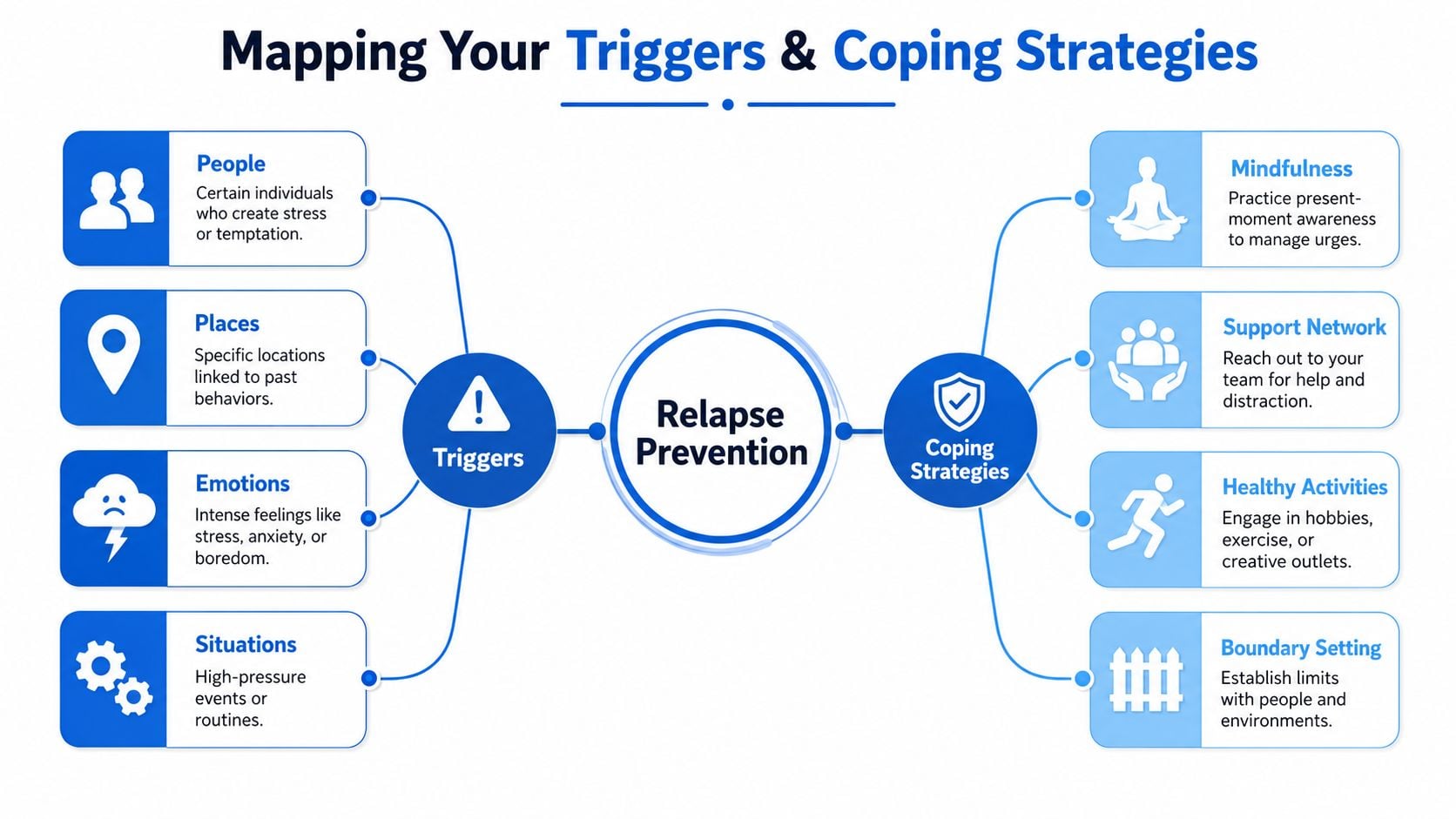
Many people say “triggers” and only think about people or places. Those matter, but the list is usually broader. Triggers often fall into four buckets:
- People you used with, people who pressure you, or people who drain you.
- Places tied to buying, using, hiding, or spiraling.
- Emotions like anger, grief, boredom, panic, shame, and loneliness.
- Situations such as payday, conflict at home, driving alone at night, custody stress, or celebrations with alcohol present.
Write your real list, not the socially acceptable one. If scrolling at night spikes cravings, put it down. If getting paid makes you feel reckless, write that too. If family contact sends your nervous system through the roof, that belongs on the page.
Build if-then coping plans
Once you name triggers, pair each one with an action. Keep it simple and concrete.
Examples:
- If I feel lonely on Friday night, then I'll call a support person and leave the house for a safe activity.
- If I drive near an old using area, then I'll change the route and play the recovery playlist I keep saved on my phone.
- If I leave a tense family interaction feeling activated, then I'll go for a walk, drink water, and wait before sending any texts.
- If boredom starts turning into romanticizing old behavior, then I'll switch locations and do one planned task from my list.
A good coping plan doesn't rely on inspiration. It gives you a move to make.
Don't ask yourself to be wise in the middle of a trigger. Decide in advance.
If you need more ideas for replacement behaviors, grounding tools, and safer ways to regulate stress, this healthy coping mechanisms guide can help you expand the list.
Keep your coping list visible
A trigger plan hidden in a drawer won't do much. Put it where you'll see it.
Good places include:
- Phone notes
- Wallet card
- Bathroom mirror
- Inside a journal
- Shared with a sponsor, counselor, or trusted family member
Keep the list short enough to use. In the moment, individuals don't need ten strategies. They need three that are realistic and fast. Leave the situation. Contact support. Change the body state. Those basics prevent a lot of damage.
Assembling Your Accountability and Support Team
Recovery gets shaky when it becomes private. The more someone isolates, the easier it is for denial to sound reasonable.
That's why accountability belongs inside a personal improvement plan, not as an optional extra. One strong data point makes the case clearly. People who report progress to an accountability partner achieve goals 76% to 95% of the time (YouTube reference). The exact form of support can vary. The pattern doesn't. Someone else knowing what you said you'd do changes follow-through.
Why accountability changes outcomes
Accountability does a few things at once. It interrupts secrecy. It gives you a place to reality-check distorted thinking. It turns vague intentions into commitments another person can ask about.
It also helps when motivation dips. On your own, it's easy to renegotiate the plan every time discomfort shows up. With another person involved, you're more likely to pause before skipping the meeting, hiding the lapse, or drifting out of routine.
A lot of people hear “accountability” and think punishment. That's not the goal. Good accountability sounds like direct care. Someone asks the hard question because your recovery matters.
Who belongs on your team
Your support team usually has layers, not just one person.
- Clinical support may include detox, medication support, counseling, intensive outpatient care, or ongoing mental health treatment.
- Peer support might be a sponsor, recovery mentor, group members, or trusted sober peers.
- Personal support can include one or two family members or friends who are stable, honest, and not wrapped up in old chaos.
Not every supportive person should have the same job. A family member may offer encouragement but not know how to respond to cravings. A peer may understand relapse thinking immediately. A clinician can help assess risk, co-occurring symptoms, medication issues, and level-of-care needs.
For people who need help choosing the right role for each person, this accountability partner guide for leaders offers practical ideas on expectations, check-ins, and communication that can be adapted well for recovery settings.
How to ask for support clearly
Specific requests work better than emotional hints. Instead of “I might need help sometimes,” try:
- Can I text you before and after my hardest meeting of the week?
- Can we talk every Sunday evening so I review my plan out loud?
- If I go quiet for a few days, will you check in directly instead of waiting for me?
- If I tell you I'm “fine” but sound off, will you ask one more question?
Also decide who doesn't belong on the team. If someone minimizes your recovery, pushes substances, stirs up drama, or expects access they haven't earned, distance may be necessary. Boundaries aren't cruelty. They're part of the plan.
Your Plan as a Living Document for Growth
The best personal improvement plan in recovery isn't rigid. It breathes. It gets reviewed, trimmed, strengthened, and rewritten as your life changes.
That matters because recovery isn't a straight climb. Some weeks you'll feel clear and steady. Other weeks will feel messy, flat, or emotional for no obvious reason. The plan should be sturdy enough to guide you and flexible enough to survive real life. Shame makes people hide when the plan slips. Growth asks for a review instead.
One simple rhythm works well. Once a week, sit down for a short check-in. Look at what you did, where you got stuck, what triggered you, and what needs adjusting. Celebrate what happened. Keeping one appointment, telling the truth sooner, leaving a risky situation, or asking for help before things escalated all count.
Recovery planning works best as a cycle. Choose. Act. Review. Adjust. Repeat.
That review is even stronger when another person hears it. People who report progress to a friend, family member, or coach achieve their goals between 76% and 95% of the time (Divinely Develop). Not because accountability makes life easy, but because it keeps you engaged with the process when your own thinking gets noisy.
You do not need a perfect plan. You need a usable one. One that protects sobriety, respects your limits, and keeps pulling you back toward the life you said you want.
If you or someone you love needs more than a self-guided plan, Addiction Resource Center LLC offers compassionate addiction treatment in Yuba City, including detox support, MAT, and intensive outpatient care. We help adults build recovery plans that fit real life, with structure, accountability, and support for both substance use and co-occurring mental health needs. Reach out when you're ready to talk through options, ask questions, or take the next step.