Explore family therapy for addiction recovery and learn practical strategies to support loved ones through treatment and rebuild healthy relationships.


Addiction doesn’t just affect the person struggling with substance abuse-it tears through entire families. When one family member battles addiction, everyone feels the impact through broken trust, poor communication, and unhealthy patterns that keep the cycle going.
Family therapy for addiction recovery offers a way to heal these wounds together. At Addiction Resource Center, we’ve seen how involving loved ones in treatment can transform not just individual recovery, but the entire family system.
How Addiction Reshapes Family Relationships
Addiction fundamentally rewires how families interact with each other. When someone develops a substance use disorder, the entire household enters a state of crisis that most people aren’t prepared to handle. Trust erodes quickly because addiction creates secrecy, financial strain, and unpredictable behavior that family members cannot control. Parents find themselves questioning whether their child is safe. Spouses watch their partner disappear into substance use and feel abandoned. Siblings witness chaos and learn to protect themselves by withdrawing. Research from SAMHSA shows that 6.4 million youth under 26 meet diagnostic criteria for a substance use disorder, which means millions of families are currently navigating this exact situation.
Predictable cycles emerge in response to addiction
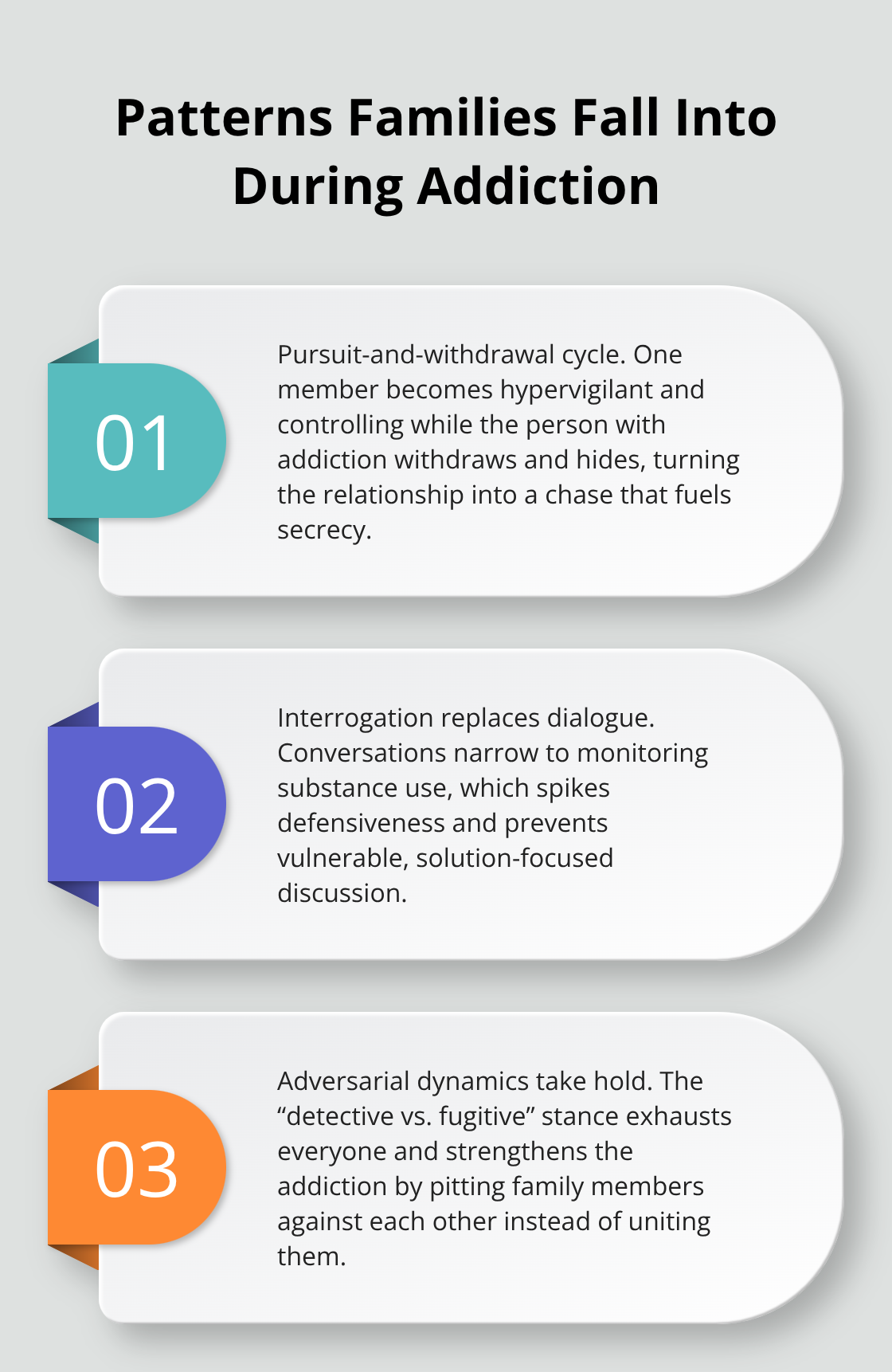
Families develop recognizable patterns when addiction enters the home. One common cycle involves a parent or partner becoming hypervigilant, constantly checking on the person struggling with substance use, asking repeated questions, and trying to prevent use through surveillance. This triggers defensive behavior, secrecy, and resentment in the person with addiction, who feels controlled rather than supported. The more one family member pursues information and control, the more the other withdraws and hides. This fugitive-detective dynamic exhausts everyone involved and actually strengthens the addiction by creating an adversarial relationship instead of a collaborative one.
Communication breaks down because conversations become interrogations rather than genuine dialogue. Family members stop talking about anything meaningful and instead focus exclusively on the substance use problem. This isolation deepens the pain for everyone.
Codependency creates false solutions
Codependency happens when family members unconsciously enable substance use while believing they’re helping. A parent might give money for rent but suspect it funds drug purchases. A spouse might call in sick to work to cover for their partner’s missed shifts. A sibling might lie to parents about where the family member really is. These actions feel compassionate in the moment, but they remove natural consequences that might otherwise prompt someone to seek treatment.
Studies show that family involvement in treatment actually increases entry into treatment and reduces dropout rates, but only when that involvement is structured and intentional. Unstructured enabling does the opposite. The person struggling with addiction loses motivation to change because the family absorbs the costs of their choices. Meanwhile, family members experience resentment and exhaustion because they work harder than the person with addiction to manage the problem.
Family therapy addresses these patterns directly
Understanding how addiction reshapes family dynamics reveals why individual treatment alone often falls short. The patterns that develop-pursuit and withdrawal, enabling and resentment, broken communication and isolation-require a family-level intervention to break. Family therapy targets these relational cycles head-on, helping households recognize unhealthy patterns and replace them with healthier ways of relating. This shift from individual focus to family focus changes everything about recovery outcomes.
How Family Therapy Reshapes Recovery Outcomes
Family Therapy Treats Addiction as a Relational Problem
Family therapy works because it treats addiction as a relational problem, not just an individual one. The therapist does not spend sessions analyzing why the person with addiction made certain choices. Instead, the focus shifts to how family members interact around substance use and what patterns keep the addiction alive. Research from SAMHSA shows that involving family members in treatment increases entry into treatment and reduces dropout rates significantly.

More importantly, meta-analytic data found that family-based approaches produce about a 5.7% reduction in substance use frequency that lasts 12 to 18 months.
Families see concrete changes when they stop operating in isolation and start working together. The therapist acts as a guide who helps family members recognize unhealthy cycles like the pursuit-and-withdrawal pattern discussed earlier, then teaches specific skills to interrupt those cycles. One powerful shift happens when parents move from a punitive stance to a resource-focused mindset. Instead of asking your teenager what drugs they used this week, you ask what activities they enjoyed and how you can support those interests. This reframing does not ignore the substance use problem-it addresses the relationship foundation that makes recovery possible.
Boundaries and Communication Create the Path to Trust
Boundaries must be rebuilt before trust can return, and this requires uncomfortable honesty from everyone involved. A parent might need to stop giving money without conditions, even when the person with addiction claims they need rent. A spouse might need to stop covering for missed work shifts. These are not punitive measures-they are natural consequences that create space for change.
Simultaneously, communication has to shift from interrogation to genuine dialogue. When your child comes home late, the instinct is to demand explanations and accusations. Family therapy teaches you to say something like: “I noticed you came home late and I was worried about your safety. I’d like to understand what happened so we can problem-solve together.” This approach removes defensiveness and opens actual conversation. Studies on Behavioral Couples Therapy show that when partners engage in structured communication training, abstinence rates improve and relationship satisfaction increases. The same principle applies to parent-child relationships.
Concrete Skills Replace Reactive Patterns
Therapists coach families in assertiveness, boundary setting, and negotiation-concrete skills practiced in sessions and then applied at home. These are not abstract concepts. You learn exactly what to say when your loved one asks for money, how to maintain limits without shame, and how to listen to their perspective while holding firm on safety. The strongest predictor of recovery success is maintaining a loving, ongoing relationship despite the addiction. Family therapy protects that relationship while addressing the substance use directly.
This foundation of relational repair and skill-building sets the stage for the practical steps families must take to access these benefits. Finding the right therapist and preparing your household for the work ahead determines whether family therapy produces lasting change or becomes another well-intentioned effort that fades.
Practical Steps for Getting Started with Family Therapy
Find a Therapist Trained in Addiction Treatment
A qualified family therapist requires specific credentials and experience with substance use disorder. Look for Licensed Marriage and Family Therapist (LMFT), Licensed Professional Counselor (LPC), or licensed clinical social worker (LCSW) with documented experience treating families affected by addiction. Call potential therapists directly and ask three specific questions: How many families with substance use disorder have you treated in the past year? Which evidence-based family therapy models do you use? Do you require all family members to attend, or do you work with whoever shows up?
The answers reveal whether they understand addiction as a family system problem. Many therapists claim family involvement without actually structuring sessions around relational patterns. You want someone who explicitly uses models like Behavioral Couples Therapy, Multidimensional Family Therapy, or Brief Strategic Family Therapy rather than someone who simply invites family members to attend individual sessions.
Address Cost and Access Barriers
Insurance coverage varies significantly, so confirm your plan covers family therapy at the rates they charge. Some therapists offer sliding scales if cost is prohibitive. Telehealth platforms now connect families with qualified therapists regardless of location, which removes a major barrier that previously prevented treatment access.
Prepare Your Family Before the First Session
Difficult conversations must happen before therapy starts. Explain to everyone that family therapy examines how the household operates around substance use, not to assign blame but to interrupt unhealthy cycles. Some family members will resist, fearing they will face accusations about causing the addiction. Address this directly by stating the therapist focuses on solutions, not past mistakes.
Set realistic expectations about timeline and cost. Most intensive family therapy programs run 16 to 25 sessions over 4 to 6 months, which requires consistent commitment and financial resources.

Know What Happens in Sessions
During initial sessions, the therapist assesses family dynamics, communication patterns, and each person’s role in the system. They will ask questions that feel uncomfortable because they target exactly where the family operates poorly. The therapist will challenge assumptions, point out unhelpful patterns like pursuit-and-withdrawal dynamics, and assign homework that requires practicing new communication skills at home.
Progress is not linear, and some sessions will feel harder than others as family members confront painful truths. The therapist’s job is to guide this process safely while keeping everyone focused on the goal of supporting recovery and rebuilding trust. Expect the work to demand honesty from all participants (not just the person with addiction) and willingness to examine your own role in family patterns.
Final Thoughts
Family therapy for addiction recovery works because it treats the household as a system rather than focusing only on the individual struggling with substance use. The patterns you’ve learned to recognize-pursuit and withdrawal, enabling and resentment, broken communication-require intentional intervention and consistent practice of new skills. When families commit to this work, the results are measurable: better treatment engagement, higher abstinence rates, and relationships that actually survive recovery instead of fracturing under the weight of addiction.
Recovery happens in your kitchen when you practice the communication skills you learned in sessions, when you maintain a boundary despite guilt or pressure, and when you celebrate small wins while responding to setbacks with compassion rather than shame. The timeline is longer than most families expect, and progress is rarely linear, but continuing unhealthy patterns while hoping something changes guarantees nothing improves. Your family deserves professional guidance to navigate this transformation, and that support is available right now through personalized addiction therapy programs designed to support not just the individual in recovery but the entire household system.