The call usually comes at the worst time. Maybe it's late at night, maybe you're already tired, maybe you've had the same conversation before. Your loved one says they want help, but they're angry, scared, ashamed, or already slipping again, and you're left trying to figure out what helps without making things worse. That's the …

The call usually comes at the worst time. Maybe it's late at night, maybe you're already tired, maybe you've had the same conversation before. Your loved one says they want help, but they're angry, scared, ashamed, or already slipping again, and you're left trying to figure out what helps without making things worse.
That's the hard part of how to support someone in recovery. Your role is real, but it isn't to control every choice, fix every crisis, or carry the whole process yourself. The most useful supporters act like facilitators, they help connect the person to treatment, protect a stable environment, and keep trust intact long enough for recovery work to keep going.
Table of Contents
- Understanding Your Role in Their Recovery Journey
- Effective Communication That Builds Trust
- Setting Healthy Boundaries for You and Them
- Navigating Lapses and Preventing Relapse
- Supporting Formal Treatment and Long-Term Recovery
- Your Self-Care Toolkit and Finding Local Help
Understanding Your Role in Their Recovery Journey
A strong evidence base shows that social support is a measurable recovery factor, not just a feel-good add-on. In one study of adults in continuing care for cocaine dependence, greater social support was associated with reduced substance use and a stronger goal of total abstinence, and research summarized in the same review found that adding medical, psychiatric, family, and employment support is linked with better substance-use outcomes and better social adjustment (PMC review on social support and recovery).
That matters because it changes the job description. You are not a manager standing over every decision, and you're not a bystander hoping for the best. You're part of the support structure that helps recovery stay connected to real life, real treatment, and real accountability.
Support works best when it is layered
A text that says “I'm proud of you” helps. So does a ride to an appointment, a calmer house, a phone number for treatment, or a conversation that gets someone back into care after they've drifted. The point is consistency, not intensity.
Practical rule: helpful support makes it easier to stay in treatment, and harder to disappear from it.
That's why encouragement alone often falls short. The person in recovery may need help with logistics, follow-through, and reducing isolation, not just reassurance. Families often underestimate how much the environment matters, especially when cravings, stress, and shame start piling up at the same time.
If you're trying to figure out where you fit, think in terms of access and stability. Can you help them reach care, keep routines steady, and lower the number of small obstacles that make dropping out easier? If the answer is yes, you're already doing more than “being supportive,” you're helping build conditions where recovery has a better chance to hold.
Effective Communication That Builds Trust
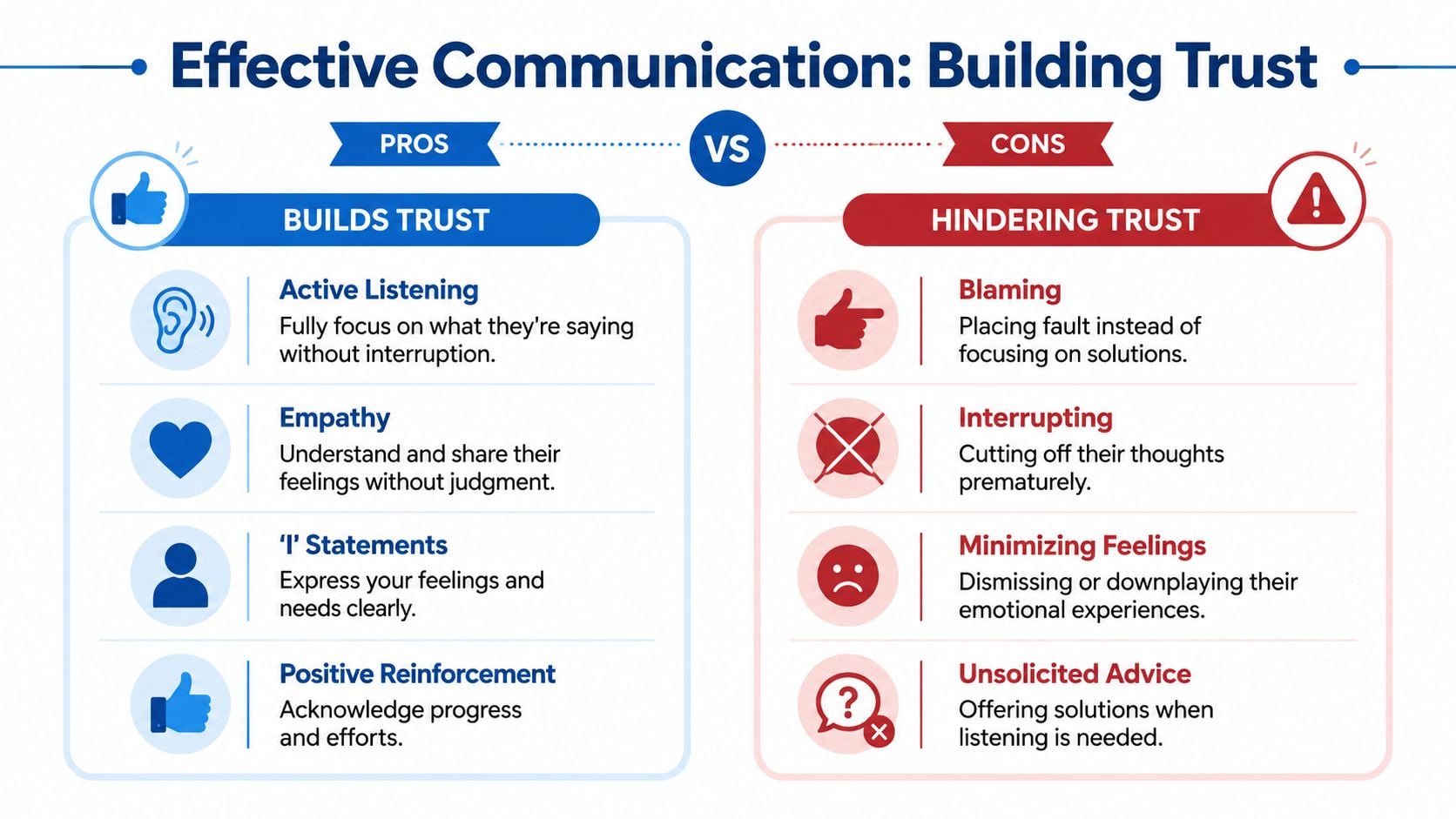
The way you talk to someone in recovery can either open a door or slam it shut. Experts recommend nonjudgmental encouragement paired with structured linkage to treatment, and they specifically flag lecturing, shaming, and judgmental language as behaviors that increase resistance and make people less likely to stay connected to care (NCBI guidance on family support and treatment engagement).
What trust-building sounds like
Start with listening, not solving. If they say, “I messed up,” a useful reply is, “I'm glad you told me. What happened right before that?” That keeps the conversation on facts and next steps instead of turning it into a trial.
Use “I” statements when you need to name your own limits or feelings. “I'm scared when I don't know where you are” lands better than “You always disappear and ruin everything.” The first sentence gives information, the second one starts a fight.
A few scripts that tend to work better:
- When they're defensive: “I'm not here to argue. I want to understand what's getting hard.”
- When they admit a slip: “Thank you for telling me. Let's talk about what support you need today.”
- When the conversation turns circular: “I'm hearing you, and I'm not going to lecture you. I do want us to stay focused on what helps next.”
What to avoid is just as important. Don't diagnose them, don't compare them to someone else, and don't use their worst day as evidence that they're hopeless. People usually open up more when they feel understood, and they shut down fast when they feel corrected or cornered.
Keep the tone steady, even when emotions spike
Recovery conversations rarely happen under calm conditions. Someone may be irritable, exhausted, or ashamed, and those feelings can make every sentence land harder than you intended. Calm tone, short sentences, and fewer words usually work better than a long explanation delivered in frustration.
If you need a quick rule, use this: acknowledge feeling, name the next step, stop talking. That sounds simple, but it prevents the spiral where one tense conversation turns into an all-night fight. For a focused script library, the internal guide on what to say when someone relapses can help you stay steady when the pressure is high.
Setting Healthy Boundaries for You and Them

Boundaries are not punishment. They're guardrails that keep support from turning into chaos, and they help you stay useful instead of resentful. When boundaries are clear, the person in recovery knows what the home can and can't absorb, and you know what you can offer without burning out.
A boundary works best when it's specific, calm, and consistent. “I love you, and I won't give you money for any reason” is clearer than repeated lectures about responsibility. “You can stay here if you're sober, but I won't argue with you when you're intoxicated” gives structure without threatening the relationship.
Boundaries that protect both people
Finances are one of the biggest traps. If money has been used to support the addiction, paying cash, covering bills without conditions, or rescuing them from consequences can keep the cycle alive. That doesn't mean you stop caring, it means you redirect support toward things that help recovery.
Household rules matter too. You might require no substances in the home, no yelling, no stealing, or no driving under the influence. These aren't power moves, they're safety measures. If you set a rule, you have to be ready to follow through calmly, because a boundary that changes every time emotions spike isn't a boundary.
Boundaries work when they're boring. The more dramatic they are, the less likely they are to hold.
If you're unsure where the line is between helping and enabling, the internal resource on codependency in recovery can help you check your patterns without turning everything into self-blame. The goal isn't to become detached. It's to become dependable.
One useful test is this, does your action make it easier for them to face reality, or easier to avoid it? If the answer is “avoid it,” the kind move may prove to be the firmer one. Recovery usually gets better when support is stable and predictable, not when everyone around the person is constantly improvising.
Navigating Lapses and Preventing Relapse
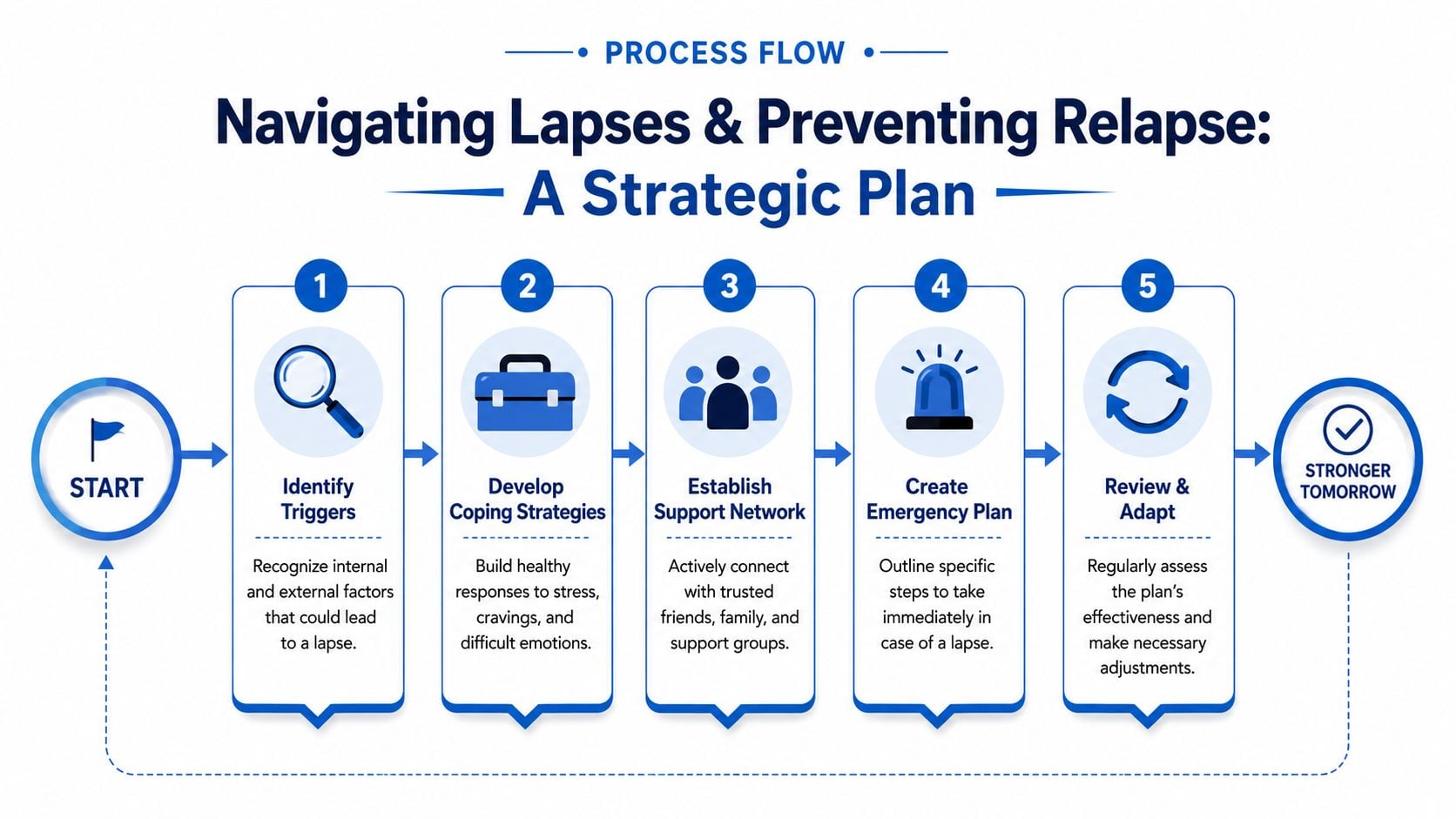
A lapse does not have to become a disaster. Recovery support should work like a relapse-management system, not a one-time rescue plan, and that means treating setbacks as learning events while still taking them seriously (ADF family support guidance). Blame usually pushes people away, while calm and practical response keeps the door open.
Use a simple response plan
When you're creating a plan, keep it narrow and realistic. The aim is not to predict every crisis, it's to reduce panic when one happens.
- Notice triggers early. Sleep loss, conflict, isolation, and stress can all make a lapse more likely.
- Name coping actions before the crisis. Short walks, a call to a trusted person, or leaving a stressful setting can interrupt the slide.
- Keep the support network visible. People need names, numbers, and places they can reach.
- Decide what counts as a safety issue. If someone is unconscious or not breathing normally, that's an emergency, not a discussion.
- Review the plan after each setback. Change what didn't work, keep what did.
If you're wondering about substances that can complicate testing or trigger confusion, a plain-language explainer on fail a drug test from CBD can help reduce guesswork before emotions take over. The point isn't to become an expert on every product. It's to avoid misinformation that leads to unnecessary panic or bad decisions.
After a lapse, use short sentences and avoid a courtroom tone. “Are you safe right now?” is a better opening than “What did you do again?” If they're willing, move quickly toward the next step, such as contacting treatment, a sponsor, a therapist, or a trusted family member.
Safety comes first when there's any sign of overdose. Wake the person, call 911, give naloxone if available, start rescue breathing, and place them on their side.
That is an overdose response, not a recovery conversation. For everything else, the main task is to reduce shame and restore structure. The internal guide on what to say when someone relapses can help you keep that conversation from turning punitive.
Supporting Formal Treatment and Long-Term Recovery
Families often become the bridge between willingness and treatment. Survey data show that in one group of more than 400 participants, 28.4% said a sibling helped them get into recovery, 25.5% cited a spouse or partner, 23.3% cited a mother or both parents, and 12.2% said friends helped them, which shows how often informal relationships connect people to formal care (survey summary on treatment entry).
That support matters because treatment is usually more effective when home life and clinical care are aligned. You don't need to know every clinical detail to help well. You do need to help the person show up, stay connected, and keep the environment from working against the plan.
How to partner with treatment without taking over
Medication-assisted treatment, or MAT, uses medication within a treatment plan to support recovery. An IOP, or Intensive Outpatient Program, gives people structured care while they keep living at home, which can make it easier to preserve work or family responsibilities. If a local option such as Addiction Resource Center LLC is involved, the supporter's job is still the same, reinforce attendance, reduce chaos, and help the person use the plan they agreed to.
Practical ways to help include:
- Driving or arranging transportation: missed appointments can become missed momentum.
- Joining family sessions when invited: this can align communication and reduce mixed messages.
- Keeping the home recovery-friendly: less conflict, fewer substances, clearer routines.
- Tracking practical needs: childcare, pharmacy runs, and appointment reminders often matter more than long speeches.
Formal care offers the advantage of giving recovery a structure you can't build alone. Your role is to support the structure, not replace it. When you treat treatment as a partner instead of a last resort, the person in recovery gets more than encouragement, they get continuity.
If you want to better understand what long-term support looks like alongside counseling and structured care, the internal guide on self-care in addiction recovery, a healing journey is a useful companion piece.
Your Self-Care Toolkit and Finding Local Help
Supporting someone in recovery can wear you down if you never step out of the crisis loop. The supporter's job is important, but it's not sustainable without rest, perspective, and your own outlet. If you don't protect your energy, you'll end up too depleted to be calm, consistent, or helpful.

Keep your own life intact
You need places to put fear, frustration, and grief that aren't the person in recovery. Support groups like Al-Anon, therapy, exercise, journaling, and time with friends all matter because they keep your identity from shrinking into the addiction around you. That isn't selfish, it's how you stay steady enough to help.
For a broader look at maintaining your own footing, the internal guide on self-care in addiction recovery, a healing journey offers a useful framework. The same principle applies to families, recovery support works better when the supporter has support too.
If you're looking for outside help with your own stress, a neutral therapist can give you a place to sort through guilt, anger, or burnout without putting that weight on your loved one. If you want to explore therapy options, use that process to find someone who understands family stress, boundaries, and addiction-related strain.
Know when local help becomes useful
Sometimes the next step is not another long conversation, it's a direct call to a treatment provider who can help you think clearly. In Yuba City, Addiction Resource Center LLC offers medically supervised detox with MAT, residential rehab through its partner facility, and an IOP that's available in person and via telehealth, along with 24/7 wellness monitoring and individualized treatment planning. It's one option when you need guidance for a loved one and you don't want to figure it out alone.
For families, the most important move is often simple, get informed before the situation gets louder. If the person you care about is ready for help, or you're not sure what to do next, reaching out early gives you more choices and fewer emergencies.
If you need guidance for a loved one in Yuba City or Northern California, contact Addiction Resource Center LLC at 1002 Live Oak Blvd., Suite A, Yuba City, CA or call/text 530-625-7910 to ask about detox, MAT, IOP, or family support.