You may be reading this after another rough night. Maybe you made it to work in Yuba City, kept the day moving, handled family responsibilities, and still ended up asking the same question again: How am I supposed to get real help without disappearing from my life? That question is more common than people think. …

You may be reading this after another rough night. Maybe you made it to work in Yuba City, kept the day moving, handled family responsibilities, and still ended up asking the same question again: How am I supposed to get real help without disappearing from my life?
That question is more common than people think. Adults across Northern California often need more than a weekly counseling appointment, but they can't step away from a job, school, parenting, court obligations, or caring for an older parent. They need treatment that is serious, structured, and still possible.
An intensive outpatient program schedule is built for that middle ground. It gives you repeated therapeutic support during the week while letting you sleep at home, keep important responsibilities in place, and start practicing recovery in real life instead of in isolation. For many people, that balance is what makes treatment feel manageable instead of impossible.
Table of Contents
- The Balancing Act Needing Help Without Pausing Your Life
- What Is a Typical IOP Schedule
- A Sample Day and Week in an IOP
- Core Therapies Within Your Weekly Schedule
- Understanding IOP Program Duration and Intensity
- Flexible Schedules for Real Life In-Person vs Telehealth
- Starting Your Program in Yuba City Practical Next Steps
The Balancing Act Needing Help Without Pausing Your Life
A lot of people come to this point privately. They aren't always in crisis in the way movies show it. They're still showing up. They're getting kids to school, driving Highway 99, clocking in, answering texts, and telling themselves they'll deal with the drinking or drug use after this week settles down.
Then another week passes.
For a working adult in Yuba City or elsewhere in Northern California, the problem often isn't recognizing that help is needed. The problem is logistics. If you're worried about missing shifts, losing privacy, or explaining a sudden absence to family, treatment can feel out of reach before you even make the first call.
Why the schedule matters so much
The schedule isn't a small detail. For many families, it's the deciding factor.
An intensive outpatient program works well for people who need more support than occasional counseling but don't necessarily need to live at a facility. That makes it easier to stay connected to home life while still stepping into a treatment routine with structure, accountability, and repeated contact during the week.
You don't have to choose between getting help and caring about your responsibilities. The right level of care is the one you can actually enter and stay with safely.
The daily rhythm matters in other ways too. Sleep is often one of the first things to unravel during active substance use or early recovery. If your nights have gotten chaotic, some people also benefit from practical advice for reclaiming your nights while they work on a treatment plan, because sleep problems can make everything feel harder than it already is.
Common worries people have before starting
These concerns come up all the time:
- Work conflicts: "Can I do this without quitting my job?"
- Family pressure: "Who will pick up the kids if I have treatment in the evening?"
- Fear of the unknown: "What happens during those hours?"
- Stigma: "Will people know where I'm going?"
- Energy level: "What if I feel drained after a full day?"
All of those questions make sense. A good intensive outpatient program schedule should answer them clearly, not brush them aside. Recovery is hard enough. The process shouldn't feel mysterious.
What Is a Typical IOP Schedule
If you live in Yuba City, work a full day, and still need treatment, the question usually is not "What is IOP?" More often, the question is, "What will my week look like, and can I make it work?"
An Intensive Outpatient Program, or IOP, is a treatment schedule built for that middle space. You need more support than a weekly counseling appointment can offer, but you do not need to stay overnight in a facility. In practical terms, IOP usually means several treatment sessions each week, often grouped into blocks long enough for real clinical work instead of quick check-ins.
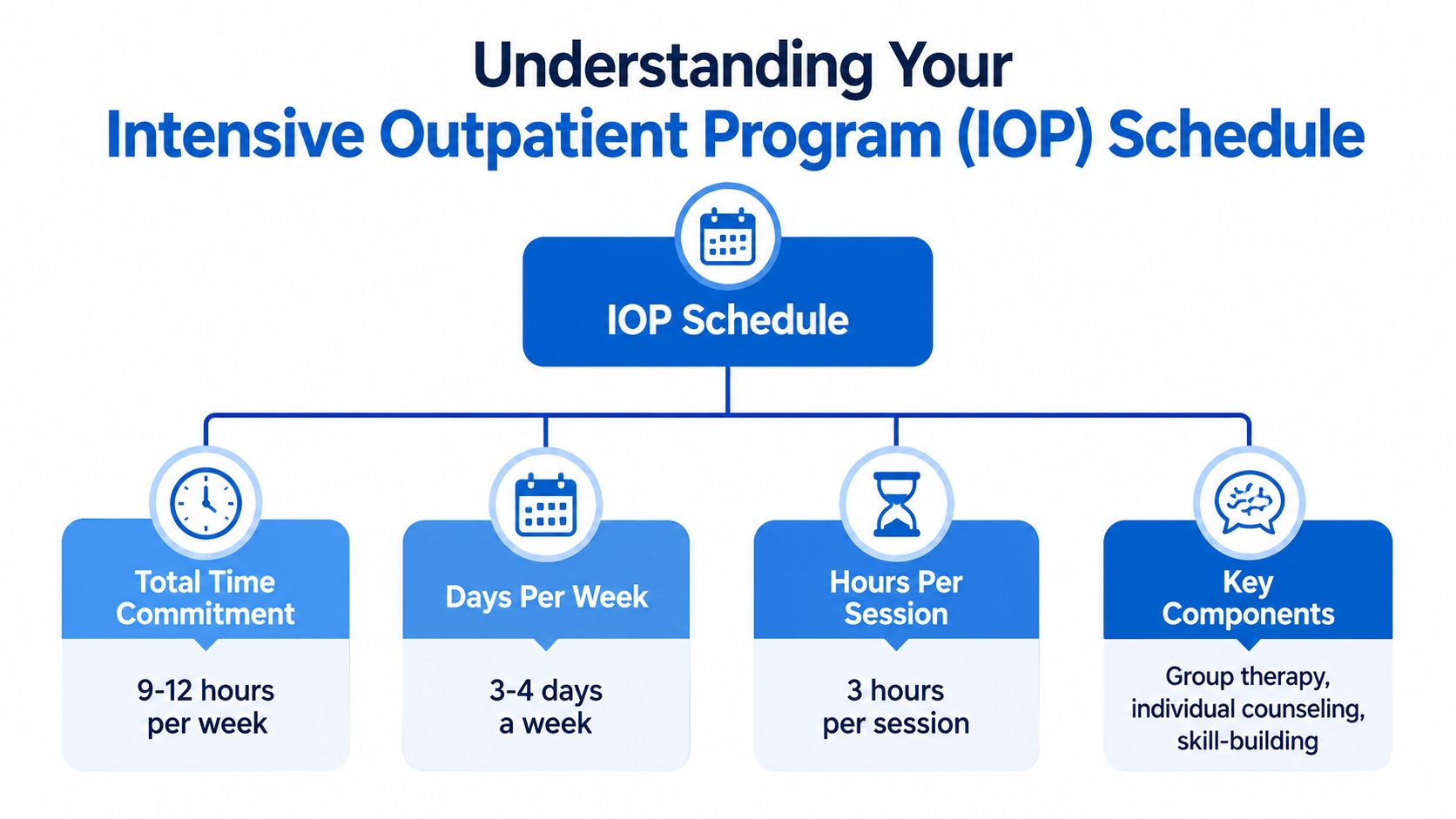
A helpful way to picture the schedule is to compare it to a college class with support built around it. You show up at set times each week, do focused work during those hours, then go home and apply what you practiced in real life. For working adults in Northern California, that matters. The schedule has to fit around commutes, school pickups, rotating shifts, court dates, and the ordinary pressure of keeping a household running.
The basic rhythm
Most IOP schedules follow a pattern like this:
- Three-hour sessions: Many programs use a single block of time so you can settle in, participate in therapy, and leave with a clear plan.
- Three to five days per week: That amount of contact keeps recovery work active instead of letting too much time pass between sessions.
- Home between treatment days: You keep living at home, going to work if appropriate, and practicing coping skills in the same environment where stress and triggers occur.
That structure is the point. Recovery often works better when support shows up often enough to interrupt old routines, but not so often that treatment becomes impossible to maintain.
Why the schedule is set up this way
The hours are meant to create repetition. A single appointment can start a conversation. Repeated sessions during the same week give you time to learn a skill, try it outside of treatment, come back, talk through what happened, and adjust.
That is especially important for adults balancing work and family life in places like Yuba City, Marysville, or nearby communities where commuting time can shape the whole day. If a program only offered scattered appointments, planning around employers, transportation, and childcare would be harder. A predictable block schedule gives families something they can plan around.
One source often used to explain IOP structure describes it as ASAM Level 2 care, with treatment commonly delivered across multiple days each week in longer sessions rather than brief visits, as explained in this ASAM-based overview of IOP structure.
What people often misunderstand
A lot of families hear the word "outpatient" and assume the schedule is loose or optional. It is structured treatment with set attendance, regular therapeutic work, and clear expectations.
People also worry that every program runs on one rigid timetable. Usually, the framework stays consistent while the session times vary. One person may attend a morning track before an afternoon shift. Another may choose evenings after work. That flexibility is often what makes IOP realistic for adults who cannot pause the rest of life to get help.
A simple way to judge whether a schedule makes sense is this. It should be steady enough to support change and realistic enough that you can keep showing up.
A Sample Day and Week in an IOP
The easiest way to understand an intensive outpatient program schedule is to see one laid out plainly. Below is a sample evening track for someone working daytime hours.
Sample IOP Weekly Schedule Evening Track
| Day | Time | Activities |
|---|---|---|
| Monday | Evening | Check-in group, recovery skills topic, guided discussion, wrap-up |
| Wednesday | Evening | Group therapy, trigger identification, coping practice, planning for the next day |
| Thursday | Evening | Relapse prevention work, peer feedback, personal goals review, closing reflection |
That table is only a sample. Some programs offer morning tracks instead. Others may adjust the days to fit demand, staffing, or telehealth access. The point is that the schedule usually follows a predictable rhythm so people can plan transportation, work, meals, and family obligations around it.
What happens during a three-hour session
A three-hour block sounds long until you understand how it's used. State-level performance specifications say that each IOP day must include at least 3 hours of programmed time, and 2.5 of those hours must be dedicated to direct clinical intervention, as outlined in these IOP performance specifications.
In plain language, most of the time is active treatment. It isn't just sitting in a room.
A typical session may include:
- Opening check-in: People talk about how they're arriving that day, what they've struggled with since the last session, and what support they need.
- Themed clinical work: A counselor guides the group through a focused topic such as cravings, communication, relapse warning signs, boundaries, or stress responses.
- Short break: People reset, use the restroom, get water, and return.
- Process and planning: The group applies the topic to real situations. Someone may talk through an upcoming family event, payday, or conflict at work.
Why this structure helps
Each block is meant to do more than "cover material." It gives people repeated practice.
If you've ever tried to change a habit with nothing but good intentions, you already know the problem. Insight alone usually isn't enough. People need rehearsal, feedback, repetition, and support close to the moments where relapse risks show up.
A good IOP day should feel structured, active, and relevant to what you're facing outside the building that same week.
A realistic Northern California example
A warehouse worker might attend evening sessions after a daytime shift. A parent with school drop-off duties might choose a mid-morning group if available. Someone on telehealth might log in from home after commuting back from Sacramento or after a farm or service job in the Yuba-Sutter area.
The schedule works best when it feels sustainable. That's what helps people keep showing up.
Core Therapies Within Your Weekly Schedule
The hours in an intensive outpatient program schedule aren't there just to fill time. Each part of the week has a purpose. When people know what those pieces are for, the schedule feels less intimidating and more useful.
Group therapy as the anchor
In most IOPs, group therapy is the main setting. That's where people practice honesty, hear how others handle similar struggles, and stop feeling like they're the only one having these thoughts.
Group work often helps with things like:
- Reducing isolation: Shame grows when people hide. Group gives struggle a voice.
- Learning in real time: You hear how another person handled a craving, conflict, or setback.
- Building accountability: If you said on Monday that you'd avoid a certain situation, the group may ask how it went on Wednesday.
For many adults, this is the part they fear most before starting and value most once they settle in.
Individual counseling for personal work
Group can't cover everything. That's where individual counseling matters.
In one-on-one sessions, people can talk more privately about trauma, grief, depression, anxiety, family conflict, legal pressure, or patterns they don't want to unpack in front of others. The counselor can also help connect the larger treatment plan to what keeps happening in your own life.
That might include:
- a recurring argument with a spouse
- drinking after late shifts
- opioid use linked to chronic pain
- hiding use from children or parents
- fear about stopping because withdrawal has been miserable before
Family sessions and home support
Recovery rarely happens in a vacuum. Even when family relationships are strained, treatment often improves when the people at home understand what supports recovery and what unintentionally makes it harder.
Family sessions may help loved ones learn how to respond without escalating conflict, rescuing in unhelpful ways, or pretending the problem isn't there. For some families, this becomes the first calm conversation they've had in a long time.
Sometimes the most important change isn't a dramatic breakthrough. It's a new pattern at home. Fewer secrets, clearer boundaries, and less chaos.
Medication management and co-occurring care
Some people in outpatient treatment also need medication support or closer attention to mental health symptoms. A schedule may include medication management visits, psychiatric follow-up, or coordination around medication-assisted treatment when appropriate.
That doesn't mean everyone in IOP has the same treatment plan. It means the weekly schedule can be layered. One person may mostly need groups and counseling. Another may need those plus medication follow-up and support for anxiety or depression.
Why the mix matters
A strong weekly schedule uses different settings for different jobs.
- Group helps people practice recovery with others.
- Individual work helps people go deeper.
- Family involvement improves the home environment.
- Medication-related care can steady the clinical foundation.
When those pieces fit together, the schedule starts to feel less like a burden and more like a framework people can lean on.
Understanding IOP Program Duration and Intensity
One of the first practical questions families ask is, "How long does this last?" That's a fair question. People need to plan work coverage, rides, child care, and emotional energy.
A standard intensive outpatient program schedule often lasts 8 to 12 weeks, and some programs may extend up to 6 months in more complex cases, according to this guide to intensive outpatient treatment timelines. The same source says outcomes tend to be better when treatment extends beyond 90 days.
Why treatment length isn't one-size-fits-all
Length depends on more than motivation. It often reflects what the person is treating.
Someone with a shorter substance use history and stable home support may move through the process differently than someone managing repeated relapse, trauma, depression, or an unsafe home environment. A person can look "functional" from the outside and still need a longer runway to stabilize.
The difference between partial hospitalization and other levels of rehab care also matters here. Some people start at a higher level of support and then step down into IOP once they're medically and emotionally steadier. Others begin directly in IOP if that level matches their current needs.
What progress usually looks like
Progress in IOP is rarely a straight line. More often, people move through phases:
- Early engagement: getting honest, showing up, learning the rhythm
- Skill building: practicing how to manage triggers, thoughts, and routines
- Stabilization: creating more consistency at home, work, and in recovery habits
- Transition planning: preparing for less frequent care without losing support
That timeline can feel slower than people want. But slower doesn't mean failing. It often means the work is sinking in.
Recovery usually becomes more stable when people have enough time to repeat new behaviors in ordinary life, not just talk about them once.
Intensity can change over time
The "intensive" part doesn't always stay the same forever. Programs may taper as clinical needs change. A person might begin with a fuller weekly schedule and later move into less frequent outpatient care when they've built more stability.
That step-down process often reassures families. Treatment doesn't have to be all or nothing.
Flexible Schedules for Real Life In-Person vs Telehealth
For many adults, the primary question isn't whether treatment sounds helpful. It's whether they can fit it into a workweek that already feels packed. In Northern California, commute times, shift work, agricultural schedules, service jobs, and family care can make that question even sharper.

In-person treatment
In-person IOP can feel grounding for people who need a clear physical separation from home stress. Leaving the house, driving to a session, and sitting with others face-to-face can create a strong sense of routine.
People often prefer in-person care when they want:
- More structure: Being somewhere specific at a set time helps reduce avoidance.
- Direct community: It can feel easier to connect with peers in the room.
- A break from home triggers: Some people focus better away from the house.
For residents in or near Yuba City, that can be especially useful if home has become tied to using, conflict, or isolation.
Telehealth treatment
Telehealth gives a different kind of support. It removes drive time, helps people stay consistent during busy weeks, and may lower the barrier for someone who would otherwise skip treatment.
For readers comparing options, this overview of virtual IOP programs near me can help clarify what remote participation can look like in practice.
Telehealth may fit best when:
- Your commute is long: Less time on the road can mean better attendance.
- Work hours are tight: Logging in from home may be easier than making an in-person trip.
- Privacy matters: Some people feel safer beginning care from a familiar place.
Evening and working-adult tracks
Evening schedules matter for people with daytime jobs. That's often the deciding factor for someone who can't attend morning treatment without risking employment.
An evening track can make space for treatment after a shift, after commuting home, or after another adult gets home to take over with children. It isn't always effortless. But it can be doable.
This short video gives a helpful look at how flexible treatment options can fit different situations.
Which format is better
Neither one is automatically better. The better choice is the one you can attend consistently and engage with sincerely.
If you're comparing the two, ask yourself:
- Where do I focus better?
- What time of day can I protect most reliably?
- Will travel make me more likely to miss sessions?
- Do I need more face-to-face support right now?
A flexible intensive outpatient program schedule should serve your life while still challenging the patterns that keep substance use going.
Starting Your Program in Yuba City Practical Next Steps
Starting usually feels hardest before you've made contact. Once the process is explained, it's more straightforward than anticipated.
What the first steps usually look like
In practical terms, the process often starts with a confidential phone call or message. During that first contact, people usually talk through what substances are involved, whether there are mental health concerns too, what the home situation looks like, and whether work or family obligations affect scheduling.
Then the team can help sort out the next questions:
- Level of care: Is IOP the right fit, or does the person need detox or a higher level first?
- Insurance verification: Staff can review benefits and explain what information is needed.
- Scheduling options: Morning, evening, in-person, or telehealth possibilities can be discussed.
- First appointment details: People learn what to bring and how to prepare.
Questions families in Yuba City often ask
Some concerns are practical and immediate.
Will insurance be checked before the first session? Usually that's part of early intake planning so families have clearer expectations before treatment begins.
What if you're trying to compare treatment types first? This guide on how to select a residential or outpatient alcohol rehab program in Yuba City can help you sort through the difference without guessing.
TRICARE often matters in this region too, especially for veterans and military families. It's worth asking about that early, along with other major insurance plans, so you know what path is realistic.
What to bring and how to prepare
People often feel calmer when they know the basics ahead of time.

A simple checklist can help:
- Bring identification: A photo ID and insurance card are commonly requested.
- List medications: Write down current prescriptions and basic medical information.
- Plan transportation: Decide in advance how you'll get there or where you'll log in.
- Protect the time block: Treat it like any other essential appointment.
- Keep expectations simple: You don't need to arrive with perfect answers. You just need to arrive honest.
Starting treatment doesn't require having your whole future figured out. It usually starts with one conversation and one scheduled session.
The first week may still feel unfamiliar. That's normal. Predictability tends to build quickly once the schedule is in motion.
If you or someone you love is trying to find a manageable path into treatment, Addiction Resource Center LLC offers in-person and telehealth support for adults in Yuba City and Northern California, along with guidance on detox, residential rehab, MAT, insurance verification, and next-step planning. You can reach the team at their Yuba City location on Live Oak Boulevard or call or text 530-625-7910 any time for confidential help.