You're sitting there after a night of drinking, and something feels off. Maybe it's a burn behind your breastbone. Maybe it's a tight, fluttery feeling. Maybe it's a deep ache that makes you wonder, “Is this just heartburn, or is something seriously wrong?” That worry makes sense. Chest pain gets our attention fast, and it …

You're sitting there after a night of drinking, and something feels off. Maybe it's a burn behind your breastbone. Maybe it's a tight, fluttery feeling. Maybe it's a deep ache that makes you wonder, “Is this just heartburn, or is something seriously wrong?”
That worry makes sense. Chest pain gets our attention fast, and it should. The tricky part is that alcohol and chest pains can be connected in more than one way. Sometimes the cause is digestive and uncomfortable, but not dangerous. Sometimes alcohol is irritating the heart itself. And sometimes the risk depends less on how often you drink and more on how much you drank in one sitting.
A lot of people get generic advice that doesn't help in the moment. “Stop drinking.” “It's probably reflux.” “It's anxiety.” The situation is more specific than that. A person who binge drinks once in a while faces a different immediate risk than someone who drinks heavily for years. Knowing that difference can help you decide what to do next.
Table of Contents
- That Worrying Pain After Drinking
- When Chest Pain Is a Medical Emergency
- How Alcohol Directly Affects Your Heart
- Non-Cardiac Pains That Feel Like a Heart Issue
- Understanding Your Personal Risk Profile
- How Doctors Diagnose the Cause of Chest Pain
- Pathways to Prevention and Recovery
That Worrying Pain After Drinking
A common story goes like this. Someone has drinks with friends, gets home, and an hour later notices chest discomfort. It may be burning, pressure, stabbing, or a strange thump-thump-pause feeling that makes it hard to relax. They sit up straighter, take a sip of water, and start searching symptoms on their phone.
That moment is hard because chest pain isn't one symptom. It's a location. Pain in the chest can come from the heart, the esophagus, the stomach, the muscles between the ribs, or even a stress response that makes the body feel like it's under attack. Alcohol can touch several of those systems at once.
Why the timing can be confusing
Alcohol-related chest discomfort doesn't always follow a neat pattern. Some people feel symptoms while they're still drinking. Others notice them later, when they lie down, when their heart starts racing, or when the sedating effect wears off and their nervous system rebounds.
Practical rule: If chest pain feels severe, new, or paired with trouble breathing, don't assume it's “just from drinking.”
One reason people get mixed messages is that two very different alcohol patterns can both cause chest symptoms:
- Binge drinking can trigger sudden problems such as palpitations, rhythm changes, or angina-like discomfort.
- Chronic heavy drinking can damage the heart muscle over time, so the heart has to work harder and starts sending distress signals.
Those aren't the same situation, and they don't carry the same kind of risk.
The question to ask first
Before you ask, “What caused this?” ask, “Do I need emergency help right now?” That's the safest first step. A dangerous heart problem and bad reflux can overlap enough that guessing isn't reliable when symptoms are intense.
If the pain passes and wasn't severe, it's still worth paying attention. Your body may be giving you a very early warning that your current drinking pattern isn't working for your heart, your digestive tract, or both.
When Chest Pain Is a Medical Emergency
Some chest symptoms need immediate action. Don't try to outthink them, and don't wait to “see if it settles down” if the picture looks dangerous.
Signs that need urgent help
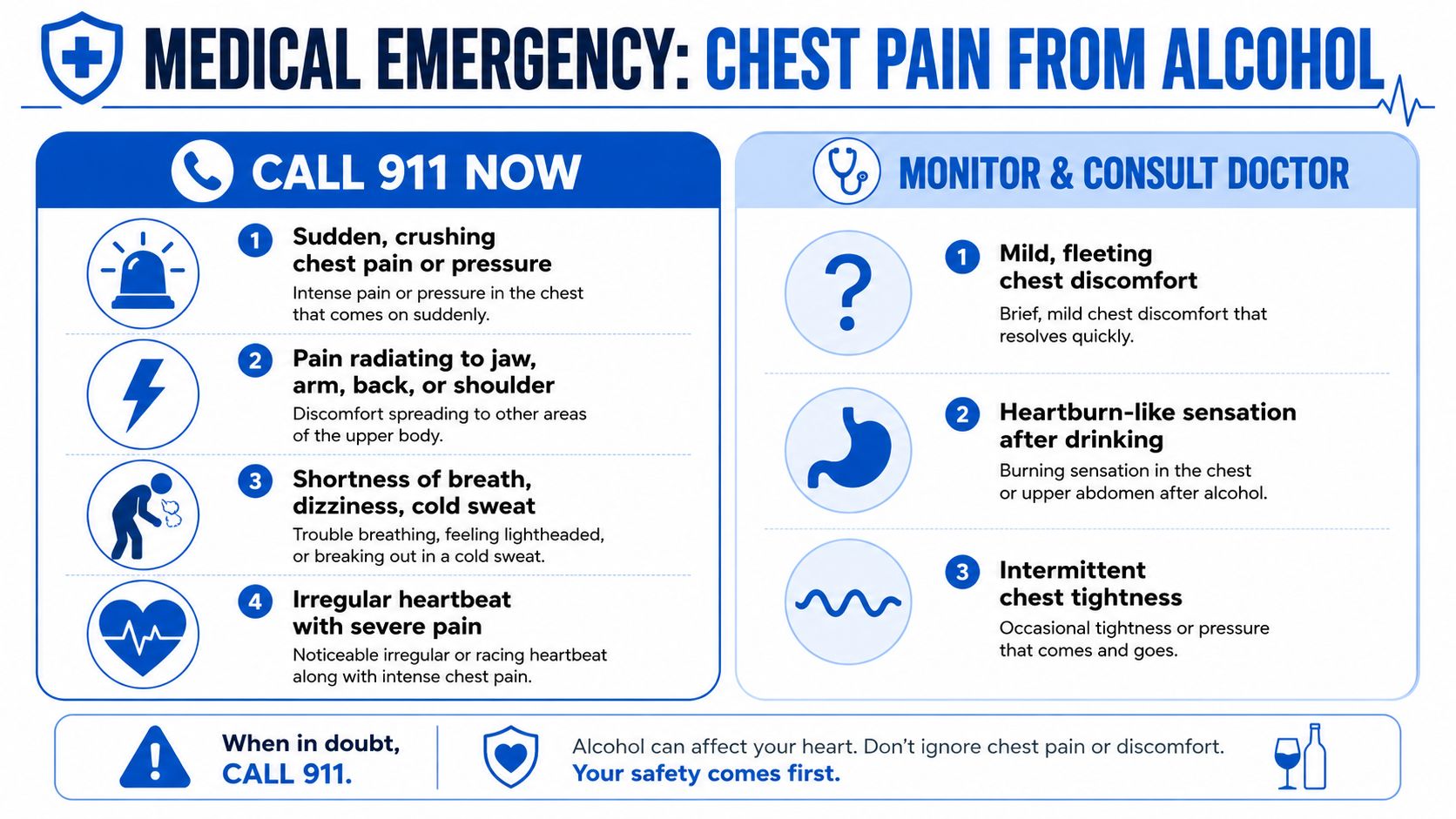
Call emergency services right away if chest pain comes with any of these:
- Crushing pressure or heavy tightness that feels severe or persistent
- Pain spreading into the arm, jaw, back, or shoulder
- Shortness of breath, dizziness, or cold sweating
- An irregular heartbeat with severe pain, faintness, or a sense that you might pass out
These features can point to a heart emergency, serious rhythm problem, or another urgent condition. Alcohol doesn't protect you from those. In some people, it may help trigger them.
Here's a visual guide you can scan quickly:
If you want a plain-language overview of what emergency response can look like, Med Jets by Air Trek's guide to emergency medical response gives a useful general primer.
A quick comparison you can use right now
| Symptom Cluster | Potential Emergency (Call 911) | Likely Non-Emergency (Schedule a Doctor's Visit) |
|---|---|---|
| Pain quality | Heavy pressure, crushing, squeezing, or severe pain | Mild burning, fleeting discomfort, or soreness |
| Pain spread | Moves to jaw, arm, back, or shoulder | Stays localized and may feel more like heartburn |
| Breathing and body response | Shortness of breath, cold sweat, dizziness, faint feeling | No major breathing trouble, symptoms may improve sitting up |
| Heart rhythm | Palpitations with severe pain, weakness, or near-fainting | Brief awareness of heartbeat without other red flags |
| Pattern | Sudden, intense, persistent, or worsening | Intermittent, position-related, or improves with antacids |
A less dangerous cause is more likely when the discomfort is mild, comes after lying down, feels like burning, or eases with antacids. But “more likely” doesn't mean guaranteed. If you're unsure, get checked.
Later, if you're stable and want to hear a cardiologist explain heart attack warning signs clearly, this video can help reinforce what to watch for:
Don't drive yourself if you feel faint, severely short of breath, or the pain is escalating.
How Alcohol Directly Affects Your Heart
Alcohol can affect the heart in two very different time frames, and that distinction matters. A single night of heavy drinking can trigger a fast, short-term problem even in someone without known heart disease. Years of heavy drinking can slowly weaken the heart muscle itself.
That difference helps explain why one person gets chest pain after a binge, while another develops symptoms after a long pattern of regular heavy use.
Short-term strain on the heart
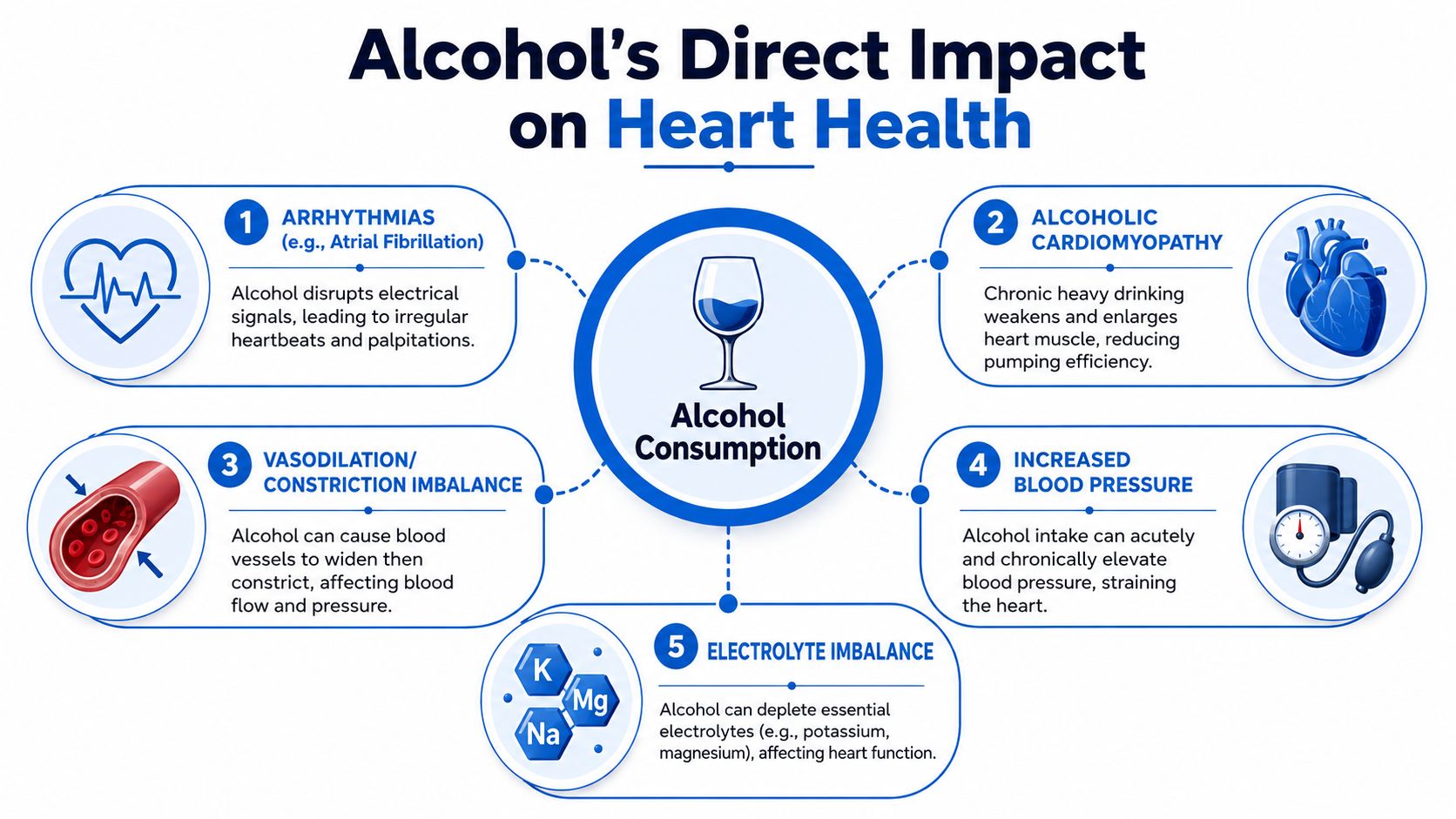
After several drinks in a short period, alcohol can disrupt the heart's electrical system and the body's fluid and mineral balance. The Cleveland Clinic explains that heavy alcohol use is linked to low magnesium and potassium, which can trigger rhythm problems often called holiday heart syndrome (Cleveland Clinic on alcoholic cardiomyopathy).
Your heart rhythm works like a carefully timed signal system. Electrolytes help those signals fire in the right order. When alcohol throws that timing off, the heartbeat can become fast, irregular, or forceful. Some people feel fluttering. Others notice pounding, skipped beats, chest tightness, or a sudden wave of anxiety.
Alcohol can also stimulate the stress response in the body. That can raise heart rate and blood pressure for a time, which may create pressure or pain in the chest. This is one reason binge drinking deserves special attention. The risk is immediate, and the symptoms can show up the same night or the next morning.
Long-term damage from chronic heavy use
A long pattern of heavy drinking creates a different kind of harm. Instead of briefly disturbing the heart's rhythm, it can weaken the heart muscle over time. The heart then stretches, enlarges, and pumps less effectively. Doctors call this alcohol-induced cardiomyopathy.
The heart muscle works like an overused elastic band. Early on, it still snaps back. After repeated strain, it loses strength and recoil. When that happens in the heart, blood does not move forward as efficiently, and symptoms such as chest discomfort, shortness of breath, fatigue, and swelling can appear.
Research describes 80 grams of alcohol a day, about 5.7 standard drinks, for at least five years as a level that significantly raises the likelihood of alcohol-induced cardiomyopathy, as noted earlier in the article. Continued heavy drinking after diagnosis is linked to much worse outcomes, also noted earlier.
This is the nuance many people miss. Binge drinking is more tied to sudden rhythm and blood pressure problems. Chronic heavy use is more tied to lasting damage to the heart muscle. Both can cause chest pain, but they do it through different pathways.
If your pattern is occasional but intense, the concern is often an acute trigger. If your pattern is steady and heavy over months or years, the concern shifts toward cumulative injury. For a broader look at how alcohol addiction affects the mind, body, and relationships, this companion resource may help put the heart effects in context.
Non-Cardiac Pains That Feel Like a Heart Issue
Not every painful chest sensation after drinking comes from the heart. In fact, one of the most common mimics is the digestive tract, especially acid reflux.
Why reflux can feel so alarming
The esophagus sits in the chest, so irritation there often feels like “heart pain.” Alcohol can relax the valve at the bottom of the esophagus, called the lower esophageal sphincter, which normally acts like a lid that keeps stomach acid where it belongs.
Alcohol can reduce lower esophageal sphincter pressure by up to 33%, allowing stomach acid to move upward and cause burning chest pain that can mimic a heart attack, according to this review of alcohol-related chest pain and reflux effects.
If you've ever had acid come up after lying down too soon, you've felt a version of this. The chest can burn, the throat can sting, and the discomfort may worsen after a large meal, mixed drinks, or going flat on your back.
A burning feeling that rises from the upper stomach or breastbone, especially when lying down, often points more toward reflux than a blocked artery.
Other non-heart causes after drinking
Alcohol can also irritate the stomach lining. That irritation can produce pain higher in the abdomen that seems to spread into the chest. Some people describe it as pressure under the sternum. Others say it feels raw, sour, or gnawing.
A few clues make a digestive source more likely:
- Position matters if the pain worsens lying down or bending over
- Meals matter if spicy, greasy, or acidic foods make it flare
- Antacids help if the discomfort eases after reflux treatment
- Burning dominates more than pressure or crushing pain
That said, reflux and heart problems can exist at the same time. A person can have chronic heartburn and still develop a dangerous heart rhythm after a binge. That's why severe symptoms should never be written off based on one familiar explanation.
Understanding Your Personal Risk Profile
A common story goes like this. Someone drinks very little most of the month, then has a wedding, vacation, or big night out and wakes up with chest pain. Another person drinks smaller amounts most evenings and feels fine for years, then slowly develops high blood pressure or a weakened heart. Those are different patterns, and they carry different kinds of risk.

Why your drinking pattern changes the kind of danger
The key question is not only how much alcohol you drink over a week. It is how that alcohol reaches your body and your heart.
Binge drinking acts like a sudden electrical and pressure surge. It can trigger rhythm problems, blood pressure swings, and chest symptoms within hours. Chronic heavy use works more like repeated wear on a pump. Over time, it can strain the heart muscle, raise blood pressure, and make future chest pain more likely even on days you are not drinking.
That difference helps explain why chest pain can seem to come out of nowhere after one heavy night. The total weekly amount may not look extreme, but the single-occasion load can still be hard on the heart.
Research in patients recovering from acute coronary syndrome found an important split. Regular weekly alcohol intake was not linked with higher major cardiovascular events in the same way, while even infrequent binge drinking was linked to a two-fold higher risk within one year in that group (European Journal of Preventive Cardiology study).
Acute risk versus long-term damage
Here is a simple way to sort it out.
If your chest symptoms show up after a large single episode, the immediate concern is the short-term stress alcohol places on heart rhythm, blood pressure, and oxygen demand. If you drink heavily on many days over months or years, the concern shifts toward cumulative injury, especially high blood pressure and weakening of the heart muscle.
Both patterns matter. They just harm the body on different timelines.
Who should be extra careful
Your personal risk rises if you already have heart disease, high blood pressure, an abnormal heart rhythm, diabetes, sleep apnea, or a history of stimulant or nicotine use with alcohol. Family history matters too. So does age.
Sex can matter as well. Women may develop alcohol-related harm at lower intake levels than men because the body often handles alcohol differently. The practical takeaway is simple. Do not assume your risk is low just because someone else drinks more than you do.
If you live with ongoing pain or a condition that makes symptoms harder to read, it may help to review your history with a clinician who understands individualized pain management approaches. Chest discomfort after drinking is not something to self-diagnose by guesswork.
Questions that can help you judge your pattern
Ask yourself:
- Do symptoms appear after a heavy night, even if you usually drink rarely? That points more toward acute binge-related risk.
- Do you drink heavily most weeks or on most days? That raises concern for long-term strain on the heart and blood pressure.
- Have episodes become more frequent, more intense, or easier to trigger? A changing pattern deserves medical attention.
- Do you also notice palpitations, shortness of breath, dizziness, or fainting? Those symptoms raise the level of concern.
- Are you minimizing it because it only happens after drinking? Alcohol can be the trigger, not the excuse.
“I only drink on weekends” can still describe a high-risk pattern if those weekends involve a large amount in one sitting.
How Doctors Diagnose the Cause of Chest Pain
A lot of people avoid care because they imagine a complicated, frightening workup. Most of the time, the first steps are straightforward and focused.
What usually happens first
Doctors start with the basics. They'll ask what the pain feels like, when it started, whether it spreads anywhere, what you drank, and what other symptoms came with it. They'll also ask about shortness of breath, palpitations, nausea, sweating, and whether anything made the pain better or worse.
Then they usually check vital signs and do an EKG. That's a fast test that looks at the heart's electrical pattern. It helps them spot rhythm problems and signs that the heart muscle may be under strain.
How doctors sort heart causes from digestive ones
Blood tests may follow if they're concerned about heart damage or other medical issues. Depending on the story, they may recommend monitoring, imaging, or referral to a heart specialist.
If the pattern sounds more digestive, they may look for reflux, gastritis, or esophageal irritation. That can involve trying targeted treatment first or arranging further evaluation. The purpose isn't to put you through random tests. It's to narrow the list quickly and safely.
A few things make the visit more useful:
- Bring timing details such as when you drank, when symptoms began, and how long they lasted
- List substances clearly including alcohol, caffeine, energy drinks, nicotine, and any drugs or supplements
- Note recurring patterns such as lying down, exertion, meals, or binge episodes
- Be honest about quantity because vague answers make diagnosis harder
If ongoing pain is part of a bigger health picture, this overview of a clinical approach to pain management can help you understand how providers think about persistent symptoms and functional recovery.
Pathways to Prevention and Recovery
A lot of people reach this point with one urgent question: “What do I do now so this does not happen again?”

The answer depends on your drinking pattern. That distinction matters. A single binge can trigger sudden chest symptoms even in someone who does not drink every day, while long-term heavy use can slowly injure the heart, blood vessels, stomach, and nerves until chest pain becomes part of a bigger health problem.
In other words, prevention is not one-size-fits-all.
If your pain happened after a heavy night of drinking and dangerous causes have already been ruled out, focus first on calming irritation and avoiding another hit to the system. Alcohol can act like a chemical irritant on the esophagus and stomach, and it can also make the heart more irritable for a short time. Giving your body a quiet recovery window often helps.
A few practical steps can lower the chance of another episode:
- Stay upright after drinking or eating so acid is less likely to wash back up into the esophagus
- Skip repeat drinking the next day or later that night because another binge can keep the cycle going
- Sip water and choose bland foods if your stomach feels raw or unsettled
- Write down the details including how much you drank, what type of alcohol you had, and when the pain started
If chest pain keeps returning, the question shifts. The issue may no longer be just one rough night. It may be a pattern your body can no longer handle safely.
That is often the turning point.
Some people notice they are drinking more than they planned, needing alcohol to relax, or feeling shaky, anxious, or unwell when they stop. In that setting, recovery means more than avoiding triggers like spicy food or lying down after drinks. It means treating the alcohol use itself.
For people who need medical support to cut down or stop, MAT treatment for alcohol use disorder may be part of the plan. Medicines can help reduce cravings or support safer recovery, especially when they are paired with counseling and follow-up care.
If you're reading from outside Northern California and helping a loved one find services elsewhere, practical rehab explainers can still be useful; for example, this guide to alcohol rehabilitation in Hyderabad walks through what families often need to consider when comparing treatment settings.
Recovery does not always begin with a dramatic moment. Sometimes it begins with a symptom that finally gets your attention. If alcohol and chest pain are showing up together, your body is giving you information. The next step is to listen to the pattern, reduce the immediate risk, and get help if drinking has become part of a larger health problem.
If alcohol and chest pains are showing up together in your life, Addiction Resource Center LLC offers compassionate help in Yuba City for adults who need support with alcohol use, detox, MAT, outpatient care, or guidance for a loved one. Their team provides individualized treatment, accepts most major insurance plans, welcomes Tricare beneficiaries, and offers a 24/7 phone and text line at 530-625-7910 so you can talk with someone when you're ready.