You're holding discharge paperwork, a medication list, and an appointment date, but you still don't know who calls if that appointment falls through. That's the gap a strong Discharge Planning Worksheet for Mental Health is meant to close. It turns discharge from a signature event into an accountable handoff. Table of Contents Why Discharge Planning …

You're holding discharge paperwork, a medication list, and an appointment date, but you still don't know who calls if that appointment falls through. That's the gap a strong Discharge Planning Worksheet for Mental Health is meant to close. It turns discharge from a signature event into an accountable handoff.
Table of Contents
- Why Discharge Planning Needs More Than Appointments
- Understanding the Worksheet Structure
- Preparing the Worksheet With Patients and Care Teams
- Documenting Clinical Status and Medication Needs
- Building a Personal Crisis and Safety Plan
- Scheduling Follow-Up and Completing the Handoff
- Screening Housing Transportation and Community Support
- Adapting the Worksheet for Co-Occurring Substance Use
- Checking Readiness Before Leaving Care
- Quick Reference for Local Mental Health Resources
- Reusable Mental Health Discharge Worksheet Template
Why Discharge Planning Needs More Than Appointments
It's discharge day. You're given a follow up date two weeks out, a prescription that runs out sooner, and instructions to call if symptoms return. Nobody's confirmed the pharmacy has the medication, you don't have a ride, and you aren't sure which number works after hours.
That scene is common because many forms record what was recommended, not whether it can happen. A useful worksheet records the next action, the person responsible, the deadline, and the backup plan if the first step fails.

What Makes a Plan Operational
Effective planning isn't a single referral. A 2019 review identifying six defining components of discharge planning named thorough needs assessment, collaborative and patient centered care, management of available resources, coordination of services, a designated discharge planner role, and a documented discharge plan.
Those components only help if they're visible on the page. Someone needs to own the prescription transfer. Someone needs to confirm the receiving clinician accepted the referral. Someone needs a plan for a missed visit, a medication problem, renewed substance use, suicidal thoughts, or psychiatric deterioration.
- Routine follow up: Scheduled contacts, refills, and check ins when you're stable but still transitioning.
- Urgent escalation: A separate, faster route when warning signs appear or safety changes.
- Unresolved items: Anything not confirmed at discharge, with a named owner and a date to resolve it.
A completed referral isn't the same as engaged care. The worksheet should prove the handoff happened, not just that it was ordered.
Discharge isn't the end of treatment. It's a transfer of responsibility among you, the discharging team, your supports, and the providers who'll see you next. The worksheet is where that transfer becomes specific enough to use under stress.
Understanding the Worksheet Structure
Think of the worksheet as a shared continuity of care record, not three unrelated forms stapled together. Clinical information explains what you need. Follow up actions show where and when you'll get it. Crisis and safety fields explain what happens between visits if things change.
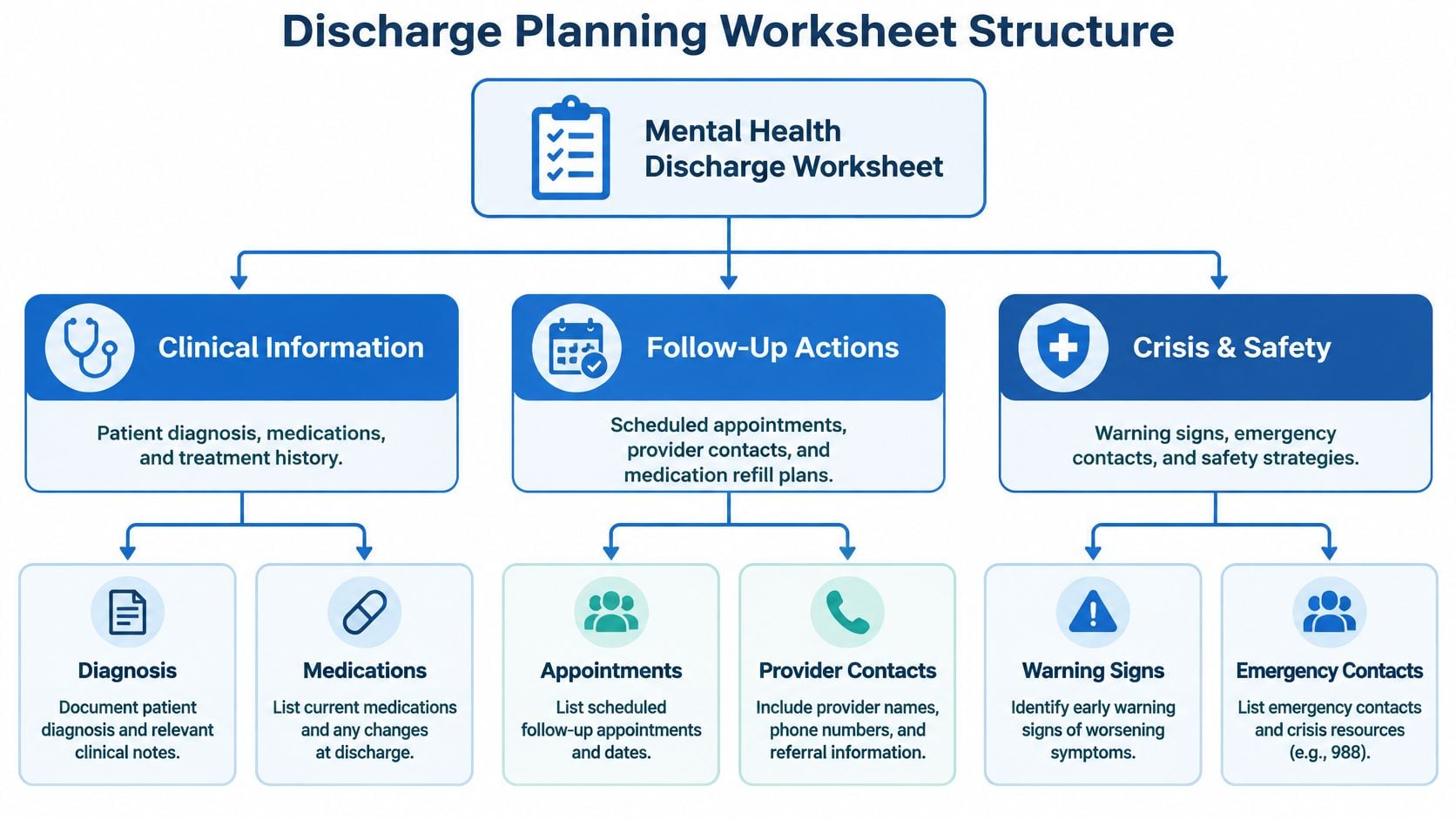
How the Sections Connect
Each category should move through the same chain. Assessment creates an action. The action gets an owner and a due date. Status shows whether it's pending, confirmed, or completed. A backup plan covers failure.
Joint Commission guidance on core discharge information supports this operational view, because a worksheet becomes useful when each action records who is responsible, when it's due, its current status, and whether the intended service was confirmed.
That structure matters across settings. Families comparing approaches in discharge planning for elderly patients will recognize the same principle, since transport, home support, and confirmed services determine whether a plan survives the first week at home.
| Worksheet area | Core question | Verification |
|---|---|---|
| Clinical information | What's your current status and medication plan? | Reconciliation completed and prescriber named |
| Follow up actions | Who will you see, where, and when? | Receiving provider accepted the referral |
| Crisis and safety | What do you do first if risk rises? | Named contacts and escalation route confirmed |
| Practical resources | Can you reach care and live safely? | Housing, transport, and pharmacy confirmed |
The categories shouldn't sit in isolation. If your diagnosis requires medication management, the medication field should link to a prescriber, a refill date, and a follow up visit. If you don't have transport, that appointment isn't confirmed yet, no matter how neatly the date is typed.
Preparing the Worksheet With Patients and Care Teams
Start early, not in the last hour before you leave. Discharge planning works best when it begins alongside treatment, while there's still time to call a pharmacy, test a phone number, or reschedule an appointment that conflicts with work or childcare.
Who Does What
You bring knowledge nobody else has. The discharge planner coordinates services. Prescribers clarify medications. Family or other supports, with your consent, confirm what they can realistically do.
Bring or verify these items together:
- Current information: Diagnoses, medication list, allergies, pharmacy, and recent treatment.
- Contact details: Your phone, emergency contacts, and preferred way to receive reminders.
- Practical facts: Insurance or benefits information, transport options, work or school constraints, and housing for the coming days.
- Access needs: Language, interpretation, hearing, vision, or other accessibility requirements.
Don't let the form default to phone calls if you respond better to texts. Record that preference where the follow up owner will see it. If you don't have a car, write down the actual bus route, ride, or telehealth alternative, not a vague note that transport is needed.
Consent and Disagreement
Releases of information belong in the record, with names and limits you understand. A support person shouldn't be assigned a task they haven't agreed to. If you and the team disagree about a recommendation, document your preference, the options discussed, and the agreed next step rather than hiding the conflict.
Assign one point of accountability for unresolved items. Committees don't make reminder calls, named people do. Before discharge, that person should review every pending field with you and confirm what happens next, in plain language you can repeat back.
Documenting Clinical Status and Medication Needs
This part of the worksheet answers a direct question. What is true about your condition on the day you leave, and what still needs attention?
Clinical Status at Discharge
Record the reason for care, admission and discharge diagnoses, treatment provided, and your response to it. Add current mental status, outstanding symptoms, and suicide or violence risk as assessed by the treating team. Note what improved, what didn't, and what the receiving provider should monitor first.
Don't copy forward an old assessment. A receiving clinician needs your condition at discharge, not how you presented on admission. If sleep remains poor, anxiety is rising in the evenings, or a new symptom appeared after a medication change, that belongs here where it can shape follow up timing.
Medication Continuity
A prescription list alone causes avoidable failures. Record each medication with these fields:
- Medication and dose: Name, strength, timing, and purpose in plain language.
- Prescriber: Who manages it now and who takes over after discharge.
- Supply plan: Pharmacy, pickup date, refill date, and who confirms it's in stock.
- Reconciliation status: Started, stopped, changed, or continued, with conflicts resolved.
- Adherence barriers: Cost, side effects, confusion, access, or concerns you raised.
Families supporting younger patients often need the same clarity about roles and follow through, which is why practical resources such as Children Psych psychiatry medication advice can help frame questions about who monitors effects and who to contact with concerns. The worksheet itself shouldn't change a prescription, it should make the current plan impossible to misread.
Consider a refill that expires on a weekend. The entry should name the pharmacy, confirm pickup before discharge or a bridge plan arranged by the prescriber, and list who you contact if the medication isn't ready. That's different from writing a drug name and hoping the timing works out.
Practical rule: Every medication needs a prescriber, a supply source, and a next review date. If one is missing, mark it unresolved.
For co-occurring substance use care, record clinically relevant withdrawal or overdose concerns here only as status and monitoring needs. The detailed continuity plan belongs in its own section so it isn't buried inside a long medication list.
Building a Personal Crisis and Safety Plan
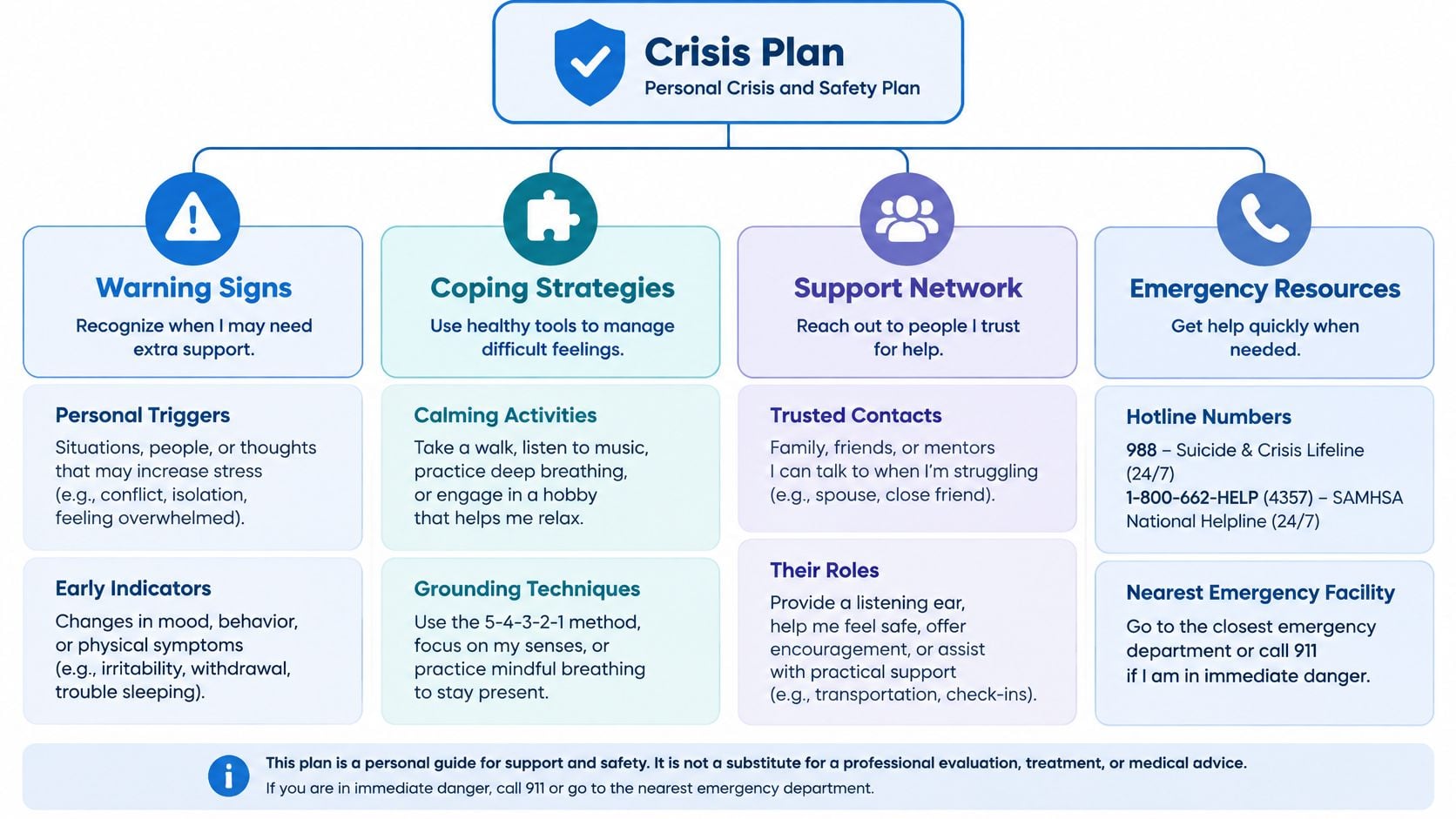
A crisis plan shouldn't read like generic advice pasted into every chart. It should sound like you, use strategies you've tried, and name people who've agreed to help.
Fields That Make the Plan Personal
SAMHSA guidance on safety planning during care transitions supports a collaborative structure covering personal warning signs, coping strategies, people and settings for distraction, named supports, professional crisis resources, and means safety actions, while separating routine follow up from emergency escalation.
Build it in order:
- Warning signs: Your earliest changes, such as not sleeping, skipping medication, withdrawing, or rising agitation.
- Internal coping steps: Specific actions you can take alone, written as verbs you can follow when concentration is poor.
- Distraction and support: People and places that help, with current phone numbers and preferred contact method.
- Professional resources: Treating providers, crisis routes, and emergency services, with hours where relevant.
- Means safety: Who will secure medications or weapons when relevant, and how that was confirmed.
Say your warning sign is two nights of poor sleep plus a missed dose. The plan might direct you to use a coping step you've chosen, contact a named support that day, and call the treating provider during office hours. If you develop intent to harm yourself or can't stay safe, the plan should move directly to emergency help rather than routine messaging.
The worksheet doesn't replace a formal safety assessment or emergency care. It preserves decisions made with your clinical team so you and your supports aren't inventing a plan during a crisis. Review it when contacts, medications, housing, or risk change, and keep a copy where you can find it quickly.
Scheduling Follow-Up and Completing the Handoff
Scheduling is only step one. Records still need to move, the receiving clinician needs to accept the referral, and someone needs to confirm you attended.
The flow below shows the minimum details that turn an appointment into a trackable handoff.
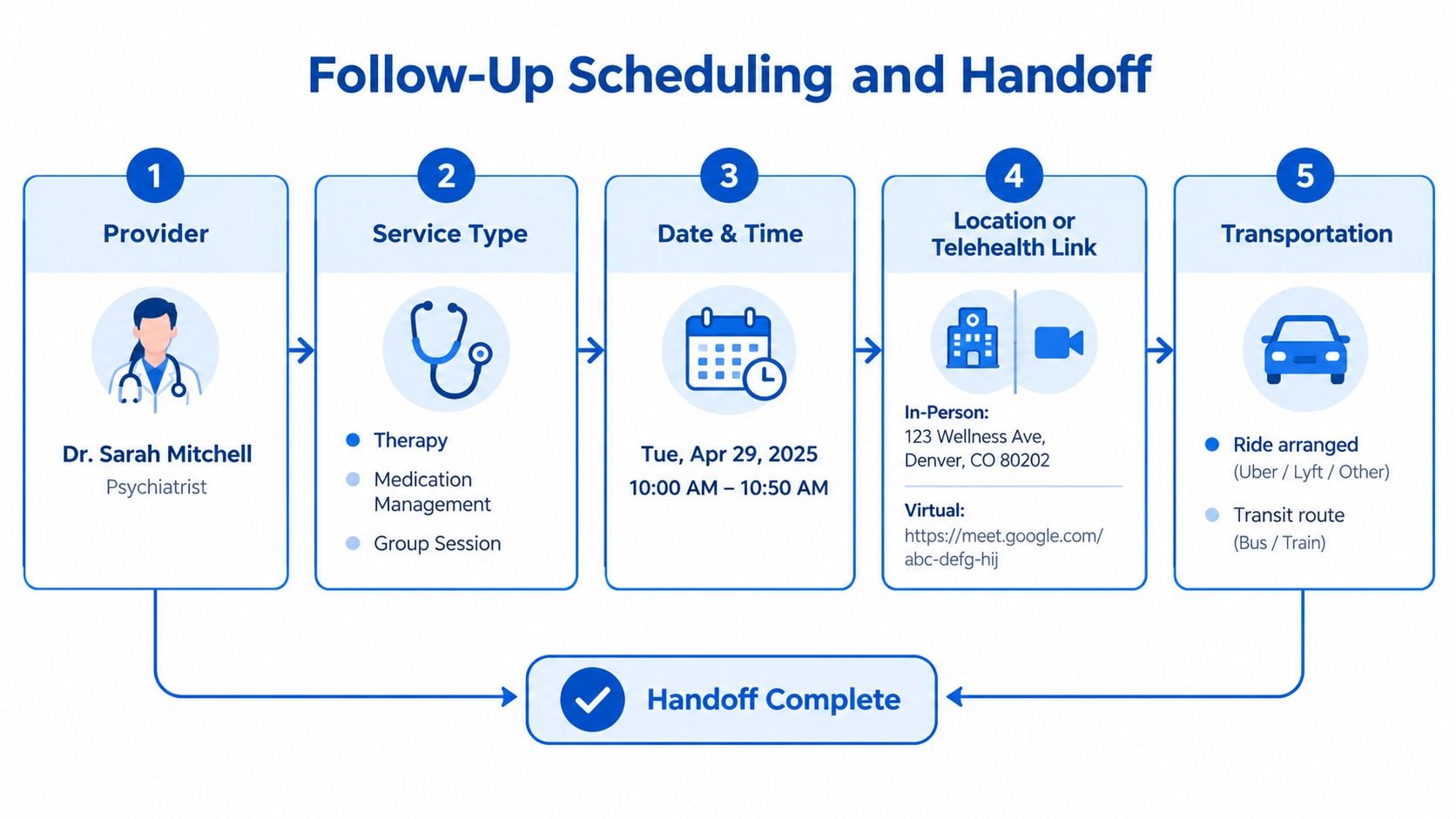
Record the Full Appointment
For every visit, document provider and specialty, service type, date and time, address or telehealth link, and a working phone number. Add insurance or authorization status, reminder method, transport plan, and the coordinator responsible for confirmation. If it's telehealth, confirm you have a private space, a charged device, and a backup phone number.
A warm handoff means direct contact with the receiving clinician or team before discharge when possible, not just a faxed referral. Record who spoke, what essential information was sent, when receipt was confirmed, and whether the referral was accepted. Readers building longer term continuity can connect this step with aftercare planning guidance for keeping recovery on track, especially when several services start at different times.
The short video below helps distinguish a referral from a completed transition before you finalize dates and owners.
If the First Visit Is Missed
Write the contingency before discharge. Who notices the no show, how quickly do they contact you, which number do they use, and when is the visit rescheduled? Document each outreach attempt with date, time, modality, outcome, and next action.
A patient can leave a psychiatric hospital with an outpatient date and still have no clinician to clinician contact. That gap is where records, medication questions, and accountability disappear. Mark the handoff complete only after acceptance is confirmed, and mark engagement complete only after attendance is verified.
Screening Housing Transportation and Community Support
Clinically sound recommendations fail in ordinary ways. The apartment falls through. The phone is disconnected. The pharmacy charge is unaffordable. The bus doesn't run early enough for the appointment.
Run a Feasibility Screen
UK guidance on discharge from mental health inpatient settings supports a broad view, since a plan should consider physical, psychological, social, cultural, housing, financial, transport, and medication access needs, with transport and follow up arranged as part of the transition.
Screen each need as confirmed, pending, or unavailable:
- Housing: Safe address for the next 7 to 30 days, who confirmed it, and a backup if it changes.
- Basics: Food, phone access, charging, and a reliable mailing or message route.
- Transportation: Driver, transit route, ride benefit, travel time, and backup ride.
- Care responsibilities: Childcare or dependent care during appointments.
- Medication access: Cost, pharmacy hours, pickup person, and delivery option if available.
- Communication: Language, sensory accommodations, and cultural needs that affect services.
Separate preference from proof. Wanting to stay with a relative isn't the same as that relative agreeing and providing a key. Accepting a referral isn't the same as having a ride. Write down who confirmed each resource and when.
Context matters when housing is unstable. A resource like the Phoenix homelessness mental health guide shows why mental health planning and housing support can't be treated as separate conversations. Your local worksheet should connect behavioral health, primary care, recovery services, benefits help, and crisis pathways without assuming you already have stable resources.
If the recommended plan is impossible in your real environment, it isn't finished. Change the appointment, the transport, or the support plan before discharge.
Adapting the Worksheet for Co-Occurring Substance Use
Keep the core mental health worksheet intact, then add a focused layer for substance use. Duplicating every field creates confusion about which provider owns which decision.
Add These Fields When Relevant
- Withdrawal and overdose risk: Current concerns identified by the treating team and who monitors them.
- Naloxone access: Whether it's clinically indicated, where you'll obtain it, and who knows where it's kept.
- MAT continuity: Medication, prescriber, pharmacy or program, next dose or appointment, and refill owner.
- Relapse triggers: People, places, symptoms, pain, insomnia, or routines that increase risk for you.
- Recovery supports: Peer, family, group, sponsor, or community contacts who've agreed to specific roles.
- Coordination: How addiction treatment, mental health care, and primary care will share information with your consent.
Give each service a distinct contact. Your therapist, MAT prescriber, primary care clinician, and peer support shouldn't be collapsed into one line called follow up. Readers who need the treatment model explained can review dual diagnosis treatment basics and integrated care for co-occurring disorders and then map each provider onto the worksheet.
Consider leaving residential or intensive outpatient care on a Friday. You need medication continuity through the weekend, a confirmed behavioral health appointment, and a relapse response that names who you call first and where you go if cravings escalate. If mental health symptoms worsen at the same time, the crisis plan should already show whether the route is your mental health provider, addiction program, crisis service, or emergency care.
These fields support individualized clinical judgment. They don't prescribe medication, level of care, or legal decisions, and they shouldn't be completed without the providers responsible for that care.
Checking Readiness Before Leaving Care
A filled form can still be unsafe. The final pass tests whether the whole plan works when read by a tired patient, a worried family member, or a receiving clinician who wasn't in the room.
Look for Contradictions and Blanks
Check for missing dates, conflicting medication instructions, unnamed owners, unconfirmed referrals, and crisis numbers buried in long paragraphs. Verify housing and transportation again, because both can change during a stay. Confirm the receiving provider accepted the handoff and that essential records were sent.
Use this readiness scan:
- Medications: List reconciled, supply confirmed, prescriber and pharmacy clear.
- Appointments: Date, modality, transport, authorization, and reminder method confirmed.
- Safety: Warning signs, coping steps, supports, and emergency route easy to find.
- Participation: You and, with consent, your supports helped build the plan.
- Missed visit plan: Owner, outreach timing, and rescheduling route documented.
Use Teach Back
A signature doesn't prove understanding. Teach back means you explain, in your own words, which medications you take and why, your warning signs, your first coping steps, your next appointment, and where you'll seek urgent help.
If you can't explain a step, the team should reteach it and revise the wording. That's not a test you failed, it's evidence the instructions weren't clear yet. Document teach back as completed only after you can describe the plan without reading it word for word.
Don't leave with essential fields marked pending unless each one has an owner, a deadline, and a way to reach you. Unresolved is acceptable only when it's visible and actively managed. Invisible is where transitions fail.
Quick Reference for Local Mental Health Resources
Put the numbers you'll need first on one page, then verify them before discharge. A resource list copied from the internet can contain old numbers, wrong hours, or services that don't accept your insurance.
Fill and Verify Each Contact
| Resource | Name and phone | Hours and access notes | Backup |
|---|---|---|---|
| Crisis route | Local crisis line or 988 where applicable | Language and text options | Emergency services |
| Discharge coordinator | Named person | Best contact method | Covering clinician |
| Outpatient clinician | Provider and office | Appointment and after hours route | Clinic main line |
| Primary care | Provider and office | Portal or phone instructions | Urgent care contact |
| Pharmacy | Name and location | Hours and delivery details | Alternate pharmacy |
| Support person | Name and relationship | Agreed role | Second support |
| Community help | Housing, transport, peer, or benefits contact | Eligibility confirmed | Coordinator |
Call or otherwise confirm critical numbers while staff can still correct them. Record eligibility, language access, accessibility, and whether an appointment or referral is required. Add the date verified so an old list isn't mistaken for a current one. For a broader view of available care, see behavioral health services in California and then replace general categories with your confirmed local contacts.
As a clearly labeled local example, Addiction Resource Center LLC lists a 24/7 phone and text line at 530-625-7910 and an address at 1002 Live Oak Blvd., Suite A, Yuba City, CA. Treat that as a treatment contact, not a substitute for emergency services. If you're in immediate danger, use emergency help first.
Reusable Mental Health Discharge Worksheet Template
Copy this framework into a printed form or electronic document. Complete it with your care team, and leave unresolved items visible until they're confirmed.
Fillable Worksheet
- Patient and coordinator: Name, preferred contact, language or access needs, discharge coordinator, emergency contacts.
- Clinical status: Diagnoses, treatment and response, current symptoms, risk concerns, condition at discharge.
- Medications: Name, dose, purpose, prescriber, pharmacy, refill date, reconciliation status, barriers, owner.
- Crisis plan: Warning signs, coping steps, distraction supports, named contacts, professional resources, means safety actions, emergency route.
- Appointments and handoff: Provider, service, date and time, location or telehealth link, records sent, referral accepted, attendance confirmed.
- Practical needs: Housing, food, phone, transportation, childcare, benefits, insurance, medication cost, backup options.
- Community supports: Family, peer, primary care, recovery, housing, and transport contacts with agreed tasks.
- Co-occurring needs: Withdrawal or overdose concerns, naloxone access, MAT continuity, triggers, relapse response, coordinating providers.
- Accountability: For each action, owner, due date, status, confirmation method, backup plan, next step.
- Final verification: Teach back completed, copies given, releases signed, missed appointment plan documented, escalation instructions reviewed.
Don't use this Discharge Planning Worksheet for Mental Health as emergency care or as a substitute for individualized clinical judgment. Resolve blank safety, medication, housing, and handoff fields before discharge whenever possible.
If you're leaving detox, residential care, or a psychiatric stay and need co-occurring mental health and substance use follow up that is actually coordinated, Addiction Resource Center LLC offers individualized treatment, medication assisted treatment, intensive outpatient care in person and by telehealth, and customized aftercare planning in Yuba City. Visit the site to ask how the team can help you turn this worksheet into confirmed appointments, medication continuity, and a workable recovery plan.