Explore 12-step discussion topics, original Step-study prompts, and what to know about meeting formats, visitor access, and treatment support.


A 12-step meeting topic sets the direction for peer discussion, focusing a group on a specific recovery theme, a Tradition, or a piece of literature. Many people attending their first support group expect a fixed curriculum or a teacher leading a structured class, but mutual-support groups operate differently. Each group functions autonomously and chooses its own format, so the agenda depends on the specific meeting you attend.
Understanding these formats helps you find the right environment for your current needs. A topic-discussion meeting typically opens around a selected recovery theme, allowing members to share their personal experiences related to that subject. A Step-study meeting focuses closely on one of the 12 Steps or related fellowship literature, moving methodically through the foundational texts. Some groups alternate their formats week by week, and others maintain a consistent structure.
Because NA groups are self-governing, they can choose how to run their meetings as long as their actions don’t adversely affect other groups or the entire NA Fellowship. The Group Booklet describes formats including study meetings, where members read and discuss part of NA-approved literature, and newcomer meetings; it also encourages groups to develop a format suited to their members and community.
For individuals in Northern California seeking a clinical foundation alongside peer support, Addiction Resource Center LLC offers direct adult intensive outpatient care in Yuba City. We do not run or manage AA or NA meetings, but we provide individualized clinical treatment that often complements the mutual support people find in community 12-step groups.
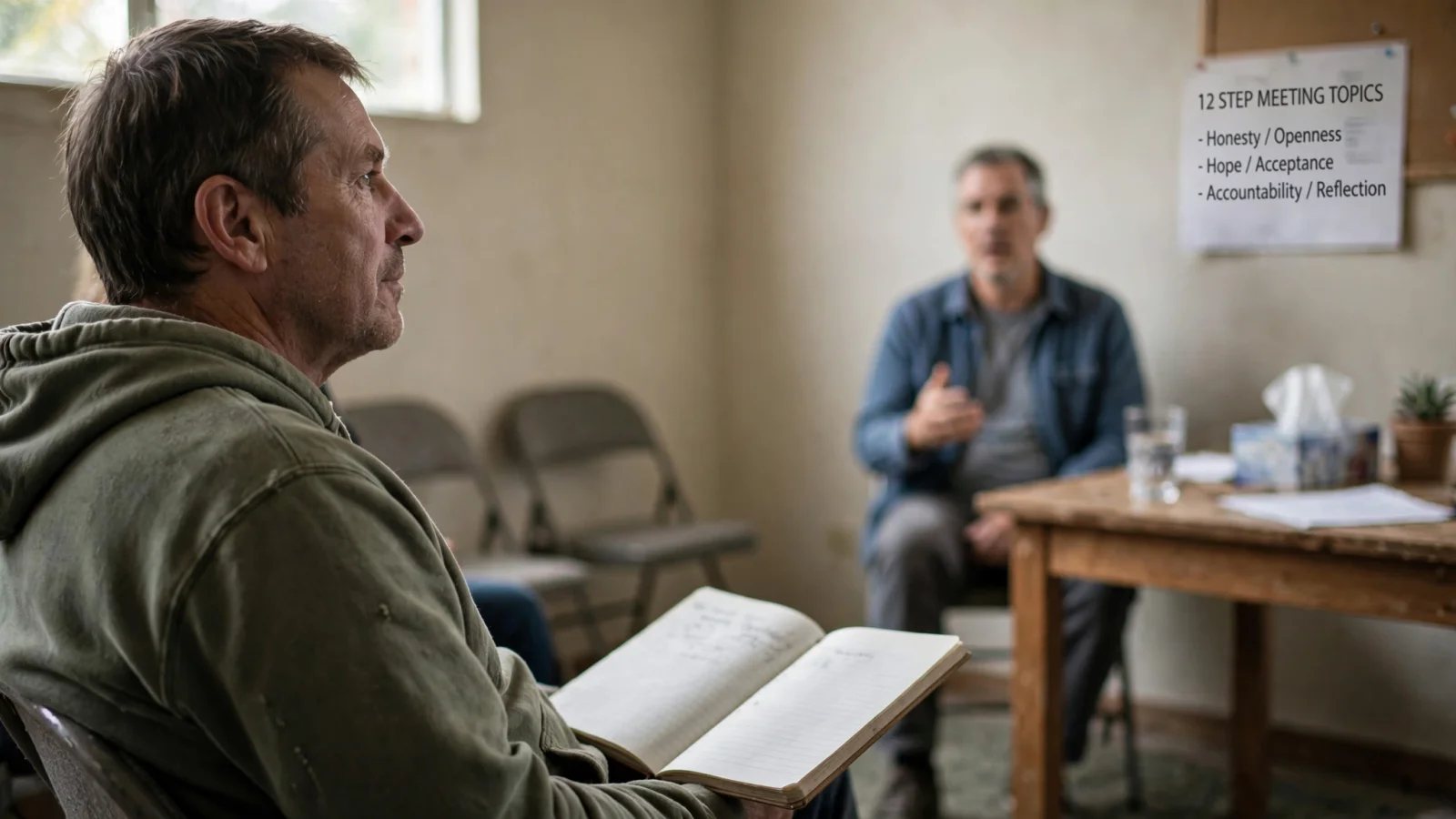
12-Step Meeting Topics and Questions to Use
Groups often need fresh, open-ended questions to keep their discussions productive and welcoming. The following prompts are original editorial suggestions designed to spark conversation around common recovery themes. They do not represent official AA or NA wording or a required curriculum, and they do not replace fellowship literature. You can adapt these 12 step meeting topics to fit the specific fellowship and local meeting format in your area.
Step-Study Discussion Prompts
These questions follow the general progression of the 12 Steps, encouraging personal reflection rather than mere recitation of the literature.
| Step theme | Sample open-ended question |
|---|---|
| Honesty and asking for help | What made it difficult, or possible, to admit you needed support? |
| Hope | Where have you found hope when you could not yet see a full plan? |
| Willingness | What does willingness look like in one ordinary choice today? |
| Self-reflection | What patterns or strengths are you learning to notice more clearly? |
| Honest sharing | What helps you feel safer sharing honestly with a trusted person? |
| Readiness for change | What change are you ready to practice, rather than only wish for? |
| Humility | When has asking for help been more useful than trying to manage everything alone? |
| Recognizing harm | How can you take responsibility without getting stuck in shame? |
| Repair and boundaries | What does respectful repair look like when safety or boundaries matter? |
| Ongoing accountability | How can you notice and address a mistake before it grows? |
| Reflection | What helps you pause, reflect, or reconnect with your values? |
| Service | What kind of service or support feels useful and sustainable for you now? |
Everyday Recovery Discussion Topics
Not every meeting focuses strictly on literature or sequential Steps. Many gatherings address the daily realities of staying sober, managing stress, and rebuilding a stable life. Incorporating practical recovery themes helps members share current challenges and recent successes.
Daily recovery requires constant adjustment, and topics like gratitude, fear, acceptance, and living one day at a time remain relevant. A prompt focusing on gratitude during a difficult stretch allows members to discuss how they maintain perspective when life feels overwhelming. Asking the group to explore willingness or acceptance helps shift the conversation away from complaints and toward actionable recovery strategies.
Relapse prevention forms another core category for topic-discussion meetings because unstructured time often triggers anxiety for people newly transitioning into recovery. You can prompt the group by asking what routines help them stay grounded on weekends or during empty evenings. Another practical question asks what helps members recognize when it is time to reach out to their sponsor or support network, rather than isolating when stress builds.
Relationships undergo strain during active substance use, making trust, boundaries, and forgiveness common discussion subjects. A prompt focusing on supportive conversations with family members allows people to share strategies for rebuilding connections. Making amends and repairing relationships takes time, and peer groups provide a space to hear how others navigate that slow, delicate process while maintaining their own healthy boundaries.
Connection within the recovery community itself frequently sustains long-term sobriety. Discussing sponsorship, asking for help, and welcoming newcomers reminds established members of their ongoing responsibilities, and service work keeps individuals engaged with the group. A useful prompt might ask members to describe a time when extending help to a newcomer reinforced their own commitment to recovery.
Treatment transitions represent a vulnerable period that warrants specific attention. People moving from residential care into an outpatient program or a community meeting face sudden shifts in accountability. A group can discuss what routines and daily supports help anchor someone after leaving a structured environment. Members might also share what questions they plan to bring to an outpatient clinician or prescriber as they learn to balance clinical care with community support.
Using Prompts Without Pressuring Members
Facilitating a peer group requires a balance between providing a clear topic and allowing members to participate at their own pace. When suggesting a prompt, frame it as an invitation for reflection. Participants benefit from following the group’s norms and their own comfort level, which often includes the option to pass on speaking entirely.
Listening holds as much value as speaking in a mutual-support setting. Pressuring a newcomer to share before they feel ready can create an intimidating environment that discourages them from returning. A prompt serves its purpose if it gives the group a shared starting point, even if only a few people choose to answer the specific question directly.
Peer discussions stay productive when they avoid crossing into clinical territory. Facilitators and members protect the group dynamic by keeping the focus on the present day and shared recovery principles rather than soliciting trauma details, medication histories, or identifying information. Support groups excel at sharing lived experiences, but they lack the professional framework to process acute psychological trauma safely.
Members keep peer support distinct from therapy or clinical decision-making by directing medical questions to qualified healthcare professionals. Avoid claims that any single topic is the best approach, clinically proven, or guaranteed to prevent relapse. Group discussions thrive when members speak only from their own experience, rather than offering prescriptive advice or amateur medical opinions.

How Peer Support Fits With Clinical Treatment
Mutual-support meetings provide connection, shared experience, and accountability, but they represent only one part of a complete recovery plan. A community group cannot replace an individualized clinical assessment or evidence-based treatment. The Substance Abuse and Mental Health Services Administration details a framework in an overview on treatment paths, describing medications, peer support, and mutual-support meetings as complementary tools. Clinical care and peer groups serve distinct, overlapping functions that support long-term health.
Medication and Withdrawal Need Clinical Guidance
Questions about medication frequently arise during early recovery. Discuss medication questions or dosage changes directly with a licensed prescriber instead of altering a prescribed medication based on a discussion heard at a community meeting. Peer groups offer invaluable emotional backing, but they cannot assess drug interactions, side effects, or medical suitability.
Withdrawal presents immediate physical risks that require medical evaluation. If someone suspects they are experiencing acute withdrawal symptoms, they need professional assessment rather than reliance on a peer meeting. The National Institute on Alcohol Abuse and Alcoholism notes that acute withdrawal may require clinical care, and that detox alone does not constitute full treatment for an alcohol use disorder. Professional medical management stabilizes the body so the individual can eventually participate effectively in outpatient therapy and community groups.
Yuba City Care Through Addiction Resource Center LLC
When you need professional clinical support, Addiction Resource Center LLC directly provides an adult intensive outpatient program in Yuba City. We design individualized plans that address your specific history with alcohol or drug use, incorporating regular progress reviews to keep your recovery on track. Our clinicians utilize cognitive behavioral therapy, motivational interviewing, and trauma-informed care to help you build practical skills for daily life.
We offer flexibility through both in-person and telehealth IOP options, allowing you to receive structured care while maintaining your home and work responsibilities. Addiction Resource Center LLC does not operate AA or NA meetings, but our team frequently helps clients understand how to integrate community peer support into their overall treatment plan. We work with most major insurance providers and offer a TRICARE-approved IOP option, though we advise all clients to verify their specific benefits and coverage costs directly.
For individuals requiring higher levels of care, we coordinate closely with our partner, Ona Treatment Center in Browns Valley. Ona delivers medically supervised detox and residential treatment, providing the stabilization necessary before stepping down to an outpatient level. Medication-assisted treatment is available onsite around the clock through Ona Treatment Center, ensuring continuous medical support during the most physically demanding phases of early recovery.
You can reach Addiction Resource Center LLC to discuss local outpatient options or a referral for residential care. Our team is available 24/7 by phone or text at 530-625-7910.
What to Know Before Attending an AA or NA Meeting
Finding the right support group often requires visiting a few different locations. Topics and formats are not fixed across the board, so a meeting that feels highly structured on a Tuesday might be followed by a relaxed, conversational gathering at a different location on Wednesday. Knowing the planned format ahead of time helps you set accurate expectations for the hour.
Check the specific meeting’s policies regarding visitors and family members, as groups designate themselves as open or closed. An open meeting welcomes anyone interested in the fellowship, including family members, students, and observing professionals. A closed meeting restricts attendance to those who have a desire to stop using substances or who identify as individuals in recovery.
Assuming every meeting accepts visitors can lead to uncomfortable situations for both the family member and the group. Review the local meeting directory or contact the group’s listed representative to confirm their access policies. Narcotics Anonymous and Alcoholics Anonymous maintain separate directories, and their specific group guidelines remain distinct from one another.
Once you confirm the format and visitor access, you can attend the group with a clearer mind. Bring a discussion prompt if the format invites suggestions, or sit and listen according to the group’s established norms. Peer support offers a flexible, community-driven space that works best when you engage with it consistently, finding the topics and the people that help reinforce your commitment to a healthier life.
Addiction Resource Center LLC provides individualized intensive outpatient treatment in Yuba City, California, and pathways to detox and residential care through our partner facility. If you or a family member need clinical support for a substance use disorder, contact us to explore your options. Learn more about our programs and approach at https://sayarc.com.