The intake room is quiet, but the person sitting in it can't settle. They're exhausted after a night without sleep, their thoughts are racing, and each new explanation about treatment seems to disappear before they can take it in. A family member may read this as unwillingness. The person may think they're failing before recovery …

The intake room is quiet, but the person sitting in it can't settle. They're exhausted after a night without sleep, their thoughts are racing, and each new explanation about treatment seems to disappear before they can take it in. A family member may read this as unwillingness. The person may think they're failing before recovery has even started.
The zones of tolerance offer another way to understand that moment. They help patients, families, and clinicians notice when the nervous system is too revved up or too shut down for learning and decision-making, then choose a response that fits. In substance use care, this isn't about willpower. It's a practical way to pace support, make sense of difficult reactions, and decide what might help next.
Table of Contents
- Why Zones of Tolerance Matter in Addiction Care
- The Window of Tolerance Explained
- Why Substance Use Narrows the Window
- Reading Hyperarousal and Hypoarousal in Real Time
- Matching Treatment to Arousal State
- Zones of Tolerance in Telehealth and Home Settings
- How to Expand the Window Over Time
- A Practical Plan You Can Start This Week
Why Zones of Tolerance Matter in Addiction Care
A person arriving for treatment may be physically uncomfortable, worried about what comes next, and distracted by cravings or withdrawal symptoms. Even a simple question can feel like one demand too many. When someone can't focus, snaps at a loved one, or goes quiet, those reactions don't automatically mean they lack motivation. Their current state may be making it hard to listen, reflect, and respond.
That distinction changes what a helpful first step looks like. A lecture about consequences or an intensive discussion about past experiences may ask too much of someone who's highly activated or emotionally shut down. The immediate task may be to reduce stimulation, support orientation, and help the person become present enough to take part.
A useful starting point: Ask what the person's nervous system can manage right now before deciding what they should be able to discuss.
The framework can also give families a less blaming way to describe what they see. Instead of calling someone difficult or distant, they can notice signs of activation or shutdown and offer a calm, specific choice. A patient might say, “I can hear you, but I can't process this yet,” or “I'm not ignoring you. I feel numb.”
The zones of tolerance aren't an abstract label to place on a person. They're a working map for self-monitoring and care decisions. Learning the basic states makes it easier to recognize what's happening, choose a matching response, and return to treatment conversations when attention and connection are more available.
The Window of Tolerance Explained
Think of your nervous system as a thermostat that responds to stress. The window of tolerance is the range where you can feel emotion without being overwhelmed, think flexibly, stay connected to others, and take in new information. You don't have to feel calm or happy to be in this range. You may be upset and still able to listen, consider options, and choose what to do.
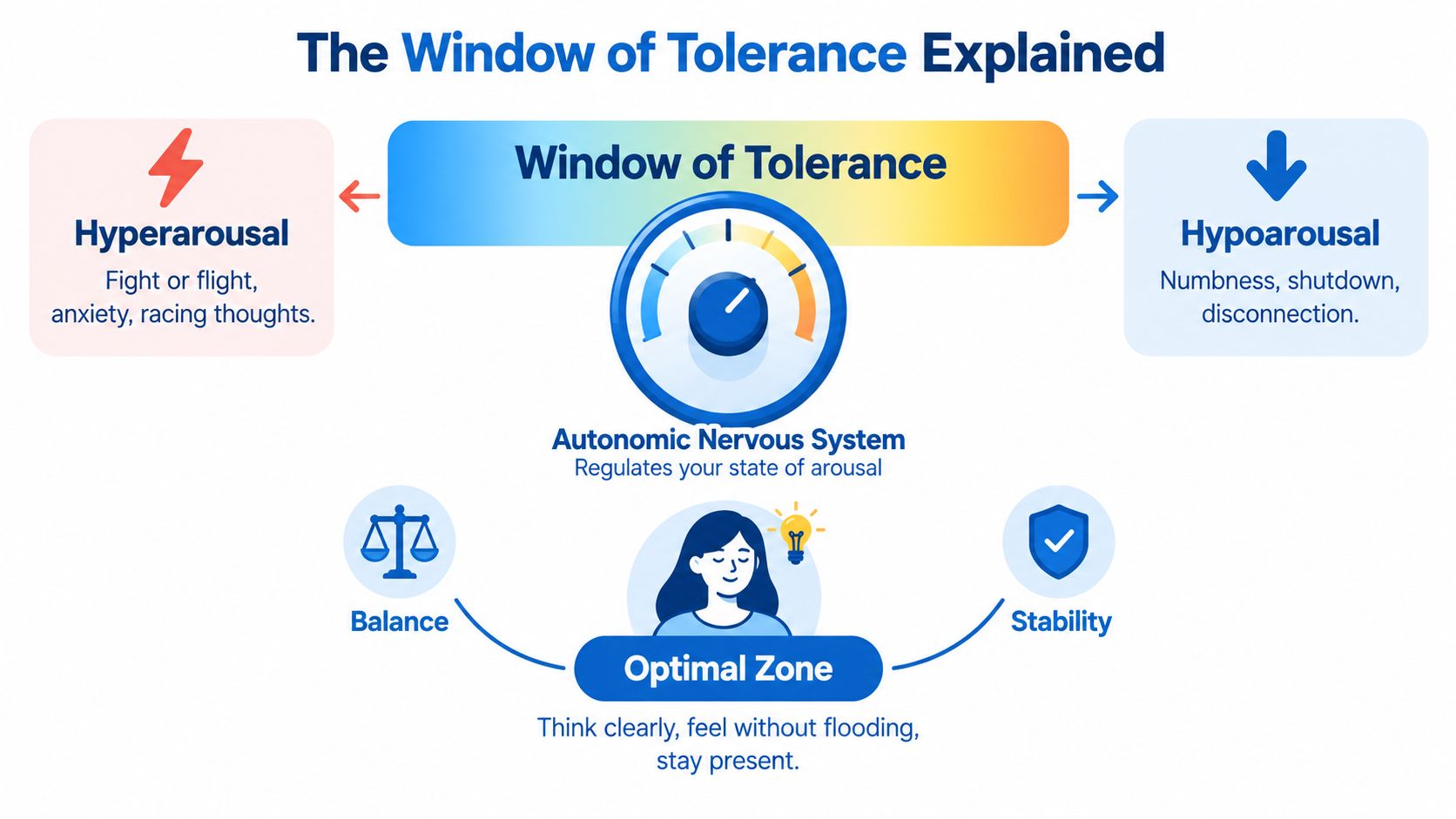
When the nervous system senses too much demand, it may move toward hyperarousal. This is the revved-up, fight-or-flight side of the map. You might notice racing thoughts, vigilance, anger, impulsive urges, rapid or shallow breathing, muscle tension, or a strong startle response. It can be hard to pause and weigh choices because your body is preparing to react.
At the other extreme, hypoarousal can feel like the system has powered down. A person may feel numb, disconnected, exhausted, or unable to respond. They may speak slowly, lose track of a conversation, or struggle to find words. From the outside, this can look like disinterest, but a person who's shut down may be having difficulty staying oriented and engaged.
| State | What it can feel like | What may be harder |
|---|---|---|
| Hyperarousal | Wired, anxious, tense, reactive | Slowing down and thinking through choices |
| Window of tolerance | Present, flexible, connected | Stress may still be uncomfortable, but manageable |
| Hypoarousal | Numb, foggy, withdrawn, depleted | Initiating action and staying engaged |
Everyone moves between states. The goal isn't to remain in one ideal setting all day. It's to notice when you've moved outside your workable range and find support to return. If pain or physical symptoms make it harder to tell what your body is signaling, this resource on pain neuroscience education offers more context about how the nervous system and pain interact.
Why Substance Use Narrows the Window
Substance use can change how the body handles stress and how a person responds to everyday demands. With repeated or escalating exposure, a person may need more of a substance to get an effect they once felt with less. That process, commonly called tolerance, isn't the same as the clinical window of tolerance. One describes changes in response to a substance; the other is a way to understand the range of arousal in which someone can stay present and engaged.
During early recovery, the window can feel especially unpredictable. A person may be tense and restless at one moment, then numb and exhausted later. Sleep disruption, fatigue, difficulty concentrating, emotional reactivity, and cue-related cravings can all make it harder to regulate. A person may also appear quiet without feeling settled, so low visible activity shouldn't be treated as proof that they're ready for a demanding conversation.
A review of recovery processes describes how repeated or escalating substance exposure can blunt peripheral stress responses while leaving craving, sleep problems, fatigue, concentration difficulties, emotional reactivity, and reduced self-regulation clinically significant. It also summarizes evidence that recovery can support better cognitive control, self-regulation, and functioning while reducing stress- and cue-related craving (review of stress processes in substance use recovery).
That's why early treatment shouldn't follow a rigid timetable. Someone who can't track a conversation or is unusually irritable may need assessment and stabilization before they can do complex planning. Difficulty concentrating, agitation, or shutdown isn't proof of personal failure. It's information to consider alongside withdrawal, sleep, medication, and other clinical factors.
Reading Hyperarousal and Hypoarousal in Real Time
When someone seems overwhelmed, begin by noticing what their body, attention, and behavior are doing. These observations can help guide a first response, but they're not a diagnosis. Ask what the person is experiencing rather than assuming you know what a behavior means.
| Signal | Hyperarousal | Hypoarousal |
|---|---|---|
| Body | Tense muscles, rapid or shallow breathing, restless movement | Low energy, stillness, slowed movement or speech |
| Thoughts | Racing, looping, threat-focused | Foggy, blank, hard to organize |
| Behavior | Snapping, pacing, interrupting, acting on an urge | Withdrawing, zoning out, struggling to respond |
| Possible first response | Lower stimulation, offer a grounding cue, slow the pace | Use gentle orientation or movement, offer a simple choice |
For a person who's highly activated, more questions and a louder voice can add pressure. Try speaking slowly, reducing noise, and offering one manageable choice, such as whether they'd rather sit somewhere quieter or take a short pause. If they're open to it, they can try grounding through the senses or breathing at a comfortable pace. Don't insist on a particular exercise if it increases discomfort.
For a person who seems shut down, demanding eye contact or asking them to explain everything may make engagement harder. Use a calm voice, orient them to what's happening, and offer a small, low-pressure action, such as shifting position, standing if safe, or naming something they can see. Give the person time to respond rather than filling every silence.
Read the state, not the character: A strong reaction or a quiet one doesn't tell you whether someone cares or is trying.
Moving outside the window doesn't by itself mean relapse or lack of motivation. Withdrawal, lost sleep, medication changes, pain, trauma reminders, and mental-health symptoms can produce similar signs. If a person's state changes sharply or you're unsure what's causing it, let their care team know rather than relying on the framework alone.
Matching Treatment to Arousal State
A person's ability to take part in treatment can change from one conversation to the next. A practical sequence is to stabilize arousal first, then ask for more complex thinking. Intensive trauma processing, relapse-prevention analysis, or demanding skills practice may need to wait until the person can sustain attention and stay oriented.
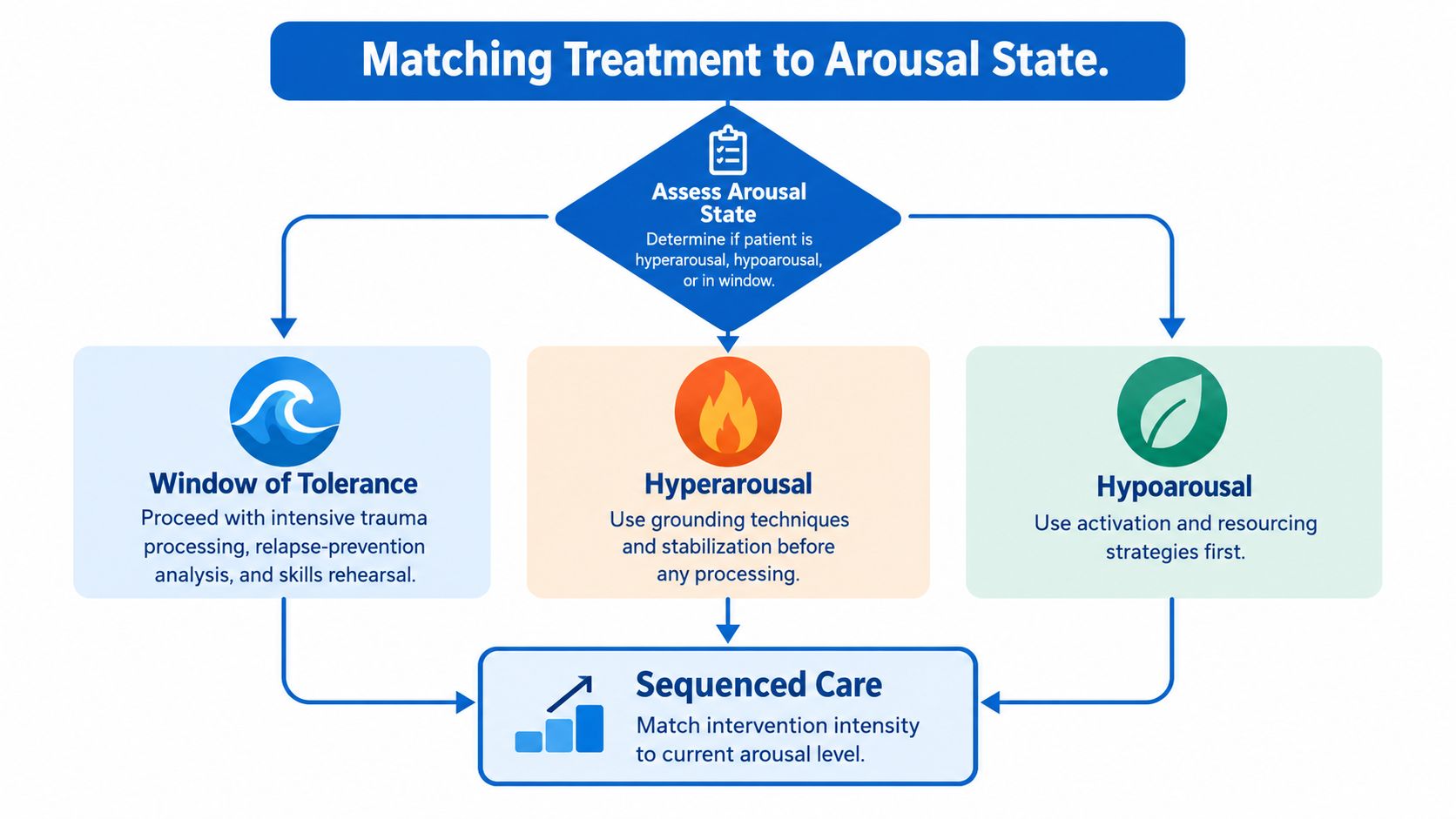
A clinician or support person can use a simple check before moving ahead:
- Notice activation and shutdown cues. Is the person tracking the conversation, able to respond, and oriented to what's happening?
- Adjust the setting. Reduce noise, interruptions, or other stimulation where possible.
- Offer a stabilizing response. Try grounding, paced breathing, a brief choice, or gentle activation, depending on the person's state.
- Reassess before continuing. If attention and reciprocal communication haven't returned, postpone the demanding discussion.
The point isn't to force a person into a calm appearance. It's to make enough room for them to participate safely and meaningfully. A quiet person may still be dissociating or struggling to concentrate, while someone who looks anxious may still be able to have a useful conversation. Clinicians should consider the whole presentation, including behavior over time, rather than use one cue as a verdict.
This model is best treated as a clinical formulation framework, not a measuring device. A single heart-rate reading or diagnosis can't show whether a person is inside or outside their window. The same sequencing principle can inform care across medication-assisted treatment, residential services, outpatient programming, and aftercare. For a broader look at how safety, collaboration, and choice shape care, see these trauma-informed care principles.
Zones of Tolerance in Telehealth and Home Settings
A video or phone session happens inside a person's real environment. A shared room, an unsafe home, poor connectivity, or concern that someone can overhear may make it harder to speak openly or stay focused. The clinician also has fewer ways to observe what's happening beyond the camera frame or the person's voice. Telehealth can extend access, but the right format depends on privacy, safety, symptoms, and clinical needs.

Before an appointment, a patient can work with the care team to choose a setting and plan for interruptions. That might mean finding a private room, using audio-only if video feels exposing, checking the connection, and agreeing on what to do if the call drops. A crisis plan should also identify whom to contact if the person becomes unsafe or too unwell to continue remotely.
Federal telehealth guidance recommends integrating remote and in-person care and emphasizes ongoing risk screening and monitoring. Its summary of nationwide claims data reports that rural substance-use-treatment utilization increased 89.9%, compared with 48.7% in urban areas, while overall treatment use among Medicaid-covered populations declined 17% despite increased telehealth treatment (federal guidance on tele-treatment for substance use disorders). Those figures point to a useful distinction: wider reach doesn't guarantee equal access or make every remote appointment suitable for every situation.
Someone experiencing serious withdrawal symptoms, intoxication, suicidal thoughts, or severe dissociation may need in-person assessment rather than a routine video visit. The clinician and patient should decide together what's appropriate for the person's immediate safety. For more context on the potential role and practical advantages of remote care, this overview explains why telehealth works for therapy.
How to Expand the Window Over Time
Expanding your window isn't about never feeling anxious, angry, or numb. It's about building more capacity to notice those states, stay connected to support, and recover enough to take the next helpful step. That capacity grows through repeated practice and care, not through one dramatic breakthrough.
Start with foundations you can repeat. Restorative sleep, rhythmic movement, and regular contact with people you trust can support steadier regulation. A walk at a manageable pace, a predictable wind-down routine, or a check-in with someone who listens without escalating the moment can be more useful than an elaborate plan you can't maintain.
Some people also benefit from paced breathing, grounding, or practicing skills with a clinician. When medication-assisted treatment is appropriate, medication is part of evidence-based care, not a shortcut or a sign of weakness. A clinician can help decide what support fits the person's health, symptoms, and recovery goals.
Not everything that reduces sensation expands the window. Avoiding every difficult conversation, withdrawing from supportive people, or using a numbing behavior may bring temporary relief without building the ability to cope. The difference is practical: does the response help you return to the situation with more choice, or does it only help you disappear from it for a while?
Progress can be uneven. A person may handle a stressful appointment one day and feel overwhelmed by a smaller demand after poor sleep or a hard trigger. That variation doesn't erase progress. For more strategies that connect regulation skills with recovery, explore these emotional regulation techniques for addiction recovery.
A Practical Plan You Can Start This Week
When cravings or withdrawal symptoms feel physical, don't try to solve everything by identifying a zone. Use the framework to notice what may be happening, then connect that observation to appropriate support. Breathing or grounding can help some people manage a difficult moment, but these tools don't replace medical assessment, detox, or medication.
Try this sequence with a clinician, trusted support person, or on your own when it's safe:
- Name your current state. Ask whether you feel revved up, shut down, or able to stay present. Notice your breathing, energy, attention, and urges.
- Lower immediate risk. If you're activated, reduce stimulation and pause before acting on an urge. If you're shut down, orient to the room and reach out to someone safe. Don't drive or take other risky actions if you're impaired.
- Contact someone before making a high-stakes decision. Call your clinician, recovery mentor, or a trusted support person and say plainly what's happening.
- Use a grounding tool as an added support. Try a sensory check or comfortable paced breathing if it helps, and tell your care team what you've tried.
Seek urgent medical help for chest pain, suicidal thoughts, severe withdrawal symptoms, or other signs that you may be in immediate danger. If you return to use, reach out to a clinician or treatment service promptly. You deserve care without judgment, and a setback doesn't remove your right to ask for help.
Access to treatment can be difficult. SAMHSA reported that 16.0% of people who needed substance-use treatment received it in 2025, and 15.7% of people with opioid use disorder received medications for opioid use disorder (2025 NSDUH findings on treatment access). If you're unsure where to begin, a local addiction program, intensive outpatient service, or telehealth consultation can help you discuss next steps. You can also explore healthy coping mechanisms to build a practical support plan alongside professional care.
Addiction Resource Center LLC offers individualized substance use and co-occurring mental health care in Yuba City and Northern California, including medically supervised detox, MAT, residential rehabilitation through its partner facility, and in-person or telehealth IOP. If you're ready to discuss treatment or support for someone you love, contact Addiction Resource Center LLC to ask about care options, insurance, or TRICARE.