You've made it through detox, or you've strung together several good weeks, and then an ordinary Tuesday undoes your confidence. An old coworker texts. Sleep has been poor. You're driving past a place tied to past use and thinking, I'm stronger than this, so why does this feel so close? That's the moment relapse prevention …

You've made it through detox, or you've strung together several good weeks, and then an ordinary Tuesday undoes your confidence. An old coworker texts. Sleep has been poor. You're driving past a place tied to past use and thinking, I'm stronger than this, so why does this feel so close? That's the moment relapse prevention counseling is built for. It doesn't assume you failed to try hard enough. It helps you map what happened before the craving peaked, practice a different response, and know exactly who to call and what to do next, whether you're fully committed to abstinence, still ambivalent, or rebuilding after a slip.
Table of Contents
- What Relapse Prevention Counseling Really Is
- How the Relapse Prevention Model Works in Practice
- Comparing CBT, MET, and the Marlatt Model
- What Happens in a Typical Session
- Adapting Counseling to Co-Occurring Mental Health Needs
- What Families Should Do When a Lapse Happens
- How to Access Relapse Prevention Counseling Near You or Online
- Common Misconceptions and What Counseling Actually Requires
What Relapse Prevention Counseling Really Is
You're three weeks out of residential care, back at work, and Friday at 5 p.m. hits differently than you expected. You're tired, you skipped lunch, your manager was sharp with you, and your usual route home passes the bar where you used to stop. You don't decide to drink in one dramatic moment. A sequence builds, often hours before any substance appears.
That sequence is the focus. Relapse prevention counseling is a cognitive-behavioral approach that treats a return to substance use as a learnable chain of triggers, thoughts, small decisions, and missing skills, not as a single moral failure. You and your counselor study that chain so you can interrupt it earlier next time.

Lapse Versus Relapse and Why the Words Matter
A lapse is a brief return to use. A relapse is a fuller return to the old pattern. The distinction isn't wordplay, because what happens right after a lapse often shapes what happens next. If shame takes over, many people think, I've blown it, so why stop now, and a short episode stretches out.
Counseling works against that spiral. You'll learn to name a lapse quickly, tell someone, and use pre-planned steps to reduce its duration and severity. Families benefit from the same clarity. Learning to recognize depression relapse signs can also help relatives notice when low mood, withdrawal, or sleep disruption is raising substance use risk, rather than waiting for a crisis.
A Working Definition You Can Test
Ask any program this question. Do you help clients identify personal high-risk situations, rehearse specific responses, and plan what happens after a lapse? If the answer is only about willpower or avoiding everything forever, you're not hearing this model.
It also looks different by stage. In detox, the work may be basic safety and getting through today. Six months into recovery, it may focus on overconfidence, boredom, relationship conflict, or a job change. The goal stays consistent. You maintain behavior change over time, in real life, where cues don't disappear.
How the Relapse Prevention Model Works in Practice
This model took formal shape in the 1980s through G. Alan Marlatt and Judith Gordon. Their 1985 book, Relapse Prevention: Maintenance Strategies in the Treatment of Addictive Behaviors, framed relapse as a multifaceted process rather than a single failure, as outlined in the Oxford Academic history of the relapse prevention model. That shift matters today because your counselor isn't hunting for blame. Your counselor is looking for intervention points.
From High-Risk Situation to Coping Response
Sessions usually move through a sequence you can learn to spot yourself.
- High-risk situation: You identify settings where risk rises, such as payday, conflict at home, pain, celebration, loneliness, or being offered a substance.
- Apparent and hidden triggers: Apparent triggers are obvious, like seeing drug paraphernalia. Hidden ones are subtler, like skipping meetings, staying up too late, or telling yourself you deserve a reward.
- Coping response: You practice behaviors that don't fit with use, such as leaving the situation, contacting support, eating, resting, or using a structured skill you've rehearsed.
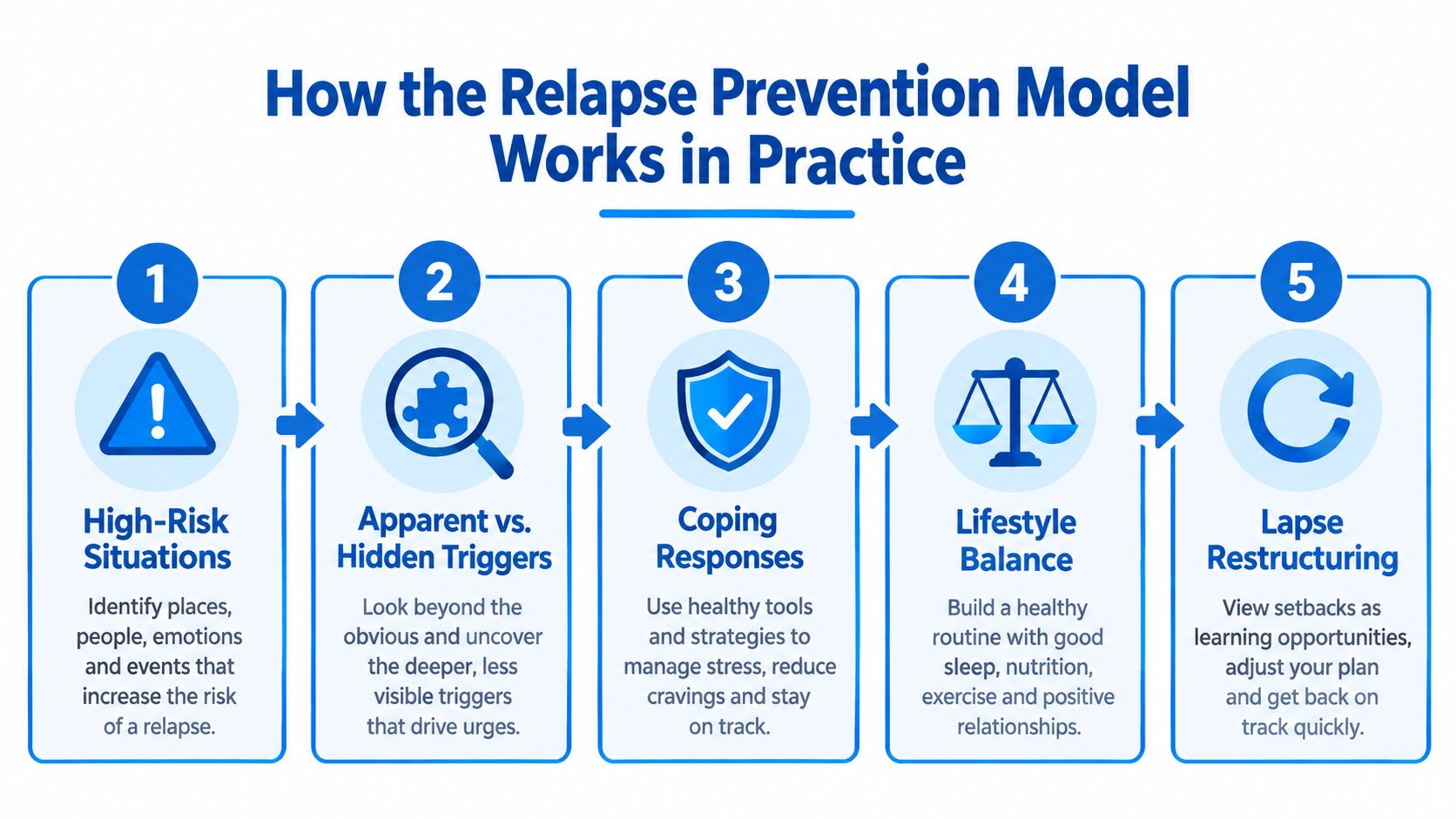
The infographic above adds two later steps. Lifestyle balance means your daily life can't run entirely on stress and deprivation, because that imbalance makes quick relief more tempting. Lapse restructuring means, if use happens, you examine it promptly and change the plan instead of treating it as proof you can't recover.
Turning Last Saturday Into Information
Say you tell your counselor, I drank last Saturday. A good counselor won't stop at the drink. You'll walk backward together. When did you first feel off? Did you argue with your partner Thursday, cancel a group session Friday, then drive past a liquor store Saturday while hungry and angry?
Clinical lens: Your counselor is asking where the chain could have been broken, not why you weren't strong enough at the final link.
That backward walk reveals skill gaps you can fix. Maybe you need an exit script for work events, a Friday evening plan, or permission to call support before a craving feels serious. Counseling can't erase every cue from your life. It can make your response less automatic and more deliberate, which is where change becomes usable.
Comparing CBT, MET, and the Marlatt Model
These names overlap, and that's where readers often get confused. Cognitive-behavioral therapy, or CBT, is the broad engine. It targets thoughts and behaviors linked to use, such as the thought, one won't hurt, followed by driving to a familiar place. For a fuller walkthrough, see this guide to cognitive behavioral therapy for addiction recovery.
Motivational enhancement therapy, or MET, targets ambivalence. It fits when part of you wants change and part of you doesn't, or when someone else, a spouse, employer, or court, wants change more urgently than you do. The Marlatt relapse prevention model integrates cognitive-behavioral skills into a stage-based curriculum focused specifically on maintaining change and managing lapses.
CBT vs MET vs Marlatt Relapse Prevention Model
| Approach | Primary Focus | Best Fit | What It Asks of You |
|---|---|---|---|
| CBT | Thoughts, behaviors, and coping skills linked to use | You want practical tools for cravings and risky routines | Track patterns, test thoughts, practice new responses |
| MET | Ambivalence and personal reasons for change | You're unsure about stopping or feel pushed into treatment | Speak honestly about pros, cons, values, and goals |
| Marlatt model | High-risk situations, lapse management, lifestyle balance | You're maintaining change and want a long-term prevention plan | Map triggers, rehearse plans, review lapses without hiding them |
How to Choose Without Overthinking the Label
Match the approach to your current problem. If you're thinking, I don't even know if I want to quit, MET gives that uncertainty room without turning sessions into an argument. If you're thinking, I want to quit but I keep acting on impulse, CBT skills and Marlatt-style planning are often more directly useful.
Co-occurring needs also shape fit. Someone managing attention difficulties alongside substance use may need counseling that accounts for impulsivity, planning, and follow-through, and readers exploring that overlap can find ADHD counselling in the UK through a resource focused on that specific presentation. The label matters less than this test. Does the approach address your motivation, your mental health, and your next high-risk moment, all at once? A program that uses only one script for every client should be able to explain why.
What Happens in a Typical Session
A session usually has a rhythm, so you aren't starting from zero each week. Your counselor opens with a check-in about mood, sleep, cravings, substance use, and safety. That isn't small talk. Changes in sleep or irritability may be early warning signs, and naming them early gives you more options.
Next, you review the week against your personal roadmap. Where did risk rise? What did you do that helped? Did you skip a support meeting, avoid a difficult conversation, or handle a cue better than expected? Your counselor listens for both skill gaps and evidence that a strategy worked.
Who Is in the Room and What Gets Practiced
In an intensive outpatient program, or IOP, for adults, you may meet individually with a counselor and also join group sessions with peers. Depending on your needs, a broader team may coordinate behind the scenes, including medical staff or a therapist working with your family. You should know who's involved in your care and what information gets shared.
Practice is the middle of the session, not an afterthought. You might rehearse refusing a drink at a family barbecue, plan what to say when an old contact texts, or role-play leaving a party early without making it a bigger conflict. The point is to make the response familiar before stress narrows your thinking.
- Skill rehearsal: You practice the exact words or actions you'll use in a risky moment.
- Next-risk planning: You identify the most likely difficult moment before your next session and build a plan around it.
- Brief homework: You leave with a specific task, such as tracking cravings, attending a support meeting, or keeping your plan on your phone.
How Progress Is Tracked
Progress isn't measured only by whether you used. Counselors also track your self-report, attendance, use of coping skills, and how quickly you re-engage after difficulty. Clinician observation matters too, including whether you're isolating, minimizing, or becoming more able to describe your patterns clearly.
Honesty is what makes the tracking useful. If you used, say so. Relapse prevention counseling can't help you restructure a lapse you keep hidden, and a counselor who responds with curiosity rather than punishment is giving you a sign the model is being used as intended.
Adapting Counseling to Co-Occurring Mental Health Needs
A fixed checklist breaks down quickly when anxiety keeps you awake, depression drains your follow-through, trauma symptoms flare in certain settings, or you aren't sure you want to stop completely. SAMHSA guidance recommends matching motivational and relapse prevention strategies to each client's stage of recovery and maintaining continuity of treatment, as described in SAMHSA guidance on co-occurring disorders and stage-matched care. That means the plan should flex with you.
For someone with co-occurring disorders, the target is broader than resisting cravings. You may need education about how psychiatric symptoms and substance use interact, support for medication adherence, dual-recovery support, and daily monitoring of symptom changes. Readers weighing integrated care can review how a dual diagnosis IOP program structures that combined support.
When a Craving Is Not Just a Craving
Your counselor should help you sort out what you're feeling. Is this urge driven by an environmental cue, like walking past a bar? Is it withdrawal, a medication side effect, rising anxiety, trauma activation, or several nights of poor sleep? Each answer leads to a different next step, and guessing can leave the true driver untreated.
A craving is information, not a diagnosis. Good counseling asks what produced it before deciding how to respond.
This is also where an abstinence-only script can fail someone who's ambivalent. Counseling can still help if you aren't ready to stop completely. The immediate work may be interrupting a lapse sooner, reducing its severity, staying connected to care, and building motivation honestly, rather than pretending commitment you don't feel.
Examples by Stage of Care
During a detox to residential transition, the plan may emphasize medical stability, basic routines, and not leaving care when discomfort spikes. During a residential to IOP step-down, the focus shifts to real-world exposure, because you're returning home each night to old stressors and cues. In telehealth, your counselor may put extra weight on your home environment, privacy, and who can support you between sessions.
In long-term maintenance, the risks often change shape. Overconfidence, grief, a new job, or a medication change may matter more than the triggers you mapped in week one. Ask any program directly how they respond when psychiatric symptoms worsen, because worsening symptoms, inability to stay safe, or concerning physical symptoms should prompt urgent medical or psychiatric evaluation, not just a note to try harder next week.
What Families Should Do When a Lapse Happens
Families often get general advice about triggers but very little guidance for the first hours after use resumes. That gap leaves people improvising while frightened and angry. A written emergency plan, agreed in advance and shared with family members, works better, and NCBI guidance on written family emergency plans supports spelling out who to call, how to respond if the person is intoxicated, how to reconnect them with treatment, and what boundaries the family will maintain.
If you don't yet know what to say in that moment, this guidance on what to say when someone relapses can help you find language that is firm without being shaming.
The First Hours
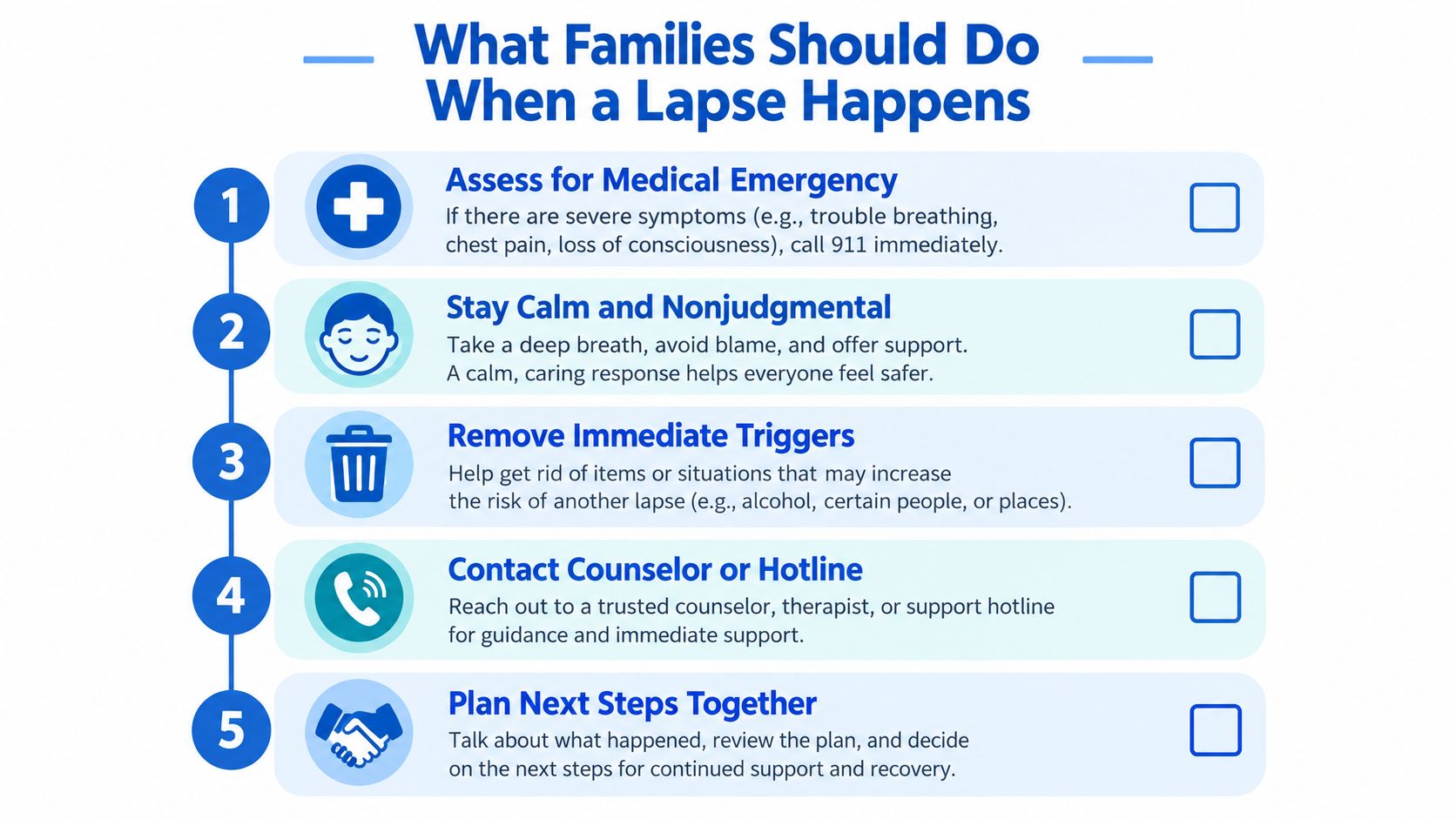
Start with safety, not a verdict on recovery.
- Assess for emergency: If the person has severe symptoms, can't be roused, or you suspect overdose, call emergency services immediately. Reduced tolerance after a period without use can raise overdose risk.
- Avoid confrontation while intoxicated: A heated debrief can wait. Speak briefly and calmly, and focus on immediate safety.
- Secure the environment: Remove access to substances where you safely can, secure medications, and arrange safe transportation rather than letting the person drive.
Within the Next Day
Contact the treatment team and plan follow-up within 24 hours. The goal is rapid damage control and re-engagement, not automatic discharge from care or a family trial. A lapse is neither inevitable nor unusual, and treating it as a total erasure of progress can push the person further from help.
Boundaries need the same clarity. Supportive accountability means you follow the agreed plan, offer a ride to treatment, and state what you will and won't do. It isn't surveillance, punishment, searching belongings, or enabling by covering consequences. Your relative remains responsible for their behavior. You're responsible for safety, communication, and your own support, and families often notice warning signs before the person does, which makes a calm, written plan more valuable than another argument about effort.
How to Access Relapse Prevention Counseling Near You or Online
Access usually follows three routes, and the right one depends on safety, stability, and how much structure you need right now. Residential step-down suits someone leaving round-the-clock care who still needs a supported transition. In-person IOP suits someone stable enough to live at home who needs frequent sessions, group support, and accountability while practicing skills in daily life. Telehealth suits someone whose work, transportation, or caregiving duties make travel difficult, provided they have privacy and a reasonably stable home environment.
The screenshot below shows the kind of program information to look for when you're comparing options online, including levels of care and how to make contact.

Questions That Separate a Real Fit From a Convenient One
Ask who delivers the counseling, how the plan is individualized, what happens after a lapse, and how family members are involved. Ask about insurance, scheduling, and whether telehealth sessions include the same relapse prevention work as in-person care. If you're researching from home, you can also browse online therapy topics to compare how virtual counseling is discussed across different needs before you call a program.
In Northern California, Addiction Resource Center LLC offers a continuum that includes medically supervised detox with medication-assisted treatment, residential rehabilitation through partner facility Ona Treatment Center in Browns Valley, CA, and an IOP available in person and via telehealth. Care is delivered by a multidisciplinary team that includes a medical doctor, registered nurse, licensed counselors (CADC), a licensed marriage and family therapist (LMFT), and recovery mentors, with 24/7 wellness monitoring and individualized treatment plans. The center accepts most major insurance plans and welcomes Tricare beneficiaries.
The video below gives a visual introduction you can watch before deciding whether to call.
If you're ready to ask about fit, call 530-625-7910 or visit 1002 Live Oak Blvd. in Yuba City. Wherever you live, choose the route that gives you enough structure for your current risk, not just the option that's easiest to schedule.
Common Misconceptions and What Counseling Actually Requires
The most damaging misconception is that a return to use means treatment failed and should end. In this model, a lapse is clinical information. It shows where the plan didn't hold, which skill was missing, or which symptom went untreated, and it should trigger a revised plan and faster support.
The second misconception is that willpower alone should be enough if you want recovery badly. Cravings are influenced by cues, stress, sleep, mental health symptoms, and learned routines. Counseling exists because intention without rehearsed skills tends to collapse under pressure, not because you lack character.
Early Recovery Only and Other Myths
A third myth says counseling only matters in the first weeks. Risk changes rather than disappears. Early recovery may center on withdrawal discomfort and obvious cues, while later recovery may involve boredom, success, grief, relationship strain, or the quiet decision to stop doing the routines that helped. The plan should be updated as your life changes.
Reality check: Telehealth isn't automatically weaker care. What matters is whether you're doing the same honest review, skill practice, and follow-up planning you'd do in person.
That said, honesty about limits matters. Counseling can't make high-risk situations vanish, do the daily practice for you, or substitute for medical or psychiatric care when symptoms escalate. It also can't work well if sessions become a place where you report only what sounds acceptable.
What It Actually Asks of You Each Week
Expect a real commitment. You'll need to show up consistently, track warning signs between sessions, practice skills when you aren't in crisis, tell the truth about use and near misses, and contact support earlier than feels natural. Families may need to uphold boundaries and their own support plan as well.
Use that list to assess readiness. You don't need perfect motivation to begin, and ambivalence can be worked with directly. You do need a program that matches your stage of change, treats mental health alongside substance use, and gives you a concrete plan for the hard hour, not just encouragement to stay strong.
If you're building that concrete plan now, Addiction Resource Center LLC offers detox, residential care through its partner facility, and IOP in person and via telehealth, with relapse prevention woven into individualized care for adults in the Yuba City region. Visit Addiction Resource Center LLC to ask about insurance, scheduling, and which level of care fits your next step.