You've finished a 30-day treatment program, returned home, and made it through the first few evenings. Then a stressful message arrives, an old contact reaches out, or a familiar route brings back a powerful urge. You know recovery matters, but knowing that doesn't automatically tell you what to do next. A relapse prevention curriculum turns …

You've finished a 30-day treatment program, returned home, and made it through the first few evenings. Then a stressful message arrives, an old contact reaches out, or a familiar route brings back a powerful urge. You know recovery matters, but knowing that doesn't automatically tell you what to do next.
A relapse prevention curriculum turns that uncertain moment into a practiced response. It combines structured learning, behavioral rehearsal, personal planning, follow-up, and measurement. Instead of treating relapse prevention as a single lecture or a worksheet handed out at discharge, a strong program treats it as an operating system for continuing recovery.
Table of Contents
- What a Relapse Prevention Curriculum Actually Is
- Core Modules and Learning Objectives
- Cognitive-Behavioral and Mindfulness-Based Approaches
- Session Outlines, Homework, and Booster Sessions
- Personalizing the Curriculum for Each Client
- How Families and Providers Support the Curriculum
- Building a Curriculum That Lasts Beyond Discharge
What a Relapse Prevention Curriculum Actually Is
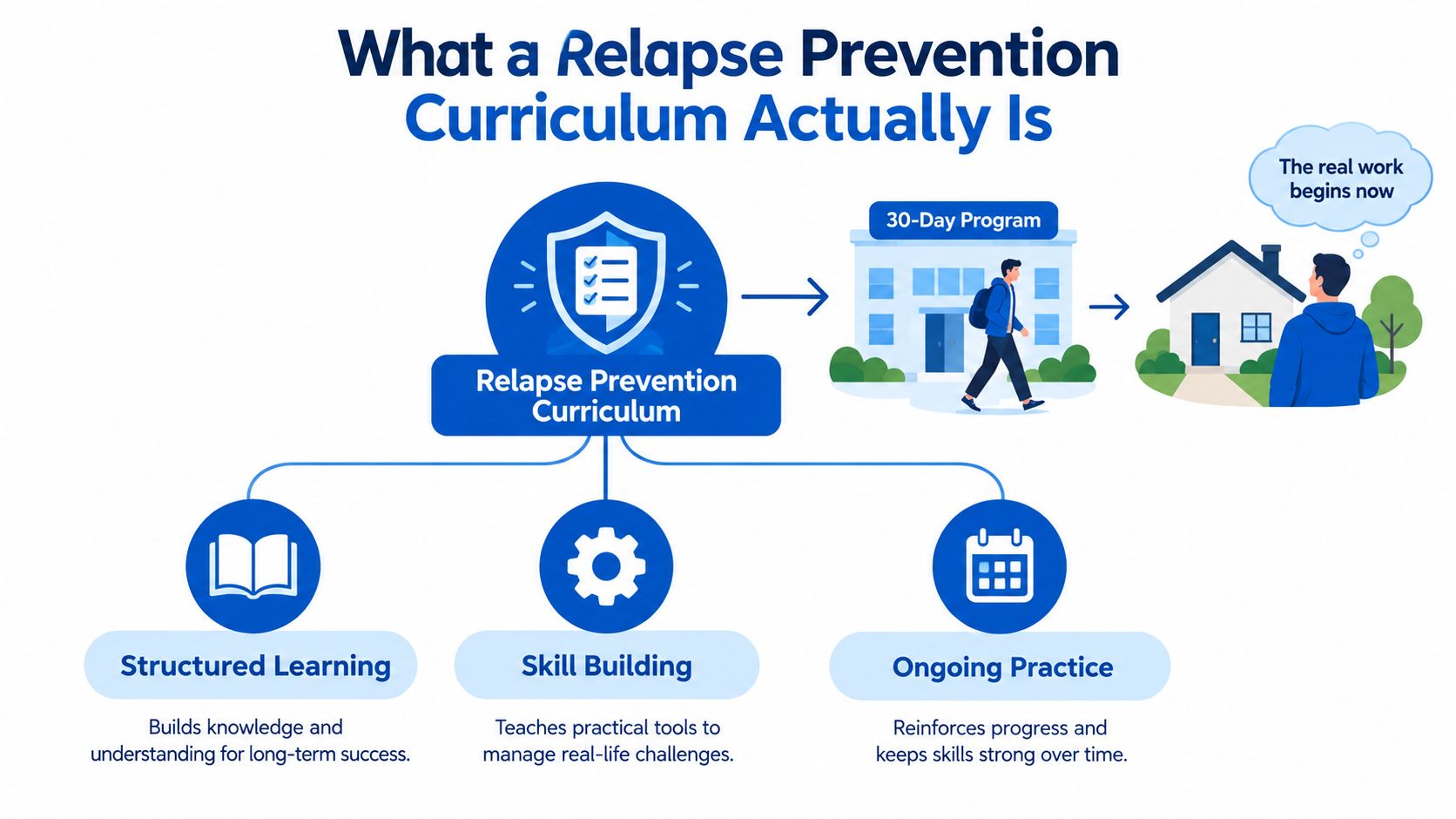
A one-time class might explain that stress, isolation, cravings, and certain environments can increase risk. That information can be useful, but it doesn't prepare someone to act when those risks appear together. A curriculum goes further. It gives the person repeated opportunities to identify a personal pattern, test a coping response, revise the plan, and practice again.
The historical foundation comes from cognitive-behavioral therapy, psychoeducation, and skills-based planning. There isn't one universal lesson order used by every program. Instead, programs arrange related components around the needs of the people they serve. A typical sequence moves from understanding the relapse process to recognizing warning signs, analyzing high-risk situations, practicing alternatives, and creating an early-intervention plan.
From information to practiced behavior
Suppose a participant identifies workplace conflict as a trigger. A lecture might label conflict as risky. A curriculum asks more useful questions:
- What happens in the hour after the conflict?
- What thoughts appear?
- Does the person isolate, contact someone, pass a familiar location, or stop following a treatment routine?
- Which response could interrupt that sequence early?
- How will the person practice that response before the next conflict?
This is why functional analysis and behavioral rehearsal matter. The person isn't told to “avoid triggers.” They map the chain from situation to thought, emotion, craving, decision, and behavior, then rehearse a different link in that chain. SAMHSA's relapse-prevention guidance describes this cognitive-behavioral emphasis on high-risk situations, self-efficacy, craving, coping, and repeated practice.
Practical rule: A useful curriculum should leave the participant with something to do, not just something to remember.
An addition to clinical care
Relapse prevention education works as an adjunct to ongoing treatment. It isn't a replacement for medication, clinical monitoring, treatment for co-occurring mental health conditions, medical care, or a higher level of support when risk increases.
Evidence from other conditions illustrates why curriculum design should be careful. A systematic review of psychosocial relapse-prevention interventions in bipolar disorder found that CBT and group psychoeducation may reduce relapse among clinically stable patients when added to usual treatment, while the evidence did not establish every psychosocial format as effective. The findings concern bipolar disorder, not addiction outcomes, but they support a broader design principle: education becomes more useful when paired with practical cognitive and behavioral skills. Read the systematic review of psychosocial relapse-prevention interventions.
For a person leaving residential care in Yuba City, Sacramento, or another community, the curriculum becomes the bridge between formal treatment and daily life. It connects treatment goals to ordinary decisions, such as whether to answer an old contact, how to respond after an argument, and whom to call when a coping plan starts to fail.
Core Modules and Learning Objectives
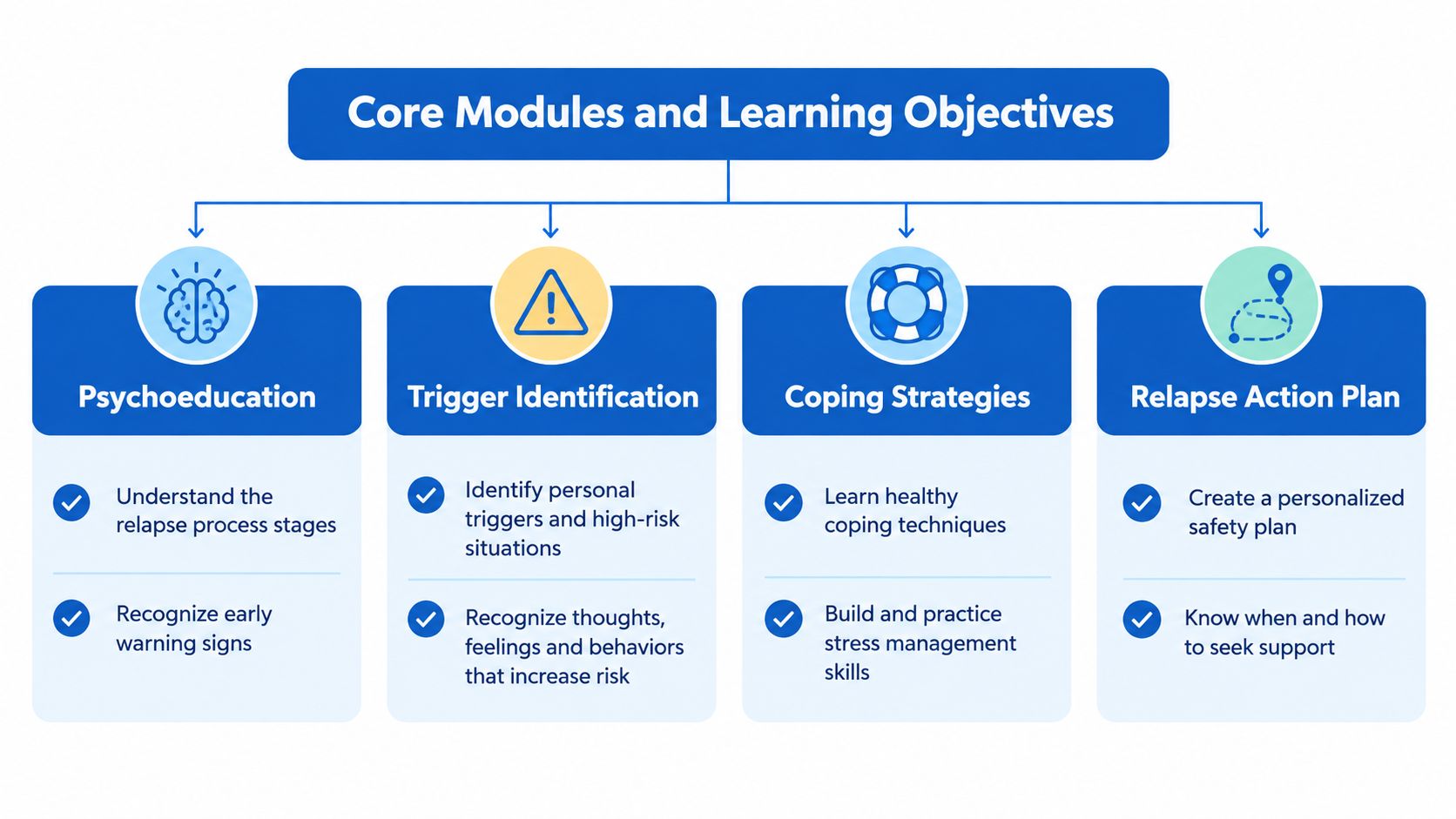
A working curriculum moves from awareness to action. Each module answers a practical question: What is happening, when does risk rise, what response is available, and what should happen after a lapse? The sequence turns separate skills into an operational system that can be practiced, recorded, and revised.
Understanding the process
Psychoeducation presents relapse as a modifiable behavioral process, rather than an unexplained event. Participants examine how thoughts, emotions, situations, cravings, coping responses, and decisions influence one another. The goal is to spot changes early enough to act while choices remain available.
For example, poor sleep, withdrawal from supportive people, and romanticizing past use may appear together. The curriculum treats that combination as a warning pattern, then links it to a defined response instead of leaving the participant to interpret it alone.
Finding high-risk situations
Trigger identification becomes more useful when “stress” is broken into observable cues. Participants examine internal and external factors, including emotions, thoughts, people, places, routines, conflict, and changes in daily structure.
A trigger log might record:
- Situation: A difficult conversation with a supervisor.
- Immediate reaction: Anger and shame.
- Thought: “I can't handle another week like this.”
- Craving intensity: A personal rating recorded consistently over time.
- Response: Leave the building, contact a support person, and avoid being alone.
The purpose is not a perfect list. It is a specific map that shows where another response can enter the sequence.
Mapping the craving and decision chain
Functional analysis examines what happened before, during, and after a use episode or near miss. Participants study the sequence without assigning blame. They may find that the best intervention point came before craving peaked, when they stopped attending support, hid difficult feelings, or entered a risky setting.
An if-then plan converts that discovery into an instruction: “If I receive a message from someone connected to past use, then I will wait before replying, show the message to my counselor or support person, and move to a safe setting.”
Rehearsing coping responses
Coping strategies can include refusal practice, communication, grounding, stress regulation, urge monitoring, and reaching out. Knowing a strategy in a classroom does not prove that it will be available under pressure, so the curriculum gives participants opportunities to rehearse it.
A participant might role-play saying no, leaving an event, requesting help, or explaining a lapse. The facilitator adjusts the wording until it sounds natural enough for real use. Repetition turns an abstract instruction into a response that can be recalled during a high-risk moment.
Writing the response plan
The final core module creates a written protocol for early warning signs and a return to use. It should identify who to contact, which immediate safety steps to take, and how to reconnect with care. A lapse should prompt rapid reassessment and re-engagement, not automatic discharge. SAMHSA's educational material supports work on trigger identification, craving management, stress coping, and actions after a return to use.
The written protocol should name a specific contact, a specific first safety step, and a specific time window for reconnecting with care.
Cognitive-Behavioral and Mindfulness-Based Approaches
Programs often combine or compare two major approaches. Cognitive-behavioral relapse prevention, or CBRP, focuses on identifying high-risk situations, examining the thinking and behavior around cravings, and rehearsing alternative responses. Mindfulness-based relapse prevention, or MBRP, adds deliberate, nonjudgmental attention to bodily sensations, difficult emotions, and craving thoughts.
CBRP may fit a participant who needs a clear behavioral sequence. For example, the person can map a conflict, identify the thought that increases urgency, practice leaving the setting, and contact support. MBRP may add value when negative affect, stress reactivity, or the physical experience of craving tends to drive automatic behavior. The participant practices noticing discomfort without treating it as an instruction to use.
| Approach | Core focus | Key exercises | Typical strength |
|---|---|---|---|
| CBRP | High-risk situations, self-efficacy, coping failure, and decision chains | Functional analysis, trigger logs, refusal practice, if-then plans | Converts risk patterns into specific actions |
| MBRP | Craving, negative affect, and automatic reactions | Mindful breathing, body awareness, urge surfing, nonjudgmental observation | Creates more space between an urge and a response |
These approaches aren't competing brands. A curriculum may use CBRP to analyze what happens after a stressful phone call, then use mindfulness practice to help the participant tolerate the physical surge of craving that follows. The choice should reflect the person's recurrence pattern, clinical needs, and ability to practice between sessions. Practical examples of these strategies are also discussed in this guide to relapse prevention techniques.
What the evidence shows
A randomized trial involving 286 people who had completed initial substance-use treatment found that both MBRP and standard relapse prevention produced significantly fewer substance-use days and heavy-drinking days than treatment as usual at six months. At 12 months, MBRP showed significantly fewer substance-use days and lower heavy drinking than both standard relapse prevention and treatment as usual. The National Center for Complementary and Integrative Health summarizes the trial and its context.
Those findings don't mean every participant needs mindfulness training, or that one approach guarantees abstinence. They suggest that curricula should measure outcomes over multiple follow-ups and should match exercises to the mechanism driving risk. A participant whose main difficulty is exposure to a high-risk person may need refusal and boundary practice. Someone whose risk rises with shame and bodily agitation may need mindfulness, emotion regulation, and rapid support contact.
Session Outlines, Homework, and Booster Sessions
A curriculum becomes easier to understand when you can see its rhythm on a calendar. An early session might begin with a brief check-in, introduce the relapse process, and ask each participant to map one recent high-risk situation. The facilitator then helps the group create a first coping plan and tests whether the plan is specific enough to use outside the room.
A later session should look different. The focus may shift to reviewing practice logs, examining a near miss, rehearsing an emergency response, and updating the written plan. If a participant's original strategy was “call someone when stressed,” the group can identify which person, at what point in the chain, and what to do if the first contact doesn't answer.
What happens between sessions
Homework isn't an academic assignment. It gives the participant a way to collect information from daily life and bring it back for adjustment.
Common practice items include:
- Urge log: Record the situation, emotion, physical sensation, craving level, response, and result.
- If-then card: Keep a short response plan on paper or a phone for quick access.
- Mindfulness exercise: Practice observing breathing, tension, or craving without immediately acting.
- Role-play practice: Rehearse refusal, boundary setting, or asking for help.
- Support check-in: Contact a designated person before risk escalates.
A facilitator can use the next session to ask what worked, what felt unrealistic, and what the participant avoided recording. That feedback is more valuable than checking whether a worksheet looks complete.
Why boosters matter
A booster session isn't a shorter regular group. It revisits known triggers, checks whether the support network still works, and refreshes skills that may feel less available after formal treatment ends. It can also respond to changes in work, housing, relationships, medication, mental health symptoms, or technology access.
A stronger schedule includes reassessments at 30, 90, 180, and 365 days. These dates are useful planning points, not proof that every person needs identical contact. A booster might focus on a new holiday-related trigger for one participant and a missed-treatment pattern for another.
Research in depression offers a useful measurement lesson, while not providing direct addiction outcomes. A systematic review of 30 randomized controlled trials involving 4,354 participants found that psychological interventions extended time to relapse in specified comparisons, with a hazard ratio of 0.60 and a median-survival difference of 6.7 weeks. The authors' findings reinforce the value of defined outcomes and follow-up rather than relying only on attendance or satisfaction. Review the depression relapse-prevention meta-analysis.
Personalizing the Curriculum for Each Client
A standard curriculum provides the skeleton. Personalization determines whether the person can use it.

A treatment team should consider clinical risk, withdrawal status, co-occurring symptoms, housing stability, transportation, privacy, technology access, family involvement, and readiness for self-management. Someone experiencing acute withdrawal or severe psychiatric symptoms may need medical or in-person support before a primarily remote curriculum is appropriate. Someone with stable housing, reliable privacy, and dependable support may use telehealth for some sessions without losing the structure of care.
A practical modality decision
Rather than asking whether in-person or remote treatment is universally better, ask which format fits the current risk profile.
- Choose more in-person contact when withdrawal concerns, unstable housing, serious co-occurring symptoms, overdose risk, limited privacy, or repeated missed virtual visits make independent participation unsafe.
- Add telehealth when travel, work, caregiving, mobility, or geography create attendance barriers but the person can participate privately and reliably.
- Use a hybrid plan when face-to-face contact is needed for assessment, connection, or accountability, while remote sessions improve continuity between visits.
- Create backup steps for a disconnected phone, missed video visit, rising cravings, or a sudden loss of privacy.
A 2025 systematic review of 34 randomized controlled trials involving 6,461 participants found that remote interventions used in addition to in-person care were associated with 39% lower odds of relapse, with an odds ratio of 0.61 and a 95% confidence interval of 0.46 to 0.81, compared with in-person care alone. Evidence was less conclusive when remote care replaced or substantially reduced in-person treatment, and the review noted risk of bias. Read the systematic review of remote and digital interventions.
A curriculum should therefore treat digital access as one part of treatment access. A person may own a phone but lack privacy, stable service, a safe place to attend, or the clinical stability needed for remote self-management. Questions about designing a written plan can also help clients prepare for modality changes through this guide to what a relapse prevention plan includes.
A provider may ask: “What happens if you miss two virtual sessions?” A thoughtful answer includes a contact pathway, a safety check, a rescheduling process, and a decision about whether more in-person care is needed.
How Families and Providers Support the Curriculum
Family members don't need to become therapists to support relapse prevention. Their role is to make the plan easier to use, notice meaningful changes, and respond to a lapse without adding shame or secrecy.
A family member might help someone attend a booster, ask whether the written plan needs updating, or notice a change in sleep, isolation, communication, or routine. They can ask, “What would help right now?” rather than interrogating the person about whether they have used. If substance use occurs, safety and connection come first. The family member can encourage contact with the treatment team and follow the agreed emergency steps.
A clear family role might look like this:
- Support attendance: Help with transportation, reminders, childcare planning, or a quiet place for telehealth.
- Notice changes: Share observations respectfully when warning behaviors increase.
- Avoid shame: Treat a lapse as information requiring action, not as proof that recovery is hopeless.
- Respect boundaries: Ask what support is wanted and avoid taking over decisions that belong to the client and clinical team.
Providers turn those observations into measurable care decisions. They may track days of substance use, heavy-use days, time to first use, treatment attendance, medication adherence where applicable, and use of coping plans. They also review whether missed sessions, rising cravings, or worsening co-occurring symptoms signal a need for more contact.
A lapse should open a rapid reassessment pathway. It shouldn't automatically close the door to treatment.
Why follow-up needs a longer view
Digital tools can make contact easier, but access to a platform isn't the same as sustained engagement. Most trials of digital substance-use interventions follow participants for only three to six months, leaving uncertainty about benefits one or two years later and whether periodic re-engagement is needed. The review of digital substance-use interventions explains this follow-up limitation.
Families can help fill the continuity gap by keeping contact information current, supporting scheduled reassessments, and asking the treatment team what changes should trigger escalation. A practical family guide can help relatives coordinate these roles through shared relapse-prevention strategies.
Building a Curriculum That Lasts Beyond Discharge
Discharge shouldn't mark the end of relapse prevention. It marks a change in the setting, intensity, and responsibility for maintaining the plan. A lasting curriculum treats recovery as continuing care, with reassessment when circumstances change rather than a single education module completed once.
A useful long-term design includes:
- Scheduled reviews: Reassess the plan at 30, 90, 180, and 365 days.
- Trigger-linked boosters: Refresh the skill connected to the person's current risk, such as conflict communication, craving tolerance, or boundary setting.
- Broader measures: Track days of use, overdose risk, functioning, housing, treatment retention, and coping-plan use, not only abstinence.
- Clear escalation: Define what happens when cravings rise, support disappears, sessions are missed, or co-occurring symptoms worsen.
- Consent-based family involvement: Give relatives a specific role without sharing private clinical information outside agreed boundaries.
This approach is different from a generic aftercare handout. A handout may list phone numbers and appointments. An operational curriculum assigns review points, identifies the data that will be discussed, and states how the team will respond when risk changes.
The uncertainty around long-term digital outcomes makes this especially important. Short follow-up windows cannot answer whether a person remains engaged after motivation changes, technology use becomes inconsistent, or social support shifts. Periodic re-engagement gives providers a chance to discover those changes before they become a crisis.
A practical next-step checklist
This week, a client or family member can:
- Write down specific triggers: Include people, places, emotions, thoughts, routines, and stressors.
- Create one if-then response: Name the situation, the action, and the person to contact.
- Schedule a plan review: Ask a clinician when the next reassessment and booster will occur.
- Clarify the care pathway: Find out what happens after a missed session, lapse, rising craving, or emergency.
- Check modality fit: Discuss privacy, technology, transportation, housing, and whether remote care should supplement in-person treatment.
- Name the measures: Ask how the program tracks progress beyond attendance.
A relapse prevention curriculum works best when the client can explain the plan, practice it before a crisis, revise it after new information, and reach support quickly. That operational detail is what turns recovery education into usable long-term care.
Addiction Resource Center LLC offers relapse prevention education, individualized planning, progress reviews, recovery-mentor support, and aftercare through in-person and telehealth intensive outpatient care, alongside detox, MAT, and residential treatment through its partner facility. Visit Addiction Resource Center LLC to discuss treatment options in Yuba City and Northern California or request guidance for yourself or a loved one.