It's late, you're searching for help, and someone you love may need treatment now. The search results are full of unfamiliar terms such as detox, IOP, MAT, residential care, and aftercare. Every facility sounds reassuring, but the important details often appear only when you ask direct questions. The right questions to ask a drug rehab …

It's late, you're searching for help, and someone you love may need treatment now. The search results are full of unfamiliar terms such as detox, IOP, MAT, residential care, and aftercare. Every facility sounds reassuring, but the important details often appear only when you ask direct questions.
The right questions to ask a drug rehab center can reveal whether a program is prepared for the person in front of you, not just whether it has an attractive website. This guide gives you eight questions to use on the phone. For each one, you'll find what a strong answer sounds like, warning signs, and a verification step you can complete during one call.
You can also review this practical guide on what to expect in therapy so the first conversation feels less unfamiliar. Keep a notebook open, write down names and promises, and ask the representative to explain anything you don't understand.
Table of Contents
- 1. Are you licensed and accredited, and can I verify it?
- 2. What levels of care do you offer, and how do you decide which one I need?
- 3. Which medications for addiction do you offer, and how are they managed?
- 4. Who will be on my treatment team, and what are their credentials?
- 5. How do you treat co-occurring mental-health conditions?
- 6. What insurance do you accept, and what will I actually pay?
- 7. How do you protect my privacy and involve my family?
- 8. What does aftercare and relapse prevention look like after I finish?
- 8 Essential Questions to Compare Drug Rehab Centers
- Turning Answers Into a Confident Decision
1. Are you licensed and accredited, and can I verify it?
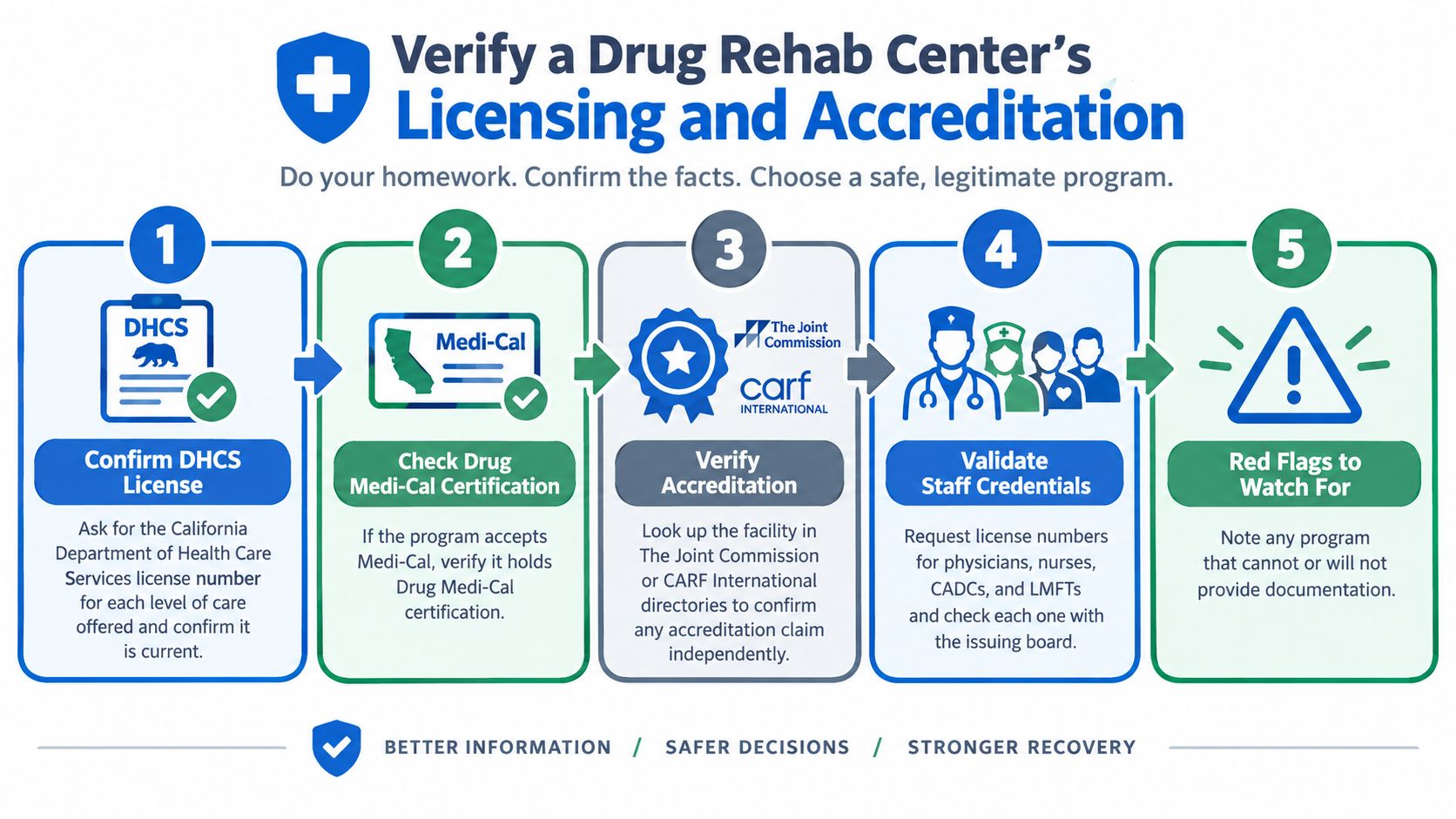
Start with credentials before discussing deposits, travel, or admission dates. Licensing shows that the program operates under the applicable state requirements. Accreditation from an independent organization can indicate that the provider has undergone a broader review of clinical, safety, and organizational practices.
Ask for the facility's exact license number, the issuing agency, and the name of any accrediting organization. Don't accept “we're fully accredited” as a complete answer. The representative should be able to identify the accreditor and explain which location and services the credential covers.
What a strong answer sounds like
A reliable facility will give you information you can check independently. In California, for example, you can ask about Department of Health Care Services licensing and whether a program that bills Medi-Cal holds the appropriate Drug Medi-Cal certification. You should also ask whether residential treatment, detox, and IOP services are covered by the same credential or require separate authorization.
Accreditation from organizations such as The Joint Commission or CARF International can be useful, but verify the claim directly through the accreditor's directory. A provider may have accreditation at one site while advertising services at another.
Practical rule: If a facility won't provide licensing details, pause the admissions process until you can verify them.
Your one-call verification step
Call the program and write down the license and accreditation numbers while you're speaking with the representative. Then ask the representative to stay on the line while you confirm the information through the relevant state agency or accreditor. For Addiction Resource Center, you can call 530-625-7910 to confirm current licensing and accreditation information, including details related to partner facility Ona Treatment Center in Browns Valley.
A strong response is specific, calm, and easy to verify. Evasion, pressure to pay before verification, or a credential that applies to a different location deserves caution.
2. What levels of care do you offer, and how do you decide which one I need?
A treatment plan should match the person's medical needs, substance-use history, mental-health symptoms, home environment, and ability to stay safe. A center that offers only one program may try to place every patient there, even when another level of care would be more appropriate.
Ask what assessment process the clinical team uses. The ASAM Criteria is a widely used framework that considers withdrawal risk, physical health, emotional and cognitive conditions, readiness for change, continued-use risk, and the recovery environment. You can ask whether the team will explain the assessment results to you.
Listen for a connected care path
A strong answer describes how someone moves through care as their needs change. For example, a person with alcohol dependence and a history of dangerous withdrawal may need medically supervised detox before residential treatment. Another person with stable housing, reliable support, and manageable withdrawal risk may be appropriate for IOP, including in-person or telehealth services.
Ask three direct questions:
- Assessment method: What tool or clinical process determines the recommended level of care?
- Decision-maker: Which licensed professional makes the placement decision?
- Step-down plan: How can a patient move from detox to residential care, or from residential treatment to IOP?
Addiction Resource Center describes medically supervised detox with MAT, residential rehabilitation through Ona Treatment Center in Browns Valley, and IOP in person or through telehealth. Ask the admissions team to map those options to the individual's situation rather than just listing them.
Your one-call verification step
Before calling, prepare a short summary of substance use, previous treatment, withdrawal symptoms, medical conditions, medications, and living arrangements. During the call, ask the representative to explain what information would change the recommended level of care.
A provider that offers only sales language, refuses to discuss assessment, or promises placement without gathering clinical information may be focused on filling a bed rather than matching care safely.
If you want more context about home-based medical access and care logistics, review this guide to whether doctors can make house calls.
The following video can also help families understand the verification process before making an admissions decision.
3. Which medications for addiction do you offer, and how are they managed?
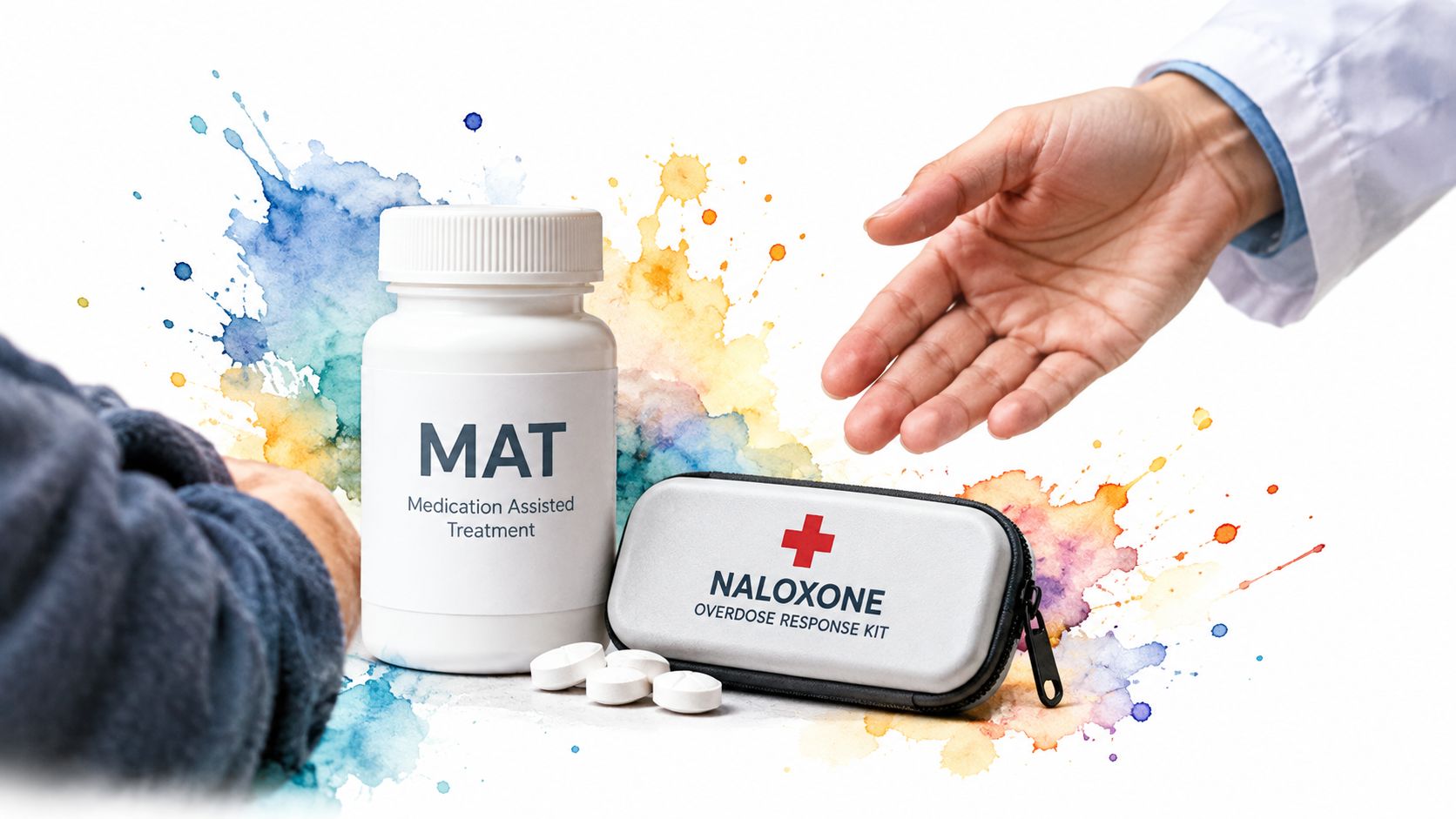
Ask about medication early, especially when opioid or alcohol use is involved. Medication for Addiction Treatment combines approved medications with counseling and behavioral support. For opioid use disorder, common options include buprenorphine, methadone, and extended-release naltrexone. For alcohol use disorder, clinicians may consider medications such as naltrexone, acamprosate, or disulfiram when medically appropriate.
For opioid use disorder, NIDA reports that people treated with methadone or buprenorphine are less likely to die or experience an overdose than people who don't receive treatment. These medications can also improve the likelihood of remaining in care, which is associated with several important health and social benefits. Read the NIDA guidance on medications for opioid use disorder for the evidence and treatment context.
What a strong answer sounds like
A strong program explains which medications are available, who prescribes them, how often patients are assessed, and how medication continues after discharge. It doesn't treat MAT as a token add-on or suggest that taking medication means someone isn't in recovery.
Ask:
- Availability: Which medications can be started or continued here?
- Oversight: Who prescribes them, and who monitors side effects, cravings, and withdrawal?
- Continuity: Can medication continue through detox, residential care, IOP, and telehealth?
- Safety: Is naloxone available, and will family members receive overdose-response education?
Addiction Resource Center includes medically supervised detox with MAT. Ask which specific medications are offered and how they connect with counseling, medical monitoring, and aftercare.
Your one-call verification step
Ask the admissions representative to connect you with the medical team or to write down the name and credentials of the prescribing clinician. Then ask what happens if a patient misses a dose, experiences worsening withdrawal, or needs a higher level of medical support.
A center that discourages evidence-based medication without explaining its clinical reasoning deserves careful scrutiny. Detox alone may address immediate withdrawal, but it doesn't automatically provide ongoing protection against cravings or overdose.
4. Who will be on my treatment team, and what are their credentials?
The person answering the phone may not be the person providing care. Ask who will assess the patient, manage medications, lead therapy, monitor wellness, and provide support after hours.
Addiction treatment often involves several roles. A medical doctor may oversee medical decisions. A registered nurse may monitor symptoms and medications. A CADC may lead addiction counseling and relapse-prevention work. An LMFT may provide individual or family therapy. A recovery mentor can offer practical support grounded in lived experience.
Ask how the team works together
Credentials matter, but coordination matters just as much. Ask whether the team uses one treatment plan, how often that plan is reviewed, and how information moves between medical, counseling, and peer-support staff.
A strong answer should identify the team members by role and explain what contact usually looks like. You might hear that a physician conducts the initial medical evaluation, a nurse supports detox monitoring, a CADC leads structured counseling, an LMFT works with family concerns, and a recovery mentor helps with accountability and daily routines.
Addiction Resource Center describes a multidisciplinary team that includes a medical doctor, registered nurse, CADCs, an LMFT, and recovery mentors. Ask how those roles would apply to the patient you're calling about, rather than accepting a general staff biography.
The right question isn't only “Who works there?” It's “Who is responsible for this part of my care, and how will that person communicate with the rest of the team?”
Your one-call verification step
Request the licenses or certifications for the clinicians who will provide direct care. Ask how you can verify those credentials with the relevant licensing board. Also ask who provides 24/7 wellness monitoring, who answers urgent calls after hours, and what happens if a medical or psychiatric concern develops overnight.
A red flag is a program that lists impressive credentials but can't explain who will be present, how often patients meet with clinical staff, or how the team responds to deterioration.
5. How do you treat co-occurring mental-health conditions?
Substance use and mental-health symptoms often affect each other. Depression, anxiety, trauma, bipolar disorder, psychosis, suicidal thoughts, and cognitive or medical complications can change what treatment is safe and effective. Treating substance use without assessing these concerns can leave a major driver of relapse unaddressed.
Ask whether screening happens during admission and which licensed professionals conduct it. A strong center should explain how it confirms diagnoses, monitors symptoms, manages psychiatric medications, handles emergencies, and changes the treatment plan when new symptoms appear.
What a strong answer sounds like
The program should describe integrated care, not a referral made after problems escalate. Counseling, medication management, family involvement, crisis procedures, and outside psychiatric referrals should fit into one coordinated plan.
SAMHSA's 2024 National Survey on Drug Use and Health analysis estimated that 21.2 million U.S. adults experienced both mental illness and a substance use disorder during the year. Only 14.5% received treatment for both conditions, while 41.2% received neither type of treatment. A separate SAMHSA analysis found that 6.9 million adults had serious mental illness and a substance use disorder, and 29.9%, approximately 2.1 million people, received neither type of treatment. These figures show why integrated assessment should be treated as a core safety question, not a decorative program feature.
Ask how the center responds to suicidal thoughts, medication changes, panic, mania, hallucinations, or trauma symptoms. You can also review this explanation of comorbidity in ADHD for broader context about overlapping conditions.
Your one-call verification step
Before admission, make a list of past psychiatric diagnoses, current medications, previous psychiatric hospitalizations, and symptoms that concern you. During the call, ask exactly which parts of that information will change the treatment plan.
A vague answer such as “we treat everything” isn't enough. Look for named professionals, documented assessments, psychiatric coordination, clear crisis procedures, and a way to measure progress beyond attendance.
6. What insurance do you accept, and what will I actually pay?
“ We accept your insurance” doesn't tell you what treatment the plan will approve or what the family will owe. Ask for a benefits check tied to the exact member identification number, facility, level of care, and planned admission date.
Coverage can involve deductibles, copays, coinsurance, prior authorization, concurrent reviews, network rules, treatment limits, and changes in coverage during a stay. The federal Mental Health Parity and Addiction Equity Act, enacted in 2008 and generally effective for calendar-year plans beginning January 1, 2010, requires covered group health plans to apply no more restrictive financial requirements or treatment limits to substance-use benefits than to comparable medical or surgical benefits. The CMS explanation of strengthened mental-health parity rules also addresses restrictions such as prior authorization and provider-network standards.
Request the details in writing
Ask the center and insurer to separate costs for detox, residential care, IOP, telehealth, laboratory services, medication, and aftercare. Ask who submits authorization, how often it must be renewed, and what happens if the insurer reduces coverage while treatment is still clinically needed.
Use this guide to verifying insurance coverage while you make the call. Keep the representative's name, the date, and any reference number.
Addiction Resource Center accepts most major insurance plans and welcomes TRICARE beneficiaries. Confirm the specific plan by calling 530-625-7910 rather than relying on a general insurance list.
Your one-call verification step
Have the insurance card ready. Ask the provider to run a benefits check, then call the insurer yourself and compare the answers. A strong facility will help explain differences and tell you who handles an appeal if authorization is denied or delayed.
Pay attention to whether the center gives you a written estimate. Pressure to pay immediately, refusal to explain authorization, or an answer based only on “insurance accepted” is a reason to slow down.
7. How do you protect my privacy and involve my family?
Families need information, but patients also need control over sensitive records. Ask how the program protects substance-use treatment information, what can be shared, and who must give consent before updates are released.
A strong facility should explain HIPAA and the additional protections that may apply under 42 CFR Part 2. Ask whether written permission is required before the center speaks with a spouse, parent, employer, primary-care clinician, or another treatment provider. Also ask how consent can be changed or withdrawn.
Family participation should be specific
Family involvement can include education, scheduled therapy, discharge planning, visitation, or limited progress updates. It should not mean that every detail of treatment is automatically shared.
Ask:
- Information boundaries: What can family members learn, and what stays private?
- Communication rules: When can the patient use phones or the internet?
- Participation options: Are family sessions or education meetings available?
- Record security: How are electronic records stored and accessed?
Addiction Resource Center's family guidance line is available 24/7 at 530-625-7910. Families can call for help understanding treatment options while the program maintains patient confidentiality. You can also review this explanation of whether rehab is confidential.
Your one-call verification step
Ask the representative to describe the consent form before admission. Find out whether you can authorize limited updates, name specific people, set an expiration date, and revoke permission later.
A red flag is a promise that the facility will “keep the family informed” without explaining how consent works. Another is a program that treats privacy as an obstacle rather than a protection. Good care makes room for both patient autonomy and appropriate family support.
8. What does aftercare and relapse prevention look like after I finish?
Discharge shouldn't be the first time anyone mentions what happens next. Ask when aftercare planning begins, who creates the plan, and how the program responds if the patient returns to use.
A useful plan connects treatment to ordinary life. It may include a step-down from residential care to IOP, follow-up medical appointments, counseling, recovery groups, peer contact, family support, medication continuation, and specific responses to known triggers. It should also name what to do during a crisis.
Look for a written, personal plan
A generic list of meetings isn't enough. Ask whether the plan addresses the person's schedule, transportation, work, housing, relationships, mental-health needs, and access to medications. If late-night isolation or workplace stress tends to precede use, the plan should identify concrete actions for those situations, such as contacting a recovery mentor, attending a scheduled group, or calling the treatment team.
For opioid use disorder, ask about naloxone access, relapse-response instructions, recovery-support contacts, and medication continuity after discharge. NIDA's treatment guidance also supports asking how the program protects continuity when a patient moves between residential, outpatient, and telehealth care.
Addiction Resource Center offers customized aftercare planning. Ask how the team will tailor the plan to the patient's triggers, schedule, and support network. Its aftercare planning guidance can help you prepare for that conversation.
Your one-call verification step
Ask the representative to describe a typical discharge plan and when planning starts. Request a written copy for the patient and, with permission, the family. Save the program's 24/7 number, 530-625-7910, and identify at least two people who can help during a crisis.
A strong program doesn't frame relapse as a moral failure. It treats renewed use as a signal that safety, medication, level of care, or support may need reassessment. A weak program ends its responsibility at discharge.
8 Essential Questions to Compare Drug Rehab Centers
| Question / Topic | Implementation complexity 🔄 | Resource requirements ⚡ | Expected outcomes ⭐📊 | Ideal use cases 💡 | Key advantages |
|---|---|---|---|---|---|
| Are you licensed and accredited, and can I verify it? | Low 🔄, request numbers and check registries | Minimal ⚡, minutes, phone or web lookup | High ⭐📊, confirms legal/safety baseline | Pre-admission vetting; avoid scams | Verifies compliance; quick protection |
| What levels of care do you offer, and how do you decide which one I need? | Medium 🔄, requires structured assessment (ASAM) | Moderate ⚡, trained assessors, multiple programs | High ⭐📊, better matching reduces under/over‑treatment | Patients needing appropriate intensity pathway | Ensures right care level; supports step‑up/step‑down |
| Which medications for addiction (MAT) do you offer, and how are they managed? | Medium 🔄, physician oversight and monitoring | Moderate ⚡, prescribers, pharmacy, naloxone supply | Very high ⭐📊, reduces relapse/overdose risk | Opioid or alcohol use disorder needing medication | Evidence‑based stabilization; life‑saving overdose prevention |
| Who will be on my treatment team, and what are their credentials? | Medium 🔄, multidisciplinary coordination | Moderate ⚡, MD, RN, CADC, LMFT, peer mentors | High ⭐📊, comprehensive care across needs | Complex cases; medical + psychosocial needs | Broad expertise; integrated medical/psychosocial support |
| How do you treat co‑occurring mental health conditions? | Medium–High 🔄, integrated screening & coordination | Moderate–High ⚡, therapists, psychiatrists, meds | High ⭐📊, reduces relapse tied to untreated MH issues | Dual‑diagnosis patients; trauma or severe MH symptoms | Integrated care addresses both disorders concurrently |
| What insurance do you accept, and what will I actually pay? | Low–Medium 🔄, benefits verification and authorizations | Variable ⚡, insurance reps, admin time, documentation | Medium ⭐📊, prevents surprise bills; informs access | Those concerned about affordability and coverage | Clear cost expectations; avoids unexpected financial barriers |
| How do you protect my privacy and involve my family? | Low 🔄, policy review and consent processes | Low–Moderate ⚡, consent forms, staff training | Medium ⭐📊, fosters trust while protecting rights | Privacy‑sensitive patients; family involvement needs | Legal compliance (HIPAA / 42 CFR Part 2); controlled family engagement |
| What does aftercare and relapse prevention look like after I finish? | Medium 🔄, planning during treatment and follow‑up | Moderate ⚡, counselors, alumni groups, scheduling | High ⭐📊, sustained engagement lowers relapse | Transitioning from inpatient/residential care | Individualized plans; ongoing support and community links |
Turning Answers Into a Confident Decision
You don't need to choose the first facility that answers your call. You need enough clear information to compare programs safely. Call more than one provider when possible, then place the answers side by side.
Start with safety and clinical fit. Confirm licensing and accreditation independently. Write down the recommended level of care and the assessment process behind it. Record which medications are available, who prescribes them, and how treatment continues after discharge. Note whether the center can address mental-health conditions alongside substance use.
Then compare the people and systems behind the program. Who provides medical oversight? Which licensed clinicians provide therapy? Is there 24/7 monitoring? How do staff communicate with one another? What happens when a patient misses an appointment, develops severe withdrawal, reports suicidal thoughts, or needs a higher level of care?
Cost and privacy deserve the same attention. Ask for written insurance and out-of-pocket information. Keep the names of representatives, authorization details, and reference numbers. Confirm what information the program can share with family and how you can change consent later.
A confident decision comes from verifiable answers, not from the warmest sales call.
Be cautious if a center avoids direct questions, guarantees a particular outcome, pressures you to pay before reviewing clinical information, discourages evidence-based medication, or cannot explain its response to emergencies. A polished website doesn't replace a clear treatment pathway.
If you're comparing care in Yuba City or Northern California, Addiction Resource Center LLC offers medically supervised detox with MAT, residential rehabilitation through Ona Treatment Center in Browns Valley, and IOP in person or through telehealth. Its multidisciplinary team includes a medical doctor, registered nurse, CADCs, an LMFT, and recovery mentors, with individualized plans, 24/7 wellness monitoring, privacy protections, and customized aftercare planning.
When you're ready, call 530-625-7910 for a tour, an admissions conversation, or guidance for a loved one. Ask the eight questions, request written answers, and verify the details before signing anything.
Addiction Resource Center LLC offers medically supervised detox with MAT, residential rehabilitation through Ona Treatment Center, and in-person or telehealth IOP for adults seeking substance-use and co-occurring mental-health care. Visit Addiction Resource Center LLC to learn about treatment options and start a confidential conversation.