A telehealth IOP program delivers intensive outpatient substance use or mental health treatment through live video sessions on a structured schedule of multiple treatment days each week. It replaces the need to travel to a clinic while preserving the clinical intensity of an in-person IOP, and research has found that nearly 80% of 4,724 participants …


A telehealth IOP program delivers intensive outpatient substance use or mental health treatment through live video sessions on a structured schedule of multiple treatment days each week. It replaces the need to travel to a clinic while preserving the clinical intensity of an in-person IOP, and research has found that nearly 80% of 4,724 participants remained engaged for 30 days, while 91% achieved at least 30 consecutive days of abstinence during treatment (study of telehealth SUD IOP outcomes).
You may be sitting at home right now, trying to decide whether treatment can fit around work, parenting, transportation problems, or recovery after detox. The question isn't whether online care exists. It's whether a virtual program offers the structure you need, whether your home environment supports honest participation, and whether a hybrid or in-person setting would give you safer, stronger support.
Telehealth became a mainstream treatment channel quickly. The Substance Abuse and Mental Health Services Administration reported that 25.7% of U.S. substance use treatment facilities used telemedicine or telehealth in 2015, increasing to 58.6% by 2020. A later update found that 80.4% of 15,953 surveyed U.S. substance use treatment facilities used telemedicine or telehealth in 2024, showing that virtual care is now embedded in the treatment field.
Table of Contents
- What a Telehealth IOP Program Actually Is
- How Virtual IOP Sessions Are Structured Each Week
- Telehealth IOP Compared with In-Person IOP
- What the Research Shows About Virtual IOP Outcomes
- Who Is a Good Fit for a Telehealth IOP Program
- Technology and Privacy Requirements for Virtual IOP
- How to Enroll and Use Insurance for Telehealth IOP
- Common Questions About Telehealth IOP Programs
What a Telehealth IOP Program Actually Is
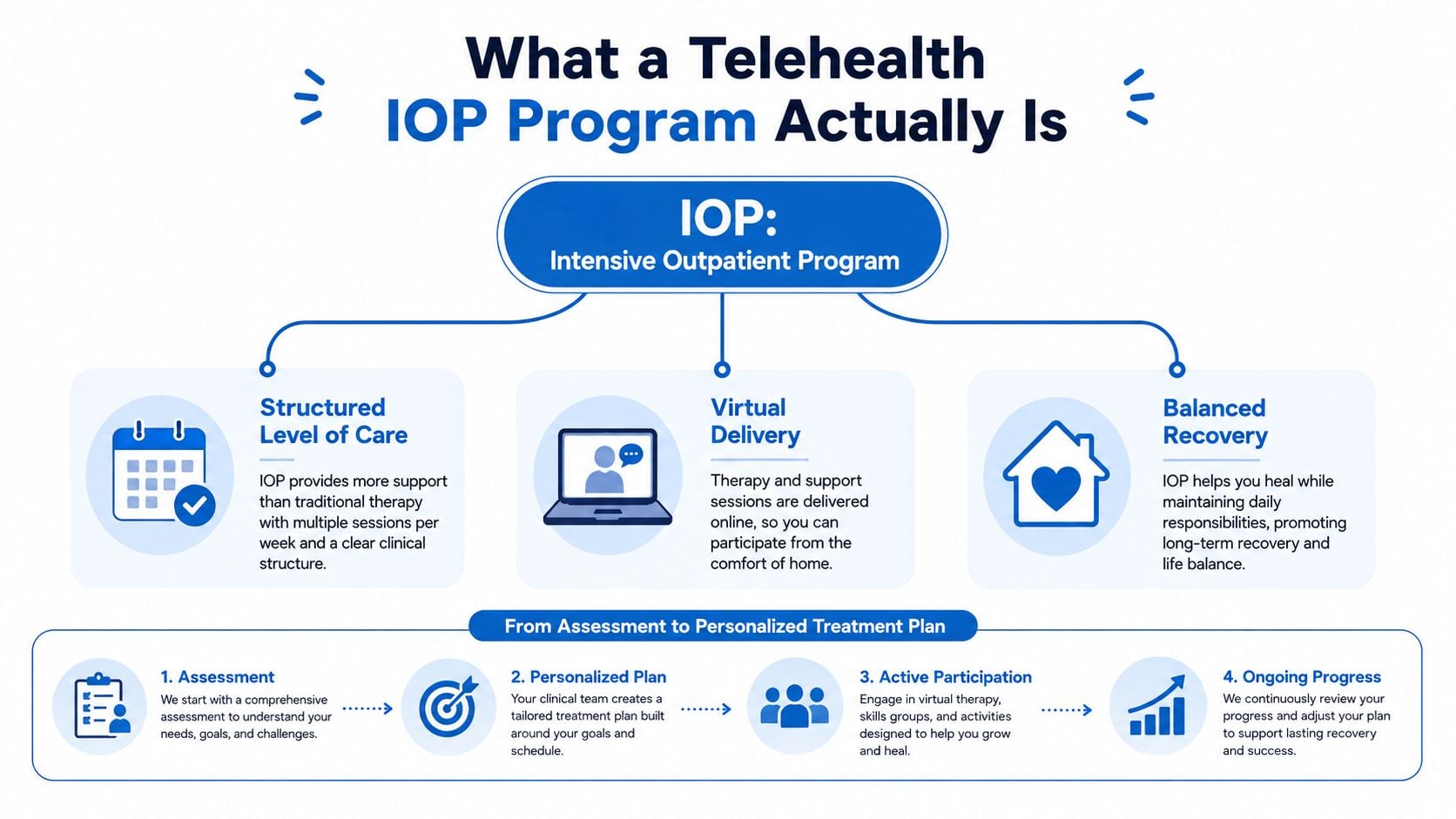
Suppose you need more support than a weekly therapy appointment but can't leave home for residential treatment. You might be weighing a long drive to a clinic against joining a recovery group from a quiet room at home. A telehealth Intensive Outpatient Program, or IOP, is designed for that middle ground.
IOP sits between lower-intensity outpatient therapy and more intensive care, such as residential treatment or partial hospitalization. Adult programs commonly provide at least 9 hours of structured services each week, often across several treatment days, although the exact schedule depends on the provider, payer, and applicable clinical requirements. The remote format uses live video sessions with licensed clinicians and peers rather than requiring you to sit in a clinic.
How IOP differs from weekly therapy
Weekly outpatient therapy usually centers on one individual appointment. An IOP functions as a coordinated program with a schedule, treatment plan, group therapy, individual clinical work, progress reviews, and communication among members of the care team.
You may participate in substance use treatment, mental health treatment, or care for both at the same time. Common clinical work can include relapse prevention, coping skills, trauma-informed therapy, emotional regulation, family work, and medication management. A person with alcohol use disorder and depression, for example, may need the program to address cravings and mood symptoms together instead of treating them as unrelated problems.
Practical rule: The important question isn't whether a provider offers video calls. Ask whether it offers a structured IOP level of care, with scheduled clinical hours, documented goals, attendance expectations, and regular review of your progress.
Telehealth also doesn't mean self-guided videos or an online library that you use alone. You should expect real-time contact with clinicians and other participants, along with accountability for attending and participating. The format changes where care happens. It doesn't remove the need for assessment, clinical judgment, or a safety plan.
How Virtual IOP Sessions Are Structured Each Week
A virtual IOP week should feel organized enough that you know where you need to be and what each session is meant to accomplish. Many programs schedule treatment across three to five days per week, with group blocks that may last several hours. Evening tracks can help people continue working or caring for family, while daytime tracks may suit someone stepping down from detox or residential care.
A realistic schedule might include an individual therapy appointment in the morning, followed by a live group session later in the day. The group may begin with a check-in, move into psychoeducation, and end with a process discussion or practice assignment. Your clinician may review a relapse-prevention worksheet, teach a dialectical behavior therapy skill, or help the group identify triggers that appeared during the week.
What happens inside a group
Group therapy is usually the central part of IOP. You may be asked to talk about cravings, stress, relationships, sleep, medication effects, or a situation that challenged your recovery. You won't necessarily speak at length every time, but active participation matters because listening to others can help you recognize patterns in your own behavior.
A program may combine:
- Check-ins: You report how you're doing, identify immediate concerns, and let staff know about changes in safety or substance use.
- Psychoeducation: Clinicians explain topics such as relapse prevention, emotional regulation, communication, or recovery planning.
- Process work: Participants connect the lesson to current experiences and receive support from the group.
- Individual therapy: You address private concerns that aren't appropriate for a group setting.
- Medication support: A prescriber reviews psychiatric or addiction medications when that service is part of the program.
Attendance policies matter. Ask how the program handles late arrivals, missed groups, technology failures, and make-up sessions before enrolling. Treatment plans are commonly reviewed during the program, and urine drug screening may be coordinated locally when clinically or contractually required.
Program length varies according to your progress, clinical needs, and insurance authorization. Many people should expect a course lasting 6 to 12 weeks, but the provider should explain how it decides when someone is ready to step down. For a plain-language overview of how treatment hours and sessions can fit together, review this intensive outpatient program schedule guide.
Telehealth IOP Compared with In-Person IOP
Telehealth and in-person IOP can use similar clinical approaches, but the setting changes the experience. Virtual care removes the commute and can make attendance possible for a rural resident, a parent without dependable childcare, or a professional who can't spend hours traveling to appointments. It can also keep treatment accessible during severe weather or a short-term illness when attending a clinic would be difficult.
In-person care offers a different kind of structure. Walking into a treatment setting separates the program from household distractions, and staff can respond directly when someone becomes visibly distressed. Clinics may also find urine or breath testing easier to coordinate on site.
| Dimension | Telehealth IOP | In-Person IOP |
|---|---|---|
| Access | Removes travel and may fit work, caregiving, mobility, or geographic needs | Requires reliable transportation and time away from home |
| Home environment | Works best with privacy, stable housing, and a predictable space | Provides a treatment setting separate from household stress |
| Group connection | Live contact is possible, but nonverbal cues and informal peer connection may be reduced | Supports embodied group presence and natural interaction before and after sessions |
| Clinical response | Clinicians can assess safety remotely, but urgent medical needs may require transfer to local care | Staff can respond immediately in the facility and coordinate on-site procedures |
| Testing | Testing may require local laboratories or other arrangements | Collection is usually easier to organize at the clinic |
| Technology | Depends on a working device, private space, and reliable internet | Technology problems are less likely to interrupt the clinical encounter |
Virtual care also has specific weaknesses. A clinician may miss subtle posture, eye contact, or movement cues when video quality is poor. A participant may be distracted by children, roommates, work messages, or conflict at home. Acute withdrawal, unstable medical conditions, or a need for frequent observation may make remote participation inappropriate.
In-person treatment isn't automatically the better choice, either. A long commute can create missed sessions, and a person may feel safer discussing sensitive experiences from home. The right decision depends on clinical stability, privacy, transportation, technology, and the kind of accountability that helps you remain engaged.
What the Research Shows About Virtual IOP Outcomes
Research supports telehealth IOP as a legitimate option, especially for adults receiving substance use treatment. In one study of 3,642 IOP patients, 58.87% received internet-only programming, 14.85% received hybrid care, and 26.28% received in-person-only care (peer-reviewed IOP delivery study). These figures show how care was delivered in that study. They do not establish that one format suits everyone.
Engagement results provide another useful measure. A retrospective cohort of 4,724 patients found that nearly 80% remained engaged for 30 days, 91% achieved at least 30 consecutive days of abstinence during treatment, and about 45% no longer required IOP after responding to treatment (telehealth SUD IOP cohort). Remote treatment can therefore support continued participation, not just initial access. For a person balancing work, caregiving, or transportation problems, attending from home may make regular treatment more realistic.
What comparisons can and can't tell us
A separate study of 960 IOP patients found that 70.8% reported continuous abstinence three months after discharge, with no significant difference among in-person, virtual, and hybrid formats. The result suggests comparable abstinence outcomes within that studied population, while leaving room for individual differences in safety, engagement, and support needs.
| Outcome metric | Telehealth IOP | In-person IOP |
|---|---|---|
| Engagement | Nearly 80% of 4,724 participants remained engaged for 30 days in one telehealth cohort | Direct comparison depends on the study and population |
| Abstinence during treatment | 91% achieved at least 30 consecutive days in the cited telehealth cohort | No universal rate can be stated from the provided evidence |
| Abstinence after discharge | 70.8% reported continuous abstinence three months after discharge in a 960-patient IOP study, with no significant format difference | No significant difference from virtual or hybrid care in that study |
| Patient experience | Virtual-only groups were rated significantly worse than in-person groups on 6 of 8 experience items in a 2024 study | In-person scored better on those experience measures |
| Hybrid experience | Hybrid groups weren't meaningfully different from in-person on the cited experience measures | Provides a useful comparison point for relational care |
The comparison becomes less favorable for virtual-only care when the outcome is the treatment experience itself. Virtual treatment may produce similar abstinence and quality-of-life outcomes, while participants can report weaker therapeutic alliance, group cohesion, and perceived support. In a 2024 study of healthcare professionals, treatment format did not predict abstinence at one year, but dual diagnosis was associated with much lower odds of abstinence, with an odds ratio of 0.24 (format, comorbidity, and long-term abstinence research).
The practical lesson is straightforward: outcome averages cannot make the treatment decision for you. A person with stable symptoms and a dependable private setting may thrive online. Someone needing closer observation, stronger group connection, or coordinated support for co-occurring conditions may need hybrid or in-person care instead. Ask the program how it assesses that difference before enrollment.
Who Is a Good Fit for a Telehealth IOP Program
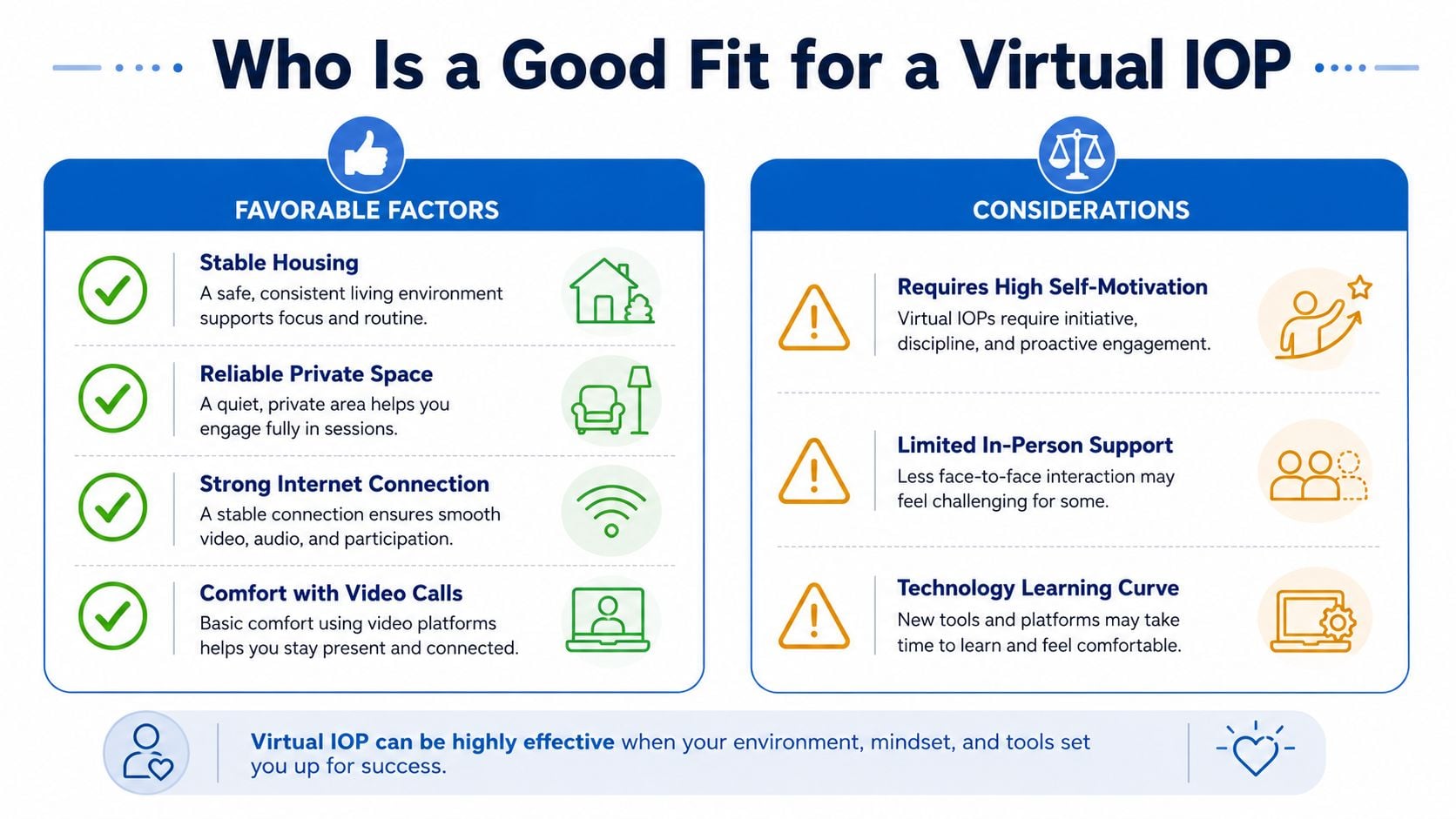
Virtual IOP tends to work best when your daily environment supports treatment rather than constantly interrupting it. Before you enroll, look beyond your preference for online care and assess whether you can reliably attend, speak privately, and respond to difficult emotions without immediate in-person supervision.
Signs virtual care may fit
You may be a reasonable candidate if you have:
- Stable housing: You know where you'll attend sessions and aren't moving between unsafe or unpredictable locations.
- A private room: Household members can't overhear group therapy, and you can participate without worrying about being interrupted.
- Reliable technology: Your device, camera, microphone, and internet connection work consistently.
- A workable schedule: Commuting several days each week would interfere with employment, caregiving, mobility, or other essential responsibilities.
- Basic comfort with video sessions: You can use the platform, contact staff when problems arise, and remain present during group.
- A safe step-down plan: You may be transitioning from detox, residential care, or another higher level of support and still have enough stability for remote treatment.
Working adults, caregivers, rural residents, and people with mobility or immune-system concerns may find virtual participation more practical. Practicality matters because a treatment plan only helps when you can attend and engage.
When to ask about hybrid or in-person care
Don't self-screen out of treatment, but be direct with the intake clinician about circumstances that may require closer support. Active suicidal intent, severe untreated psychosis, unstable bipolar symptoms, serious withdrawal risk, or urgent medical needs can make a fully virtual model unsafe. A chaotic home, ongoing violence, homelessness, or no private place to speak can also undermine remote care.
Some people need more frequent testing or observation than a virtual program can easily provide. If your treatment team recommends urine testing several times a week, ask whether hybrid attendance or an in-person track would make that process more reliable.
Virtual care should reduce barriers, not hide risks. Tell the program what happens between sessions, not only what you hope treatment will look like.
Use this intensive outpatient program requirements guide to prepare questions, then let a licensed clinician determine whether virtual, hybrid, or in-person care matches your needs.
Technology and Privacy Requirements for Virtual IOP
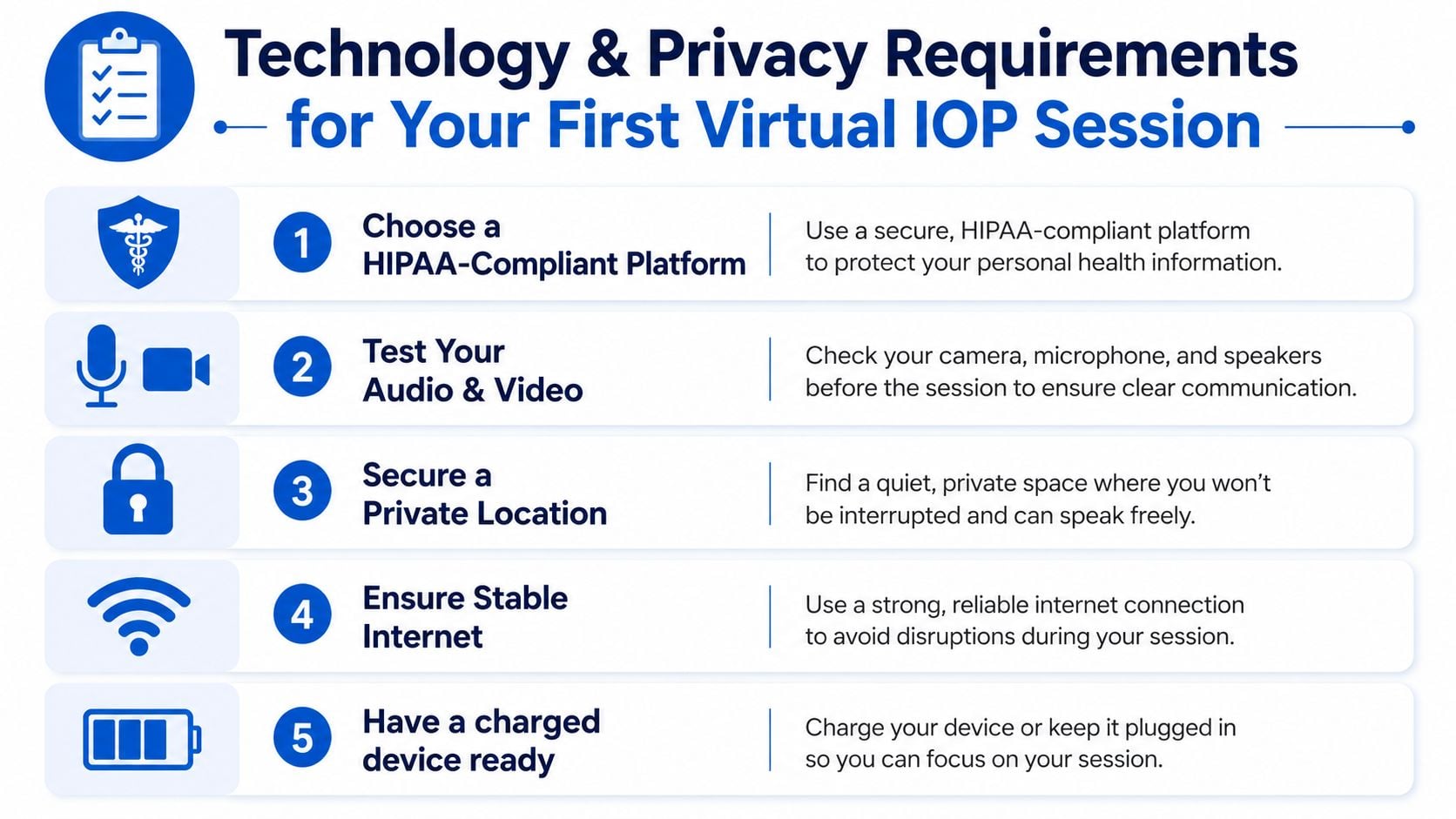
A successful first session usually depends on a few practical decisions made before the appointment. Your provider should use a HIPAA-compliant video platform and explain how it protects clinical information. Substance use treatment records may also involve the added confidentiality protections of 42 CFR Part 2, so ask how the program handles consent, disclosures, and communications.
Start with the room, not the software. Choose a space where family members, roommates, and visitors can't overhear group discussion. Headphones can help, but they don't replace a private location. Don't join from a public place, a shared living room, or a car parked where other people may hear you.
A simple setup checklist
- Use a suitable device: A computer or tablet with a working camera and microphone is usually easier for group participation than a small phone screen.
- Update before treatment: Install operating-system and browser updates ahead of time, then test the provider's platform.
- Protect the conversation: Ask whether sessions are recorded. Treatment groups generally shouldn't be recorded without explicit written permission and clear agreement from everyone affected.
- Stabilize your connection: A wired connection or strong home internet is preferable. If your service is unreliable, ask whether a phone hotspot can serve as backup.
- Charge the device: Keep the charger nearby and silence notifications that could expose private information or distract you.
Programs may prohibit public Wi-Fi, attendance from a public parking lot, or another adult appearing on camera without the group's consent. These rules protect every participant, not just you. Privacy is shared responsibility: the clinic secures its platform and procedures, while you control your physical setting.
If a provider needs help managing calls, reminders, or administrative communication, virtual medical receptionist services may be a useful operational resource for a healthcare practice. That service doesn't replace clinical staff or the privacy obligations of the treatment platform.
How to Enroll and Use Insurance for Telehealth IOP
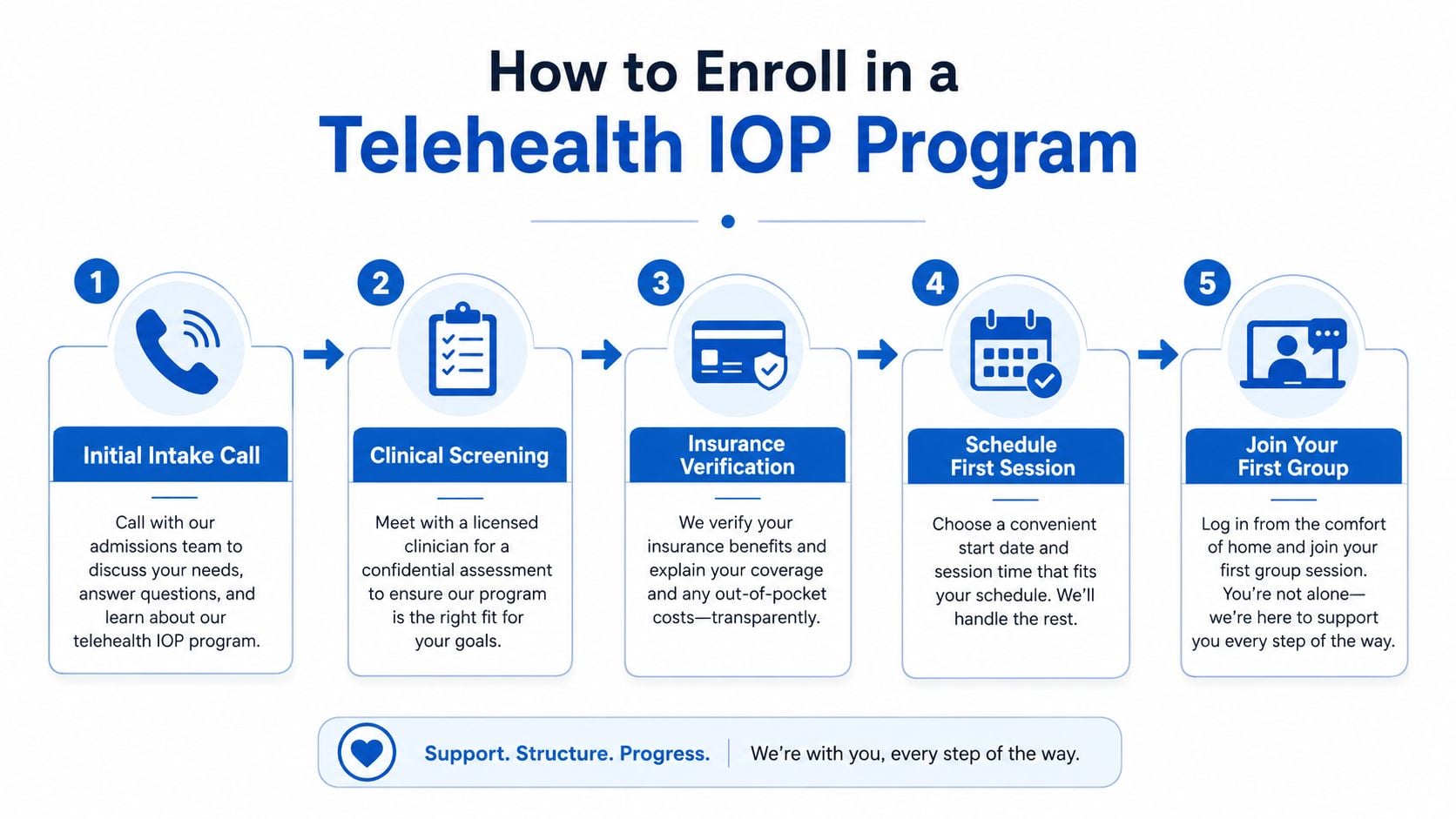
Enrollment usually begins with a phone call or online form, but the first conversation is more than scheduling. Intake staff may ask about substance use, mental health symptoms, current medications, medical concerns, safety, location, and the support available at home. Providing straightforward answers helps the provider decide whether IOP is appropriate and whether a virtual setting is safe.
The usual enrollment sequence
- Initial intake: Provide demographic information, your location, contact details, treatment goals, and the reason you're seeking help.
- Clinical screening: A licensed clinician reviews substance use, mental health, withdrawal concerns, medical needs, and immediate safety risks.
- Insurance verification: Give the insurer, member information, and plan details. Ask the program to verify telehealth IOP benefits specifically, not just general behavioral health coverage.
- Cost review: Request an estimate of copay, coinsurance, deductible responsibility, and any out-of-network exposure.
- Authorization: Find out whether the insurer requires prior authorization, clinical records, or ongoing utilization reviews.
- First session: Complete consent forms, confirm the technology, review attendance and privacy rules, and join the first live group or individual appointment.
The clinical assessment may last 60 to 90 minutes, depending on the provider and complexity of your history. It should help the team determine your level of care, identify safety concerns, and create an individualized treatment plan rather than place you into the next available online group.
Some programs can admit a clinically appropriate person the same day or on the next business day, but timing depends on clinician availability, insurance approval, and documentation. Coverage can become complicated when the clinician and patient are in different states, when an insurer limits audio-only services, or when the program is out of network.
Before agreeing to begin, ask whether the program is in network, whether virtual group hours qualify under your plan, and whether telehealth parity rules in your state affect reimbursement. This guide to verifying insurance coverage can help you organize the questions.
The enrollment process is easier when you keep your insurance card, medication list, recent discharge papers, and emergency contact information available. If you don't have every document, still call. Intake staff can tell you what can be completed later.
You can also watch this overview before speaking with a provider:
Common Questions About Telehealth IOP Programs
Is virtual IOP confidential?
It should use a HIPAA-compliant platform and clear consent procedures, but no platform can make an open room private. Attend from a location where others can't hear the conversation, use headphones when appropriate, and ask whether recording is permitted. You should also understand how the provider handles substance use treatment records and disclosures under applicable confidentiality rules.
Can medication-assisted treatment be provided remotely?
Medication-assisted treatment, including medications such as buprenorphine or naltrexone, may be coordinated through virtual appointments when the prescriber and program can legally provide that care. A clinician may meet with you by video, while laboratory work, physical checks, or prescription fulfillment occur through local services. Ask who manages the medication, how urgent side effects are handled, and whether the program coordinates with your primary care clinician or pharmacy.
What happens if the connection drops?
Tell the program how it will contact you if video fails. The backup may involve a phone call, a secure message, or rejoining through a different connection, but the provider should define the process before your first group. If you miss enough of a session to affect attendance, ask whether you need a make-up appointment.
How long does telehealth IOP last?
Many programs plan for 6 to 12 weeks, although the actual duration depends on your progress, clinical recommendations, and insurer authorization. A responsible discharge plan should begin before the final session. It may include standard outpatient therapy, medication follow-up, peer or alumni support, relapse-prevention planning, and a response plan for renewed cravings or mental health symptoms.
Can family members participate?
Family involvement can be helpful when you consent and the clinical team believes it supports recovery. A family session might address communication, boundaries, warning signs, or how loved ones can respond without taking over your treatment. The provider should explain what information can be shared and obtain the necessary permissions.
The right virtual program won't ask you to solve every recovery problem alone. It should connect group care, individual treatment, medication support when needed, safety planning, and the next step after IOP.
If you're in immediate danger, experiencing severe withdrawal, or having thoughts of harming yourself or someone else, contact emergency services or a crisis resource in your area rather than waiting for an IOP intake.
Addiction Resource Center LLC offers an Intensive Outpatient Program for adults, with in-person and telehealth options, individualized treatment planning, relapse-prevention education, accountability, and aftercare support for substance use and co-occurring mental health needs. Visit Addiction Resource Center LLC to ask about virtual IOP, insurance, or the right next step for you or a loved one.